
Matlab梯度下降及正规方程实现多变量的线性回归
如果需要代做算法,可以联系我...博客右侧有联系方式。
一、相关概念
1.梯度下降
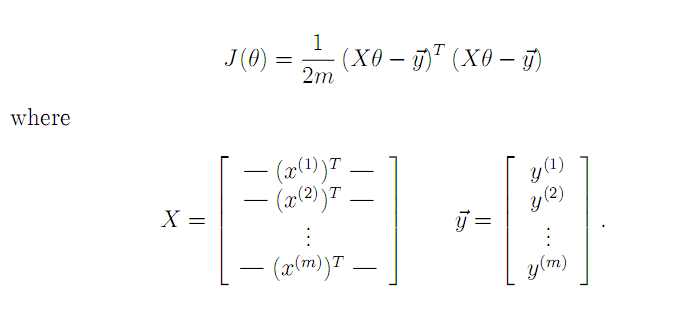
由于Z= X*theta - y是列向量,所以Z'*Z就是平方和连加,就是2范数;如果Z是矩阵呢,那么Z'*Z的对角线就是Z矩阵每列的2范数。
2.正规方程(Normal Equation)
θ = (XTX)-1XTY。
二、代码实现
2104,3,399900

1600,3,329900

2400,3,369000

1416,2,232000

3000,4,539900

1985,4,299900

1534,3,314900

1427,3,198999

1380,3,212000

1494,3,242500

1940,4,239999

2000,3,347000

1890,3,329999

4478,5,699900

1268,3,259900

2300,4,449900

1320,2,299900

1236,3,199900

2609,4,499998

3031,4,599000

1767,3,252900

1888,2,255000

1604,3,242900

1962,4,259900

3890,3,573900

1100,3,249900

1458,3,464500

2526,3,469000

2200,3,475000

2637,3,299900

1839,2,349900

1000,1,169900

2040,4,314900

3137,3,579900

1811,4,285900

1437,3,249900

1239,3,229900

2132,4,345000

4215,4,549000

2162,4,287000

1664,2,368500

2238,3,329900

2567,4,314000

1200,3,299000

852,2,179900

1852,4,299900

1203,3,239500
......................
%% Clear and Close Figures

clear ; close all; clc

data = load('ex1data2.txt');

X = data(:, 1:2);

y = data(:, 3);

m = length(y);

% Scale features and set them to zero mean

%不对Y 规范化

[X mu sigma] = featureNormalize(X);

% Add intercept term to X

%为了矩阵的形式(theta0) theta'*X

X = [ones(m, 1) X];

%% ================ Part 2: Gradient Descent ================

alpha = 0.01;

num_iters = 400;

theta = zeros(3, 1);

[theta, J_history] = gradientDescentMulti(X, y, theta, alpha, num_iters);

%convergence : 收敛

% Plot the convergence graph

figure;

%numel  矩阵中元素个数

plot(1:numel(J_history), J_history, '-b', 'LineWidth', 2);

xlabel('Number of iterations');

ylabel('Cost J');

% Display gradient descent's result

fprintf('Theta computed from gradient descent: \n');

fprintf(' %f \n', theta);

fprintf('\n');

% Estimate the price of a 1650 sq-ft, 3 br house

% ====================== YOUR CODE HERE ======================

% Recall that the first column of X is all-ones. Thus, it does

% not need to be normalized.

price = 0; % You should change this

Xp = [1 1650 3];

Xp = [Xp(1),(Xp(2) - mu(1))/sigma(1),(Xp(3) - mu(2))/sigma(2)];

price = Xp*theta;

fprintf(['Predicted price of a 1650 sq-ft, 3 br house ' ...

         '(using gradient descent):\n $%f\n'], price);

%% ================ Part 3: Normal Equations ================

data = csvread('ex1data2.txt');

X = data(:, 1:2);

y = data(:, 3);

m = length(y);

% Add intercept term to X

X = [ones(m, 1) X];

% Calculate the parameters from the normal equation

theta = normalEqn(X, y);

% Display normal equation's result

fprintf('Theta computed from the normal equations: \n');

fprintf(' %f \n', theta);

fprintf('\n');

% Estimate the price of a 1650 sq-ft, 3 br house

% ====================== YOUR CODE HERE ======================

price = 0; % You should change this

Xexample = [1 1650 3];

price = Xexample*theta;

fprintf(['Predicted price of a 1650 sq-ft, 3 br house ' ...

         '(using normal equations):\n $%f\n'], price);
...............
function [theta] = normalEqn(X, y)

%NORMALEQN Computes the closed-form solution to linear regression

%   NORMALEQN(X,y) computes the closed-form solution to linear

%   regression using the normal equations.

theta = zeros(size(X, 2), 1);

% 1.对于方阵A,如果为非奇异方阵,则存在逆矩阵inv(A)

% 2.对于奇异矩阵或者非方阵,并不存在逆矩阵,但可以使用pinv(A)求其伪逆

%

% 很多时候你不需要求逆矩阵,例如

% inv(A)*B

% 实际上可以写成

% A\B

% B*inv(A)

% 实际上可以写成

% B/A

% 这样比求逆之后带入精度要高

theta = pinv((X'*X))*X'*y;

end
..............
function [theta, J_history] = gradientDescentMulti(X, y, theta, alpha, num_iters)

% Initialize some useful values

m = length(y); % number of training examples

J_history = zeros(num_iters, 1);

for iter = 1:num_iters

    %theta 是 3*1 是列向量   X的第一列是1 恰好乘以theta0

    % (1*3 X  3*47  -  1*47)'*

    theta = theta - alpha * ((theta'*X'-y')*X)'/m;

    % Save the cost J in every iteration

    J_history(iter) = computeCostMulti(X, y, theta);

end

end
..........
function J = computeCostMulti(X, y, theta)

% Initialize some useful values

m = length(y); % number of training examples

J = 0;

J = sum(((theta'*(X')-y').^2))/(2*m);

end
三、结果
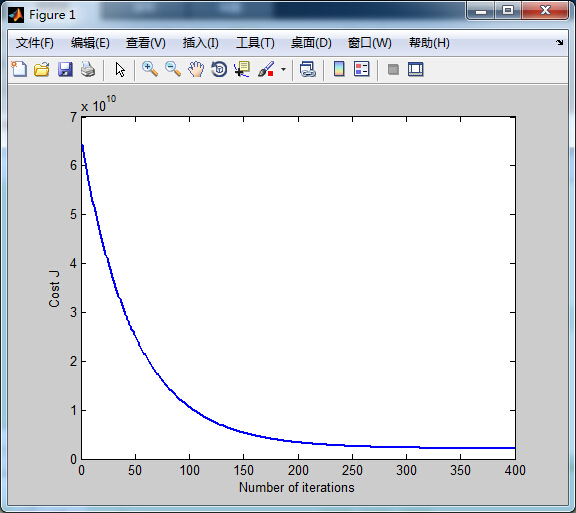
1.代价函数
2.预测结果
Theta computed from gradient descent:

 334302.063993

 100087.116006

 3673.548451

Predicted price of a 1650 sq-ft, 3 br house (using gradient descent):

 $289314.620338

Theta computed from the normal equations:

 89597.909545

 139.210674

 -8738.019113

Predicted price of a 1650 sq-ft, 3 br house (using normal equations):

 $293081.464335
Matlab梯度下降及正规方程实现多变量的线性回归的更多相关文章
- Matlab梯度下降解决评分矩阵分解
for iter = 1:num_iters %梯度下降 用户向量 for i = 1:m %返回有0有1 是逻辑值 ratedIndex1 = R_training(i,:)~=0 ; %U(i,: ...
- 梯度下降(Gradient descent)
首先,我们继续上一篇文章中的例子,在这里我们增加一个特征,也即卧室数量,如下表格所示: 因为在上一篇中引入了一些符号,所以这里再次补充说明一下: x‘s:在这里是一个二维的向量,例如:x1(i)第i间 ...
- ML:多变量代价函数和梯度下降(Linear Regression with Multiple Variables)
代价函数cost function 公式: 其中,变量θ(Rn+1或者R(n+1)*1) 向量化: Octave实现: function J = computeCost(X, y, theta) %C ...
- 多变量线性回归时使用梯度下降(Gradient Descent)求最小值的注意事项
梯度下降是回归问题中求cost function最小值的有效方法,对大数据量的训练集而言,其效果要 好于非迭代的normal equation方法. 在将其用于多变量回归时,有两个问题要注意,否则会导 ...
- 梯度下降、随机梯度下降、方差减小的梯度下降(matlab实现)
梯度下降代码: function [ theta, J_history ] = GradinentDecent( X, y, theta, alpha, num_iter ) m = length(y ...
- [笔记]线性回归&梯度下降
一.总述 线性回归算法属于监督学习的一种,主要用于模型为连续函数的数值预测. 过程总得来说就是初步建模后,通过训练集合确定模型参数,得到最终预测函数,此时输入自变量即可得到预测值. 二.基本过程 1. ...
- logistics回归简单应用——梯度下降,梯度上升,牛顿算法(一)
警告:本文为小白入门学习笔记 由于之前写过详细的过程,所以接下来就简单描述,主要写实现中遇到的问题. 数据集是关于80人两门成绩来区分能否入学: 数据集: http://openclassroom.s ...
- 梯度下降(gradient descent)算法简介
梯度下降法是一个最优化算法,通常也称为最速下降法.最速下降法是求解无约束优化问题最简单和最古老的方法之一,虽然现在已经不具有实用性,但是许多有效算法都是以它为基础进行改进和修正而得到的.最速下降法是用 ...
- 各种梯度下降 bgd sgd mbgd adam
转载 https://blog.csdn.net/itchosen/article/details/77200322 各种神经网络优化算法:从梯度下降到Adam方法 在调整模型更新权重和偏差 ...
随机推荐
- poj 3080 kmp求解多个字符串的最长公共字串,(数据小,有点小暴力 16ms)
Blue Jeans Time Limit: 1000MS Memory Limit: 65536K Total Submissions: 14113 Accepted: 6260 Descr ...
- Servlet 返回Json数据格式
其实就是把数据库中的数据查询出来拼接成一个Json数据 import dao.UserDao; import endy.User; import javax.servlet.ServletExcept ...
- XJOI NOIP模拟题1
第一题 分析: 开始想的是贪心,取每列均值最大一段. 应该是01分数规划,具体看代码 代码: program gold; var a:..]of int64; n,i,m,j,x:longint; f ...
- H3C交换机端口链路聚合
H3C交换机端口链路聚合 以太网链路聚合 -- 以太网链路聚合配置命令 -- lacp system-prioritylacp system-priority命令用来配置系统的LACP优先级.undo ...
- C++11 tuple元组
C++11 tuple 元组 tuple容器(元组), 是表示元组容器, 是不包含任何结构的,快速而低质(粗制滥造, quick and dirty)的, 可以用于函数返回多个返回值; tuple容器 ...
- [CF932D]Tree
题目大意:两种操作: $1\;u\;w:$把下一个点挂在$u$下,权值为$w$. $2\;u\;w:$询问从$u$开始的序列的最长长度.序列为从$u$开始的祖先序列中的不严格上升序列 题解:可以把一个 ...
- [洛谷P4149][IOI2011]Race
题目大意:给一棵树,每条边有边权.求一条简单路径,权值和等于$K$,且边的数量最小. 题解:点分治,考虑到这是最小值,不满足可减性,于是点分中的更新答案的地方计算重复的部分要做更改,就用一个数组记录前 ...
- 洛谷 P1903 [国家集训队]数颜色 解题报告
P1903 [国家集训队]数颜色 题目描述 墨墨购买了一套\(N\)支彩色画笔(其中有些颜色可能相同),摆成一排,你需要回答墨墨的提问.墨墨会向你发布如下指令: 1.Q L R代表询问你从第\(L\) ...
- Eclipse 日文乱码怎么解决Shift_JIS
https://jingyan.baidu.com/article/870c6fc325a691b03fe4beac.html Eclipse设置编码的地方主要有三处,这三处的设置都会影响中文的显示. ...
- P2659 美丽的序列 (单调栈)
题目链接 Solution 直接考虑单调栈处理出每一个点作为最小值的区间长度. 然后 \(O(n)\) 找一遍最大值即可. 记得开 long long,以及要注意 \(0\) 的问题. Code #i ...