
A/B Testing with Practice in Python (Part One)
I learned A/B testing from a Youtube vedio. The link is https://www.youtube.com/watch?v=Bu7OqjYk0jM.
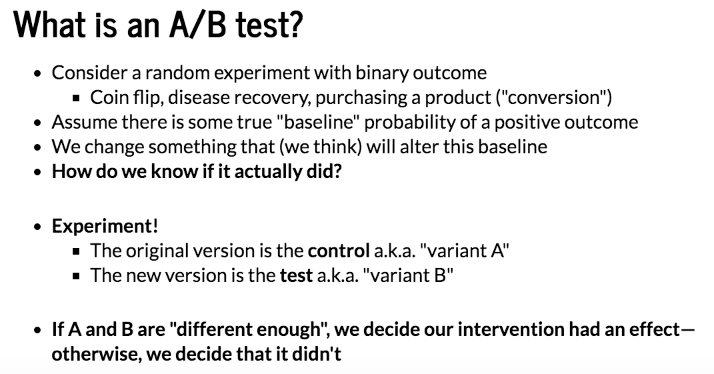
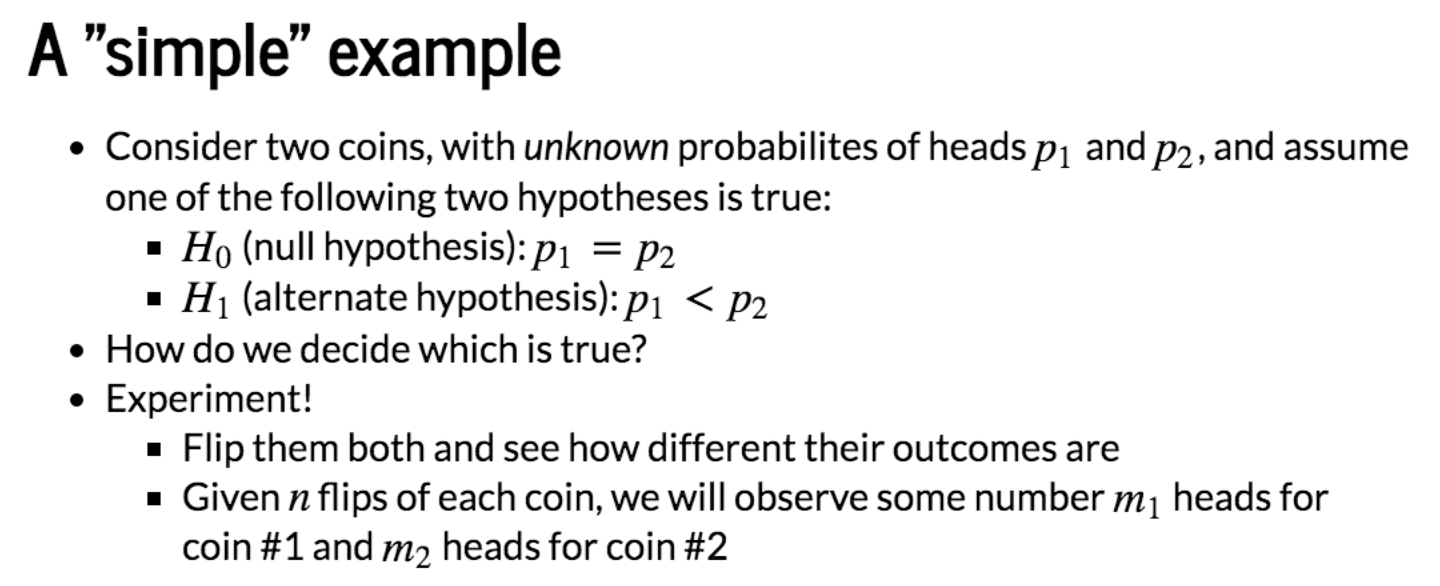
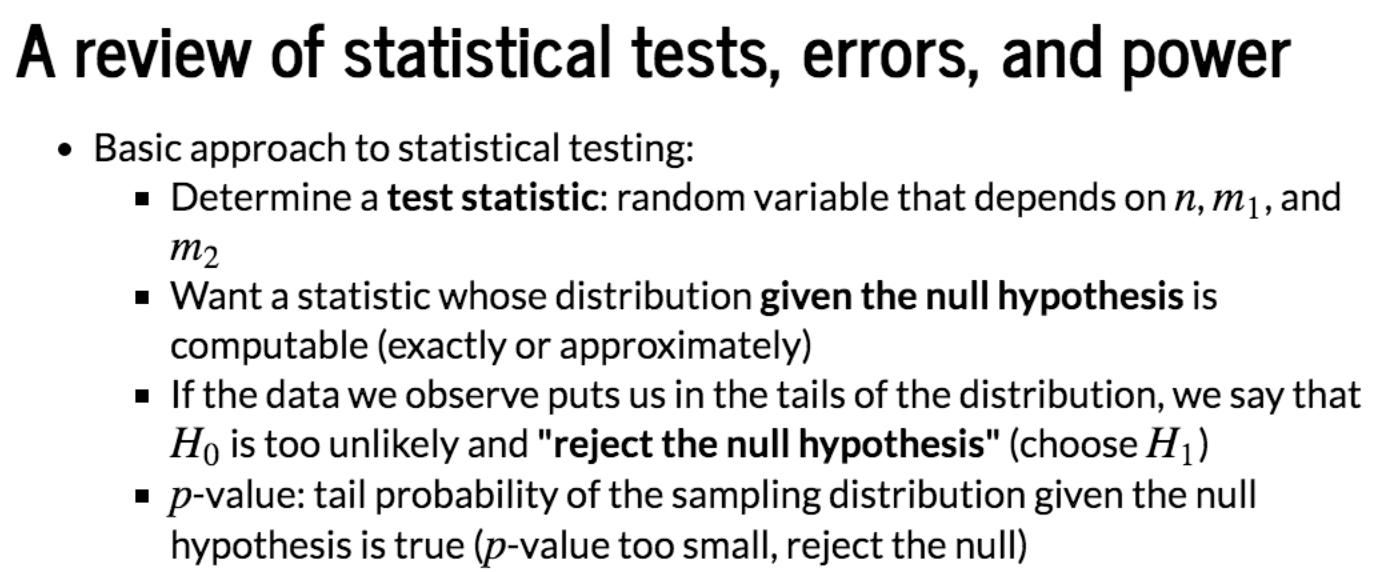
I will divide the note into two parts. The first part is generally an overview of hypothesis testing. Most concepts can be found in the article "Statistics Basics: Main Concepts in Hypothesis Testing" and I will focus on pratical applications here.

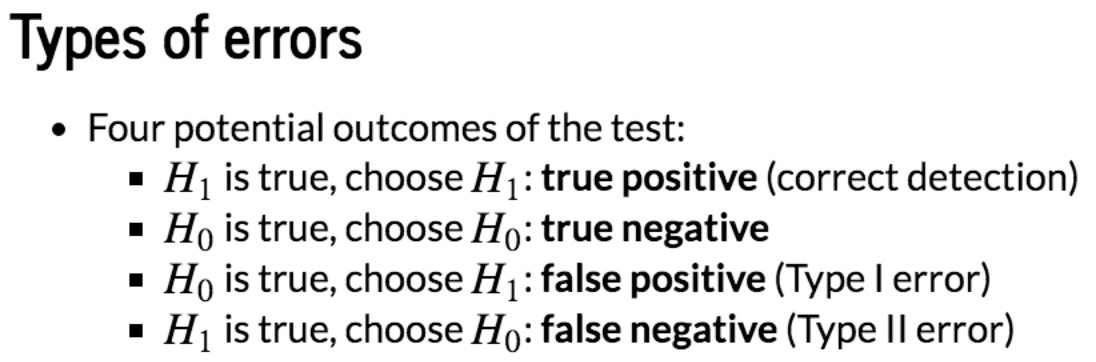
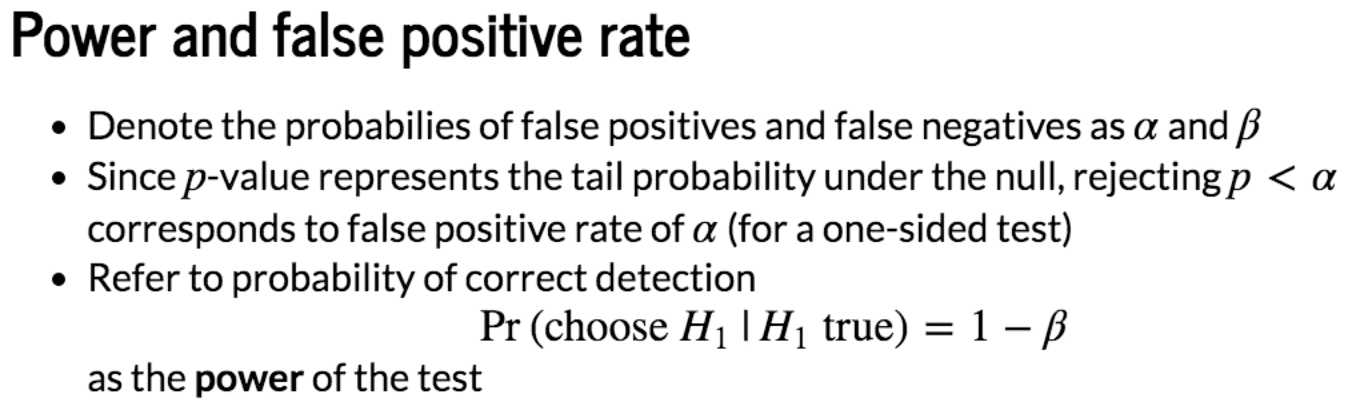
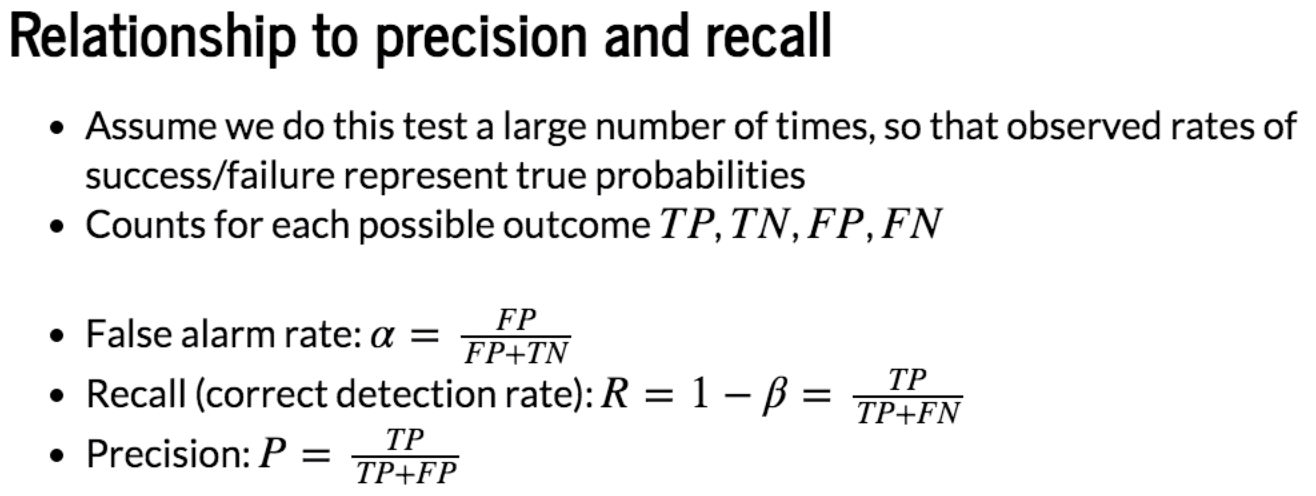
|
Actual Predicted |
T (H1) | F (H0) |
| T (H1) | TP | FP (α) |
| F (H0) | FN (β) | TN |
P = TP/(TP+FN)
R = 1-β =TP/(TP+FN)
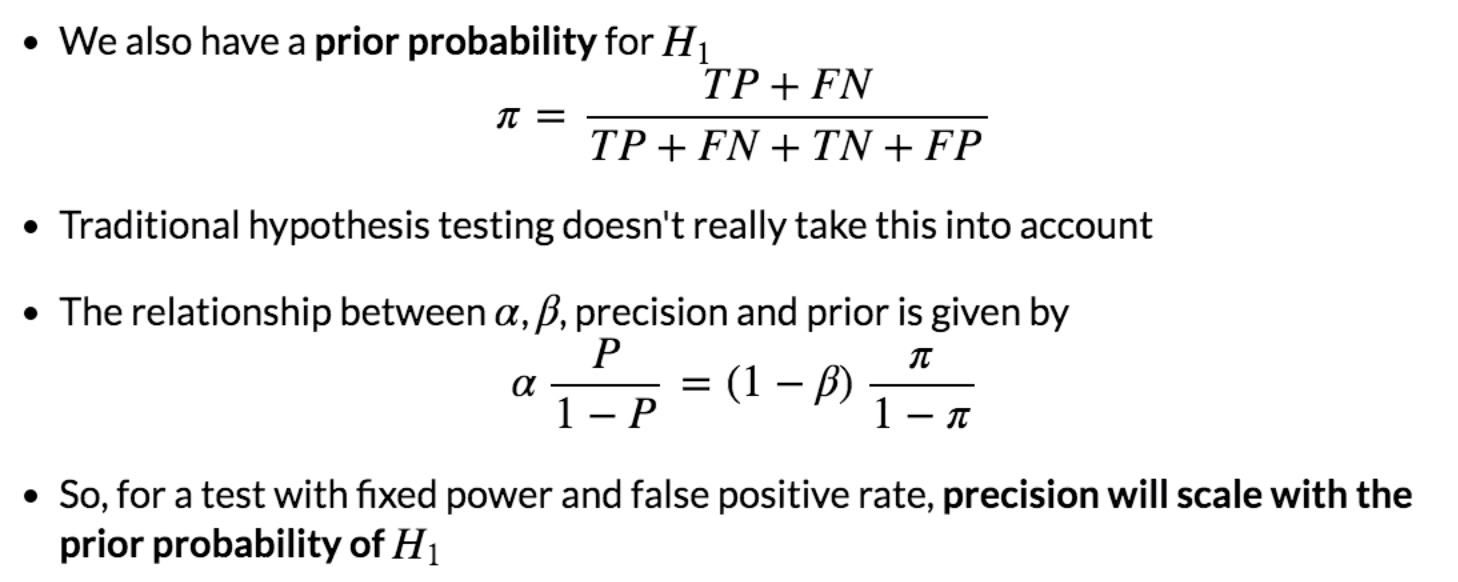
Python Example
Case #1: Alternate hypothesis is true
n = 100

p1 = 0.4

p2 = 0.6

# Compute distributions

x = np.arange(0,n+1)

pmf1 = stats.binom.pmf(x,n,p1)

pmf2 = stats.binom.pmf(x,n,p2)

plot(x,pmf1,pmf2)
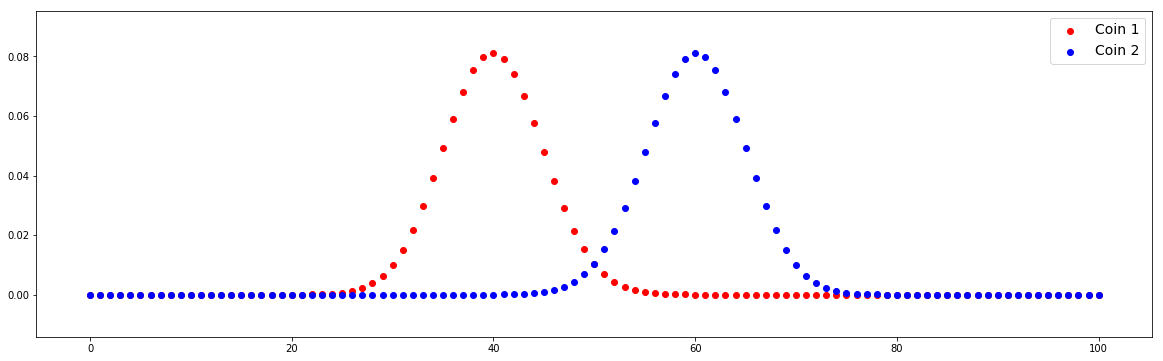
We can find that the distributions between Coin 1 and Coin 2 are different. We check different values of m1 and m2.
# Example outcomes

m1, m2 = 40, 60

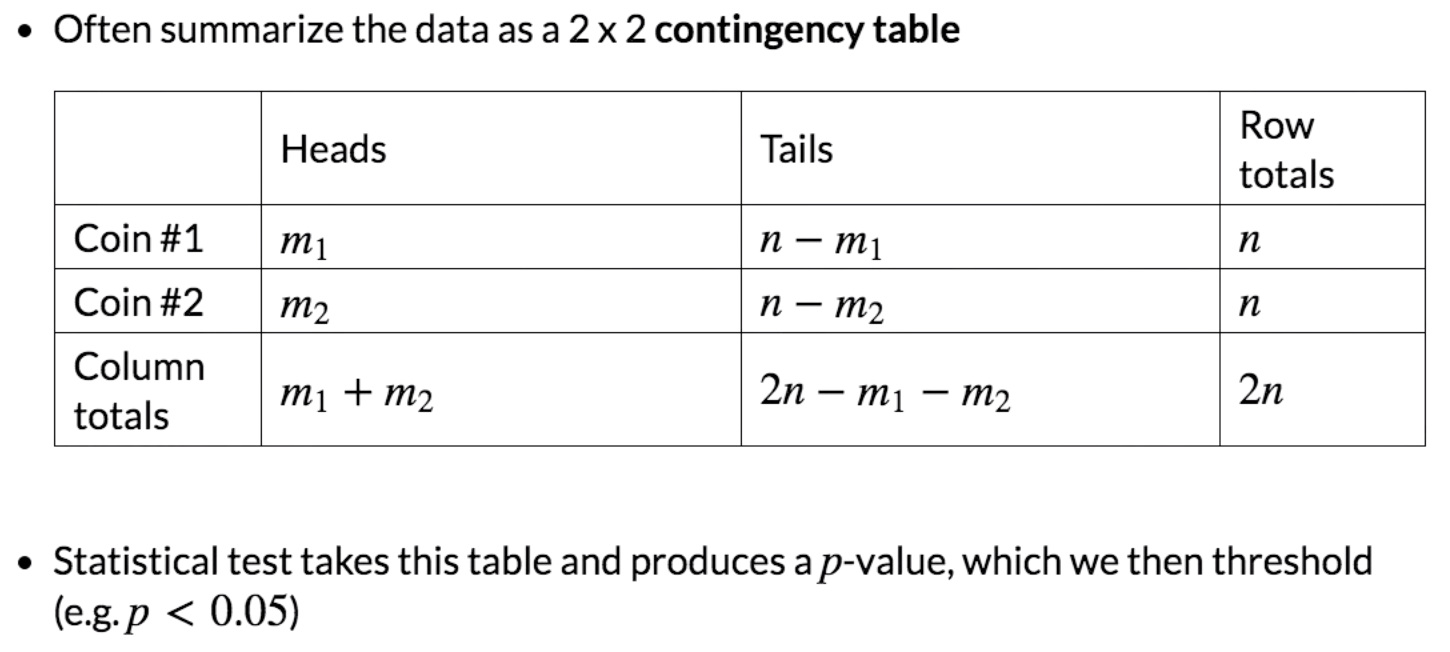
table = [[m1, n-m1], [m2, n-m2]]

chi2, pval, dof, expected = stats.chi2_contingency(table)

decision = 'reject H0' if pval<0.05 else 'accept H0'

print('{} ({})'.format(pval,decision))
0.007209570764742524 (reject H0)
# Example outcomes

m1, m2 = 43, 57

table = [[m1, n-m1], [m2, n-m2]]

chi2, pval, dof, expected = stats.chi2_contingency(table)

decision = 'reject H0' if pval<0.05 else 'accept H0'

print('{} ({})'.format(pval,decision))
0.06599205505934735 (accept H0)
In the secod example, m1 and m2 are not different significantly to reject H0.
Case #2: Null hypothesis is true
n = 100

p1 = 0.5

p2 = 0.5

# Compute distributions

x = np.arange(0,n+1)

pmf1 = stats.binom.pmf(x,n,p1)

pmf2 = stats.binom.pmf(x,n,p2)

plot(x,pmf1,pmf2)
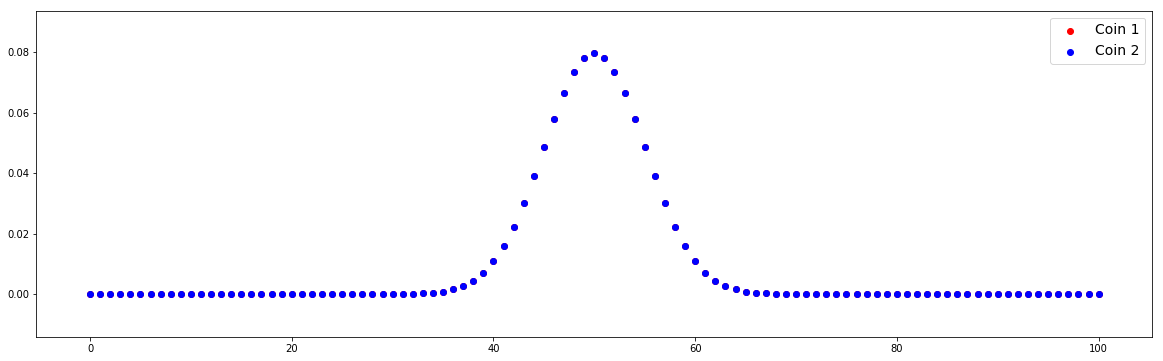
In this case, two distributions overlap because we define the same value of p1 and p2.
# Example outcomes

m1, m2 = 49, 51

table = [[m1, n-m1], [m2, n-m2]]

chi2, pval, dof, expected = stats.chi2_contingency(table)

decision = 'reject H0' if pval<0.05 else 'accept H0'

print('{} ({})'.format(pval,decision))
0.887537083981715 (accept H0)
Actuall, we can only say that m1 and m2 are not different significantly to reject H0. It doesn't mean we should accept H0. The explanation is given in the previous article.
# Example outcomes

m1, m2 = 42, 58

table = [[m1, n-m1], [m2, n-m2]]

chi2, pval, dof, expected = stats.chi2_contingency(table)

decision = 'reject H0' if pval<0.05 else 'accept H0'

print('{} ({})'.format(pval,decision))
0.033894853524689295 (reject H0)

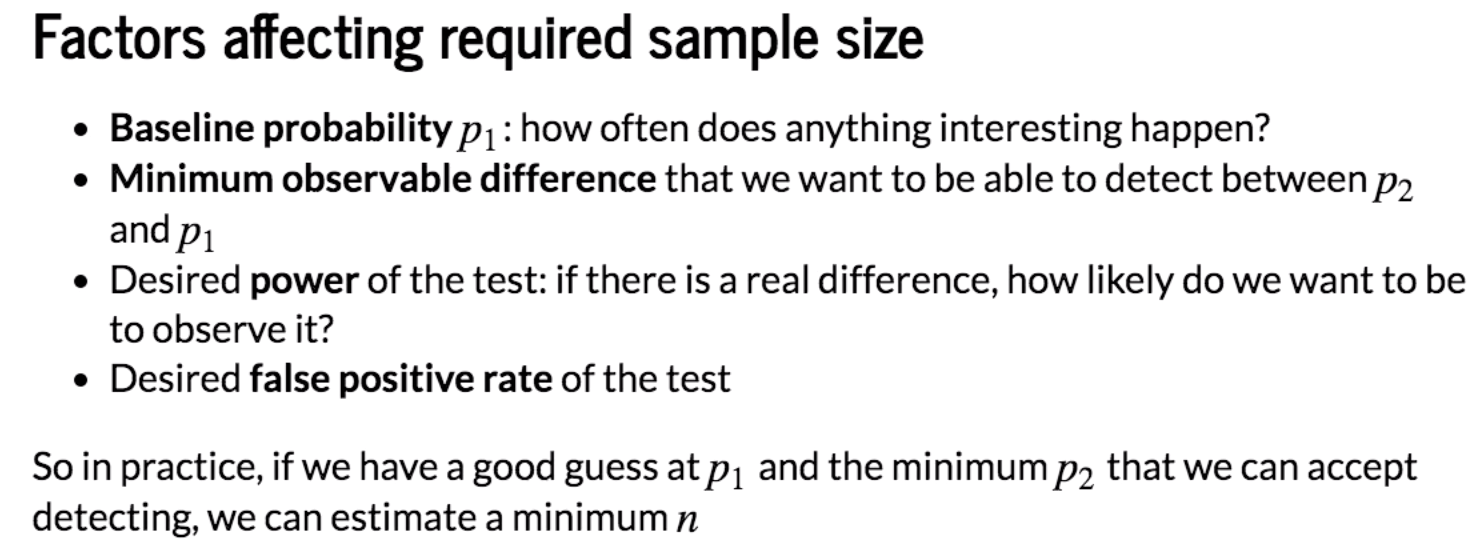
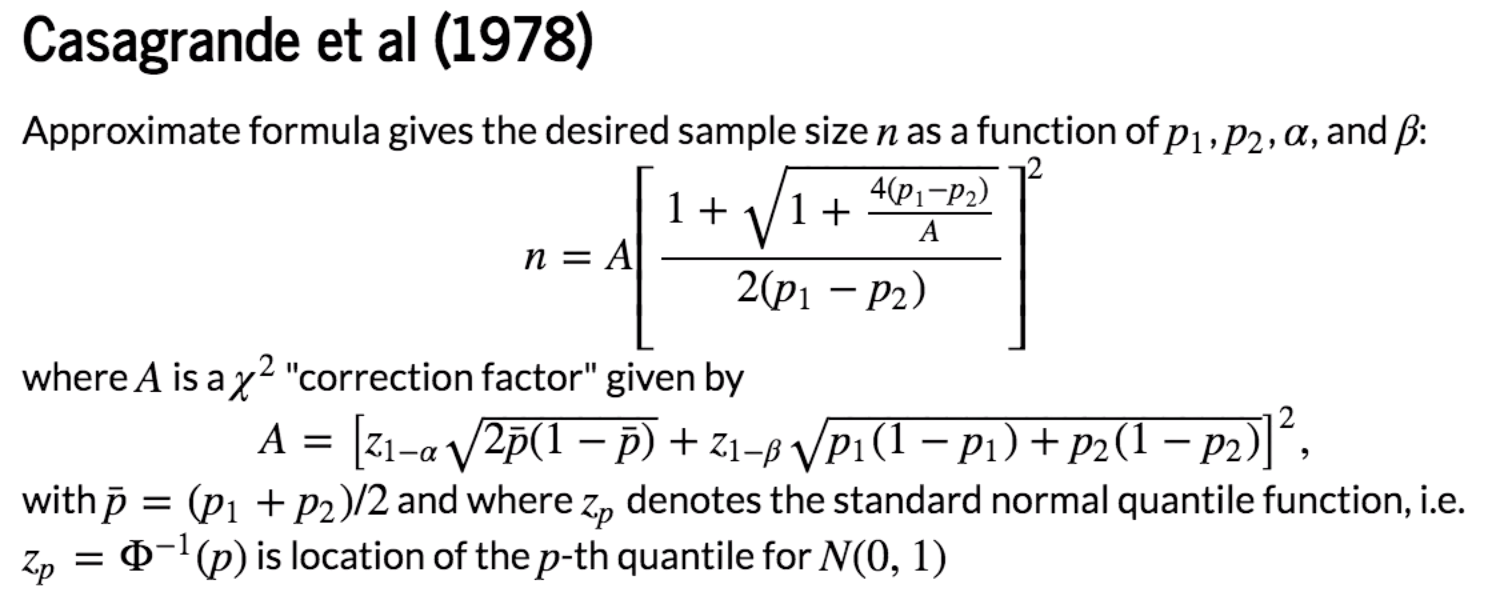
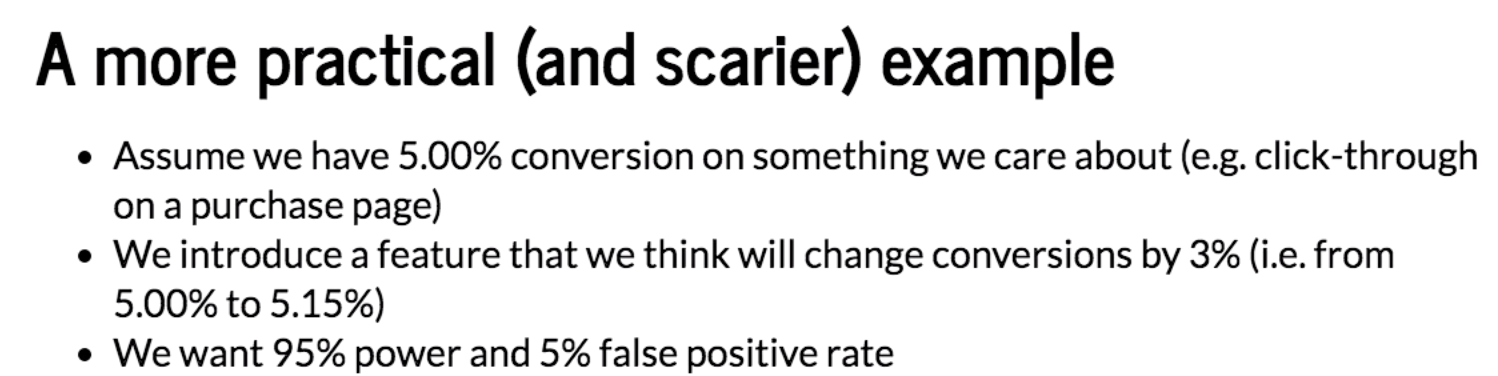
Firstly, calculate the sample size:
p1, p2 = 0.0500, 0.0515

alpha = 0.05

beta = 0.05

# Evaluate quantile function

p_bar = (p1+p2)/2.0

za = stats.norm.ppf(1-alpha/2) # Two-sided test

zb = stats.norm.ppf(1-beta)

# Compute correction factor

A = (za*np.sqrt(2*p_bar*(1-p_bar))+ zb*np.sqrt(p1*(1-p1)+p2*(1-p2)))**2

#Estimate samples required

n = A*(((1+np.sqrt(1+4*(p1-p2)/A)))/(2*(p1-p2)))**2

print (n) # we need 2n users
555118.7638311392
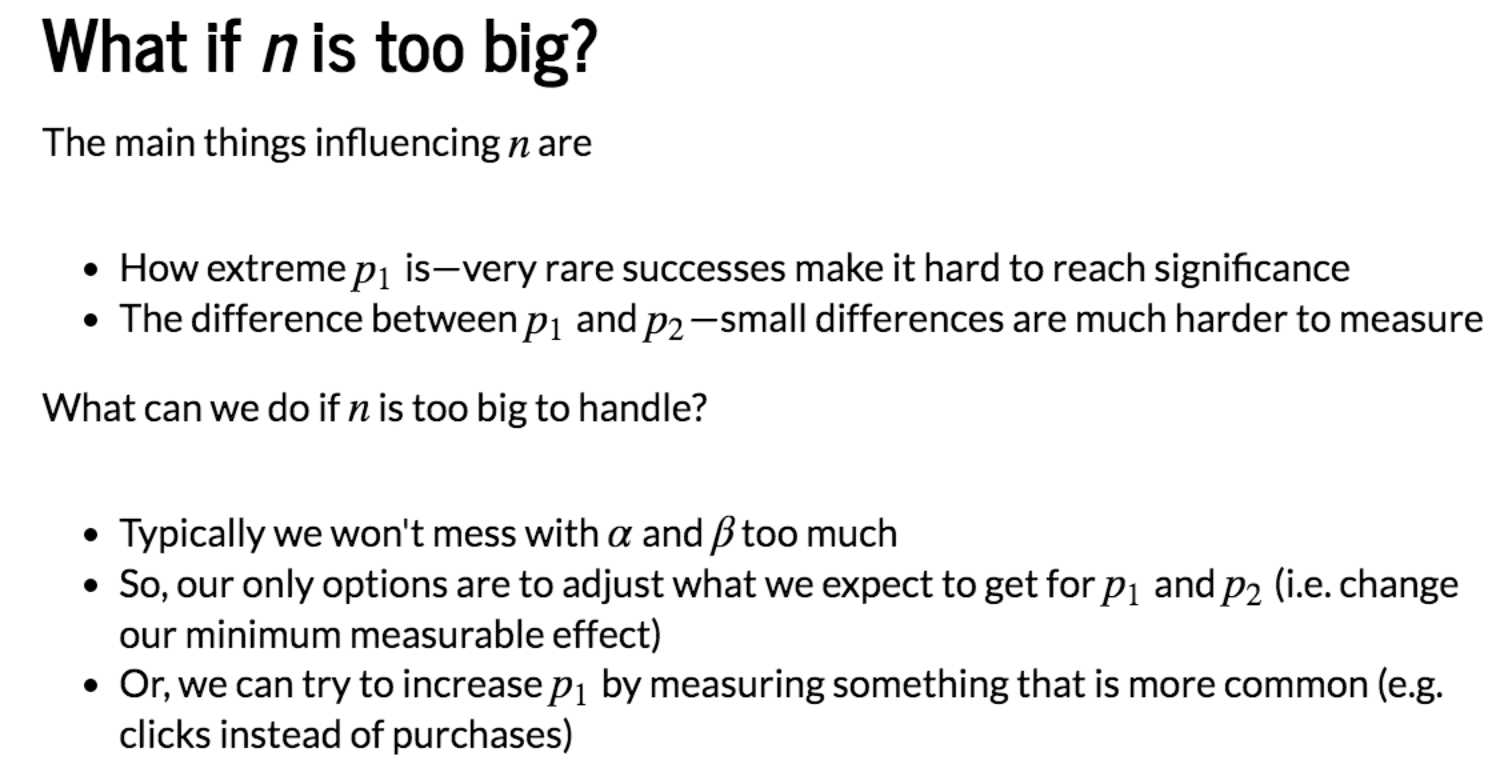
So for test and control combined we'll need at least 2n = 1.1 million users. This is where this stuff gets hard and you're trying to measure something that doesn't happen often which is usally the thing to care because if it's rare, it's usually valuable. When you're trying to change it, you usually can't change it much because if you can change it a lot then your business would be easier usually it's harder to change the thing you care the most about. So in that case, it's like the hardest case where a/b testing the most values are unchange.
Next we can perform a/b testing:
n = 555119

n_trials = 10000

# Simulate experimental results when null is true

control0 = stats.binom.rvs (n,p1,size = n_trials)

test0 = stats.binom.rvs(n, p1, size = n_trials) # Test and control are the same

tables0 = [[[a, n-a], [b, n-b]] for a, b in zip(control0, test0)]

results0 = [stats.chi2_contingency(T) for T in tables0]

decisions0 = [x[1] <= alpha for x in results0]

# Simulate experimental results when alternate is true

control1 = stats.binom.rvs (n,p1,size = n_trials)

test1 = stats.binom.rvs(n, p2, size = n_trials) # Test and control are the same

tables1 = [[[a, n-a], [b, n-b]] for a, b in zip(control1, test1)]

results1 = [stats.chi2_contingency(T) for T in tables1]

decisions1 = [x[1] <= alpha for x in results1]

# Compute false alarm and correct detection rates

alpha_est = sum(decisions0)/float(n_trials)

power_est = sum(decisions1)/float(n_trials)

print('Theoretical false alarm rate = {:0.4f}, '.format(alpha)+

     'empirical false alarm rate = {:0.4f}'.format(alpha_est))

print('Theoretical power = {:0.4f}, '.format(1-beta)+

     'empirical power = {:0.4f}'.format(power_est))
Theoretical false alarm rate = 0.0500, empirical false alarm rate = 0.0509

Theoretical power = 0.9500, empirical power = 0.9536
A/B Testing with Practice in Python (Part One)的更多相关文章
- A/B Testing with Practice in Python (Part Two)
This is the second part of A/B testing notes, which contains the practical issues and alternatives o ...
- [Python + Unit Testing] Write Your First Python Unit Test with pytest
In this lesson you will create a new project with a virtual environment and write your first unit te ...
- Testing shell commands from Python
如何测试shell命令?最近,我遇到了一些情况,我想运行shell命令进行测试,Python称为万能胶水语言,一些自动化测试都可以完成,目前手头的工作都是用python完成的.但是无法从Python中 ...
- [The Basics of Hacking and Penetration Testing] Learn & Practice
Remember to consturct your test environment. Kali Linux & Metasploitable2 & Windows XP
- Automation Testing - Best Practice(书写规范)
Coding Standards Coding Standards are suggestions that will help us to write automation Scripts code ...
- Machine and Deep Learning with Python
Machine and Deep Learning with Python Education Tutorials and courses Supervised learning superstiti ...
- python安装locustio报错error: invalid command 'bdist_wheel'的解决方法
locust--scalable user load testing tool writen in Python(是用python写的.规模化.可扩展的测试性能的工具) 安装locustio需要的环境 ...
- Python框架、库以及软件资源汇总
转自:http://developer.51cto.com/art/201507/483510.htm 很多来自世界各地的程序员不求回报的写代码为别人造轮子.贡献代码.开发框架.开放源代码使得分散在世 ...
- Awesome Python
Awesome Python A curated list of awesome Python frameworks, libraries, software and resources. Insp ...
随机推荐
- Pascal编写的蠕虫病毒,凌盟提供,Chaobs转载
{ Happy Birthday (c) 1998 WoRmI don't take responsibility for any damage caused by this virus.It was ...
- leetcode 【 Intersection of Two Linked Lists 】python 实现
题目: Write a program to find the node at which the intersection of two singly linked lists begins. Fo ...
- 性能测试之siege
一.siege介绍 Siege是一个压力测试和评测工具,设计用于WEB开发这评估应用在压力下的承受能力:可以根据配置对一个WEB站点进行多用户的并发访问,记录每个用户所有请求过程的相应时间,并在一定数 ...
- 孤荷凌寒自学python第五十九天尝试使用python来读访问远端MongoDb数据服务
孤荷凌寒自学python第五十九天尝试使用python来读访问远端MongoDb数据服务 (完整学习过程屏幕记录视频地址在文末) 今天是学习mongoDB数据库的第五天.今天的感觉是,mongoDB数 ...
- RGB和YUV、YCbCr 以及格式的转换总结
比较好的文章收集链接: https://www.douban.com/note/76361504/ http://blog.sina.com.cn/s/blog_a85e142101010h8n.ht ...
- 决策树之CART算法
顾名思义,CART算法(classification and regression tree)分类和回归算法,是一种应用广泛的决策树学习方法,既然是一种决策树学习方法,必然也满足决策树的几大步骤,即: ...
- zabbixproxy安装
目录 1 zabbix3.2安装.... 1 2 安装proxy. 1 2.1 安装zabbix-proxy. 1 2.1.1 配置zabbix yum源.... 1 2.1 ...
- beta版本前准备
目录 过去存在的问题 任务分工 开发规范 后端总结 卉卉 家灿 前端总结 绪佩 青元 恺琳 宇恒 丹丹 算法&API接口 家伟 鸿杰 一好 文档&博客撰写 政演 产品功能 我们已经做了 ...
- 个人支付宝监控并自动获取交易记录对接系统API
我们都知道,支付宝支付API接口只有企业才能使用,但有一部分业务,可能我们不方便使用企业收款,但又想做到自动化,那怎么办呢 于是一个支付宝交易记录自动监控软件诞生了. 支付宝都有一个收款二维码,收款提 ...
- asp.net连接SQL server,SQLLite,Oracle,Access数据库
asp.net中连接数据库有两种方式为appSettings和connectionStrings connectionStrings比较常用,所以只讲一下connectionStrings方式的连接 ...