
maven为不同环境打包(hibernate)-超越昨天的自己系列(6)
超越昨天的自己系列(6)
mvn archetype:create -DgroupId=work -DartifactId=HibernateFirst
最重要的pom.xml,profiles节点中的两个profile就是对不同环境的打包选择不同的properties文件进行了描述,可以看到
<activeByDefault>true</activeByDefault>默认触发的意思,其实就是说我用dev(默认)这个时,env这个参数等于dev,如果选择production的时候,env就等于production了。
单单这样还不能实现对不同环境打包时,使用不同的properties,注意下面build节点,这个节点描述了打包时的行为。
filters节点是类似全局替换的感觉,使用的${user.dir}/env/filter-${env}.properties就能明白上面提到的env的作用了,就是修改了下文件名嘛,靠~。
我们在pom同目录下的env文件夹里放了filter-dev.properties 和 filter-production.properties,就可以啦。
这样的配置就会把properties 文件里的内容自动的去替换了,还有个问题,这个替换的动作针对的文件夹是哪个?
下面的resource节点就是描述这事的。
<project xmlns="http://maven.apache.org/POM/4.0.0" xmlns:xsi="http://www.w3.org/2001/XMLSchema-instance"

  xsi:schemaLocation="http://maven.apache.org/POM/4.0.0 http://maven.apache.org/xsd/maven-4.0.0.xsd">

  <modelVersion>4.0.0</modelVersion>

  <groupId>work</groupId>

  <artifactId>HibernateFirst</artifactId>

  <version>1.0-SNAPSHOT</version>

  <packaging>jar</packaging>

  <name>HibernateFirst</name>

  <url>http://maven.apache.org</url>

<profiles>

          <!-- 开发环境,默认激活 -->

          <profile>

               <id>dev</id>

               <properties>

                    <env>dev</env>

                    <maven.test.skip>true</maven.test.skip>

               </properties>

               <activation>

                    <activeByDefault>true</activeByDefault>

               </activation>

          </profile>

          <!-- 生产环境,默认激活 -->

          <profile>

               <id>production</id>

               <properties>

                    <env>production</env>

               </properties>

          </profile>

     </profiles>

  <properties>

    <project.build.sourceEncoding>UTF-8</project.build.sourceEncoding>

  </properties>

  <dependencies>

    <dependency>

      <groupId>junit</groupId>

      <artifactId>junit</artifactId>

      <version>3.8.1</version>

      <scope>test</scope>

    </dependency>

     <dependency>

          <groupId>ch.qos.logback</groupId>

          <artifactId>logback-classic</artifactId>

          <version>0.9.24</version>

          <scope>runtime</scope>

     </dependency>

     <dependency>

       <groupId>org.hibernate</groupId>

       <artifactId>hibernate-core</artifactId>

       <version>3.3.2.GA</version>

    </dependency>

    <dependency>

       <groupId>org.hibernate</groupId>

       <artifactId>hibernate-entitymanager</artifactId>

       <version>3.4.0.GA</version>

    </dependency>

     <dependency>

      <groupId>mysql</groupId>

      <artifactId>mysql-connector-java</artifactId>

      <version>5.1.10</version>

    </dependency>

  </dependencies>

       <!-- Build Settings -->

    <build>

          <defaultGoal>install</defaultGoal>

          <filters>

               <filter>${user.dir}/env/filter-${env}.properties</filter>

          </filters>

          <resources>

               <resource>

                    <directory>src/main/resources</directory>

                    <filtering>true</filtering>

               </resource>

          </resources>

    </build>

</project>
jdbc.driverClassName=com.mysql.jdbc.Driver

jdbc.url=jdbc:mysql://192.168.20.106:/adplugin?autoReconnect=true

jdbc.username=root

jdbc.password=root123
hibernate
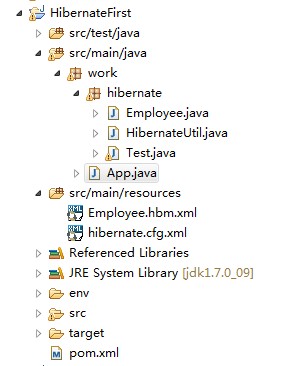
public class HibernateUtil {

    private static final SessionFactory sessionFactory = buildSessionFactory();

    private static SessionFactory buildSessionFactory() {

        try {

            // Create the SessionFactory from hibernate.cfg.xml

            return new Configuration()

                    .configure()

                    .buildSessionFactory();

        } catch (Throwable ex) {

            System.err.println("Initial SessionFactory creation failed." + ex);

            throw new ExceptionInInitializerError(ex);

        }

    }

    public static SessionFactory getSessionFactory() {

        return sessionFactory;

    }

}
Employee:
public class Employee {

    private Long id;

    private String firstname;

    private String lastname;

    private Date birthDate;

    private String cellphone;

    public Employee() {

    }

    public Employee(String firstname, String lastname, Date birthdate, String phone) {

        this.firstname = firstname;

        this.lastname = lastname;

        this.birthDate = birthdate;

        this.cellphone = phone;

    }

....get set....
Test:
Employee.hbm.xmlpublic class Test {

    public static void main( String[] args )

    {

        list();

        System.out.println( "Hello World!" );

    }

    private static List list() {

        SessionFactory sf = HibernateUtil.getSessionFactory();

        Session session = sf.openSession();

        List employees = session.createQuery("from Employee").list();

        System.out.println(employees.size());

        session.close();

        return employees;

    }

}
Employee.hbm.xml
<?xml version="1.0" encoding="UTF-8"?>

<!DOCTYPE hibernate-mapping PUBLIC

        "-//Hibernate/Hibernate Mapping DTD 3.0//EN"

        "http://hibernate.sourceforge.net/hibernate-mapping-3.0.dtd">

<hibernate-mapping package="work.hibernate">

    <class name="Employee" table="EMPLOYEE">

        <id name="id" column="ID">

            <generator class="native"/>

        </id>

        <property name="firstname" />

        <property name="lastname" column="lastname"/>

        <property name="birthDate" type="date" column="birth_date"/>

        <property name="cellphone" column="cell_phone"/>

    </class>

</hibernate-mapping>
hibernate.cfg.xml 注意这里的数据库配置文件中的替换值,就是最前面提到的properties文件中的值,在install的时候自动替换。
<?xml version="1.0" encoding="UTF-8"?>

<!DOCTYPE hibernate-configuration PUBLIC

        "-//Hibernate/Hibernate Configuration DTD 3.0//EN"

        "http://hibernate.sourceforge.net/hibernate-configuration-3.0.dtd">

<hibernate-configuration>

    <session-factory name="mysql">

        <property name="hibernate.connection.driver_class">${jdbc.driverClassName}</property>

        <property name="hibernate.connection.url">${jdbc.url}</property>

        <property name="hibernate.connection.username">${jdbc.username}</property>

        <property name="hibernate.connection.password">${jdbc.password}</property>

        <!-- JDBC connection pool (use the built-in) -->

        <property name="connection.pool_size">1</property>

        <!-- SQL dialect -->

        <property name="dialect">org.hibernate.dialect.MySQLDialect</property>

        <!-- Enable Hibernate's automatic session context management -->

        <property name="current_session_context_class">thread</property>

        <!-- Disable the second-level cache  -->

        <property name="cache.provider_class">org.hibernate.cache.NoCacheProvider</property>

        <!-- Echo all executed SQL to stdout -->

        <property name="show_sql">false</property>

        <property name="hbm2ddl.auto">validate</property>

        <mapping resource="Employee.hbm.xml" />

    </session-factory>

</hibernate-configuration>
--------------------------------------------------
让我们继续前行!
maven为不同环境打包(hibernate)-超越昨天的自己系列(6)的更多相关文章
- 时间作为横轴的图表(morris.js)超越昨天的自己系列(8)
超越昨天的自己系列(8) morris.js的官网有详细的例子:http://www.oesmith.co.uk/morris.js/ 特别注意它的依赖: <link rel="sty ...
- spring和redis的整合-超越昨天的自己系列(7)
超越昨天的自己系列(7) 扯淡: 最近一直在慢慢多学习各个组件,自己搭建出一些想法.是一个涉猎的过程,慢慢意识到知识是可以融汇贯通,举一反三的,不过前提好像是研究的比较深,有了自己的见解.自认为学习 ...
- Maven根据不同环境打包不同配置文件
开发项目时会遇到这个问题:开发环境,测试环境,生产环境的配置文件不同,打包时经常要手动更改配置文件,更改的少还可以接受,但是如果需要更多个配置文件,手动的方法就显得非常笨重了. 下面介绍一种方法,利用 ...
- maven项目多环境打包问题
1.xxx-api是基于springboot的模块 2.配置文件 application.properties spring.profiles.active=@activeEnv@ applicati ...
- Maven实现多环境打包
在开发的过程中,经常需要面对不同的运行环境(开发环境.测试环境.生产环境.内网环境.外网环境等等),在不同的环境中,相关的配置一般不一样,比如数据源配置.日志文件配置.以及一些软件运行过程中的基本配置 ...
- HashMap归档-超越昨天的自己系列
java HashMap 读一下源码,一个数组存储数据: transient Entry[] table; 内部存key和value的内部类: static class Entry<K,V> ...
- Collections.reverse 代码思考-超越昨天的自己系列(13)
点进Collections.reverse的代码瞄了眼,然后就开始了一些基础知识的收集. 现在发现知道的越多,知道不知道的越多. 列几个记录下: reverse方法源码: /** * Reverses ...
- crontab 移动日志-超越昨天的自己系列(12)
linux上定时执行某些脚本是管理服务器的时候比较常用的场景,比如定时检查进程是否存在,定时启动或关闭进程,定时检查日志删除日志等. 当我打开google百度crontab时长篇大论的一大堆,详细解释 ...
- java进程性能分析步骤-超越昨天的自己系列(11)
java进程load过高分析步骤: top 查看java进程情况 top -Hp 查看某个进程的具体线程情况 printf 0x%x 确认哪一个线程占用cpu比较多,拿出来转成16进制 ...
随机推荐
- 如何实现301的跳转?当输入域名http://xxx.com的时候自动重定向到www上去
答案:在服务器上操作,注意勾选和不勾选的区别,使用Fiddle进行观察,301和302之间的区别
- String.resize()
void resize (size_t n); void resize (size_t n, char c); 测试代码: // resizing string #include <iostre ...
- node.js+WebStorm路径问题
目录路径 :A文件夹下有B.C文件夹和app.js文件.B文件夹下有webserver.js文件等. A B webserver.js ...... C ...... app.js WebStorm配 ...
- NoSQL分类
NoSQL数据库分类: NoSQL DEFINITION:Next Generation Databases mostly addressing some of the points: beingno ...
- [CSS]三层嵌套的滑动门
原理: 最外层放水平平铺的背景,第二层放左边,第三层放右边,注意这个做法背景图不能透明 结构: <div class="module-title"> <span ...
- nginx不支持pathinfo 导致thinkphp出错解决办法
location / { if (!-e $request_filename) { rewrite ^(.*)$ /index.php?s=$1 last; break; } } 然后项目配置下url ...
- wp8.1 C#技巧: 计时器
public MainPage() { this.InitializeComponent(); this.timer = new DispatcherTimer();//新建委托时间实例 timer. ...
- 五大要求让BPM与企业对接
BPM(即业务流程管理)在中国已经有多年的发展历史,但人们经常提到的还是企业对流程的迫切需要,鲜有人讨论什么样的企业才能实施BPM,或者换句话说BPM的本身对企业有什么要求.不是所有的工作都适合BPM ...
- 面试题之spring
一.Spring的理解 Spring是一个轻量级的容器,非侵入性的框架.最重要的核心概念是IOC,并提供AOP概念的实现方式,提供对持久层,事务的支持,对当前流行的一些框架(Struts,Hibern ...
- Iterator和ListIterator的区别
Iterator是ListIterator的父接口. Iterator是Collection中取元素的方式,ListIterator局限于List Iterator只有hasNext(),next() ...