
A Small Definition of Big Data
A Small Definition of Big Data
The term "big data" seems to be popping up everywhere these days. And there seems to be as many uses of this term as there are contexts in which you find it: 'big data' is often used to refer to any dataset that is difficult to manage using traditional database systems; it is also used as a catch-all term for any collection of data that is too large to process on a single server; yet others use the term to simply eman "a lot of data"; sometimes it turns out it doesn't even have to be large. So what exactly is big data?
A precise specification of 'big' is elusive. What is considered big for one organization may be small for another. What is large-scale today will likely seem small-scale in the near future. petabyte is the new terabyte. Thus, size alone cannot specify big data. The complexity of the data is an import factor that must also be considered.
Most now agree with the characterizating of big data using the 3 V's coined by Doug Laney of Gartner:
- Volume: this refers to the vast amounts of data that is generated every second/min-ute/hour/day in our digitized world.
- Velocity: This refers to the speed at which data is beging generated and the pace at which data moves from one point to the next.
- Variety: This refers to the ever-increasing different forms that data can come in, e.g., text, images, voice, geospatial.
- A fourth V is now also sometimes added:
- Veracity: This refers to the quality of the data, which can vary greatly.
- The above V's are the dimensions that characterize big data, and also embody its challenges; We have huge amounts of data, in different formats and varing quality, that must be processed quickly.
- It is important to note that the goal of processing big data is to gain insight to support decision-making. It is not sufficient to just be able to capture and store the data. The point of collecting and processing volumes of complex data is to understand trends, uncover hidden patterns, detect anomalies, etc. So that you have a better understanding of the problem being analyzed and can make more informed, data-driven decisions. In fact, many consider value as the fifth V of big data:
- Value: Processing big data must bring about value from insights gained.
To address the challenges of big data, innovative technologies are needed. Parallel, distributed computing paradigms, scalable machine learning algorithms, and real-time querying are key to analysis of big data. Distributed file systems, computing clusters, cloud computing, and data stores supporting data variety and agility are also necessary to provide the infrastructure for processing of big data. Workflows provide an intuitive, reusable, scalable and reproducible way to process big data to gain verifiable value from it in and enable application of same methods to different datasets.
With all the data generated from social media, smart sensors satellites, surveillance carmera, the Internet, and countless other devices, big data is all around us. The endeavor to make sense out of that data brings about exciting opportunities indeed!
Data Science
Data Science is about extracting knowledge from data. At the WorkDS Center, we define data science as a multidisciplinary craft that combines people, process, computational and Big Data platforms, application-specific purpose and programmability. Publications and provenance of the data products leading to these publications are also important for data science.
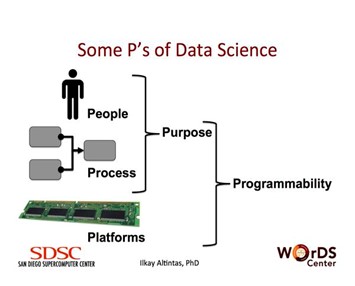
- People: The data scientists are often seen as people who possess skills on a variety of topics including: science or business domain knowledge; analysis using statistics, machine learning and mathematical knowledge; data management, programming and computing. In practice, this is generally a group of researchers comprised of people with complementary skills.
- Process: The process of data science includes techniques for statistics, machine learning, programming, computing and data management. Data science workflows combine such steps in executable graphs. we believe that process-origented thinking is a transformative way of conducting data science to connect people and techniques to applications. Challenges for the data science progress include 1) how to easily integrate all needed tasks to build such a progress; 2) how to find the best computing resources and efficiently schedule process executions to the resource based on process definition, parameter settings, and user preferences.
- Purpose: Purpose comes when people use generalizable processes with a particular goal in mind. The purpose can be related to a scientific analysis with a hypothesis or a business metric that needs to be analyzed based often on Big Data. Note that similar reusable processes can be applicable to many applications with different purposes when employed within different workflows.
- Platforms: Based on the needs of an application-driven purpose and the amount of data and computing required to perform this application, different computing and data platforms can be used as a part of the data science process. This scalability should be made part of any data science solution architecture.
- Programmability: Capturing a scalable data science process requires aid from programming languages, e.g. R, and patterns, e.g., MapReduce. Tools that provide access to such programming techniques are key to making the data science process programmable on a variety of platforms.
Execution of such a data science process requires access to many datasets, Big and small, bringing new opportunities and challenges to Data Science. There are many Data Science steps or tasks, such as Data Collection, Data Cleaning, Data Processing/Analysis, Result Visualization, resulting in a Data Science Workflow. Data Science Processes may need user interaction and other manual operations, or be fully automated.
MapReduce
Map-Reduce is a scalable programming model that simplifies distributed processing of data. Map-Reduce consists of three main steps: Mapping, Shuffling and Reducing. An easy way to think about a Map-Reduce job is to compare it with act of 'delegating' a large task to a group of people, and combining the result of each person's effort, to produce the final outcome.
Let's take an example to bring the point across. You just heard about this great news at your office, and are throwing a party for all your colleagues! You decide to cook Pasta for the dinner. Four of your friends, who like cooking, also volunteer to join you in preparation. The task of preparing Pasta broadly involves chopping the vegetables, cooking, and garnishing.
Let's take the job of chopping the vegetables and see how it is analogous to map-reduce task. Here the raw vegetables are symbolic of the input data, your friends are equivalent to compute nodes, and final chopped vagetables are analogous to desired outcome. Each friend is allotted onions, tomatoes and peppers to chop and weigh.
You would also like to know how much of each vegetable types you have in the kitchen. You would also like to chop these vegetables while this calculation is occurring. In the end, the onions should be in one large bowl with a label that displays its weight in pounds, tomatoes in aseparate one, and so on.

MAP: To start with, you assign each of your four friends a random mix of different types of vegetables. They are required to use their 'compute' powers to chop them and measure the weight of each type of veggie. They need to ensure not mix different types of veggies. So each friend will generate a mapping of <key,value> pairs that looks like:
Friend X:
<tomatoes, 5lbs>
<onions, 10lbs>
<garlic, 2lbs>
Friend Y:
<onions, 22lbs>
<green peppers, 5lbs>
……
Seems like you are having a really big party! Now that your friends have chopped the vegetables, and labeled each bowl with the weight and type of vegetable, we move to the next stage: Shuffling.
SHUFFLE: This stage is also called Grouping. Here you want to group the veggies by their types. You assign different parts of your kitchen to each type of veggie, and your friends are supposed to group the bowls, so that like items are placed together.

North End of Kitchen:
<tomatoes, 5lbs>
<tomatoes, 11lbs>

West End of Kitchen:
<onions, 10lbs>
<onions, 22lbs>
<onions, 1.4lbs>

East End of Kitchen:
<green peppers, 3lbs>
<green peppers, 10lbs>
The party start in a couple of hours, but you are impressed by what your friends have accomplished by Mapping and Grouping so far! The kitchen looks much more organized now and the raw material is chopped. The final stage of this task is to measure how much of each veggie you actually have. This brings us to the Reduce stage.
REDUCE: In this stage, you ask each of your friend to collect items of same type, put them in a large bowl, and label this large bowl with sum of individual bowl weights. Your friends cannot wait for the party to start, and immediately start 'reducing' small bowls. In the end, you have nice large bowls, with total weight of each vegetable labeled on it.
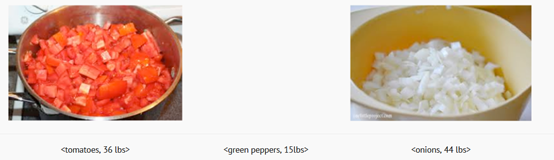
Your friends('compute nodes') just performed a Map-Reduce task to help you get started with cooking the Pasta. Since you were coordinating the entire exercise, you are "The Master" node of this Map-Reduce task. Each of your friends took roles of Mappers, Groupers and Reducers at different times. This example demonstrates the power of this technique.
This simple and powerful technique can be scaled very easily if more of your friends decide to join you.
A Small Definition of Big Data的更多相关文章
- Toward Scalable Systems for Big Data Analytics: A Technology Tutorial (I - III)
ABSTRACT Recent technological advancement have led to a deluge of data from distinctive domains (e.g ...
- TYPES、DATA、TYPE、LIKE、CONSTANTS、STATICS、TABLES
声明:原创作品,转载时请注明文章来自SAP师太技术博客( 博/客/园www.cnblogs.com):www.cnblogs.com/jiangzhengjun,并以超链接形式标明文章原始出处,否则将 ...
- CAST function should support INT synonym for SIGNED. i.e. CAST(y AS INT)
Login / Register Developer Zone Bugs Home Report a bug Statistics Advanced search Saved searches T ...
- Examples of MIB Variables - SNMP Tutorial
30.5 Examples of MIB Variables Versions 1 and 2 of SNMP each collected variables together in a singl ...
- xml的解析与创建——bing到youdao导入文件的转换
首先是为了解决一个问题:如何将必应单词本中记录的单词转入到有道词典中去.实际上,必应词典可以导出xml文件,但是该文件有道词典无法解析.这里涉及到xml的解析和创建了. 代码如下: import ja ...
- 直接放个DB2 SQL STATEMENT大全好了!
SQL statements This topic contains tables that list the SQL statements classified by type. SQL sch ...
- MEMORY Storage Engine MEMORY Tables TEMPORARY TABLE max_heap_table_size
http://dev.mysql.com/doc/refman/5.7/en/create-table.html You can use the TEMPORARY keyword when crea ...
- ORACLE恢复数据
ORACLE恢复删除表或表记录 一:表的恢复 对误删的表,只要没有使用PURGE永久删除选项,那么从flash back区恢复回来希望是挺大的.一般步骤有: 1.从flash back里查询 ...
- sphinx配置文件sphinx.conf参数详细说明
sphinx配置文件sphinx.conf参数详细说明 sphinx.conf各个参数详细说明 # # Sphinx configuration file sample # # WARNING! Wh ...
随机推荐
- 关于k阶裴波那契序列的两种解法
在学校的anyview的时候,遇到了这个题: [题目]已知k阶裴波那契序列的定义为f(0)=0, f(1)=0, ..., f(k-2)=0, f(k-1)=1;f(n)=f(n-1)+f(n-2)+ ...
- Oracle中的日期数据类型
TimeStamp日期类型 TimeStamp数据类型用于存储日期的年.月.日,以及时间的小时.分和秒,其中秒值精确到小数点后6位,该数据类型 同时包含时区信息.systimestamp函数的功能是返 ...
- Java 线程 —— Wait (等待)和 Notify(唤醒)
Wait (等待)和 Notify(唤醒) 这里讲了一个Wait (等待)和 Notfity(唤醒),下面这个实例(工厂,商店,消费者) 额,然后,你就知道了,需要写三个类:工厂类,Shop类,消费者 ...
- hihocoder1703 第K小先序遍历
思路: 给定n个节点二叉树的中序遍历,不同形态的二叉树的种类数有卡特兰数个.为了在中序序列[l, r]表示的子树上找先序序列第k小的树,首先需要从小到大枚举每个节点作根所能构成的二叉树的数目来确定树根 ...
- Android习惯——给全部Activity添加集合管理
title: 2017-3-23 Android习惯--给全部Activity添加集合管理 public void ActivityCollector{ public static List<A ...
- [Windows Server 2012] MySQL移机方法
★ 欢迎来到[护卫神·V课堂],网站地址:http://v.huweishen.com ★ 护卫神·V课堂 是护卫神旗下专业提供服务器教学视频的网站,每周更新视频. ★ 本节我们将带领大家:MySQL ...
- (转)Nutz | Nutz项目整合Spring实战
http://blog.csdn.net/evan_leung/article/details/54767143 Nutz项目整合Spring实战 前言 Github地址 背景 实现步骤 加入spri ...
- 说说C#中list与IList中的区别(转载)
首先IList 泛型接口是 ICollection 泛型接口的子代,并且是所有泛型列表的基接口. 但是它仅仅是所有泛型类型的接口,并没有太多方法可以方便实用,如果仅仅是作为集合数据的承载体,确实,IL ...
- Vue 点击事件怎么传递 this ?
Part.1 问题 如何使上面的三个按钮单个点击后实现第一个按钮现在的样式呢? Part.2 思路 为当前点击的按钮添加一个 单独的类名,我的做法: .active { background: #3C ...
- vue之package.json文件解析
1.package.json是什么? 什么是Node.js的模块(Module)?在Node.js中,模块是一个库或框架,也是一个Node.js项目.Node.js项目遵循模块化的架构,当我们创建了一 ...