
Python - 八大排序算法
1、序言
本文使用Python实现了一些常用的排序方法。文章结构如下:
1.直接插入排序
2.希尔排序
3.冒泡排序
4.快速排序
5.简单选择排序
6.堆排序
7.归并排序
8.基数排序
上述所有的排序均写在一个Python自定义类中,作为成员函数。
2、排序方法详细介绍
1.直接插入排序
直接插入排序(Straight Insertion Sort)是一种最简单的排序方法,它的基本操作是一个值插入到已排好序的有序表中,从而得到一个新的、记录数增1的有序表。如下图所示:
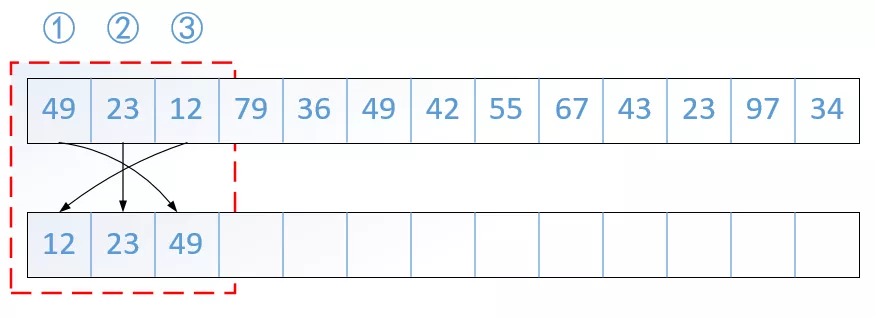
由上图可知若最初始的有序表即为数组的第一个元素。用Python实现如下:
def straight_insertion_sort(self, value_list):

    """

    直接插入排序

    :param value_list: 无序列表

    :return:

    """

    return self.__straight_insert(value_list)

@staticmethod

def __straight_insert(value_list):

    sorted_list = []

    sorted_list.append(value_list.pop(0))

    for i in range(0, len(value_list)):

        tail = True  # 是否在尾部插入

        insert_loc = 0

        for j in range(len(sorted_list)):

            if value_list[i] <= sorted_list[j]:

                tail = False

                insert_loc = j

                break

        sorted_list.append(value_list[i])  # 先将值插入尾部

        if not tail:

            # 移动值

            for j in range(len(sorted_list) - 1, insert_loc, -1):

                temp = sorted_list[j]

                sorted_list[j] = sorted_list[j - 1]

                sorted_list[j - 1] = temp

    return sorted_list
2.希尔排序
希尔排序(Shell’s Sort)又称“缩小增量排序”(Diminishing Incerement Sort),它也是一种数插入排序的方法,但在时间效率上较前面的排序方法有较大的改进。它的基本思想是:先将整个待排记录序列分割成若干个子序列分别进行直接插入排序,待整个序列中的记录“基本有序”时,再对全体记录进行一次直接插入排序。如下图所示:
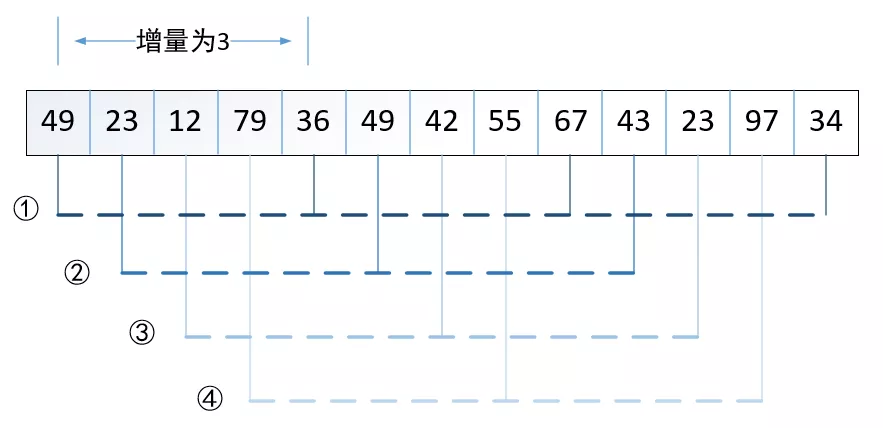
即根据增量将原序列分割成多个子序列进行直接插入排序。增量应不断减小,且最后一个增量为1。用Python实现如下:
def shells_sort(self, value_list):

    """

    希尔排序

    :param value_list: 待排序的无序列表

    :return: 排序后的列表

    """

    gap = len(value_list) // 2

    while gap >= 1:

        i = 0

        while(i + gap) < len(value_list):

            start = i

            gap_list = []

            while start < len(value_list):

                gap_list.append(value_list[start])

                start = start + gap

            gap_list = self.__straight_insert(gap_list)

            start = i

            while start < len(value_list):

                value_list[start] = gap_list.pop(0)

                start += gap

            i += 1

        gap //= 2

    sorted_list = value_list

    return sorted_list
3.冒泡排序
冒泡排序(Bubble Sort)的过程很简单。首先将第一个记录的关键字和第二个记录的关键字进行比较,若逆序(与需要的顺序相反),则将两个记录交换之,然后比较第二个记录和第三个记录的关键字,以此类推。为第一趟冒泡结束,接着对前n-1个记录继续进行上述的过程。这样重复的过程直至n-1=1结束。排序过程如下所示:
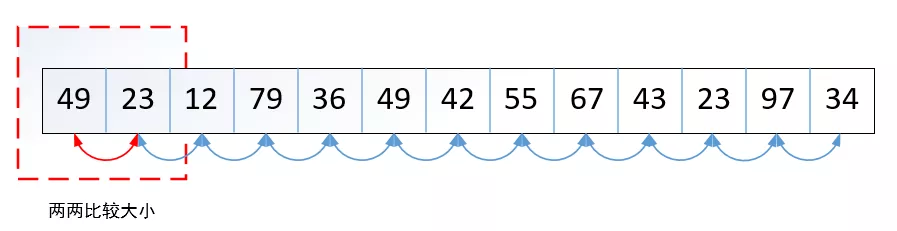
用Python实现如下:
@staticmethod

def bubble_sort(value_list):

    """

    冒泡排序

    :param value_list: 待排序的无序列表

    :return: 排序后的列表

    """

    for i in range(len(value_list) - 1):

        for j in range(i + 1, len(value_list)):

            if value_list[i] > value_list[j]:

                value_list[i], value_list[j] = value_list[j], value_list[i]

    sorted_list = value_list

    return sorted_list
4.快速排序
快速排序(Quick Sort)是对冒泡排序的一种改进。它的基本思想是,通过一趟排序将待排记录分割成独立的两部分,其中一部分记录的关键字均比另一部分记录的关键字小,则可分别对这两部分记录继续进行排序,已达到整个序列有序。其排序思想如下:
首先任意选取一个记录(通常可选第一个记录)作为枢轴,然后按下述原则重新排列记录:将所有关键字较它小的记录都安置在它的位置之前,将所有关键字较它大的记录都安置在它的位置之后。一趟快速排序的具体做法是:设两个指针low和high,他们的初值分别为最低位置的下一个位置和最高位,设最低位置枢轴的关键字为pivotkey,则首先从high所指位置起向前搜索找到第一个关键字小于pivotkey的记录的枢轴记录互相交换。发生了交换后才从low所指向的位置起向后搜索,找到第一个关键字大于pivotkey的记录和枢轴记录互相交换。重复这两步直至low=how为止
如下图所示:

特别要注意换方向的时机是发生了交换后,用Python实现如下:
def quick_sort(self, value_list):

    """

    快速排序

    :param value_list: 待排序的无序列表

    :return: 排序后的列表

    """

    low = 0

    high = len(value_list) - 1

    self.__qsort(value_list, low, high)

    sorted_list = value_list

    return sorted_list

def __qsort(self, val_list, low, high):

    """

    快速排序辅助函数

    :param val_list: 无序列表

    :param low: 低位

    :param high: 高位

    :return:

    """

    if low >= high:

        return

    pivot_key = low

    temp_low = pivot_key

    temp_high = high

    while low < high:

        # 分成一边比轴(pivot)大,一边比轴(pivot)小的顺序

        while low < high:

            if val_list[high] < val_list[pivot_key]:

                temp = val_list[high]

                val_list[high] = val_list[pivot_key]

                val_list[pivot_key] = temp

                pivot_key = high

                break  # 发生交换后,就换方向

            else:

                high -= 1

        while low < high:

            if val_list[low] > val_list[pivot_key]:

                temp = val_list[low]

                val_list[low] = val_list[pivot_key]

                val_list[pivot_key] = temp

                pivot_key = low

                break  # 发生交换后,就换方向

            else:

                low += 1

    self.__qsort(val_list, temp_low, pivot_key - 1)

    self.__qsort(val_list, pivot_key + 1, temp_high)
5.简单选择排序
选择排序(Selection Sort)是一种简单直观的排序算法。它的基本思想是:每一趟在n-i+1(i=1,2,...,n-1)个记录中选取关键字最小的记录作为有序序列中第i个记录。简单选择排序:通过n-1次关键字的比较,从n-i+1个记录中选出关键字最小的记录,并和第i(1≤i≤n)个记录交换之。如下图所示:
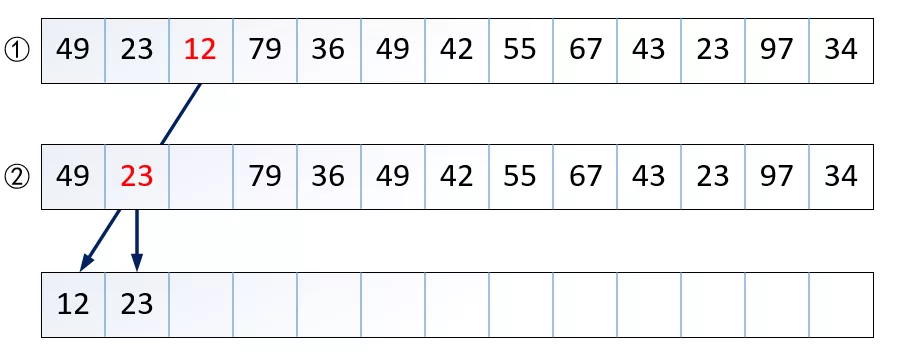
用Python实现如下:
@staticmethod

def simple_selection_sort(value_list):

    """

    简单选择排序

    :param value_list: 待排序的无序列表

    :return: 排序后的列表

    """

    for i in range(len(value_list)):

        min_val = 9999999

        for j in range(i, len(value_list)):

            if min_val > value_list[j]:

                min_val = value_list[j]

        count = 0  # 如果有多个相同的最小值

        for j in range(i, len(value_list)):

            if min_val == value_list[j]:

                value_list[j], value_list[i + count] = value_list[i + count], value_list[j]

    sorted_list = value_list

    return sorted_list
6.堆排序
堆排序(Heap Sort)是指利用堆这种数据结构所设计的一种排序算法。堆的定义如下:
n个元素的序列{k1,k2,...,kn}当且仅当满足一下关系时,称之为堆。
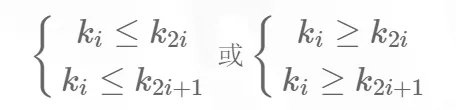
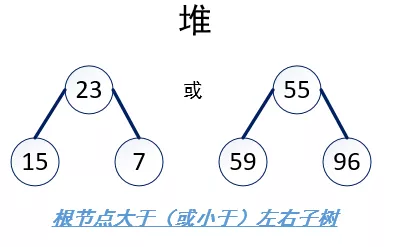
若将序列看成是一个完全二叉树,则堆的含义表明,完全二叉树中所有非终端节点均不大于(或不小于)其左、右孩子节点的值。由此,若序列是堆,则堆顶元素必为序列中的最小值(或最大值)。如下图所示:
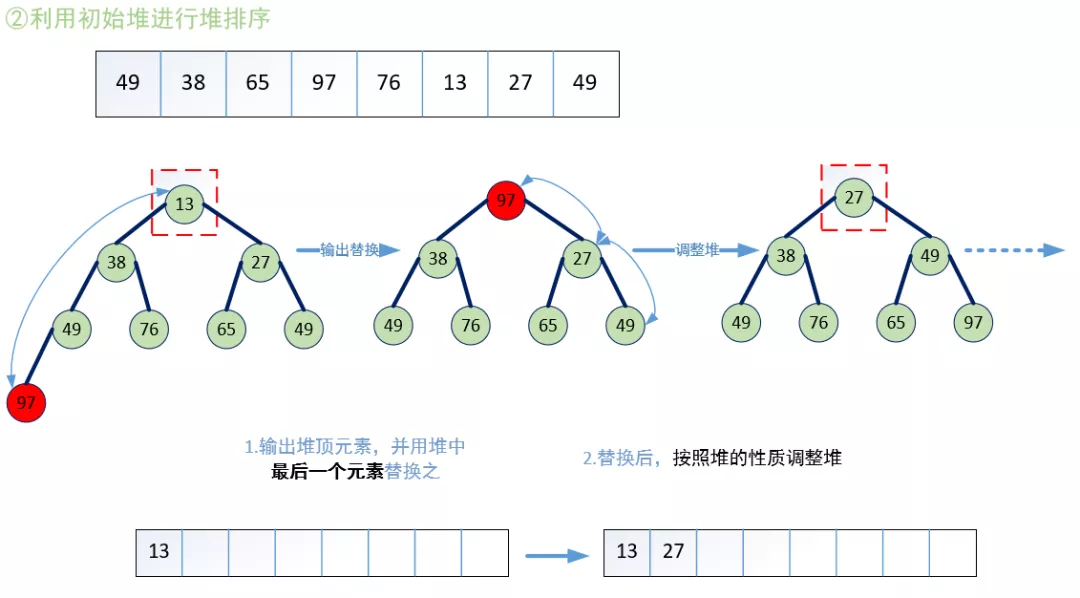
至此,我们可以给出堆排序的过程:若在输出堆顶的最小值后,使得剩余n-1个元素的序列又建成一个堆,则得到n个元素中的次小值。如此反复执行,便能得到一个有序序列。
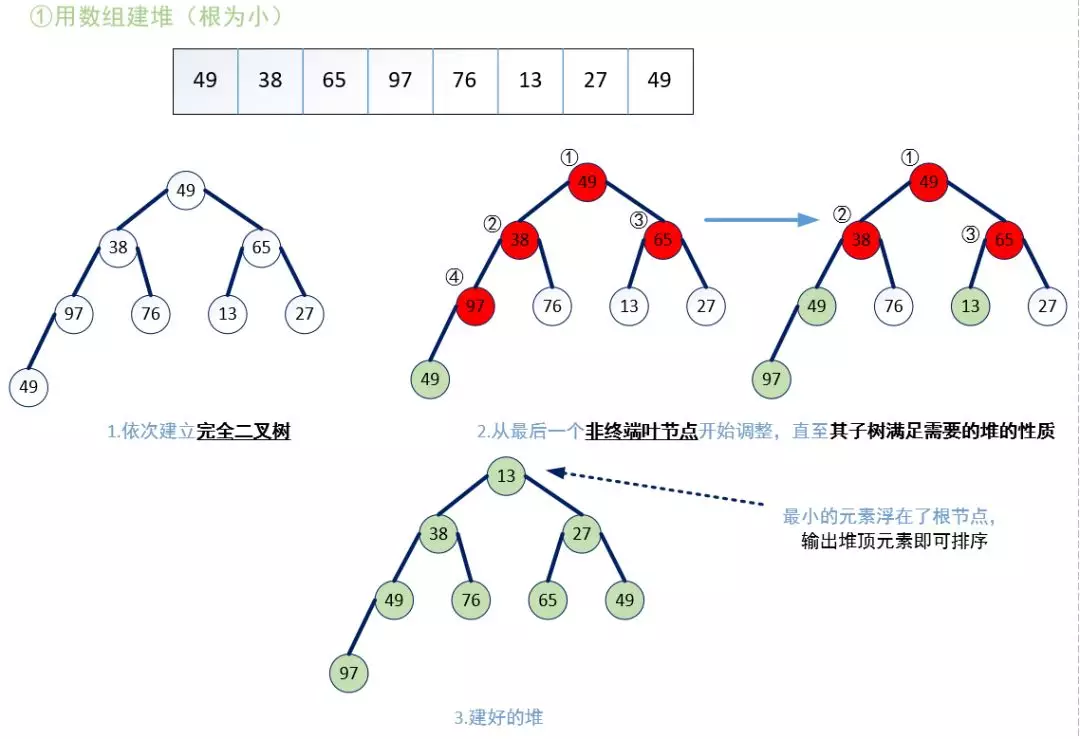
故整个堆排序可以大致分为两个过程:
·将无序序列建成堆。
·输出堆顶元素后,用类似建堆的方法调整堆。
如下两个图所示:
根据堆排序的特点总结出两点注意事项:
1.利用把堆看成完全二叉树的特点,用完全二叉树的性质解决算法问题。
2.建堆的过程是从树种的最后一个非终端节点逆序开始调整的。
3.每调整一次需要检查前后是否依然保持堆的特征。
本文利用了二叉树的孩子兄弟表示法来生成二叉树(堆)的。代码如下:
class CldSibNode(object):

    """

    私有内部类:孩子兄弟二叉链表节点

    """

    def __init__(self, val):

        self.value = val

        self.child = None

        self.sibling = None

def heap_sort(self, value_list):

    """

    堆排序

    :param value_list: 待排序的无序列表

    :return: 排序后的列表

    """

    sorted_list = []

    root_node = self.CldSibNode(None)

    self.__child_sibling(root_node, value_list, 0)

    for ct in range(1, len(value_list) // 2 + 1):  # 建堆

        self.__adjust_heap(root_node, len(value_list) // 2 + 1 - ct, 1)

    for i in range(1, len(value_list) + 1):  # 堆排序

        sorted_list.append(root_node.value)  # 输出堆顶元素

        head = root_node

        self.__shrink_heap(root_node, len(value_list) + 1 - i, 1, head)

        self.__adjust_heap(root_node, 1, 1)  # 调整堆

    return sorted_list

def __child_sibling(self, node, value_list, ind):

    """

    创建完全二叉树的左孩子右兄弟二叉链表

    :param node: 当前节点

    :param value_list: 待排序的无序列表

    :param ind:

    :return:

    """

    if ind >= len(value_list):

        return

    node.value = value_list[ind]

    if ind * 2 + 1 < len(value_list):

        node.child = self.CldSibNode(None)  # 孩子

        self.__child_sibling(node.child, value_list, ind * 2 + 1)

    if ind * 2 + 2 < len(value_list):

        node.child.sibling = self.CldSibNode(None)  # 兄弟

        self.__child_sibling(node.child.sibling, value_list, ind * 2 + 2)

def __adjust_heap(self, root_node, last_ind, now_ind):

    if not root_node or not root_node.child:  # 不为空且有孩子

        return

    if now_ind == last_ind:

        # 需要调整的非终端节点

        temp = root_node

        cg = False

        while temp.child:

            if temp.value > temp.child.value:

                temp.value, temp.child.value = temp.child.value, temp.value

                cg = True  # 发生交换

            if temp.child.sibling:

                if temp.value > temp.child.sibling.value:

                    if cg:

                        # 如果发生过交换

                        temp.value, temp.child.value = temp.child.value, temp.value

                    temp.value, temp.child.sibling.value = temp.child.sibling.value, temp.value

                    temp = temp.child.sibling

                    continue

                else:

                    if cg:

                        # 如果发生过交换

                        temp = temp.child

                        continue

            break

    # 递归

    self.__adjust_heap(root_node.child, last_ind, now_ind * 2)

    if root_node.child.sibling:

        self.__adjust_heap(root_node.child.sibling, last_ind, now_ind * 2 + 1)

def __shrink_heap(self, root_node, last_ind, now_ind, head):

    if not root_node or now_ind * 2 > last_ind:

        # 为空

        return

    if last_ind == now_ind * 2 + 1:

        head.value = root_node.child.sibling.value

        root_node.child.sibling = None

        return True

    if last_ind == now_ind * 2:

        head.value = root_node.child.value

        root_node.child = None

        return True

    if root_node.child:

        self.__shrink_heap(root_node.child, last_ind, now_ind * 2, head)

        self.__shrink_heap(root_node.child.sibling, last_ind, now_ind * 2 + 1, head)
7.归并排序
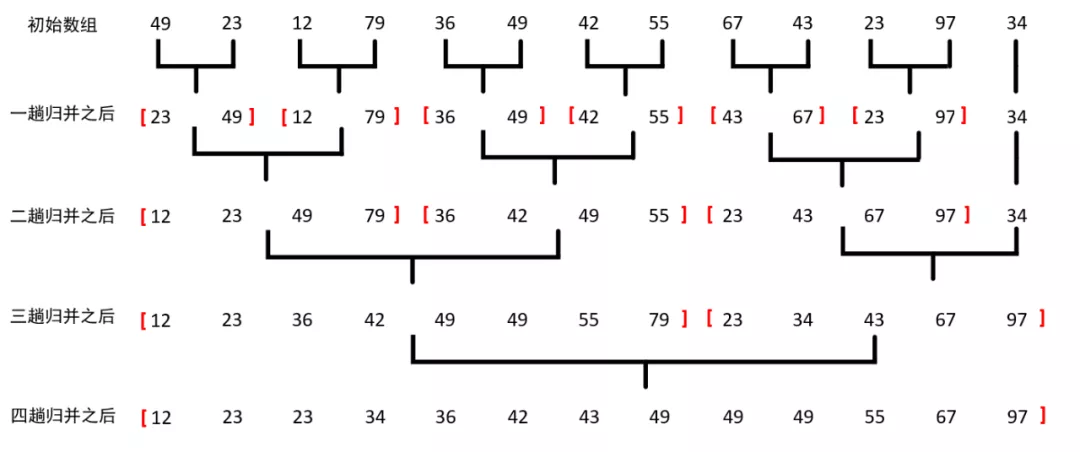
归并排序(Merging Sort),“归并”的含义是将两个或两个以上的有序表组合成一个新的有序表。假设初始序列有n个记录,则可看成是n个有序的子序列,每个子序列的长度为1,然后两两归并,得到[n/2]个长度为2或1的有序子序列;再两两归并,……,如此重复,直至得到一个长度为n的有序序列为止,这种排序方法为2-路归并排序。算法的基本思想如下图所示:
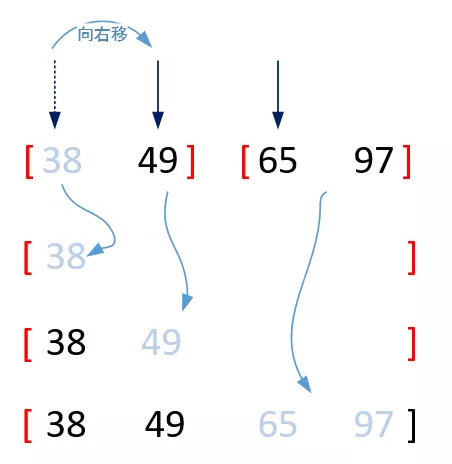
其中两个子序列的合并大有学问,基本思想就是:分别在两个序列头设置指针,比较两个序列指针所指的值的大小,将满足要求的值提取出来形成新列表,并将指针右移。当其中一个指针指向结尾之后时,表示其中一个列表已取尽,接着直接在新列表尾部连接另一个列表。如下图所示:
用Python实现如下:
@staticmethod

def merging_sort(self, value_list):

    """

    归并排序

    :param value_list: 待排序的无序列表

    :return: 排序后的新列表

    """

    i = 0

    while np.power(2, i) < len(value_list):

        count = np.power(2, i)

        start = 0

        outer_temp = []

        while start < len(value_list):

            # 定位另一边

            other = start + count

            temp = []

            if other >= len(value_list):

                # 另一边不存在:直接合并

                outer_temp.extend(value_list[start: start + count])

                break

            left, right = 0, 0

            while left < count or right < count:

                if other + right >= len(value_list):

                    # 右边提前结束

                    temp.extend(value_list[start + left: start + count])

                    break

                elif value_list[start + left] < value_list[other + right]:

                    # 左边更小

                    temp.append(value_list[start + left])

                    left += 1

                    if left == count:

                        # 左边遍历结束

                        temp.extend(value_list[other + right: other + count])

                        break

                else:

                    # 右边更小

                    temp.append(value_list[other + right])

                    right += 1

                    if right == count:

                        # 右边遍历结束

                        temp.extend(value_list[start + left: start + count])

                        break

            outer_temp.extend(temp)

            start += count * 2

        value_list = outer_temp

        i += 1

    sorted_list = value_list

    return sorted_list
8.基数排序
基数排序(Radix Sort)是一种非比较整数排序算法,其原理是将整数按位数切割成不同的数字,然后按每个位数分别比较。由于整数也可以表达字符串(比如名字或日期)和特定格式的浮点数,所以基数排序也不是只能使用于整数。
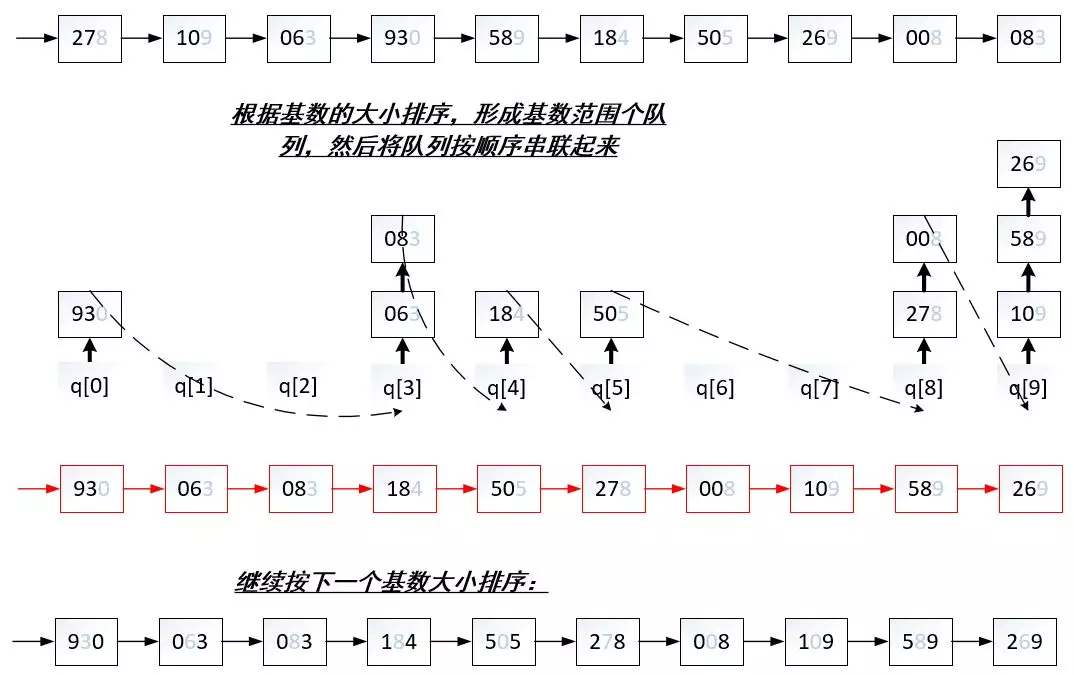
排序时有两点需要注意:
1.每完成一趟排序,要清空队列。
2.队列的连接要找到第一个不为空的队列作为头,和绕开所有空队列。
用Python实现如下:
@staticmethod

def radix_sort(value_list):

    """

    基数排序

    :param value_list: 待排序的无序列表

    :return: 排序后的新列表

    """

    i = 0

    max_num = max(value_list)

    n = len(str(max_num))

    while i < n:

        # 初始化桶数组

        bucket_list = [[] for _ in range(10)]

        for x in value_list:

            # 找到位置放入桶数组

            bucket_list[int(x / (10 ** i)) % 10].append(x)

        value_list.clear()

        for x in bucket_list:

            # 放回原序列

            for y in x:

                value_list.append(y)

        i += 1

    sorted_list = value_list

    return sorted_list
测试代码:
编写测试代码运行结果如下:
if __name__ == '__main__':

    li = list(np.random.randint(1, 1000, 30))

    my_sort = MySort()

    print("original sequence:", li)

    print("*" * 100)

    print("1.straight_insertion_sort:", my_sort.straight_insertion_sort(li.copy()))

    print("2.shells_sort:", my_sort.shells_sort(li.copy()))

    print("3.bubble_sort:", my_sort.bubble_sort(li.copy()))

    print("4.quick_sort:", my_sort.quick_sort(li.copy()))

    print("5.simple_selection_sort:", my_sort.simple_selection_sort(li.copy()))

    print("6.heap_sort:", my_sort.heap_sort(li.copy()))

    print("7.merging_sort:", my_sort.merging_sort(li.copy()))

    print("8.radix_sort:", my_sort.radix_sort(li.copy()))
测试运行结果:
original sequence: [424, 381, 234, 405, 554, 742, 527, 876, 27, 904, 169, 566, 854, 448, 65, 508, 226, 477, 12, 670, 408, 520, 774, 99, 159, 565, 393, 288, 149, 711]

****************************************************************************************************

1.straight_insertion_sort: [12, 27, 65, 99, 149, 159, 169, 226, 234, 288, 381, 393, 405, 408, 424, 448, 477, 508, 520, 527, 554, 565, 566, 670, 711, 742, 774, 854, 876, 904]

2.shells_sort: [12, 27, 65, 99, 149, 159, 169, 226, 234, 288, 381, 393, 405, 408, 424, 448, 477, 508, 520, 527, 554, 565, 566, 670, 711, 742, 774, 854, 876, 904]

3.bubble_sort: [12, 27, 65, 99, 149, 159, 169, 226, 234, 288, 381, 393, 405, 408, 424, 448, 477, 508, 520, 527, 554, 565, 566, 670, 711, 742, 774, 854, 876, 904]

4.quick_sort: [12, 27, 65, 99, 149, 159, 169, 226, 234, 288, 381, 393, 405, 408, 424, 448, 477, 508, 520, 527, 554, 565, 566, 670, 711, 742, 774, 854, 876, 904]

5.simple_selection_sort: [12, 27, 65, 99, 149, 159, 169, 226, 234, 288, 381, 393, 405, 408, 424, 448, 477, 508, 520, 527, 554, 565, 566, 670, 711, 742, 774, 854, 876, 904]

6.heap_sort: [12, 27, 65, 99, 149, 159, 169, 226, 234, 288, 381, 393, 405, 408, 424, 448, 477, 508, 520, 527, 554, 565, 566, 670, 711, 742, 774, 854, 876, 904]

7.merging_sort: [12, 27, 65, 99, 149, 159, 169, 226, 234, 288, 381, 393, 405, 408, 424, 448, 477, 508, 520, 527, 554, 565, 566, 670, 711, 742, 774, 854, 876, 904]

8.radix_sort: [12, 27, 65, 99, 149, 159, 169, 226, 234, 288, 381, 393, 405, 408, 424, 448, 477, 508, 520, 527, 554, 565, 566, 670, 711, 742, 774, 854, 876, 904]
总结
各个排序效率见下图:
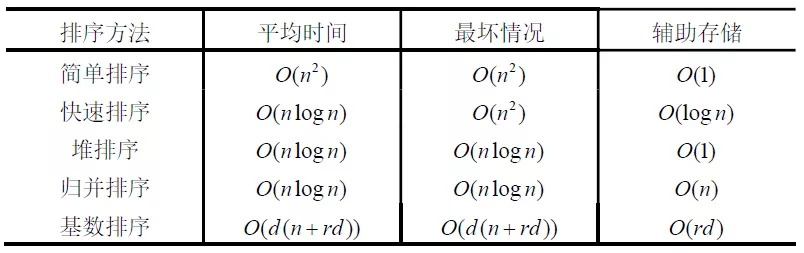
可以得出以下几个结论:
1.从平均时间性能而言,快速排序最佳。
2.堆排序适用于n较大的数据。
3.基数排序是稳定的,时间复杂度较大的简单排序方法也是稳定的。
4.稳定性是由方法本身决定的。
5.没有最好的排序方法,视情况而定。
#! /usr/bin/env python3

# -*- coding:utf-8 -*-

# Author   : MaYi

# Blog     : http://www.cnblogs.com/mayi0312/

# Date     : 2020-01-06

# Name     : mySort

# Software : PyCharm

# Note     : 八大排序算法

import numpy as np

class MySort(object):

    """

    自定义一个排序的类

    """

    def straight_insertion_sort(self, value_list):

        """

        直接插入排序

        :param value_list: 待排序的无序列表

        :return: 排序后的列表

        """

        return self.__straight_insert(value_list)

    @staticmethod

    def __straight_insert(value_list):

        sorted_list = []

        sorted_list.append(value_list.pop(0))

        for i in range(0, len(value_list)):

            tail = True  # 是否在尾部插入

            insert_loc = 0

            for j in range(len(sorted_list)):

                if value_list[i] <= sorted_list[j]:

                    tail = False

                    insert_loc = j

                    break

            sorted_list.append(value_list[i])  # 先将值插入尾部

            if not tail:

                # 移动值

                for j in range(len(sorted_list) - 1, insert_loc, -1):

                    sorted_list[j], sorted_list[j - 1] = sorted_list[j - 1], sorted_list[j]

        return sorted_list

    def shells_sort(self, value_list):

        """

        希尔排序

        :param value_list: 待排序的无序列表

        :return: 排序后的列表

        """

        gap = len(value_list) // 2

        while gap >= 1:

            i = 0

            while(i + gap) < len(value_list):

                start = i

                gap_list = []

                while start < len(value_list):

                    gap_list.append(value_list[start])

                    start = start + gap

                gap_list = self.__straight_insert(gap_list)

                start = i

                while start < len(value_list):

                    value_list[start] = gap_list.pop(0)

                    start += gap

                i += 1

            gap //= 2

        sorted_list = value_list

        return sorted_list

    @staticmethod

    def bubble_sort(value_list):

        """

        冒泡排序

        :param value_list: 待排序的无序列表

        :return: 排序后的列表

        """

        for i in range(len(value_list) - 1):

            for j in range(i + 1, len(value_list)):

                if value_list[i] > value_list[j]:

                    value_list[i], value_list[j] = value_list[j], value_list[i]

        sorted_list = value_list

        return sorted_list

    def quick_sort(self, value_list):

        """

        快速排序

        :param value_list: 待排序的无序列表

        :return: 排序后的列表

        """

        low = 0

        high = len(value_list) - 1

        self.__qsort(value_list, low, high)

        sorted_list = value_list

        return sorted_list

    def __qsort(self, val_list, low, high):

        """

        快速排序辅助函数

        :param val_list: 无序列表

        :param low: 低位

        :param high: 高位

        :return:

        """

        if low >= high:

            return

        pivot_key = low

        temp_low = pivot_key

        temp_high = high

        while low < high:

            # 分成一边比轴(pivot)大,一边比轴(pivot)小的顺序

            while low < high:

                if val_list[high] < val_list[pivot_key]:

                    temp = val_list[high]

                    val_list[high] = val_list[pivot_key]

                    val_list[pivot_key] = temp

                    pivot_key = high

                    break  # 发生交换后,就换方向

                else:

                    high -= 1

            while low < high:

                if val_list[low] > val_list[pivot_key]:

                    temp = val_list[low]

                    val_list[low] = val_list[pivot_key]

                    val_list[pivot_key] = temp

                    pivot_key = low

                    break  # 发生交换后,就换方向

                else:

                    low += 1

        self.__qsort(val_list, temp_low, pivot_key - 1)

        self.__qsort(val_list, pivot_key + 1, temp_high)

    @staticmethod

    def simple_selection_sort(value_list):

        """

        简单选择排序

        :param value_list: 待排序的无序列表

        :return: 排序后的列表

        """

        for i in range(len(value_list)):

            min_val = 9999999

            for j in range(i, len(value_list)):

                if min_val > value_list[j]:

                    min_val = value_list[j]

            count = 0  # 如果有多个相同的最小值

            for j in range(i, len(value_list)):

                if min_val == value_list[j]:

                    value_list[j], value_list[i + count] = value_list[i + count], value_list[j]

        sorted_list = value_list

        return sorted_list

    class CldSibNode(object):

        """

        私有内部类:孩子兄弟二叉链表节点

        """

        def __init__(self, val):

            self.value = val

            self.child = None

            self.sibling = None

    def heap_sort(self, value_list):

        """

        堆排序

        :param value_list: 待排序的无序列表

        :return: 排序后的列表

        """

        sorted_list = []

        root_node = self.CldSibNode(None)

        self.__child_sibling(root_node, value_list, 0)

        for ct in range(1, len(value_list) // 2 + 1):  # 建堆

            self.__adjust_heap(root_node, len(value_list) // 2 + 1 - ct, 1)

        for i in range(1, len(value_list) + 1):  # 堆排序

            sorted_list.append(root_node.value)  # 输出堆顶元素

            head = root_node

            self.__shrink_heap(root_node, len(value_list) + 1 - i, 1, head)

            self.__adjust_heap(root_node, 1, 1)  # 调整堆

        return sorted_list

    def __child_sibling(self, node, value_list, ind):

        """

        创建完全二叉树的左孩子右兄弟二叉链表

        :param node: 当前节点

        :param value_list: 待排序的无序列表

        :param ind:

        :return:

        """

        if ind >= len(value_list):

            return

        node.value = value_list[ind]

        if ind * 2 + 1 < len(value_list):

            node.child = self.CldSibNode(None)  # 孩子

            self.__child_sibling(node.child, value_list, ind * 2 + 1)

        if ind * 2 + 2 < len(value_list):

            node.child.sibling = self.CldSibNode(None)  # 兄弟

            self.__child_sibling(node.child.sibling, value_list, ind * 2 + 2)

    def __adjust_heap(self, root_node, last_ind, now_ind):

        if not root_node or not root_node.child:  # 不为空且有孩子

            return

        if now_ind == last_ind:

            # 需要调整的非终端节点

            temp = root_node

            cg = False

            while temp.child:

                if temp.value > temp.child.value:

                    temp.value, temp.child.value = temp.child.value, temp.value

                    cg = True  # 发生交换

                if temp.child.sibling:

                    if temp.value > temp.child.sibling.value:

                        if cg:

                            # 如果发生过交换

                            temp.value, temp.child.value = temp.child.value, temp.value

                        temp.value, temp.child.sibling.value = temp.child.sibling.value, temp.value

                        temp = temp.child.sibling

                        continue

                    else:

                        if cg:

                            # 如果发生过交换

                            temp = temp.child

                            continue

                break

        # 递归

        self.__adjust_heap(root_node.child, last_ind, now_ind * 2)

        if root_node.child.sibling:

            self.__adjust_heap(root_node.child.sibling, last_ind, now_ind * 2 + 1)

    def __shrink_heap(self, root_node, last_ind, now_ind, head):

        if not root_node or now_ind * 2 > last_ind:

            # 为空

            return

        if last_ind == now_ind * 2 + 1:

            head.value = root_node.child.sibling.value

            root_node.child.sibling = None

            return True

        if last_ind == now_ind * 2:

            head.value = root_node.child.value

            root_node.child = None

            return True

        if root_node.child:

            self.__shrink_heap(root_node.child, last_ind, now_ind * 2, head)

            self.__shrink_heap(root_node.child.sibling, last_ind, now_ind * 2 + 1, head)

    @staticmethod

    def merging_sort(value_list):

        """

        归并排序

        :param value_list: 待排序的无序列表

        :return: 排序后的新列表

        """

        i = 0

        while np.power(2, i) < len(value_list):

            count = np.power(2, i)

            start = 0

            outer_temp = []

            while start < len(value_list):

                # 定位另一边

                other = start + count

                temp = []

                if other >= len(value_list):

                    # 另一边不存在:直接合并

                    outer_temp.extend(value_list[start: start + count])

                    break

                left, right = 0, 0

                while left < count or right < count:

                    if other + right >= len(value_list):

                        # 右边提前结束

                        temp.extend(value_list[start + left: start + count])

                        break

                    elif value_list[start + left] < value_list[other + right]:

                        # 左边更小

                        temp.append(value_list[start + left])

                        left += 1

                        if left == count:

                            # 左边遍历结束

                            temp.extend(value_list[other + right: other + count])

                            break

                    else:

                        # 右边更小

                        temp.append(value_list[other + right])

                        right += 1

                        if right == count:

                            # 右边遍历结束

                            temp.extend(value_list[start + left: start + count])

                            break

                outer_temp.extend(temp)

                start += count * 2

            value_list = outer_temp

            i += 1

        sorted_list = value_list

        return sorted_list

    @staticmethod

    def radix_sort(value_list):

        """

        基数排序

        :param value_list: 待排序的无序列表

        :return: 排序后的新列表

        """

        i = 0

        max_num = max(value_list)

        n = len(str(max_num))

        while i < n:

            # 初始化桶数组

            bucket_list = [[] for _ in range(10)]

            for x in value_list:

                # 找到位置放入桶数组

                bucket_list[int(x / (10 ** i)) % 10].append(x)

            value_list.clear()

            for x in bucket_list:

                # 放回原序列

                for y in x:

                    value_list.append(y)

            i += 1

        sorted_list = value_list

        return sorted_list

if __name__ == '__main__':

    li = list(np.random.randint(1, 1000, 30))

    my_sort = MySort()

    print("original sequence:", li)

    print("*" * 100)

    print("1.straight_insertion_sort:", my_sort.straight_insertion_sort(li.copy()))

    print("2.shells_sort:", my_sort.shells_sort(li.copy()))

    print("3.bubble_sort:", my_sort.bubble_sort(li.copy()))

    print("4.quick_sort:", my_sort.quick_sort(li.copy()))

    print("5.simple_selection_sort:", my_sort.simple_selection_sort(li.copy()))

    print("6.heap_sort:", my_sort.heap_sort(li.copy()))

    print("7.merging_sort:", my_sort.merging_sort(li.copy()))

    print("8.radix_sort:", my_sort.radix_sort(li.copy()))
完整代码
Python - 八大排序算法的更多相关文章
- Python 八大排序算法速度比较
这篇文章并不是介绍排序算法原理的,纯粹是想比较一下各种排序算法在真实场景下的运行速度. 算法由 Python 实现,用到了一些语法糖,可能会和其他语言有些区别,仅当参考就好. 测试的数据是自动生成的, ...
- 八大排序算法的 Python 实现
转载: 八大排序算法的 Python 实现 本文用Python实现了插入排序.希尔排序.冒泡排序.快速排序.直接选择排序.堆排序.归并排序.基数排序. 1.插入排序 描述 插入排序的基本操作就是将一个 ...
- Python实现八大排序算法(转载)+ 桶排序(原创)
插入排序 核心思想 代码实现 希尔排序 核心思想 代码实现 冒泡排序 核心思想 代码实现 快速排序 核心思想 代码实现 直接选择排序 核心思想 代码实现 堆排序 核心思想 代码实现 归并排序 核心思想 ...
- 【Python】八大排序算法的比较
排序是数据处理比较核心的操作,八大排序算法分别是:直接插入排序.希尔排序.简单选择排序.堆排序.冒泡排序.快速排序.归并排序.基数排序 以下是排序图解: 直接插入排序 思想 直接插入排序是一种最简单的 ...
- 八大排序算法总结与java实现(转)
八大排序算法总结与Java实现 原文链接: 八大排序算法总结与java实现 - iTimeTraveler 概述 直接插入排序 希尔排序 简单选择排序 堆排序 冒泡排序 快速排序 归并排序 基数排序 ...
- [Data Structure & Algorithm] 八大排序算法
排序有内部排序和外部排序之分,内部排序是数据记录在内存中进行排序,而外部排序是因排序的数据很大,一次不能容纳全部的排序记录,在排序过程中需要访问外存.我们这里说的八大排序算法均为内部排序. 下图为排序 ...
- Python之排序算法:快速排序与冒泡排序
Python之排序算法:快速排序与冒泡排序 转载请注明源地址:http://www.cnblogs.com/funnyzpc/p/7828610.html 入坑(简称IT)这一行也有些年头了,但自老师 ...
- 八大排序算法Java实现
本文对常见的排序算法进行了总结. 常见排序算法如下: 直接插入排序 希尔排序 简单选择排序 堆排序 冒泡排序 快速排序 归并排序 基数排序 它们都属于内部排序,也就是只考虑数据量较小仅需要使用内存的排 ...
- python实现排序算法 时间复杂度、稳定性分析 冒泡排序、选择排序、插入排序、希尔排序
说到排序算法,就不得不提时间复杂度和稳定性! 其实一直对稳定性不是很理解,今天研究python实现排序算法的时候突然有了新的体会,一定要记录下来 稳定性: 稳定性指的是 当排序碰到两个相等数的时候,他 ...
随机推荐
- python3爬取百度知道的问答并存入数据库(MySQL)
一.链接分析: 以"Linux"为搜索的关键字为例: 首页的链接为:https://zhidao.baidu.com/search?lm=0&rn=10&pn=0& ...
- python后续学习
关于使用python输出中文字符的问题: Python中默认的编码格式是 ASCII 格式,在没修改编码格式时无法正确打印汉字,所以在读取中文时会报错. 解决方法为只要在文件开头加入 # -*- co ...
- AAC DRC
DRC feature 在AAC decoder是optional.DRC info是在编码在fill element. Program reference level是进行DRC的一个参考值.是原始 ...
- SFSA
#include<stdio.h> #include<string.h> #include<math.h> #include<iostream> #in ...
- 传奇服务端添加双倍经验卷的方法 双倍经验卷轴DB示例展示
第一步我们在DBC数据库中添加好双倍经验卷轴DB,以下是现成的双倍经验卷DB,导入到DB里面就可以了. 222;双倍经验卷;31;0;1;20;0;0;265;0;0;0;0;0;0;0;0;0;0; ...
- python接口自动化测试 - requests库的post请求进行文件上传
前言 如果需要发送文件到服务器,比如上传图片.视频等,就需要发送二进制数据. 一般上传文件使用的都是 Content-Type: multipart/form-data; 数据类型,可以发送文件,也可 ...
- WSUS补丁服务器部署详细
利用WSUS部署更新程序 来源于网络转载 WSUS概述 为了让用户的windows系统与其他microsoft产品能够更安全,更稳定,因此microsoft会不定期在网站上推出最新的更新程序供用户下 ...
- bugku 白哥的鸽子
首先下载之后发现是一个txt 然后更改一下后缀名发现这是一张jpg 图片然后看一下属性然后用hxd分析一下 看看有没有zip 发现没有 然后拖到地下然后发现有一串密码有些问题 然后查一下发现是 栏杆密 ...
- Visual Studio Code修改全屏背景
打开VSCode安装目录,找到workbench.desktop.main.css文件 在最后一行添加以下代码: body{ pointer-events:auto !important; backg ...
- 【C语言】一元二次方程(求实根和虚根)
求一元二次方程:ax2+bx+c=0 的根. 输入三个实数a,b,c的值,且a不等于0. #include<stdio.h> #include<math.h> int main ...