
[原创]Zynq AXI-CDMA的使用
Xilinx 提供了3种DMA
- AXI-DMA
- AXI-CDMA
- AXI-VDMA
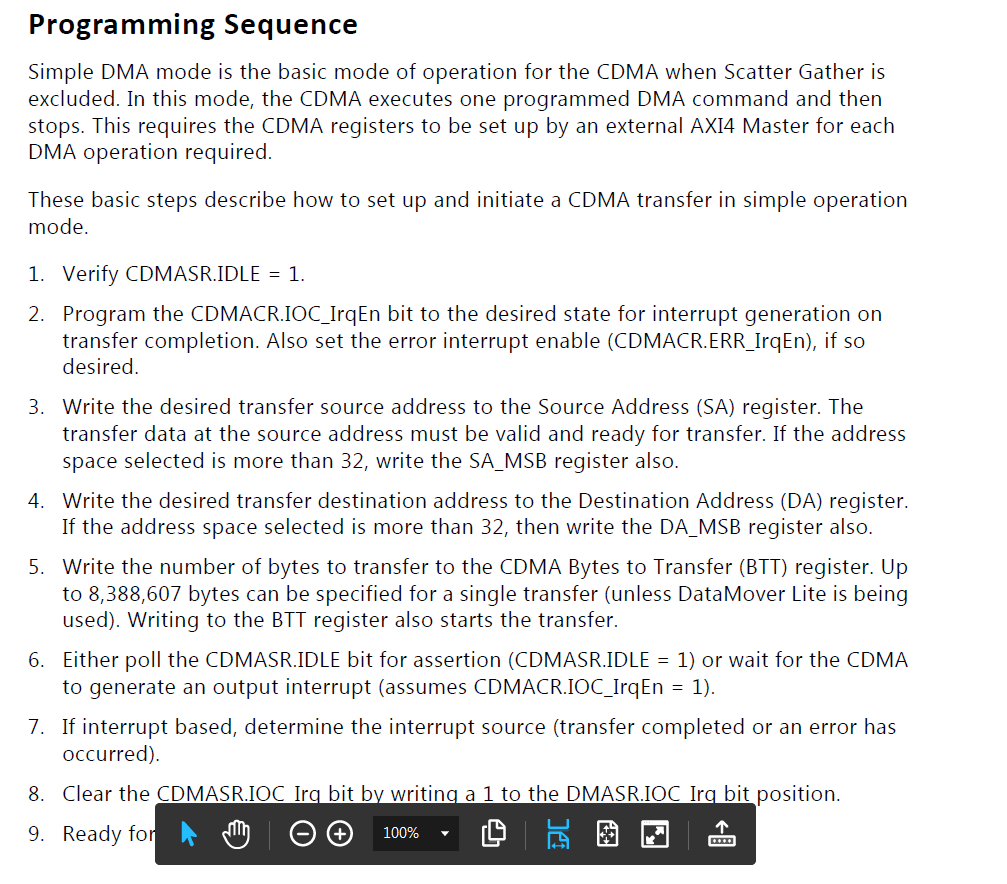
使用CDMA能够满足项目需求(MM-MM),DS文档介绍如下:
The Xilinx LogiCORE™ IP AXI Central Direct Memory Access (CDMA) core is a soft Xilinx Intellectual Property (IP) core for use with the Vivado® Design Suite. The AXI CDMA provides high-bandwidth Direct Memory Access (DMA) between a memory-mapped source address and a memory-mapped destination address using the AXI4 protocol. An optional Scatter Gather (SG) feature can be used to offload control and sequencing tasks from the system CPU. Initialization, status, and control registers are accessed through an AXI4-Lite slave interface, suitable for the Xilinx MicroBlaze™ processor.
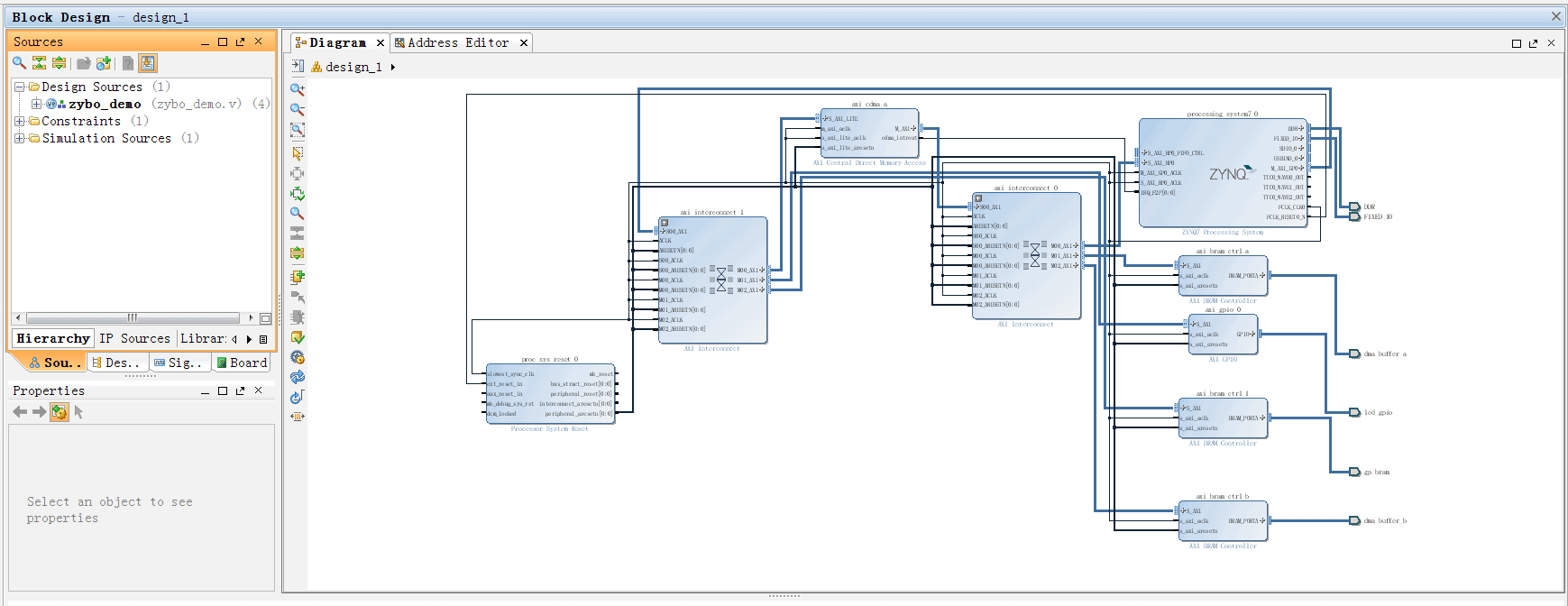
BD连接如下:
Standalone APP代码
#include "xparameters.h"

#include <stdio.h>

#include "xaxicdma.h"

#include "xil_cache.h"

#include "xscutimer.h"

#define TIMER_LOAD_VALUE	0xFFFFFFFF

#define BRAM_GP0_ADDR 0x40000000

XAxiCdma_Config *axi_cdma_cfg;

XAxiCdma axi_cdma;

#define PS_OCM_Addr 0x10000000 // some address in OCM

#define PL_BRAM_Addr 0xC0000000 // Not 'seen' by the PS

//#define BUFF_LEN 16*4

//16384*32bit/8=65536Byte

//32768*32bit/8=131072Byte

#define BUFF_LEN 131072

XScuTimer Timer;

void hs_timer(void)

{

	int Status;

	XScuTimer_Config *ConfigPtr;

	XScuTimer *TimerInstancePtr=&Timer;

    /*

     * Initialize the Scu Private Timer so that it is ready to use.

     */

    ConfigPtr = XScuTimer_LookupConfig(XPAR_PS7_SCUTIMER_0_DEVICE_ID);

    /*

     * This is where the virtual address would be used, this example

     * uses physical address.

     */

    Status = XScuTimer_CfgInitialize(TimerInstancePtr, ConfigPtr, ConfigPtr->BaseAddr);

    if (Status != XST_SUCCESS) {

    	return XST_FAILURE;

    }

    else

	xil_printf("XScuTimer_CfgInitialize OK\n\r");

}

int main()

{

xil_printf("%c[2J",27);

	int i,k;

	int Status;

	volatile int CntValue1,CntValue2;

	u32 *Saddr2 = (u32 *)0x02000000;

	u32 *rx_buffer = (u32 *) PS_OCM_Addr;

	u32 *tx_buffer = (u32 *) PL_BRAM_Addr;

	u32 *rd_ram    = (u32 *) BRAM_GP0_ADDR;

	hs_timer()  	;

	xil_printf("-----------------------*-----------------------\n\r");

	xil_printf("-Simple DMA demo based on Zybo board          -\n\r");

	xil_printf("-write some data to DDR                       -\n\r");

	xil_printf("-move those data to bram and read it from GP0 -\n\r");

	xil_printf("-----------------------*-----------------------\n\r");

	// Set up the AXI CDMA

	printf("--Set up the AXI CDMA\n\r");

	axi_cdma_cfg = XAxiCdma_LookupConfig(XPAR_AXICDMA_0_DEVICE_ID);

	if (!axi_cdma_cfg) {

		printf("AXAxiCdma_LookupConfig failed\n\r");

	}

	Status = XAxiCdma_CfgInitialize(&axi_cdma, axi_cdma_cfg, axi_cdma_cfg->BaseAddress);

	if (Status == XST_SUCCESS ){

		printf("XAxiCdma_CfgInitialize succeed\n\r");

	}

	printf("--Disable Interrupt of AXI CDMA\n\r");

	XAxiCdma_IntrDisable(&axi_cdma, XAXICDMA_XR_IRQ_ALL_MASK);

	if (XAxiCdma_IsBusy(&axi_cdma)) {

	printf("AXI CDMA is busy...\n\r");

	while (XAxiCdma_IsBusy(&axi_cdma));

	}

	Xil_DCacheFlush();

    XScuTimer_LoadTimer(&Timer, TIMER_LOAD_VALUE);

 	CntValue1 = XScuTimer_GetCounterValue(&Timer);

 	XScuTimer_Start(&Timer);

	Status = XAxiCdma_SimpleTransfer(

									 &axi_cdma,

									 (u32) tx_buffer,

									 (u32) rx_buffer,

									 BUFF_LEN,

									 NULL,

									 NULL);

	Xil_DCacheFlush();

 	CntValue2 = XScuTimer_GetCounterValue(&Timer);

 	XScuTimer_Stop(&Timer);

	printf("DMA Move 32768*32bit Total Time: %d us\n\r", (CntValue1-CntValue2)*3/1000);

	// Wait until core isn't busy

	if (XAxiCdma_IsBusy(&axi_cdma)) {

	printf("AXI CDMA is busy...\n\r");

	while (XAxiCdma_IsBusy(&axi_cdma));

	}

	Xil_DCacheInvalidateRange((u32)PS_OCM_Addr, BUFF_LEN);

	for(i=0; i<4; i++)

	//for(i=0; i<BUFF_LEN/4; i++)

	{

		k = *(rx_buffer + i);

		xil_printf("The DMA read from address = %2d, the     read value = %8x-----------------------\n\r",i,k);

		xil_printf("The DMA read from address = %2d, the MSB read value = %8d-----------------------\n\r",i,k >> 16);

		xil_printf("The DMA read from address = %2d, the LSB read value = %8d-----------------------\n\n\n\r",i,k & 0x0000FFFF);

	}

	for(i=32764; i<=32767; i++)

	//for(i=0; i<BUFF_LEN/4; i++)

	{

		k = *(rx_buffer + i);

		xil_printf("The DMA read from address = %2d, the     read value = %8x-----------------------\n\r",i,k);

		xil_printf("The DMA read from address = %2d, the MSB read value = %8d-----------------------\n\r",i,k >> 16);

		xil_printf("The DMA read from address = %2d, the LSB read value = %8d-----------------------\n\n\n\r",i,k & 0x0000FFFF);

	}

	return 0;

}
Linux APP代码
#include <unistd.h>

#include <stdio.h>

#include <stdlib.h>

#include <string.h>

#include <fcntl.h>

#include <sys/mman.h>

#include <sys/time.h>

#define CDMA_BASE_ADDRESS     0x7E200000

#define GPIO_DATA_OFFSET     0

#define GPIO_DIRECTION_OFFSET     4

#define PL_BRAM_SRC_ADDRESS  0xC0000000

#define DDR_BASE_ADDRESS     0x10000000

#define DDR_BASE_WRITE_ADDRESS    0x10000000

#define XGPIO_CHAN_OFFSET  8

#define XAXICDMA_CR_OFFSET    	0x00000000  /**< Control register */

#define XAXICDMA_SR_OFFSET    	0x00000004  /**< Status register */

#define XAXICDMA_CDESC_OFFSET 	0x00000008  /**< Current descriptor pointer */

#define XAXICDMA_TDESC_OFFSET	0x00000010  /**< Tail descriptor pointer */

#define XAXICDMA_SRCADDR_OFFSET 0x00000018  /**< Source address register */

#define XAXICDMA_DSTADDR_OFFSET 0x00000020  /**< Destination address register */

#define XAXICDMA_BTT_OFFSET     0x00000028  /**< Bytes to transfer */

/** @name Bitmasks of XAXICDMA_CR_OFFSET register

 * @{

 */

#define XAXICDMA_CR_RESET_MASK	0x00000004 /**< Reset DMA engine */

#define XAXICDMA_CR_SGMODE_MASK	0x00000008 /**< Scatter gather mode */

/** @name Bitmask for interrupts

 * These masks are shared by XAXICDMA_CR_OFFSET register and

 * XAXICDMA_SR_OFFSET register

 * @{

 */

#define XAXICDMA_XR_IRQ_IOC_MASK	0x00001000 /**< Completion interrupt */

#define XAXICDMA_XR_IRQ_DELAY_MASK	0x00002000 /**< Delay interrupt */

#define XAXICDMA_XR_IRQ_ERROR_MASK	0x00004000 /**< Error interrupt */

#define XAXICDMA_XR_IRQ_ALL_MASK	0x00007000 /**< All interrupts */

#define XAXICDMA_XR_IRQ_SIMPLE_ALL_MASK	0x00005000 /**< All interrupts for

                                                        simple only mode */

/*@}*/

/** @name Bitmasks of XAXICDMA_SR_OFFSET register

 * This register reports status of a DMA channel, including

 * idle state, errors, and interrupts

 * @{

 */

#define XAXICDMA_SR_IDLE_MASK         0x00000002  /**< DMA channel idle */

#define XAXICDMA_SR_SGINCLD_MASK      0x00000008  /**< Hybrid build */

#define XAXICDMA_SR_ERR_INTERNAL_MASK 0x00000010  /**< Datamover internal err */

#define XAXICDMA_SR_ERR_SLAVE_MASK    0x00000020  /**< Datamover slave err */

#define XAXICDMA_SR_ERR_DECODE_MASK   0x00000040  /**< Datamover decode err */

#define XAXICDMA_SR_ERR_SG_INT_MASK   0x00000100  /**< SG internal err */

#define XAXICDMA_SR_ERR_SG_SLV_MASK   0x00000200  /**< SG slave err */

#define XAXICDMA_SR_ERR_SG_DEC_MASK   0x00000400  /**< SG decode err */

#define XAXICDMA_SR_ERR_ALL_MASK      0x00000770  /**< All errors */

/*@}*/

#define MAP_SIZE 4096UL

#define MAP_MASK (MAP_SIZE - 1)

#define DDR_MAP_SIZE 0x00100000

#define DDR_MAP_MASK (DDR_MAP_SIZE - 1)

#define DDR_WRITE_OFFSET 0x10000000

#define BUFFER_BYTESIZE		32768	// Length of the buffers for DMA transfer

	long times = 0;	// us

	double dbTotalTimes = 0.0;	// s

	long nReadTotal = 0;

	struct timeval timeStart, timeEnd;

int main()

{

    int memfd;

    void *mapped_base, *mapped_dev_base;

    off_t dev_base = CDMA_BASE_ADDRESS;

    int memfd_2;

    void *mapped_base_2, *mapped_dev_base_2;

    off_t dev_base_2 = DDR_BASE_WRITE_ADDRESS;

    unsigned int TimeOut =5;

    unsigned int ResetMask;

    unsigned int RegValue;

    unsigned int DestArray[BUFFER_BYTESIZE ];

    unsigned int Index;

  	for (Index = 0; Index < (BUFFER_BYTESIZE/2); Index++)

  	{

  			DestArray[Index] = 0x12345678+Index;

  	}

    memfd = open("/dev/mem", O_RDWR | O_SYNC);

    if (memfd == -1)

    {

        printf("Can't open /dev/mem.\n");

        exit(0);

    }

	printf("/dev/mem opened.\n");

    // Map one page of memory into user space such that the device is in that page, but it may not

    // be at the start of the page.

    mapped_base = mmap(0, MAP_SIZE, PROT_READ | PROT_WRITE, MAP_SHARED, memfd, dev_base & ~MAP_MASK);

    if (mapped_base == (void *) -1)

    {

          printf("Can't map the memory to user space.\n");

          exit(0);

      }

    // get the address of the device in user space which will be an offset from the base

    // that was mapped as memory is mapped at the start of a page

    mapped_dev_base = mapped_base + (dev_base & MAP_MASK);

    //Reset CDMA

      do{

    	  	  ResetMask = (unsigned long )XAXICDMA_CR_RESET_MASK;

 			*((volatile unsigned long *) (mapped_dev_base + XAXICDMA_CR_OFFSET)) = (unsigned long)ResetMask;

			/* If the reset bit is still high, then reset is not done	*/

			ResetMask = *((volatile unsigned long *) (mapped_dev_base + XAXICDMA_CR_OFFSET));

			if(!(ResetMask & XAXICDMA_CR_RESET_MASK))

			{

				break;

			}

			TimeOut -= 1;

      }while (TimeOut);

      	//enable Interrupt

      RegValue = *((volatile unsigned long *) (mapped_dev_base + XAXICDMA_CR_OFFSET));

      RegValue = (unsigned long)(RegValue | XAXICDMA_XR_IRQ_ALL_MASK );

      *((volatile unsigned long *) (mapped_dev_base + XAXICDMA_CR_OFFSET)) = (unsigned long)RegValue;

      // Checking for the Bus Idle

      RegValue = *((volatile unsigned long *) (mapped_dev_base + XAXICDMA_SR_OFFSET));

      if(!(RegValue & XAXICDMA_SR_IDLE_MASK))

      {

    	  printf("BUS IS BUSY Error Condition \n\r");

    	  return 1;

      }

      // Check the DMA Mode and switch it to simple mode

      RegValue = *((volatile unsigned long *) (mapped_dev_base + XAXICDMA_CR_OFFSET));

      if((RegValue & XAXICDMA_CR_SGMODE_MASK))

      {

    	  RegValue = (unsigned long)(RegValue & (~XAXICDMA_CR_SGMODE_MASK));

    	  printf("Reading \n \r");

    	  *((volatile unsigned long *) (mapped_dev_base + XAXICDMA_CR_OFFSET)) = (unsigned long)RegValue ;

      }

      //Set the Source Address

      *((volatile unsigned long *) (mapped_dev_base + XAXICDMA_SRCADDR_OFFSET)) = (unsigned long)PL_BRAM_SRC_ADDRESS;

      //Set the Destination Address

      *((volatile unsigned long *) (mapped_dev_base + XAXICDMA_DSTADDR_OFFSET)) = (unsigned long)DDR_BASE_WRITE_ADDRESS;

      RegValue = (unsigned long)(BUFFER_BYTESIZE);

      // write Byte to Transfer

      *((volatile unsigned long *) (mapped_dev_base + XAXICDMA_BTT_OFFSET)) = (unsigned long)RegValue;

    	/*======================================================================================

    	STEP 6 : Wait for the DMA transfer Status

    	========================================================================================*/

gettimeofday(&timeStart, NULL);

      do

      {

    	 	  RegValue = *((volatile unsigned long *) (mapped_dev_base + XAXICDMA_SR_OFFSET));

      }while(!(RegValue & XAXICDMA_XR_IRQ_ALL_MASK));

gettimeofday(&timeEnd, NULL);

			times  = 1000000*(timeEnd.tv_sec - timeStart.tv_sec) + timeEnd.tv_usec - timeStart.tv_usec;

if(BUFFER_BYTESIZE == 32768)

printf("Read  32 Lines * 512 Dots :\n\r");

else

printf("Read 128 Lines * 512 Dots :\n\r");

printf("Xilinx AXI-CDMA Read %d Byte = %d us \n",   BUFFER_BYTESIZE,times);

      if((RegValue & XAXICDMA_XR_IRQ_IOC_MASK))

      {

    	  printf("Transfer Completed \n\r ");

      }

      if((RegValue & XAXICDMA_XR_IRQ_DELAY_MASK))

      {

      	printf("IRQ Delay Interrupt\n\r ");

      }

      if((RegValue & XAXICDMA_XR_IRQ_ERROR_MASK))

      {

      	printf("Transfer Error Interrupt\n\r ");

      }

      /*======================================================================================

       STEP 7 : Un-map the AXI CDMA memory from the User layer.

      ========================================================================================*/

      if (munmap(mapped_base, MAP_SIZE) == -1)

      {

      		printf("Can't unmap memory from user space.\n");

      		exit(0);

      }

      close(memfd);

   /*======================================================================================

    STEP 8 : Map the kernel memory location starting from 0x30000000 to the User layer

    ========================================================================================*/

      memfd_2 = open("/dev/mem", O_RDWR | O_SYNC);

       if (memfd_2 == -1)

       {

    	   printf("Can't open /dev/mem.\n");

           exit(0);

       }

       printf("/dev/mem opened.\n");

       // Map one page of memory into user space such that the device is in that page, but it may not

       // be at the start of the page.

       mapped_base_2 = mmap(0, DDR_MAP_SIZE, PROT_READ | PROT_WRITE, MAP_SHARED, memfd_2, dev_base_2 & ~DDR_MAP_MASK);

       if (mapped_base_2 == (void *) -1)

       {

    	   printf("Can't map the memory to user space.\n");

           exit(0);

       }

       printf("Memory mapped at address %p.\n", mapped_base_2);

        // get the address of the device in user space which will be an offset from the base

        // that was mapped as memory is mapped at the start of a page

        mapped_dev_base_2 = mapped_base_2 + (dev_base_2 & DDR_MAP_MASK);

        /*======================================================================================

        STEP 9 : Copy the Data from DDR Memory location 0x20000000 to Destination Buffer

        ========================================================================================*/

        memcpy(DestArray, mapped_dev_base_2, (BUFFER_BYTESIZE ));

        /*======================================================================================

        STEP 10 : Un-map the Kernel memory from the User layer.

        ========================================================================================*/

        if (munmap(mapped_base_2, DDR_MAP_SIZE) == -1)

        {

        	printf("Can't unmap memory from user space.\n");

            exit(0);

        }

       close(memfd_2);

       /*======================================================================================

        STEP 11 : Compare Source Buffer with Destination Buffer.

       ========================================================================================*/

	for(i=0; i<4; i++)

	{

		k = DestArray[i];

		printf("The AXI-CDMA read from address = %4d, the read value = 0x0%7x, MSB value=%5d, LSB value=%5d-----\n\r",i,k,k >> 16,k & 0x0000FFFF);

 	}

	for(i=8188; i<8192; i++)

	{

		k = DestArray[i];

		printf("The AXI-CDMA read from address = %4d, the read value = 0x%8x, MSB value=%5d, LSB value=%5d-----\n\r",i,k,k >> 16,k & 0x0000FFFF);

 	}

    return 0;

}
测试结果可参见:
https://www.cnblogs.com/ifpga/p/7859068.html
[原创]Zynq AXI-CDMA的使用的更多相关文章
- [原创]Zynq SDIO WIFI SotfAP调试
编译好kernel和driver 加载firmware后,运行下述命令. mkdir /var/run/ mkdir /var/run/hostapd ifconfig -a ...
- [原创]Zynq AXI-CDMA测试结果
经过研究与demo,在zynq上使用axi-cmda效率还是很高,测试报告如下所示 对于读取32KB,GP0和HP0的测试结果如下:
- 原创zynq文章整理(MiZ702教程+例程)
MiZ702教程+例程 网盘链接: http://pan.baidu.com/s/1sj23yxv 不时会跟新版本,增加勘误之类的,请关注--
- ZYNQ笔记(7):AXI从口自定义IP封装
使用 AXI_Lite 从口实现寄存器列表的读写,并且自己封装为一个自定义 IP,以便以后使用.本次记录的是 M_AXI_GP0 接口,此接口是 ARM 作为主机,FPGA 作为从机,配置 FPGA ...
- Xilinx DMA的几种方式与架构
DMA是direct memory access,在FPGA系统中,常用的几种DMA需求: 1. 在PL内部无PS(CPU这里统一称为PS)持续干预搬移数据,常见的接口形态为AXIS与AXI,AXI与 ...
- Learn ZYNC (2)
AXI HP接口的DMA+GIC编程(参照博客) 参照文档:UG873,博客文档 参考设计代码文件:ug873源码 我的Vivado+SDK工程文件打包(60+M) 我的DMA驱动程序(已完成) Vi ...
- 一步一步学ZedBoard & Zynq(四):基于AXI Lite 总线的从设备IP设计
本帖最后由 xinxincaijq 于 2013-1-9 10:27 编辑 一步一步学ZedBoard & Zynq(四):基于AXI Lite 总线的从设备IP设计 转自博客:http:// ...
- 利用ZYNQ SOC快速打开算法验证通路(6)——利用AXI总线实时配置sysGen子系统
利用ZYNQ验证算法的一大优势在于,可以在上位机发送指令借助CPU的控制能力和C语言易开发特点,实时配置算法模块的工作模式.参数等对来对其算法模块性能进行全面的评估.最重要的是无需重新综合硬件模块. ...
- 利用ZYNQ SOC快速打开算法验证通路(4)——AXI DMA使用解析及环路测试
一.AXI DMA介绍 本篇博文讲述AXI DMA的一些使用总结,硬件IP子系统搭建与SDK C代码封装参考米联客ZYNQ教程.若想让ZYNQ的PS与PL两部分高速数据传输,需要利用PS的HP(高性能 ...
随机推荐
- BZOJ 1815: [Shoi2006]color 有色图(Polya定理)
题意 如果一张无向完全图(完全图就是任意两个不同的顶点之间有且仅有一条边相连)的每条边都被染成了一种颜色,我们就称这种图为有色图. 如果两张有色图有相同数量的顶点,而且经过某种顶点编号的重排,能够使得 ...
- JavaScript中new实现原理
JavaScript中new实现原理 1.创建一个空对象 obj 2.将该对象 obj 的原型链 __proto__ 指向构造函数的原型 prototype, 并且在原型链 __proto__ 上设置 ...
- 前端三剑客:html,css,JavaScript
一.前端概念 二.html详细介绍 三.css基础 四.css盒模型 五.css高级布局 六.JS基础 七.JS常用类 八.JS基础操作 九.JS高级与事件 十.BOM与DOM 十一.jQuery初识 ...
- java的三大特征:封装,继承和多态
有点递进关系,继承增加了代码的复用性,多态必须基于继承才可以实现. 一.封装 使用原因:当我们没有为类进行封装的时候,类中定义的属性可以被外界随意访问,这样容易造成一些合法性的问题.封装可以非常好的解 ...
- window.location.href 传参中文乱码问题!!!
不是所有地方都会用Ajax 当你使用window.location.href 来传中文参数的时候 如何避免乱码问题 js 是这样写的 下面代码中 方式 封装编码 参数 username ...
- 0426JavaSE01day02.txt=========正则、Object、包装类详解
正则表达式 基本正则表达式:正则表达式简介.分组(). "^"和"$" String正则API:matches方法.split方法.replaceAll方法 O ...
- Angular记录(6)
文档资料 箭头函数--MDN:https://developer.mozilla.org/zh-CN/docs/Web/JavaScript/Reference/Functions/Arrow_fun ...
- CSS部分语法1
<!-- 第1部分 CSS规则特性 1 继承性:父元素样式可以被子元素继承,一般只能继承颜色和字体: 2 层叠性:给一个元素设置不同声明,效果会叠加: 3 优先级:给同一个元素设置相同声明,效果 ...
- hibernate自定义校验Valid
步骤: 1.定义注解: import javax.validation.Constraint; import javax.validation.Payload; import java.lang.an ...
- [译]Ocelot - Rate Limiting
原文 Ocelot支持对上游做访问限流,这样就可以保证下游不要负载太大了. 如果要启用访问限流,需要做如下配置: "RateLimitOptions": { "Clien ...