
Avoiding post increase or decrease
When we write a loop, most of us will use post increase or decrease, but there is a better solution. See below examples, which one is the better one?
Example1:
uint8_t CalcParity1(uint8_t* data, uint8_t len)

{

   uint8_t rt = ;

   for (uint8_t i = ; i < len; i++)

   {

      if (*data++)

      {

         rt++;

      }

   }

   return rt;

}
Example 2:
uint8_t CalcParity2(uint8_t* data, uint8_t len)

{

   uint8_t rt = ;

   for (uint8_t i = ; i < len; ++i)

   {

      if (*data)

      {

         rt++;

      }

      ++data;

   }

   return rt;

}
The answer is Example 2. Why? Let’s check the assemble code which is based on IAR MSP430 (note that it can be different for different compiler).
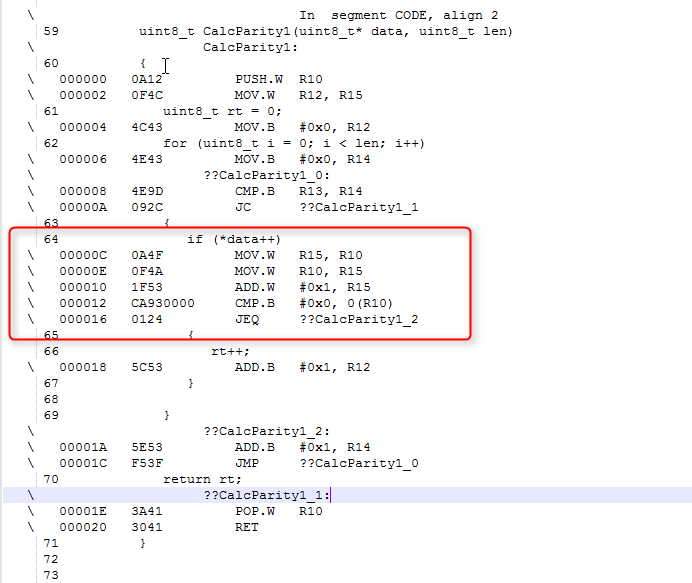
There are 32 execution codes totally. But in Example 2, there is 24 execution codes. The example 1 has a less source code, but the example 2 has a better performance with better reading.

See another example 3 below.
uint8_t CalcParity3(uint8_t* data, uint8_t len)

{

   uint8_t rt = ;

   for (uint8_t i = len; i > ; --i)

   {

      if (*data)

      {

         rt++;

      }

      ++data;

   }

   return rt;

}
It is my prefer solution. In most situations, it has a better performance than example 2. But there are same between example 2 and example 3 after checking assemble code at IAR MSP430. The IAR compiler did a good job.

It is also the recommendation of TI ULP Advisor.
" line 77: remark #1544-D: (ULP 13.1) Detected loop counting up. Recommend loops count down as detecting zeros is easier.
I list the rule13.1 here.
Rule 13.1 Count down in loops
What it means
In MSP430 assembly code, a conditional branch based on comparing a variable/register against a non-zero value requires two instructions: compare and branch. However, when branching & comparing against zero, a specific instruction, BNE, can be used to perform both actions. This also holds true for a branch statement in C. Hence a counting down loop can reduce one instruction for each iteration of the loop when compared to a loop counting up.
Risks, Severity
A counting-up loop consumes one extra instruction for every iteration of the loop.
Why it is happening
A loop with an index counting up is detected in the code.
Remedy
- Use a loop that counts down whenever possible.
- Ensure that -o2 optimization level is selected in the compiler, or greater implements are included in the project settings to enable optimization for counting down loops.
Code Example
int i;
P1OUT |= 0x01; // Set P1.0 LED on
for (i = 5000; i>0; i--) // Count down loop
// In instead of: (i = 0; i <5000; i++)
{
/* Execute your application code */
}
Avoiding post increase or decrease的更多相关文章
- Oracle 10g Block Change Tracking特性
Using Block Change Tracking to Improve Incremental Backup Performance 使用块改变跟踪改善增量备份的性能 The block cha ...
- Oracle 差异增量和累计增量备份
网址: http://www.eygle.com/digest/2009/04/oracle_rman_incremental_backup.html 在rman增量备份中,有差异增量和累积增量的概念 ...
- Garbage Collectors – Serial vs. Parallel vs. CMS vs. G1 (and what’s new in Java 8)
转自:http://blog.takipi.com/garbage-collectors-serial-vs-parallel-vs-cms-vs-the-g1-and-whats-new-in-ja ...
- 提高神经网络的学习方式Improving the way neural networks learn
When a golf player is first learning to play golf, they usually spend most of their time developing ...
- Chapter 6 — Improving ASP.NET Performance
https://msdn.microsoft.com/en-us/library/ff647787.aspx Retired Content This content is outdated and ...
- Garbage Collectors - Serial vs. Parallel vs. CMS vs. G1 (and what's new in Java 8)--转
The 4 Java Garbage Collectors - How the Wrong Choice Dramatically Impacts Performance The year is 20 ...
- Spark RDD Transformation 简单用例(二)
aggregateByKey(zeroValue)(seqOp, combOp, [numTasks]) aggregateByKey(zeroValue)(seqOp, combOp, [numTa ...
- USB ISP(ICSP) Open Programmer < PWM ADC HV PID >
http://sourceforge.net/projects/openprogrammer/?source=navbar Open Programmer http://openprog.alterv ...
- Oracle 块修改跟踪 (Block Change Tracking) 说明
Block ChangeTracking 是Oracle 10g里推出的特性.官网对Block change tracking 的定义如下: Adatabase option that causes ...
随机推荐
- Comparable和Comparator接口是干什么的?列出它们的区别。
Comparable和Comparator接口是干什么的?列出它们的区别. Java提供了只包含一个compareTo()方法的Comparable接口.这个方法可以个给两个对象排序.具体来说,它返回 ...
- 强化学习10-Deep Q Learning-fix target
针对 Deep Q Learning 可能无法收敛的问题,这里提出了一种 fix target 的方法,就是冻结现实神经网络,延时更新参数. 这个方法的初衷是这样的: 1. 之前我们每个(批)记忆都 ...
- C:基础知识
基础知识 一.基础转义字符 1.常用的转义字符 \n 回车换行 (10) \” 双引号 \t 横向跳格(9) \0 空字符(0) \v 竖向跳格 (11) \a 响铃(7) \b 退格 (8) \ ...
- 17 多校1 Add More Zero 水题
Problem Description There is a youngster known for amateur propositions concerning several mathemati ...
- 河南省第四届ACM省赛(T3) 表达式求值
表达式求值 时间限制:3000 ms | 内存限制:65535 KB 难度:3 描述 Dr.Kong设计的机器人卡多掌握了加减法运算以后,最近又学会了一些简单的函数求值,比如,它知道函数min ...
- hadoop day 3
1.map:局部处理:reduce:汇总 mapper对数据做切分,一份程序在不同的DataNode上独立运行对数据进行处理,reduce程序将所有DataNode上的统计数据进行汇总 Mapper& ...
- VMware虚拟机与主机共享文件夹
VMware也可以像docker容器那样"挂载"主机上的目录给虚拟机,在虚拟机上访问共享目录就跟访问自己的目录一样方便. 1. 虚拟机(M) -> 设置(S)-> 选项 ...
- 【转载】 Pytorch中的学习率调整lr_scheduler,ReduceLROnPlateau
原文地址: https://blog.csdn.net/happyday_d/article/details/85267561 ------------------------------------ ...
- 一种绕过PTRACE反调试的办法
Linux 系统gdb等调试器,都是通过ptrace系统调用实现.Android加固中,ptrace自身防止调试器附加是一种常用的反调试手段. 调试时一般需要手工在ptrace处下断点,通过修改ptr ...
- poj 1236 强联通分量
大致题意给你有一个点数为n<=100的有向图. 求解两个子任务: 1:最少给多少个点信息,这些点的信息可以顺着有向边传遍全图. 2:最少要加多少条边,使得整个图强联通. 求强联通分量再缩点后得到 ...