
变长编码表 ASCII代码等长编码
小结:
1、ASCII编码、GBK编码不是变长编码;
2、数据压缩;
示例:
aabacdab → 00100110111010 → |0|0|10|0|110|111|0|10| → aabacdab
3、变长编码:
符号-位长 映射;
https://en.wikipedia.org/wiki/Variable-length_code
https://baike.baidu.com/item/变长编码表
变长编码表是通过一种评估来源符号出现机率的方法得到的,出现机率高的字母使用较短的编码,反之出现机率低的则使用较长的编码,这便使编码之後的字串的平均长度、期望值降低,从而达到无失真压缩资料的目的。
Variable-length code
Jump to navigationJump to search
In coding theory a variable-length code is a code which maps source symbols to a variable number of bits.
Variable-length codes can allow sources to be compressed and decompressed with zero error (lossless data compression) and still be read back symbol by symbol. With the right coding strategy an independent and identically-distributed source may be compressed almost arbitrarily close to its entropy. This is in contrast to fixed length coding methods, for which data compression is only possible for large blocks of data, and any compression beyond the logarithm of the total number of possibilities comes with a finite (though perhaps arbitrarily small) probability of failure.
Some examples of well-known variable-length coding strategies are Huffman coding, Lempel–Ziv coding and arithmetic coding.
Contents
Codes and their extensions[edit]
The extension of a code is the mapping of finite length source sequences to finite length bit strings, that is obtained by concatenating for each symbol of the source sequence the corresponding codeword produced by the original code.
Using terms from formal language theory, the precise mathematical definition is as follows: Let {\displaystyle S}


Classes of variable-length codes[edit]
Variable-length codes can be strictly nested in order of decreasing generality as non-singular codes, uniquely decodable codes and prefix codes. Prefix codes are always uniquely decodable, and these in turn are always non-singular:
Non-singular codes[edit]
A code is non-singular if each source symbol is mapped to a different non-empty bit string, i.e. the mapping from source symbols to bit strings is injective.
- For example the mapping {\displaystyle M_{1}=\{\,a\mapsto 0,b\mapsto 0,c\mapsto 1\,\}}
is not non-singular because both "a" and "b" map to the same bit string "0" ; any extension of this mapping will generate a lossy (non-lossless) coding. Such singular coding may still be useful when some loss of information is acceptable (for example when such code is used in audio or video compression, where a lossy coding becomes equivalent to source quantization).
- However, the mapping {\displaystyle M_{2}=\{\,a\mapsto 1,b\mapsto 011,c\mapsto 01110,d\mapsto 1110,e\mapsto 10011,f\mapsto 0\}}
is non-singular ; its extension will generate a lossless coding, which will be useful for general data transmission (but this feature is not always required). Note that it is not necessary for the non-singular code to be more compact than the source (and in many applications, a larger code is useful, for example as a way to detect and/or recover from encoding or transmission errors, or in security applications to protect a source from undetectable tampering).
Uniquely decodable codes[edit]
A code is uniquely decodable if its extension is non-singular (see above). Whether a given code is uniquely decodable can be decided with the Sardinas–Patterson algorithm.
- The mapping {\displaystyle M_{3}=\{\,a\mapsto 0,b\mapsto 01,c\mapsto 011\,\}}
is uniquely decodable (this can be demonstrated by looking at the follow-set after each target bit string in the map, because each bitstring is terminated as soon as we see a 0 bit which cannot follow any existing code to create a longer valid code in the map, but unambiguously starts a new code).
- Consider again the code {\displaystyle M_{2}}
from the previous section. This code, which is based on an example found in,[1] is not uniquely decodable, since the string 011101110011 can be interpreted as the sequence of codewords 01110 – 1110 – 011, but also as the sequence of codewords 011 – 1 – 011 – 10011. Two possible decodings of this encoded string are thus given by cdb and babe. However, such a code is useful when the set of all possible source symbols is completely known and finite, or when there are restrictions (for example a formal syntax) that determine if source elements of this extension are acceptable. Such restrictions permit the decoding of the original message by checking which of the possible source symbols mapped to the same symbol are valid under those restrictions.
Prefix codes[edit]
A code is a prefix code if no target bit string in the mapping is a prefix of the target bit string of a different source symbol in the same mapping. This means that symbols can be decoded instantaneously after their entire codeword is received. Other commonly used names for this concept are prefix-free code, instantaneous code, or context-free code.
- The example mapping {\displaystyle M_{3}}
in the previous paragraph is not a prefix code because we don't know after reading the bit string "0" if it encodes an "a" source symbol, or if it is the prefix of the encodings of the "b" or "c" symbols.
- An example of a prefix code is shown below.
| Symbol | Codeword |
|---|---|
| a | 0 |
| b | 10 |
| c | 110 |
| d | 111 |
-
- Example of encoding and decoding:
- aabacdab → 00100110111010 → |0|0|10|0|110|111|0|10| → aabacdab
- Example of encoding and decoding:
A special case of prefix codes are block codes. Here all codewords must have the same length. The latter are not very useful in the context of source coding, but often serve as error correcting codes in the context of channel coding.
Another special case of prefix codes are variable-length quantity codes, which encode arbitrarily large integers as a sequence of octets -- i.e., every codeword is a multiple of 8 bits.
Advantages[edit]
The advantage of a variable-length code is that unlikely source symbols can be assigned longer codewords and likely source symbols can be assigned shorter codewords, thus giving a low expected codeword length. For the above example, if the probabilities of (a, b, c, d) were {\displaystyle \textstyle \left({\frac {1}{2}},{\frac {1}{4}},{\frac {1}{8}},{\frac {1}{8}}\right)}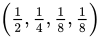
-
- {\displaystyle 1\times {\frac {1}{2}}+2\times {\frac {1}{4}}+3\times {\frac {1}{8}}+3\times {\frac {1}{8}}={\frac {7}{4}}}
.
- {\displaystyle 1\times {\frac {1}{2}}+2\times {\frac {1}{4}}+3\times {\frac {1}{8}}+3\times {\frac {1}{8}}={\frac {7}{4}}}
As the entropy of this source is 1.7500 bits per symbol, this code compresses the source as much as possible so that the source can be recovered with zero error.
Notes[edit]
- ^ Berstel et al. (2009), Example 2.3.1, p. 63
References[edit]
- Berstel, Jean; Perrin, Dominique; Reutenauer, Christophe (2010). Codes and automata. Encyclopedia of Mathematics and its Applications. 129. Cambridge: Cambridge University Press. ISBN 978-0-521-88831-8. Zbl 1187.94001. Draft available online
| hide
Data compression methods
|
|||||||
|---|---|---|---|---|---|---|---|
| Lossless |
|
||||||
| Audio |
|
||||||
| Image |
|
||||||
| Video |
|
||||||
| Theory | |||||||
变长编码表 ASCII代码等长编码的更多相关文章
- HTML中特殊字符和与之对应的ASCII代码
ASCII代码是说明了在html中每个特殊字符的属性以及字符的简要说明.在使用html时,如何把ASCII代码添加到网页中.例如版权符号'©'在html中可以通过 "©"来显示. ...
- Java 控制台输入数字 输出乘法表(代码练习)
最近,回忆了一些刚学习Java时经常练习的一些小练习题.感觉还是蛮有趣的,在回顾时想起好多学习时的经历和坎坷,一道小小的练习题要研究半天,珍重过往,直面未来.下面贡献代码,Java 控制台输入数字 输 ...
- 基于HTML5手机登录注册表单代码
分享一款基于HTML5手机登录注册表单代码.这是一款鼠标点击注册登录按钮弹出表单,适合移动端使用.效果图如下: 在线预览 源码下载 实现的代码. html代码: <div class=&qu ...
- 基于jQuery会员中心安全修改表单代码
基于jQuery会员中心安全修改表单代码.这是一款登录密码,交易密码,手机号码,实名认证,电子邮箱,安全设置表单,会员表单等设置代码.效果图如下: 在线预览 源码下载 实现的代码. html代码: ...
- 常用字符与ASCII代码对照表
常用字符与ASCII代码对照表 为了便于查询,以下列出ASCII码表:第128-255号为扩展字符(不常用) ASCII码 键盘 ASCII 码 键盘 ASCII 码 键盘 ASCII 码 键盘 27 ...
- [转]常用字符与ASCII代码对照表
常用字符与ASCII代码对照表 为了便于查询,以下列出ASCII码表:第128-255号为扩展字符(不常用) ASCII码 键盘 ASCII 码 键盘 ASCII 码 键盘 ASCII 码 键盘 27 ...
- 基于jQuery商品分类选择提交表单代码
分享一款基于jQuery商品分类选择提交表单代码.这是一款基于jQuery实现的商品信息选择列表表单提交代码. 在线预览 源码下载 实现的代码: <div class="yList ...
- Cheat Engine 作弊表框架代码
打开游戏 打开自动汇编 扫描的所有过程,这里就省略了 引用作弊表框架代码 查找使阳光减少的地址 拷贝这个地址 添加到自动汇编脚本里,并添加汇编指令 分配到当前作弊表 生成自动汇编脚本 进行激活测试 可 ...
- CSS样式表初始化代码
CSS为什么要初始化?建站老手都知道,这是为了考虑到浏览器的兼容问题,其实不同浏览器对有些标签的默认值是不同的,如果没对CSS初始化往往会出现浏览器之间的页面差异.当然,初始化样式会对SEO有一定的影 ...
随机推荐
- 每日英语:Who Needs to Know How to Code
Like many 10-year-olds, Nick Wald takes private lessons. His once-a-week tutor isn't helping him wit ...
- Ubuntu 卸载重装 IntelliJ Idea Community
参考: https://stackoverflow.com/questions/22983101/how-to-uninstall-intellij-idea-on-ubuntu-13-10 @SLH ...
- 带cookie跨域问题的思路以及echo的解决方案
问题起因 前后端分离,前端要访问后端资源,而且需要携带cookie信息,这时碰到了跨域问题.一开始以为设置为允许跨域allow_origins为即可.可是浏览器还是拦截的请求,于是查看跨域规则,原来跨 ...
- java.lang.String.regionMatches方法使用
regionMatches(boolean ignoreCase,int toffset,String other,int ooffset,int len): regionMatches(int to ...
- Java开发中Maven Jar包管理建议
Jar包管理规范 基于使用Git做版本控制,使用Jenkins做持续集成,以及Git-flow分支管理策略的情况: 带-SNAPSHOT为快照版本,例如1.0.0-SNAPSHOT 正式发布版本只有版 ...
- MAC下Myeclipse SVN插件安装
1.下载SVN插件包:http://download.csdn.net/detail/frankyanchen/4512899 2.在myeclipse文件夹下创建一个文件夹为svntool并复制下载 ...
- MTK 自定义系统服务
添加系统服务需要添加aidl,service,manager文件,需要修改SystemServer,Context,ContextImpl 下面举例进行说明,主要添加一个服务,用于获取系统时间和版本号 ...
- Kafka ACL使用实战
自0.9.0.0.版本引入Security之后,Kafka一直在完善security的功能.当前Kafka security主要包含3大功能:认证(authentication).信道加密(encry ...
- 系统信号(signal)与其他(定时器,退出清理等)
信号signal,可以用作进程线程通信,也可以用作接收中断后退出,退出时,清理资源,记录日志.python相关包为signa. linux信号表 root@server:~# kill -l ) SI ...
- day_6.7 py tcp
2018-6-7 09:20:34 #!/usr/bin/env python #!--*--coding:utf-8 --*-- #!@Time :2018/6/7 9:54 #!@Author T ...