
POJ1523 SPF[无向图割点]
| Time Limit: 1000MS | Memory Limit: 10000K | |
| Total Submissions: 8139 | Accepted: 3723 |
Description
Node 3 is therefore a Single Point of Failure (SPF) for this network. Strictly, an SPF will be defined as any node that, if unavailable, would prevent at least one pair of available nodes from being able to communicate on what was previously a fully connected network. Note that the network on the right has no such node; there is no SPF in the network. At least two machines must fail before there are any pairs of available nodes which cannot communicate. 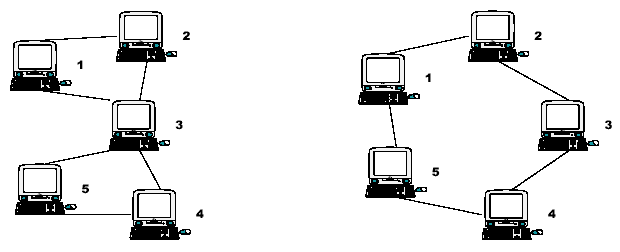
Input
Output
The first network in the file should be identified as "Network #1", the second as "Network #2", etc. For each SPF node, output a line, formatted as shown in the examples below, that identifies the node and the number of fully connected subnets that remain when that node fails. If the network has no SPF nodes, simply output the text "No SPF nodes" instead of a list of SPF nodes.
Sample Input
1 2

5 4

3 1

3 2

3 4

3 5

0

1 2

2 3

3 4

4 5

5 1

0

1 2

2 3

3 4

4 6

6 3

2 5

5 1

0

0
Sample Output
Network #1

  SPF node 3 leaves 2 subnets

Network #2

  No SPF nodes

Network #3

  SPF node 2 leaves 2 subnets

  SPF node 3 leaves 2 subnets
Source
cut vertex裸题,只不过求的是能分成几个subnets,使成为割点的子节点数+1就行(还有父辈们一个),注意root不能加1
//

//  main.cpp

//  poj1523

//

//  Created by Candy on 9/26/16.

//  Copyright © 2016 Candy. All rights reserved.

//

#include <iostream>

#include <cstdio>

#include <algorithm>

#include <cstring>

using namespace std;

const int N=1e3+,INF=1e9+;

inline int read(){

    char c=getchar();int x=,f=;

    while(c<''||c>''){if(c=='-')f=-;c=getchar();}

    while(c>=''&&c<=''){x=x*+c-'';c=getchar();}

    return x;

}

int n=,u,v,w,cas=;

struct edge{

    int v,ne;

}e[N*N];

int h[N],cnt=;

inline void ins(int u,int v){

    cnt++;

    e[cnt].v=v;e[cnt].ne=h[u];h[u]=cnt;

    cnt++;

    e[cnt].v=u;e[cnt].ne=h[v];h[v]=cnt;

}

int pre[N],sn[N],dc=;

int dfs(int u,int fa){

    int lowu=pre[u]=++dc,child=;

    for(int i=h[u];i;i=e[i].ne){

        int v=e[i].v;

        if(!pre[v]){

            child++;

            int lowv=dfs(v,u);

            lowu=min(lowu,lowv);

            if(lowv>=pre[u]) sn[u]++;//,printf("v %d %d\n",u,v);

        }else if(pre[v]<pre[u]&&v!=fa)

            lowu=min(lowu,pre[v]);

    }

    if(fa==-&&child==) sn[u]=;

    return lowu;

}

int main(int argc, const char * argv[]) {

    while((u=read())){

        int root=,flag=; n=;

        memset(h,,sizeof(h)); cnt=;

        memset(pre,,sizeof(pre));

        memset(sn,,sizeof(sn));

        v=read();

        ins(u,v);

        n=max(n,max(u,v));

        while((u=read())){

            v=read();

            ins(u,v);

            n=max(n,max(u,v)); root=u;

        }

        dfs(root,-);

        if(sn[root]!=) sn[root]--;

        printf("Network #%d\n",++cas);

        for(int i=;i<=n;i++) if(sn[i]){

            printf("  SPF node %d leaves %d subnets\n",i,sn[i]+);

            flag=;

        }

        if(!flag) printf("  No SPF nodes\n");

        printf("\n");

    }

    return ;

}
POJ1523 SPF[无向图割点]的更多相关文章
- POJ1523 SPF(割点模板)
题目求一个无向图的所有割点,并输出删除这些割点后形成几个连通分量.用Tarjan算法: 一遍DFS,构造出一颗深度优先生成树,在原无向图中边分成了两种:树边(生成树上的边)和反祖边(非生成树上的边). ...
- POJ 1523 SPF (无向图割点)
<题目链接> 题目大意: 给你一个连通的无向图,问你其中割点的编号,并且输出删除该割点后,原图会被分成几个连通分量. 解题分析: Tarjan求割点模板题. #include <cs ...
- tarkjan求无向图割点模板
#include<bits/stdc++.h> using namespace std; typedef long long ll; int n,m; ; ; struct node { ...
- POJ1144 Network 无向图割点
题目大意:求以无向图割点. 定义:在一个连通图中,如果把点v去掉,该连通图便分成了几个部分,则v是该连通图的割点. 求法:如果v是割点,如果u不是根节点,则u后接的边中存在割边(u,v),或者v-&g ...
- POJ1523:SPF(无向连通图求割点)
题目:http://poj.org/problem?id=1523 题目解析: 注意题目输入输入,防止PE,题目就是求割点,并问割点将这个连通图分成了几个子图,算是模版题吧. #include < ...
- poj 1523 SPF 无向图求割点
SPF Description Consider the two networks shown below. Assuming that data moves around these network ...
- SPF Tarjan算法求无向图割点(关节点)入门题
SPF 题目抽象,给出一个连通图的一些边,求关节点.以及每个关节点分出的连通分量的个数 邻接矩阵只要16ms,而邻接表却要32ms, 花费了大量的时间在加边上. // time 16ms 1 ...
- POJ 1523 SPF 求割点的好(板子)题!
题意: 给个无向图,问有多少个割点,对于每个割点求删除这个点之后会产生多少新的点双联通分量 题还是很果的 怎么求割点请参考tarjan无向图 关于能产生几个新的双联通分量,对于每个节点u来说,我们判断 ...
- POJ1523 SPF 单点故障
POJ1523 题意很简单,求删除割点后原先割点所在的无向连通图被分成了几个连通部分(原题说prevent at least one pair of available nodes from bein ...
随机推荐
- rem在响应式布局中的应用
rem/em/px/pt的基友关系 px 像素相对长度单位,相对于显示器屏幕分辨率而言 em 相对长度单位,根据其父元素来设置字体大小 pt point,是印刷行业常用单位,等于1/72英寸 rem ...
- JS 事件代理
事件处理器:onclick.onmouseover.... 在传统的事件处理中,你需要为每一个元素添加或者是删除事件处理器.然而,事件处理器将有可能导致内存泄露或者是性能下降——你用得越多这种风险就越 ...
- ae工具是一种特殊的命令
itool继承icommand,所以itool工具的调用类似于icommand,而icommand的调用主要是oncreate和onclick方法,oncreate需要传入事件执行的的对象,oncli ...
- 从angularJS看MVVM
javascript厚积薄发走势异常迅猛,导致现在各种MV*框架百家争雄,MVVM从MVC演变而来,为javascript注入了全新的活力.我工作的业务不会涉及到angularJS[ng]这么重量级的 ...
- XListView
第一步:到官网下载第三方包,拷贝到自己的项目中 https://github.com/Maxwin-z/XListView-Android 第二步:xml文件 <me.maxwin.view.X ...
- Swift-Switch穿透
switch vegetable { case "celery": print("Add some raisins and make ...
- 我的第一节Android课
我的第一节安卓课程,今天非比寻常的一天,我开始了我程序猿之路的第一节安卓课程,安卓课程只是我的一个兴趣班,我的本专业是java开发,因为喜欢做一个属于自己的一个手机APP,就选多个一样技能,毕竟十八般 ...
- 【代码笔记】iOS-点击一个button,出6个button
一,效果图. 二,工程图. 三,代码. RootViewController.h #import <UIKit/UIKit.h> //加入头文件 #import "DCPathB ...
- 【读书笔记】iOS网络-使用推送通知
一,本地通知 本地通知有64位的最大限制.虽然,你依然可以调度通知,不过到到达的通知数被限定为接近64个,并且按照fireDate的顺序排序,系统会忽略掉其余的通知.这意味着如果现在有64个调用的本地 ...
- CoreData的使用
#import "ViewController.h" #import "Person.h" @interface ViewController () <U ...