
java04异常处理课堂总结
一,动手动脑
1,请阅读并运行AboutException.java示例,然后通过后面的几页PPT了解Java中实现异常处理的基础知识。
import javax.swing.*;

class AboutException {

   public static void main(String[] a)

   {

      int i=1, j=0, k;

      //k=i/j;

    try

    {

        k = i/j;    // Causes division-by-zero exception

        throw new Exception("Hello.Exception!");

    }

    catch ( ArithmeticException e)

    {

        System.out.println("除0.  "+ e.getMessage());

    }

    catch (Exception e)

    {

        if (e instanceof ArithmeticException)

            System.out.println("除0");

        else

        {

            System.out.println(e.getMessage());

        }

    }

    finally

    {

             JOptionPane.showConfirmDialog(null,"OK");

     }

  }

}
运行测试

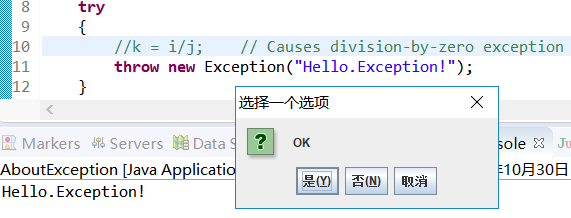
总结:
1,把可能会发生错误的代码放进try语句块中。
2,当程序检测到出现了一个错误时会抛出一个异常对象。异常处理代码会捕获并处理这个错误。 catch语句块中的代码用于处理错误。
3,当异常发生时,程序控制流程由try语句块跳转到catch语句块。
4,不管是否有异常发生,finally语句块中的语句始终保证被执行。
5,如果没有提供合适的异常处理代码,JVM将会结束掉整个应用程序。
2,阅读以下代码(CatchWho.java),写出程序运行结果:
public class CatchWho {

    public static void main(String[] args) {

        try {

                try {

                    throw new ArrayIndexOutOfBoundsException();

                }

                catch(ArrayIndexOutOfBoundsException e) {

                       System.out.println(  "ArrayIndexOutOfBoundsException" +  "/内层try-catch");

                }

            throw new ArithmeticException();

        }

        catch(ArithmeticException e) {

            System.out.println("发生ArithmeticException");

        }

        catch(ArrayIndexOutOfBoundsException e) {

           System.out.println(  "ArrayIndexOutOfBoundsException" + "/外层try-catch");

        }

    }

}
运行测试
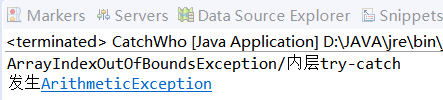
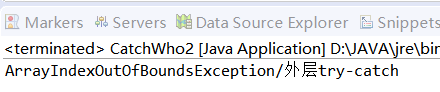
写出CatchWho2.java程序运行的结果
public class CatchWho2 {

    public static void main(String[] args) {

        try {

                try {

                    throw new ArrayIndexOutOfBoundsException();

                }

                catch(ArithmeticException e) { //不同

                    System.out.println( "ArrayIndexOutOfBoundsException" + "/内层try-catch");

                }

            throw new ArithmeticException(); //没有运行

        }

        catch(ArithmeticException e) {

            System.out.println("发生ArithmeticException");

        }

        catch(ArrayIndexOutOfBoundsException e) {

            System.out.println( "ArrayIndexOutOfBoundsException" + "/外层try-catch");

        }

    }

}
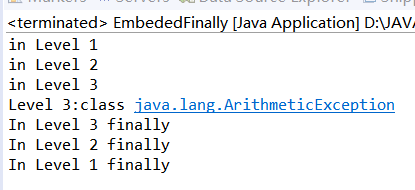
请先阅读 EmbedFinally.java示例,再运行它,观察其输出并进行总结。
public class EmbededFinally {

    public static void main(String args[]) {

        int result;

        try {

            System.out.println("in Level 1");

             try {

                System.out.println("in Level 2");

  // result=100/0;  //Level 2

                 try {

                     System.out.println("in Level 3");

                     result=100/0;  //Level 3

                }

                catch (Exception e) {

                    System.out.println("Level 3:" + e.getClass().toString());

                }

                finally {

                    System.out.println("In Level 3 finally");

                }

                // result=100/0;  //Level 2

                }

            catch (Exception e) {

                 System.out.println("Level 2:" + e.getClass().toString());

             }

             finally {

                System.out.println("In Level 2 finally");

             }

            // result = 100 / 0;  //level 1

        }

        catch (Exception e) {

            System.out.println("Level 1:" + e.getClass().toString());

        }

        finally {

             System.out.println("In Level 1 finally");

        }

    }

}
辨析:finally语句块一定会执行吗?请通过 SystemExitAndFinally.java示例程序回答上述问题
public class SystemExitAndFinally {

    public static void main(String[] args){

        try{

            System.out.println("in main");

            throw new Exception("Exception is thrown in main");

                    //System.exit(0);

        }catch(Exception e)

            {

            System.out.println(e.getMessage());

            System.exit(0);

        }

        finally

        {

            System.out.println("in finally");

        }

    }

}
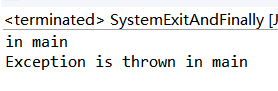
多层异常捕获总结:
1,当有多个嵌套的try…catch…finally时,try是从最外层向最里层依次执行,finally是从最里层向最外层依次执行(类似于栈:try=入栈,finally=出栈)。
2,当有多层嵌套的finally时,异常在不同的层次抛出,在不同的位置抛出,可能会导致不同的finally语句块执行顺序。
3,try-catch-finally相互嵌套时,先处理最内层的try-catch-finally。当try抛出了与catch匹配的异常,则代码到相应的catch()中执行。如果catch也出现了异常,程序会检测finally中是否有异常,若有,则覆盖。如果只有try-finally,那么先执行finally,如果finally没有异常,则返回处理try中的异常,如果finally有异常,则覆盖try中的异常
4,finally语句块不一定会执行(如:System.exit(0);强行在finally之前终止程序运行)。
java04异常处理课堂总结的更多相关文章
- 课堂动手动脑验证以及自定义异常类实现对异常处理——java异常类
异常(exception):发生在程序执行期间,表明出现了一个非法运行的情况.许多JDK中的方法在检测到非法情况时,都会抛出一个异常对象.例如:数组越界和被0除. 代码验证: package test ...
- Java中的异常处理try catch(第八周课堂示例总结)
异常处理 使用Java异常处理机制: 把可能会发生错误的代码放进try语句块中. 当程序检测到出现了一个错误时会抛出一个异常对象. 异常处理代码会捕获并处理这个错误. catch语句块中的代码用于处理 ...
- java-04类和对象课堂练习
1.请运行并输入以下代码,得到什么结果 public class Test { public static void main(String[] args){ Foo obj1=new Foo(); ...
- 小D课堂 - 零基础入门SpringBoot2.X到实战_第4节 Springboot2.0单元测试进阶实战和自定义异常处理_17、SpringBootTest单元测试实战
笔记 1.@SpringBootTest单元测试实战 简介:讲解SpringBoot的单元测试 1.引入相关依赖 <!--springboot程 ...
- java课堂作业--异常处理
一. 运行结果: 二. 结果: ArrayIndexOutOfBoundsException/内层try-catch 发生ArithmeticException 三. 结果: ArrayIndexOu ...
- 小课堂Week10 例外处理设计的逆袭Part3
小课堂Week10 例外处理设计的逆袭Part3 今天是<例外处理设计的逆袭>这本书阅读的第三天,也是最后一天,我们会主要通过实例,对Part2中提出的例外处理等级进行解读. Level1 ...
- 小课堂Week9 例外处理设计的逆袭Part2
小课堂Week9 例外处理设计的逆袭Part2 今天继续阅读<例外处理设计的逆袭>这本书,我们先看两个案例: 案例1 问:如果要设计一个依据学号到数据库中查询学生资料的函数,当找不到符合条 ...
- Spark小课堂Week4 从控制台看Spark逻辑结构
Spark小课堂Week4 从控制台看Spark逻辑结构 层级关系: 从监控控制台,我们可以看到如下关系: 一个 Job 包含 n Stage 一个 Stage 包含 n Task Job0解决什么问 ...
- 异常处理第一讲(SEH),筛选器异常,以及__asm的扩展,寄存器注入简介
异常处理第一讲(SSH),筛选器异常,以及__asm的扩展 博客园IBinary原创 博客连接:http://www.cnblogs.com/iBinary/ 转载请注明出处,谢谢 一丶__Asm的 ...
随机推荐
- jquery源码部分分析
1.整体架构和如何辨别浏览器端和node端 自执行函数,判断在什么端,如果在浏览器端就执行factory函数 //(function(){a,b})(a,b) //jq大架构,闭包,自执行函数,传入函 ...
- 题解 P2801 【教主的魔法】
分块入门题,不错的,建议大家做一做 开始学习 先看一下数列分块入门 2 这道题想让我们求区间[l,r]>=c的个数,然后我们可以看到"数列分块入门 2"是求区间[l,r]&l ...
- 1_01_MSSQL课程_基础入门
0. 课程安排: 课程共7天课,前两天SQL基础,后面三天Ado.Net ,最后两天数据库高级进阶学习. 1.数据库的概念 ->数据库就是数据仓库. ->DBMS:数据库管理系统.SQLS ...
- Ubuntu系统配置Zabbix前端及中文乱码解决方案
Ubuntu系统配置Zabbix前端及中文乱码解决方案 作者:尹正杰 版权声明:原创作品,谢绝转载!否则将追究法律责任. 一.安装zabbix 博主推荐阅读: https://www.cnblogs ...
- PAT (Advanced Level) 1144~1147:1145Hash二次探查 1146拓扑排序 1147堆
1144 The Missing Number(20 分) 题意:给定N个数的序列,输出不在序列中的最小的正整数. 分析: 1.给定的N个数可能为正,可能为负,可能重复. 2.由于N≤105,所 ...
- Hexo搭建个人博客及next主题基本配置
前言 国内一些免费的博客平台比如CSDN.博客园都已经很成熟,功能齐全,已经可以满足我们的需求,帮助我们记录学习过程遇到的问题,还能分享帮助其他人解决问题.为什么还要自己动手去搭建博客呢?首先写博客是 ...
- ThinkPhp3.2.3缓存漏洞复现以及修复建议
小编作为一个php(拍黄片)的程序员,今天早上无意间看到thinkphp的缓存漏洞,小编在实际开发过程中用thinkphp3.2.3挺多的. 我们这里来复现一下漏洞 后面我会提出修复建议 首先我们下载 ...
- tp5日志分表
/** * 记录网站日志 * * @return bool */ public function record() { // 组装数据 $log = self::$param; $log[self:: ...
- 洛谷P2089 烤鸡
标签:暴力,枚举 题目背景 猪猪 Hanke 得到了一只鸡. 题目描述 猪猪 Hanke 特别喜欢吃烤鸡(本是同畜牲,相煎何太急!)Hanke 吃鸡很特别,为什么特别呢?因为他有 10 种配料(芥末. ...
- Linux下安装JDK及其碰到的问题解决
1.下载一个linux版本的jdk包 2.新建一个目录,专门用来存放安装包 mkdir /home/software 3.将jdk包拷贝到/home/software下面,并解压 4.配置jdk ...