
Ordering Cows
题意描述
好像找不到链接(找到了请联系作者谢谢),所以题目描述会十分详细:
Problem 1: Ordering Cows [Bruce Merry, South African Computer Olympiad, 2003]
Farmer John has noticed that when his N (1 <= N <= 1,500) cows line up to be milked, certain cows always line up ahead of certain other cows. He has made a list of L (1 <= L <= 10,000) pairs of cows for which he has noticed this. He wants to send this list to his friend, Farmer Bob. Unfortunately, the inter-farm cowmunication network is very slow.
FJ has realized that he can compress the list by removing redundant information. The information he has is all of the form "cow A lines up before cow B". Information is redundant if it can be deduced from
other information on the list. For example, given "Alice is before Betty", "Betty is before Carol" and "Alice is before Carol" the last statement is redundant. Of course, the cows are numbered with unique serial numbers in the range 1..N; only a few of them have names (and those are not used here).Help Farmer John by finding the smallest subset of his list from which the rest of the list can be deduced. Happily, the answer is guaranteed to be unique, and the original list contains no contradictions such as "Alice before Betty" and "Betty before Alice".
PROBLEM NAME: order
INPUT FORMAT:
Line 1: Two space-separated integers: N and L.
Lines 2..L+1: Two integers X and Y (1 <= X,Y <= N), indicating that cow X lines up before cow Y. No fact is duplicated.
SAMPLE INPUT (file order.in):
5 6
3 5
4 2
5 2
2 1
3 1
4 1OUTPUT FORMAT:
Line 1: A single line with the number of facts that Farmer John will send to Farmer Bob.
Lines 2..U+1: The facts from the input file that Farmer John will transmit. These must be lists in the same format as the entries in the input file. They must be sorted numerically on the first entry in the line, with ties being broken by the second entry on the line.
SAMPLE OUTPUT (file order.out):
4
2 1
3 5
4 2
5 2OUTPUT DETAILS:
The facts "cow 3 before cow 1" and "cow 4 before cow 1" can be deduced from the 4 facts listed in the output. However, none of the output facts can be deduced from the others.
给你关于 \(N\) 个数的 \(L\) 对大小关系,其中关系 x y 表示 x>y。
如果有关系 x y 与关系 y z 那么显然关系 x z 是不必要的。
求出这 \(L\) 对关系中的最少必要关系。(即通过省下的这些关系可以推出被删去的关系)
写出其数量并按照以数字一为主关键字,以数字二为次关键字的顺序从小到大输出。
算法分析
类似传递闭包,但是这里要求你排除冗余的关系。
那么显然,如果我们可以确定一个顺序,保证后面的关系不会影响前面的关系。
那么只需要从前往后扫一遍,遇到多余的关系排除即可。(因为只有前面的关系可能影响后面的关系)
排除的方法之后再说。
确定方法的关系:
- 将每个关系当做有向边建图,易证这是个 DAG 图。
- 将此图拓扑排序,按照拓扑排序的顺序给各个节点从小到大赋值。
- 按照每个关系的数字一拓扑值从大到小为主关键字,数字二拓扑值从小到大为次关键字排序。
- 所得即上面所说的遍历顺序。
解释一下,我们给每个节点赋予一个 ”贡献值“,表示其对其它节点的影响力。
那么显然影响大的边要先考虑(这也符合上面的顺序)。
易得,拓扑值大的节点影响力也大,所以以其从大到小为主关键字。
但是,当从同一个点出发考虑关系时,就应当优先考虑拓扑值小的,理由如下:
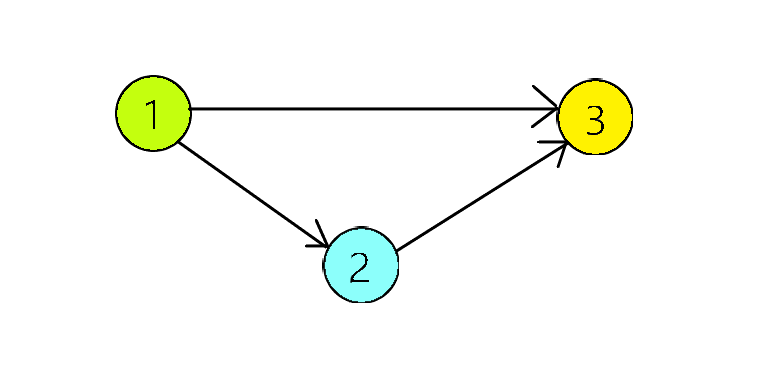
那么显然只有按照以从小到大为次关键字,才能将关系 1 3 排除。
然后就按照这个顺序往后排查即可,具体方法为状压 DP。
但是由于节点数量很多,所以要用到 C++ STL 的 bitset。
假设有关系 \(x\to y\),如果 \(bits(x,y)\) 这个关系为多余关系。
否则 \(bits(x)|=bits(y)\)。
代码实现
#include<cstdio>

#include<cstring>

#include<algorithm>

#include<iostream>

#include<cmath>

#include<bitset>

#include<queue>

#define N 1510

#define M 10010

using namespace std;

int n,m,head[N],cnt=0;

int ru[N],Topo[N],tot=0;

struct Edge{

	int nxt,to,frm;

}ed[M];

struct Ans{

	int u,v;

}ans[M];

bitset<N>bits[N];

queue<int>q;

int read(){

	int x=0,f=1;char c=getchar();

	while(c<'0' || c>'9') f=(c=='-')?-1:1,c=getchar();

	while(c>='0' && c<='9') x=x*10+c-48,c=getchar();

	return x*f;

}

void add(int u,int v){

	ed[++cnt].nxt=head[u];

	ed[cnt].frm=u;

	ed[cnt].to=v;

	head[u]=cnt;

	return;

}

void topo(){

	for(int i=1;i<=n;i++)

		if(!ru[i]) q.push(i);

	while(!q.empty()){

		int u=q.front();q.pop();

		Topo[u]=++tot;

		for(int i=head[u];i;i=ed[i].nxt)

			if(!--ru[ed[i].to]) q.push(ed[i].to);

	}

	return;

}

bool cmp(Edge a,Edge b){

	if(a.frm!=b.frm)

		return Topo[a.frm]>Topo[b.frm];

	return Topo[a.to]<Topo[b.to];

}

bool cnp(Ans a,Ans b){

	if(a.u!=b.u) return a.u<b.u;

	return a.v<b.v;

}

int main(){

	//freopen("order.in","r",stdin);

	//freopen("order.out","w",stdout);

	memset(ru,0,sizeof(ru));

	n=read(),m=read();

	for(int i=1;i<=m;i++){

		int u=read(),v=read();

		add(u,v);++ru[v];

	}

	topo();//简简单单的拓扑排序。

	sort(ed+1,ed+m+1,cmp);

	for(int i=1;i<=n;i++)

		bits[i][i]=true;//预处理。

	tot=0;

	for(int i=1;i<=m;i++){

		int u=ed[i].frm,v=ed[i].to;

		if(bits[u][v]) continue;

		bits[u]=bits[u]|bits[v];//DP。

		ans[++tot]=(Ans){u,v};

	}

	sort(ans+1,ans+tot+1,cnp);

	printf("%d\n",tot);

	for(int i=1;i<=tot;i++)

		printf("%d %d\n",ans[i].u,ans[i].v);

	//fclose(stdin);fclose(stdout);

	return 0;

}
完结撒花。
Ordering Cows的更多相关文章
- DP百题练(二)
目录 DP百题练(二) 区间 DP NOI1995 石子合并 IOI1998 Polygon CH5302 金字塔 USACO06FEB Treats for the Cows G/S LG1043 ...
- [poj2182] Lost Cows (线段树)
线段树 Description N (2 <= N <= 8,000) cows have unique brands in the range 1..N. In a spectacula ...
- Lost Cows
Time Limit: 1000MS Memory Limit: 65536K Total Submissions: 9669 Accepted: 6228 Description N (2 ...
- Lost Cows(线段树 POJ2182)
Lost Cows Time Limit: 1000MS Memory Limit: 65536K Total Submissions: 10354 Accepted: 6631 Descriptio ...
- POJ 2182 Lost Cows
Time Limit: 1000MS Memory Limit: 65536K Total Submissions: 10996 Accepted: 7059 Description N (2 ...
- HDU-2711 Lost Cows
Lost Cows Time Limit: 2000/1000 MS (Java/Others) Memory Limit: 32768/32768 K (Java/Others) Total ...
- Lost Cows(BIT poj2182)
Lost Cows Time Limit: 1000MS Memory Limit: 65536K Total Submissions: 10609 Accepted: 6797 Descri ...
- POJ 2182 Lost Cows(牛排序,线段树)
Language: Default Lost Cows Time Limit: 1000MS Memory Limit: 65536K Total Submissions: 9207 Acce ...
- poj 2182 Lost Cows(段树精英赛的冠军)
主题链接:http://poj.org/problem? id=2182 Lost Cows Time Limit: 1000MS Memory Limit: 65536K Total Submi ...
随机推荐
- Python-输入输出-input ouput
输入.输出? 这种统称为IO流,也就是数据流向,在标准中,从终端输入称为标准输入 sidin,从终端输出为标准输出 stdout,从终端错误输出则为标准错误输出 stderr.这些只是IO流中终端方面 ...
- 一道web入门题
9月27日00:00 这道题是我将hctf_warmup魔改之后得到的,难度比较低,主要还是讲一些web相关的思考方式,所以这篇文章会比较冗长过于详细.(毕竟是给小姑娘入门看的23333).就当M1s ...
- angularCroppie
下载 angularCroppieangularCroppie 图像Cropper使用Croppie 安装 Npm: Npm安装角croppie 使用 添加依赖项:angular.模块("m ...
- 洛谷 P3413 【萌数】
敲完这篇题解,我就,我就,我就,嗯,好,就这样吧... 思路分析: 首先我们要知道一个回文串的性质--假如说一个[l-1,r+1]的串是回文的,那么[l,r]一定也是回文的. 所以我们只要记录前一个数 ...
- .Net Core 读取,导入 excel数据 officeopenxml
/// <summary> /// 导出Excel /// </summary> /// <param name="path">路径</p ...
- swoole父进程和子进程之间通信的例子
<?php /** 这是一个swoole父进程和子进程之间通信的例子 */ //进程创建成功后回调处理 function handle(swoole_process $worker){ //从进 ...
- 在实际开发中Java中enum的用法
在日常项目的开发中,往往会存在一些固定的值,而且"数据集"中的元素是有限的. 例如:st_code// 一些状态机制:01-激活 02-未激活 03 -注册..等等 还有一特性 ...
- java怎么产生随机数
随机数的产生在一些代码中很常用,也是我们必须要掌握的.而java中产生随机数的方法主要有三种: 第一种:new Random() 需要借助java.util.Random类来产生一个随机数发生器,也是 ...
- HDU - 6736 F - Forest Program
题意 给你n个点m条边,并且保证整个图是仙人掌. 仙人掌:每条边仅属于1条或者0条回路 且无重边和自环 让你删掉一些边使其变成一棵树(拥有点数-1条边) 注意一个点也是森林 图可能是不联通的 思路 考 ...
- 骨架屏(page-skeleton-webpack-plugin)初探
作者:小土豆biubiubiu 博客园:https://www.cnblogs.com/HouJiao/ 掘金:https://juejin.im/user/2436173500265335 微信公众 ...