
Linux graphics stack
2D图形架构
早期Linux图形系统的显示全部依赖X Server,X Client调用Xlib提供的借口向 X Server发送渲染命令,X Server根据 X Client的命令请求向硬件设备绘制图形,X Client与X Server之间通过X11协议通讯。通过这种方式,X Server屏蔽了所有的硬件差异,保证同一个X程序能够在不同的硬件设备上运行。
X Server需要与多种多样的硬件打交道,每个硬件提供自己的DDX驱动程序,X Server最后调用DDX的接口将图形发送给硬件设备。

3D图形架构
通过3D硬件执行3D加速能够大大提高绘制效率,根据不同的模式有两种架构:
Indirect Rendering
这种模式下,仅仅X Server能够访问3D硬件设备,X Client需要绘图时通过X11扩展协议将3D命令发送给X Server,然后由X Server控制3D硬件设备执行,这种模式称为“非直接渲染”。
这种模式与2D模式类似。
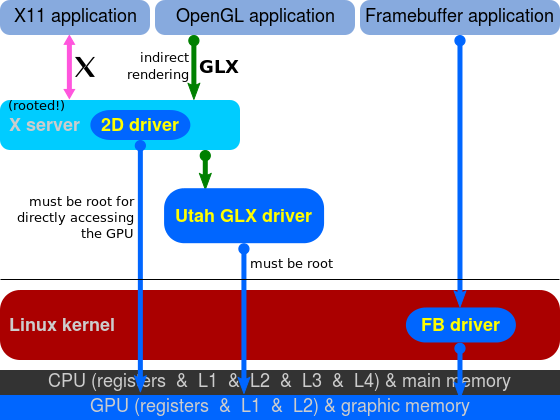
但是这种模式无法发挥出3D硬件的效率
Direct Rendering
DRI(Direct Rendering Infrastructure)架构允许X Client直接控制3D硬件设备,所以这种模式下要求X Client与X Server必须位于同一个设备上。
DRM(Direct Rendering Manager)是DRI架构下的Kernel实现,DRM负责:hardware locking, access synchronization, video memory and more.
DRM also provides userspace with an API that it can use to submit commands and data in a format that is adequate for modern GPUs, which effectively allows userspace to communicate with the graphics hardware.
Notice that many of these things have to be done specifically for the target hardware so there are different DRM drivers for each GPU.
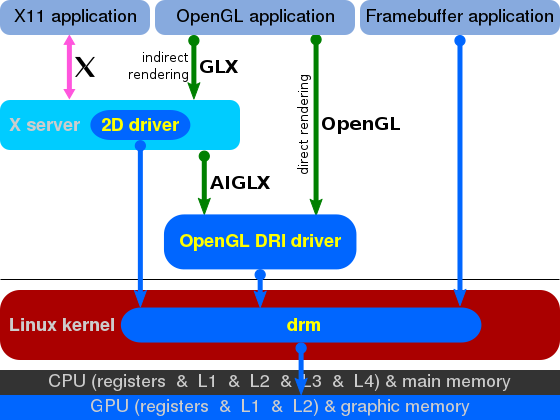
DRI/DRM provide the building blocks that enable userspace applications to access the graphics hardware directly in an efficient and safe manner, but in order to use OpenGL we need another piece of software that, using the infrastructure provided by DRI/DRM, implements the OpenGL API while respecting the X server requirements.
Mesa
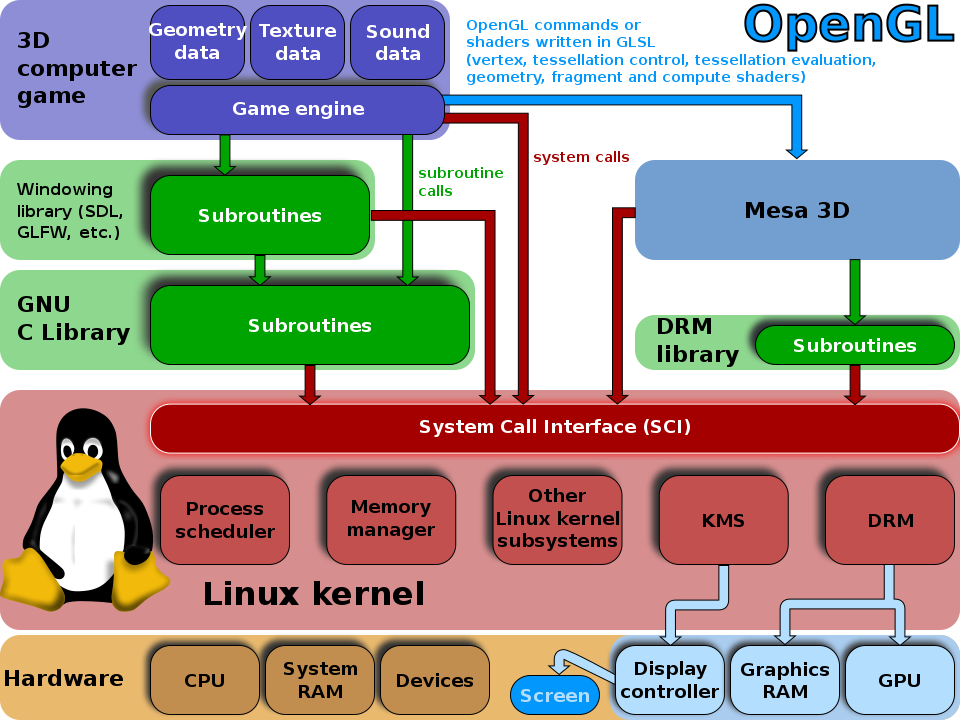
Mesa is a free software implementation of the OpenGL specification, and as such, it provides a libGL.so, which OpenGL based programs can use to output 3D graphics in Linux. Mesa can provide accelerated 3D graphics by taking advantage of the DRI architecture to gain direct access to the underlying graphics hardware in its implementation of the OpenGL API.
When our 3D application runs in an X11 environment it will output its graphics to a surface (window) allocated by the X server. Notice, however, that with DRI this will happen without intervention of the X server, so naturally there is some synchronization to do between the two, since the X server still owns the window Mesa is rendering to and is the one in charge of displaying its contents on the screen. This synchronization between the OpenGL application and the X server is part of DRI. Mesa’s implementation of GLX (the extension of the OpenGL specification that addresses the X11 platform) uses DRI to talk to the X server and accomplish this.
Mesa also has to use DRM for many things. Communication with the graphics hardware happens by sending commands (for example “draw a triangle”) and data (for example the vertex coordinates of the triangle, their color attributes, normals, etc). This process usually involves allocating a bunch of buffers in the graphics hardware where all these commands and data are copied so that the GPU can access them and do its work. This is enabled by the DRM driver, which is the one piece that takes care of managing video memory and which offers APIs to userspace (Mesa in this case) to do this for the specific target hardware. DRM is also required whenever we need to allocate and manage video memory in Mesa, so things like creating textures, uploading data to textures, allocating color, depth or stencil buffers, etc all require to use the DRM APIs for the target hardware.
引用原文:https://blogs.igalia.com/itoral/2014/07/29/a-brief-introduction-to-the-linux-graphics-stack/
Linux graphics stack的更多相关文章
- Monitoring and Tuning the Linux Networking Stack: Receiving Data
http://blog.packagecloud.io/eng/2016/06/22/monitoring-tuning-linux-networking-stack-receiving-data/ ...
- Queueing in the Linux Network Stack !!!!!!!!!!!!!!!
https://www.coverfire.com/articles/queueing-in-the-linux-network-stack/ Queueing in the Linux Networ ...
- Linux Storage Stack Diagram存储堆栈图
这是一个描述非常好的存储栈,版本为:Linux Storage Stack Diagram v4.10,我在这里转载下图片,可以提升大家对存储栈的理解. https://www.thomas-kren ...
- Linux Kernel Stack
整理一些杂乱的内容.以下x86架构. Linux 内核栈大小 内核栈大小是固定的,默认为8k,曾经有选项可以设置为4k栈.由于大小固定,申请过大的栈内存,或者函数调用层次过深,都可能导致栈溢出. 关注 ...
- 《Monitoring and Tuning the Linux Networking Stack: Receiving Data》翻译
Overview 从宏观的角度来看,一个packet从网卡到socket接收缓冲区的路径如下所示: 驱动加载并初始化 packet到达网卡 packet通过DMA被拷贝到内核中的一个ring buff ...
- The Linux Storage Stack Diagram
相关文章: 如何提高Linux下块设备IO的整体性能?
- linux io stack
- The Linux Storage Stack Diagram 内核 4.0 版的 I/O 栈
- Linux Storage Stack Diagram 4.0
https://www.thomas-krenn.com/en/wiki/Linux_Storage_Stack_Diagram
随机推荐
- PIE模型
首先,我们需要明确程序的Bug有如下的定义: 1. Fault/Defect 静态的,存在于软件中的缺陷.例如:一段有缺失或者错误的代码. 2. Error 运行时一种不正确的中间状态. 3. Fai ...
- Could not transfer artifact org.apache.maven.plugins:maven-clean-plugin:pom:2.5 from 这类问题的解决方法
最近换了台电脑,所以重新在IEDA上搭建Spring Boot环境,遇到一个问题,网上查了很久,又实践了一通,终于解决,这里把步骤详细记录下来. 问题描述:创建IDEA的Maven项目后,出现 Mav ...
- A - Promotions
题目详见http://7xjob4.com1.z0.glb.clouddn.com/3f644de6844d64706eb36baa3a0c27b0 这题是普通的拓扑排序,要把每一层的都保存下来. # ...
- hdu1263 水果
Problem Description 夏天来了~~好开心啊,呵呵,好多好多水果~~ Joe经营着一个不大的水果店.他认为生存之道就是经营最受顾客欢迎的水果.现在他想要一份水果销售情况的明细表,这样J ...
- UVA-257 哈希算法
UVA-257 题意: 给你很多串,你需要找到这个串内有没有两个长度大于3的回文字符串,且要保证这两个回文字符串不相同,也不能完全覆盖,但可以重合一部分 题解: 首先判断回文的话可以通过马拉车算法(M ...
- JavaScript——四
引用案例:事件只能执行一次 array里面都是事件对象 点击box3区域时,则会有事件冒泡现象,即:box3响应后,box2(比他大一节)的区域,box1(比box2大一级)相应出现响应事件现象 捕获 ...
- OpenStack Train版-10.安装neutron网络服务(网络节点:可选)
可选:安装neutron网络服务节点(neutron01网络节点192.168.0.30)网络配置按照官网文档的租户自助网络 配置系统参数 echo 'net.ipv4.ip_forward = 1' ...
- windows7 更新失败,无法开机处理方法
记录一次今天同事笔记本无法开机的故障处理 windows7系统,安装更新失败,无法开机,卡在配置更新界面 处理方法,强制关机,开机按F8,进入安全模式,安全模式还会卡在配置更新界面,但是卡一会会进入系 ...
- Cron表达式在 定时执行专家 5.0 中的使用方式
在<定时执行专家 V5.0>程序内部使用了包含 6 位的 Cron表达式,第一个字段(second)没有使用.程序内部一直 second 位是 0.在 Cron表达式的界面上可以设置 5位 ...
- 操作系统 part1
实验好多,人好累... 一.进程和线程 references: 进程三种基本状态 进程和线程的概念.区别和联系 进程和线程的主要区别(总结) 进程间通信IPC 1.进程 进程,是资源分配和调度的基本单 ...