
Kafka的3节点集群详细启动步骤(Zookeeper是外装)
首先,声明,kafka集群是搭建在hadoop1、hadoop2和hadoop3机器上。
kafka_2.10-0.8.1.1.tgz的1或3节点集群的下载、安装和配置(图文详细教程)绝对干货
如下分别是各自的配置信息。(网上说,还需要配置zookeeper.properties,其实不需要,因为,zookeeper集群那边已经配置好了。)

[hadoop@hadoop1 config]$ pwd

/home/hadoop/kafka/config

[hadoop@hadoop1 config]$ ll

total

-rw-r--r--  hadoop hadoop  Sep     consumer.properties

-rw-r--r--  hadoop hadoop  Sep     log4j.properties

-rw-r--r--  hadoop hadoop  Sep     producer.properties

-rw-r--r--  hadoop hadoop  May   : server.properties

-rw-r--r--  hadoop hadoop  Sep     test-log4j.properties

-rw-r--r--  hadoop hadoop   Sep     tools-log4j.properties

-rw-r--r--  hadoop hadoop  Sep     zookeeper.properties

[hadoop@hadoop1 config]$ vim server.properties
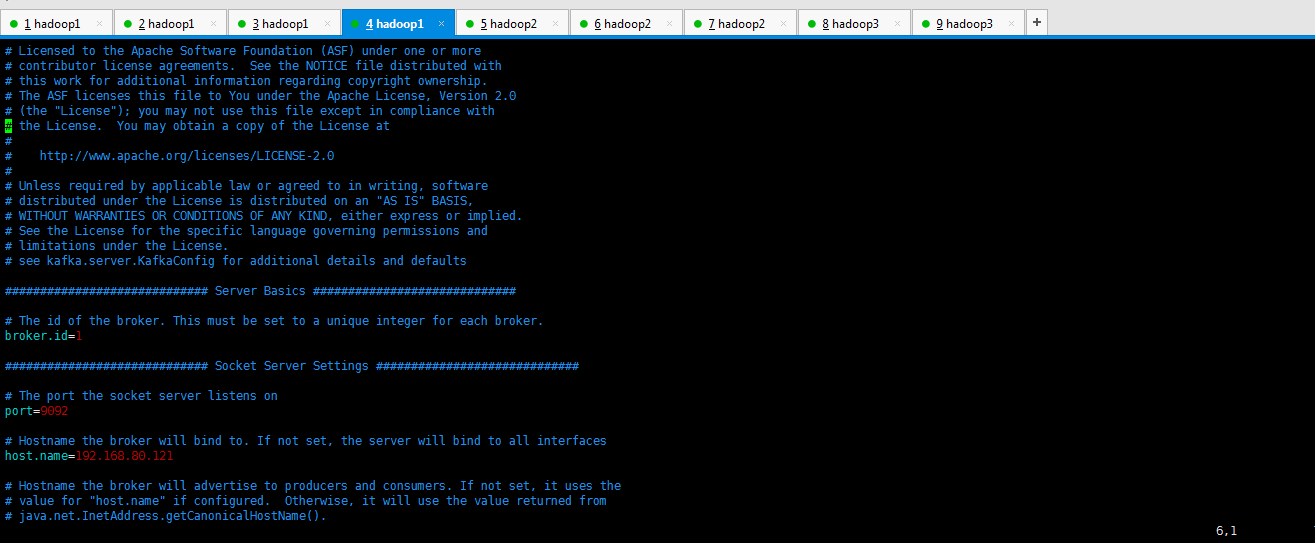
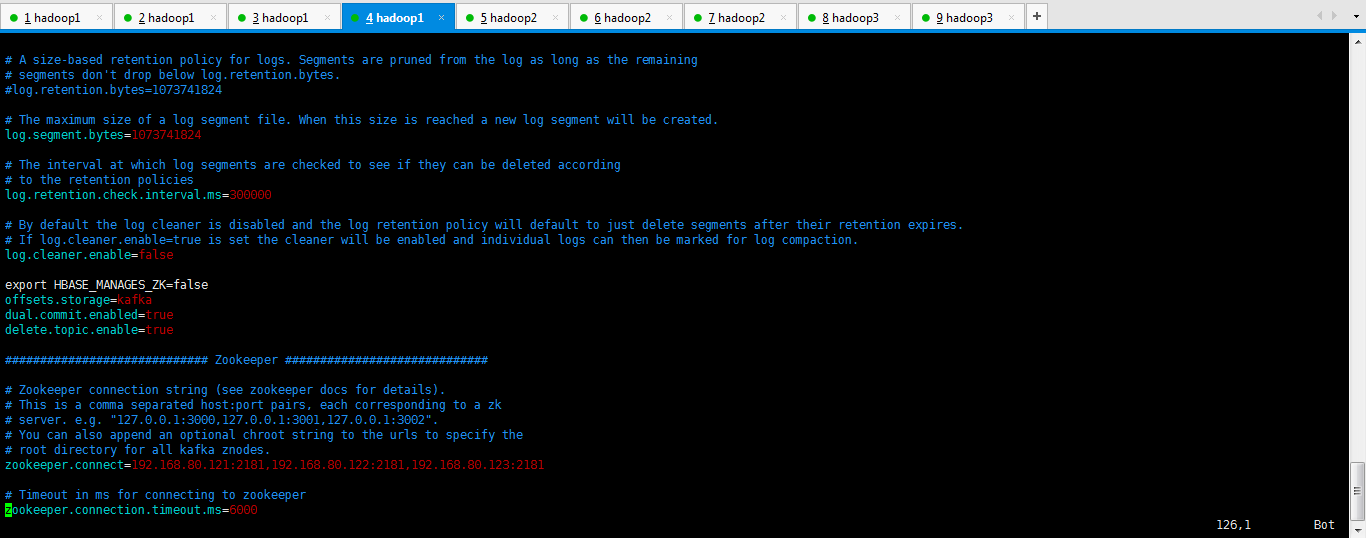
# Licensed to the Apache Software Foundation (ASF) under one or more

# contributor license agreements.  See the NOTICE file distributed with

# this work for additional information regarding copyright ownership.

# The ASF licenses this file to You under the Apache License, Version 2.0

# (the "License"); you may not use this file except in compliance with

# the License.  You may obtain a copy of the License at

#

#    http://www.apache.org/licenses/LICENSE-2.0

#

# Unless required by applicable law or agreed to in writing, software

# distributed under the License is distributed on an "AS IS" BASIS,

# WITHOUT WARRANTIES OR CONDITIONS OF ANY KIND, either express or implied.

# See the License for the specific language governing permissions and

# limitations under the License.

# see kafka.server.KafkaConfig for additional details and defaults

############################# Server Basics #############################

# The id of the broker. This must be set to a unique integer for each broker.

broker.id=

############################# Socket Server Settings #############################

# The port the socket server listens on

port=

# Hostname the broker will bind to. If not set, the server will bind to all interfaces

host.name=192.168.80.121

# Hostname the broker will advertise to producers and consumers. If not set, it uses the

# value for "host.name" if configured.  Otherwise, it will use the value returned from

# java.net.InetAddress.getCanonicalHostName().

#advertised.host.name=<hostname routable by clients>

# The port to publish to ZooKeeper for clients to use. If this is not set,

# it will publish the same port that the broker binds to.

#advertised.port=<port accessible by clients>

# The number of threads handling network requests

num.network.threads=

# The number of threads doing disk I/O

num.io.threads=

# The send buffer (SO_SNDBUF) used by the socket server

socket.send.buffer.bytes=

# The receive buffer (SO_RCVBUF) used by the socket server

socket.receive.buffer.bytes=

# The maximum size of a request that the socket server will accept (protection against OOM)

socket.request.max.bytes=

############################# Log Basics #############################

# A comma seperated list of directories under which to store log files

log.dirs=/home/kafka-logs

# The default number of log partitions per topic. More partitions allow greater

# parallelism for consumption, but this will also result in more files across

# the brokers.

num.partitions=

# The number of threads per data directory to be used for log recovery at startup and flushing at shutdown.

# This value is recommended to be increased for installations with data dirs located in RAID array.

num.recovery.threads.per.data.dir=

############################# Log Flush Policy #############################

# Messages are immediately written to the filesystem but by default we only fsync() to sync

# the OS cache lazily. The following configurations control the flush of data to disk.

# There are a few important trade-offs here:

#    . Durability: Unflushed data may be lost if you are not using replication.

#    . Latency: Very large flush intervals may lead to latency spikes when the flush does occur as there will be a lot of data to flush.

#    . Throughput: The flush is generally the most expensive operation, and a small flush interval may lead to exceessive seeks.

# The settings below allow one to configure the flush policy to flush data after a period of time or

# every N messages (or both). This can be done globally and overridden on a per-topic basis.

# The number of messages to accept before forcing a flush of data to disk

#log.flush.interval.messages=

# The maximum amount of time a message can sit in a log before we force a flush

#log.flush.interval.ms=

############################# Log Retention Policy #############################

# The following configurations control the disposal of log segments. The policy can

# be set to delete segments after a period of time, or after a given size has accumulated.

# A segment will be deleted whenever *either* of these criteria are met. Deletion always happens

# from the end of the log.

# The minimum age of a log file to be eligible for deletion

log.retention.hours=

# A size-based retention policy for logs. Segments are pruned from the log as long as the remaining

# segments don't drop below log.retention.bytes.

#log.retention.bytes=

# The maximum size of a log segment file. When this size is reached a new log segment will be created.

log.segment.bytes=

# The interval at which log segments are checked to see if they can be deleted according

# to the retention policies

log.retention.check.interval.ms=

# By default the log cleaner is disabled and the log retention policy will default to just delete segments after their retention expires.

# If log.cleaner.enable=true is set the cleaner will be enabled and individual logs can then be marked for log compaction.

log.cleaner.enable=false

export HBASE_MANAGES_ZK=false

offsets.storage=kafka

dual.commit.enabled=true

delete.topic.enable=true

############################# Zookeeper #############################

# Zookeeper connection string (see zookeeper docs for details).

# This is a comma separated host:port pairs, each corresponding to a zk

# server. e.g. "127.0.0.1:3000,127.0.0.1:3001,127.0.0.1:3002".

# You can also append an optional chroot string to the urls to specify the

# root directory for all kafka znodes.

zookeeper.connect=192.168.80.121:,192.168.80.122:,192.168.80.123:

# Timeout in ms for connecting to zookeeper

zookeeper.connection.timeout.ms=


# Licensed to the Apache Software Foundation (ASF) under one or more

# contributor license agreements.  See the NOTICE file distributed with

# this work for additional information regarding copyright ownership.

# The ASF licenses this file to You under the Apache License, Version 2.0

# (the "License"); you may not use this file except in compliance with

# the License.  You may obtain a copy of the License at

#

#    http://www.apache.org/licenses/LICENSE-2.0

#

# Unless required by applicable law or agreed to in writing, software

# distributed under the License is distributed on an "AS IS" BASIS,

# WITHOUT WARRANTIES OR CONDITIONS OF ANY KIND, either express or implied.

# See the License for the specific language governing permissions and

# limitations under the License.

# see kafka.server.KafkaConfig for additional details and defaults

############################# Server Basics #############################

# The id of the broker. This must be set to a unique integer for each broker.

broker.id=

############################# Socket Server Settings #############################

# The port the socket server listens on

port=

# Hostname the broker will bind to. If not set, the server will bind to all interfaces

host.name=192.168.80.122

# Hostname the broker will advertise to producers and consumers. If not set, it uses the

# value for "host.name" if configured.  Otherwise, it will use the value returned from

# java.net.InetAddress.getCanonicalHostName().

#advertised.host.name=<hostname routable by clients>

# The port to publish to ZooKeeper for clients to use. If this is not set,

# it will publish the same port that the broker binds to.

#advertised.port=<port accessible by clients>

# The number of threads handling network requests

num.network.threads=

# The number of threads doing disk I/O

num.io.threads=

# The send buffer (SO_SNDBUF) used by the socket server

socket.send.buffer.bytes=

# The receive buffer (SO_RCVBUF) used by the socket server

socket.receive.buffer.bytes=

# The maximum size of a request that the socket server will accept (protection against OOM)

socket.request.max.bytes=

############################# Log Basics #############################

# A comma seperated list of directories under which to store log files

log.dirs=/home/kafka-logs

# The default number of log partitions per topic. More partitions allow greater

# parallelism for consumption, but this will also result in more files across

# the brokers.

num.partitions=

# The number of threads per data directory to be used for log recovery at startup and flushing at shutdown.

# This value is recommended to be increased for installations with data dirs located in RAID array.

num.recovery.threads.per.data.dir=

############################# Log Flush Policy #############################

# Messages are immediately written to the filesystem but by default we only fsync() to sync

# the OS cache lazily. The following configurations control the flush of data to disk.

# There are a few important trade-offs here:

#    . Durability: Unflushed data may be lost if you are not using replication.

#    . Latency: Very large flush intervals may lead to latency spikes when the flush does occur as there will be a lot of data to flush.

#    . Throughput: The flush is generally the most expensive operation, and a small flush interval may lead to exceessive seeks.

# The settings below allow one to configure the flush policy to flush data after a period of time or

# every N messages (or both). This can be done globally and overridden on a per-topic basis.

# The number of messages to accept before forcing a flush of data to disk

#log.flush.interval.messages=

# The maximum amount of time a message can sit in a log before we force a flush

#log.flush.interval.ms=

############################# Log Retention Policy #############################

# The following configurations control the disposal of log segments. The policy can

# be set to delete segments after a period of time, or after a given size has accumulated.

# A segment will be deleted whenever *either* of these criteria are met. Deletion always happens

# from the end of the log.

# The minimum age of a log file to be eligible for deletion

log.retention.hours=

# A size-based retention policy for logs. Segments are pruned from the log as long as the remaining

# segments don't drop below log.retention.bytes.

#log.retention.bytes=

# The maximum size of a log segment file. When this size is reached a new log segment will be created.

log.segment.bytes=

# The interval at which log segments are checked to see if they can be deleted according

# to the retention policies

log.retention.check.interval.ms=

# By default the log cleaner is disabled and the log retention policy will default to just delete segments after their retention expires.

# If log.cleaner.enable=true is set the cleaner will be enabled and individual logs can then be marked for log compaction.

log.cleaner.enable=false

export HBASE_MANAGES_ZK=false

offsets.storage=kafka

dual.commit.enabled=true

delete.topic.enable=true

############################# Zookeeper #############################

# Zookeeper connection string (see zookeeper docs for details).

# This is a comma separated host:port pairs, each corresponding to a zk

# server. e.g. "127.0.0.1:3000,127.0.0.1:3001,127.0.0.1:3002".

# You can also append an optional chroot string to the urls to specify the

# root directory for all kafka znodes.

zookeeper.connect=192.168.80.121:,192.168.80.122:,192.168.80.123:

# Timeout in ms for connecting to zookeeper

zookeeper.connection.timeout.ms=

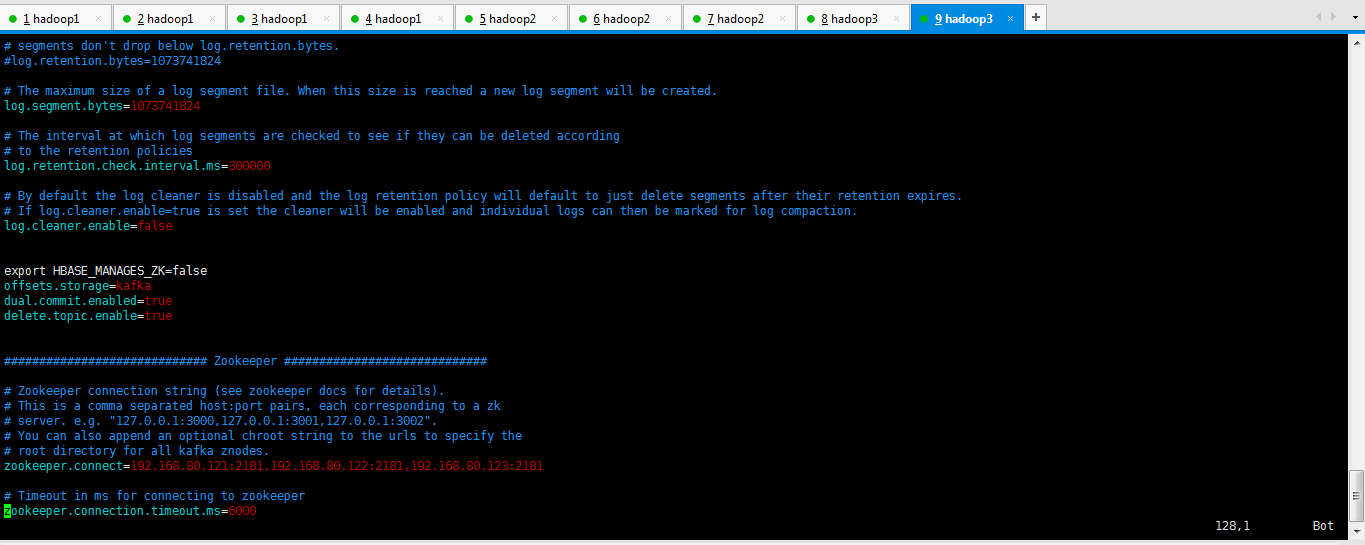
# Licensed to the Apache Software Foundation (ASF) under one or more

# contributor license agreements.  See the NOTICE file distributed with

# this work for additional information regarding copyright ownership.

# The ASF licenses this file to You under the Apache License, Version 2.0

# (the "License"); you may not use this file except in compliance with

# the License.  You may obtain a copy of the License at

#

#    http://www.apache.org/licenses/LICENSE-2.0

#

# Unless required by applicable law or agreed to in writing, software

# distributed under the License is distributed on an "AS IS" BASIS,

# WITHOUT WARRANTIES OR CONDITIONS OF ANY KIND, either express or implied.

# See the License for the specific language governing permissions and

# limitations under the License.

# see kafka.server.KafkaConfig for additional details and defaults

############################# Server Basics #############################

# The id of the broker. This must be set to a unique integer for each broker.

broker.id=

############################# Socket Server Settings #############################

# The port the socket server listens on

port=

# Hostname the broker will bind to. If not set, the server will bind to all interfaces

host.name=192.168.80.123

# Hostname the broker will advertise to producers and consumers. If not set, it uses the

# value for "host.name" if configured.  Otherwise, it will use the value returned from

# java.net.InetAddress.getCanonicalHostName().

#advertised.host.name=<hostname routable by clients>

# The port to publish to ZooKeeper for clients to use. If this is not set,

# it will publish the same port that the broker binds to.

#advertised.port=<port accessible by clients>

# The number of threads handling network requests

num.network.threads=

# The number of threads doing disk I/O

num.io.threads=

# The send buffer (SO_SNDBUF) used by the socket server

socket.send.buffer.bytes=

# The receive buffer (SO_RCVBUF) used by the socket server

socket.receive.buffer.bytes=

# The maximum size of a request that the socket server will accept (protection against OOM)

socket.request.max.bytes=

############################# Log Basics #############################

# A comma seperated list of directories under which to store log files

log.dirs=/home/kafka-logs

# The default number of log partitions per topic. More partitions allow greater

# parallelism for consumption, but this will also result in more files across

# the brokers.

num.partitions=

# The number of threads per data directory to be used for log recovery at startup and flushing at shutdown.

# This value is recommended to be increased for installations with data dirs located in RAID array.

num.recovery.threads.per.data.dir=

############################# Log Flush Policy #############################

# Messages are immediately written to the filesystem but by default we only fsync() to sync

# the OS cache lazily. The following configurations control the flush of data to disk.

# There are a few important trade-offs here:

#    . Durability: Unflushed data may be lost if you are not using replication.

#    . Latency: Very large flush intervals may lead to latency spikes when the flush does occur as there will be a lot of data to flush.

#    . Throughput: The flush is generally the most expensive operation, and a small flush interval may lead to exceessive seeks.

# The settings below allow one to configure the flush policy to flush data after a period of time or

# every N messages (or both). This can be done globally and overridden on a per-topic basis.

# The number of messages to accept before forcing a flush of data to disk

#log.flush.interval.messages=

# The maximum amount of time a message can sit in a log before we force a flush

#log.flush.interval.ms=

############################# Log Retention Policy #############################

# The following configurations control the disposal of log segments. The policy can

# be set to delete segments after a period of time, or after a given size has accumulated.

# A segment will be deleted whenever *either* of these criteria are met. Deletion always happens

# from the end of the log.

# The minimum age of a log file to be eligible for deletion

log.retention.hours=

# A size-based retention policy for logs. Segments are pruned from the log as long as the remaining

# segments don't drop below log.retention.bytes.

#log.retention.bytes=

# The maximum size of a log segment file. When this size is reached a new log segment will be created.

log.segment.bytes=

# The interval at which log segments are checked to see if they can be deleted according

# to the retention policies

log.retention.check.interval.ms=

# By default the log cleaner is disabled and the log retention policy will default to just delete segments after their retention expires.

# If log.cleaner.enable=true is set the cleaner will be enabled and individual logs can then be marked for log compaction.

log.cleaner.enable=false

export HBASE_MANAGES_ZK=false

offsets.storage=kafka

dual.commit.enabled=true

delete.topic.enable=true

############################# Zookeeper #############################

# Zookeeper connection string (see zookeeper docs for details).

# This is a comma separated host:port pairs, each corresponding to a zk

# server. e.g. "127.0.0.1:3000,127.0.0.1:3001,127.0.0.1:3002".

# You can also append an optional chroot string to the urls to specify the

# root directory for all kafka znodes.

zookeeper.connect=192.168.80.121:,192.168.80.122:,192.168.80.123:

# Timeout in ms for connecting to zookeeper

zookeeper.connection.timeout.ms=
Kafka的3节点集群详细启动步骤
第一步、首先启动kafka进程
[hadoop@hadoop1 kafka]$ nohup bin/kafka-server-start.sh config/server.properties > kafka.log >& &
[2] 4609
[hadoop@hadoop2 kafka]$ nohup bin/kafka-server-start.sh config/server.properties > kafka.log >& &
[2] 10077
[hadoop@hadoop3 kafka]$ nohup bin/kafka-server-start.sh config/server.properties > kafka.log >& &
[1] 8079
第二步、创建topics
[hadoop@hadoop1 bin]$ ./kafka-topics.sh --zookeeper hadoop1:,hadoop2:,hadoop3: --create --topic t-behavior --replication-factor --partitions
或者
[hadoop@hadoop1 bin]$ ./kafka-topics.sh --zookeeper hadoop1: --create --topic t-behavior --replication-factor --partitions
第三步:查看topic 和 topic详情
[hadoop@hadoop1 bin]$ ./kafka-topics.sh --zookeeper hadoop1:,hadoop2:,hadoop3: --list
t-behavior
[hadoop@hadoop1 bin]$ ./kafka-topics.sh --zookeeper hadoop1:,hadoop2:,hadoop3: --describe --topic t-behavior
或者
[hadoop@hadoop1 bin]$
./kafka-topics.sh --zookeeper hadoop1: --list
t-behavior
[hadoop@hadoop1 bin]$ ./kafka-topics.sh --zookeeper hadoop1: --describe --topic t-behavior
Topic:t-behavior PartitionCount:1 ReplicationFactor:3 Configs:
Topic: t-behavior Partition: 0 Leader: 3 Replicas: 3,2,1 Isr: 3,1,2
第四步:开启Kafka producer生产者(在hadoop1和hadoop2和hadoop3都可以)
模拟producer发送消息
用命令行的方式手动的往kafka的topic里面发送消息:
[hadoop@hadoop2 bin]$ ./kafka-console-producer.sh --broker-list hadoop1:,hadoop1:,hadoop1: --topic t-behavior
[2015-09-24 14:03:24,616] WARN Property topic is not valid (kafka.utils.VerifiableProperties)
This is Kafka producer.
Hello
或者
[hadoop@hadoop2 bin]$ ./kafka-console-producer.sh --broker-list hadoop1: --topic t-behavior
第五步:开启Kafka consumer消费者(在hadoop1和hadoop2和hadoop3都可以)
[hadoop@hadoop3 bin]$./kafka-console-consumer.sh --zookeeper hadoop1:,hadoop2:,hadoop3: --topic t-behavior --from-beginning
This is Kafka producer.
Hello
或者
[hadoop@hadoop3 bin]$./kafka-console-consumer.sh --zookeeper hadoop1: --topic t-behavior
第六步:停止kafka
cd $KAFKA_HOME/bin
./kafka-server-stop.sh
或者找到kafka的进程,直接kill掉即可。
彻底删除topic:
1、删除kafka存储目录(server.properties文件log.dirs配置,默认为"/tmp/kafka-logs")相关topic目录
2、如果配置了delete.topic.enable=true直接通过命令删除,如果命令删除不掉,直接通过zookeeper-client 删除掉broker下的topic即可。
[hadoop@hadoop1 bin]$ ./kafka-topics.sh --delete --zookeeper hadoop1:2181,hadoop2:2181,hadoop3:2181 --topic t-behavior
其实啊,现在越来越多的优秀插件出来了。
可以不需这么命令行去做了,直接界面化多么的好!
基于Web的Kafka管理器工具之Kafka-manager安装之后第一次进入web UI的初步配置(图文详解)
Kafka的3节点集群详细启动步骤(Zookeeper是外装)的更多相关文章
- HBase的多节点集群详细启动步骤(3或5节点)(分为Zookeeper自带还是外装)
HBase的多节点集群详细启动步骤(3或5节点)分为: 1.HBASE_MANAGES_ZK的默认值是false(zookeeper外装)(推荐) 2.HBASE_MANAGES_ZK的默认值是tru ...
- Hadoop的多节点集群详细启动步骤(3或5节点)
版本1 利用自己写的脚本来启动,见如下博客 hadoop-2.6.0-cdh5.4.5.tar.gz(CDH)的3节点集群搭建 hadoop-2.6.0.tar.gz的集群搭建(3节点) hadoop ...
- Zookeeper的多节点集群详细启动步骤(3或5节点)
分为 (1)分别去3或5节点上去启动Zookeeper进程 (2)自己写个脚本,直接在主节点上去启动Zookeeper进程. (1)分别去3或5节点上去启动Zookeeper进程 第一步: [hado ...
- storm的3节点集群详细启动步骤(非HA和HA)(图文详解)
前期博客 apache-storm-1.0.2.tar.gz的集群搭建(3节点)(图文详解)(非HA和HA) 启动storm集群(HA) 本博文情况是 master(主) nimbus slave1( ...
- HBase的单节点集群详细启动步骤(分为Zookeeper自带还是外装)
伪分布模式下,如(weekend110)hbase-env.sh配置文档中的HBASE_MANAGES_ZK的默认值是true,它表示HBase使用自身自带的Zookeeper实例.但是,该实例只能为 ...
- Hive的单节点集群详细启动步骤
说在前面的话, 在这里,推荐大家,一定要先去看这篇博客,如下 再谈hive-1.0.0与hive-1.2.1到JDBC编程忽略细节问题 Hadoop Hive概念学习系列之hive三种方式区别和搭建. ...
- Hadoop的单节点集群详细启动步骤
见,如下博客 hadoop-2.2.0.tar.gz的伪分布集群环境搭建(单节点) 很简单,不多赘述.
- Zookeeper的单节点集群详细启动步骤
这个很简单,见如下博客. 1 week110的zookeeper的安装 + zookeeper提供少量数据的存储 [hadoop@weekend110 zookeeper-3.4.6]$ pwd/ho ...
- Hyperledger Fabric 1.0 从零开始(九)——Fabric多节点集群生产启动
7:Fabric多节点集群生产启动 7.1.多节点服务器配置 在生产环境上,我们沿用4.1.配置说明中的服务器各节点配置方案. 我们申请了五台生产服务器,其中四台服务器运行peer节点,另外一台服务器 ...
随机推荐
- vue-router2.0二级路由的简单使用
1.app.vue中 <template> <div id="app"> <router-view></router-view> & ...
- Python基础(十一) 异常处理
在程序运行过程中,总会遇到各种各样的错误,有的错误是程序编写有问题造成的,比如本来应该输出整数结果输出了字符串,这样的错误我们通常称之为BUG,BUG是必须修复的.在Python中内置了一套异常处理机 ...
- 夜话JAVA设计模式之代理模式(Proxy)
代理模式定义:为另一个对象提供一个替身或者占位符以控制对这个对象的访问.---<Head First 设计模式> 代理模式换句话说就是给某一个对象创建一个代理对象,由这个代理对象控制对原对 ...
- springmvc 日期转换器
package com.xxx.common.controller.converter; import org.joda.time.DateTime; import org.joda.time.for ...
- 新手学測试----Unit Test(单元測试)
在程序猿做项目的过程中,每当完毕一个功能,首先自己须要对完毕的功能进行測试.我如今正在做的项目用的工具是VS2012.那么接下来,就说一说在VS2012中是怎样创建单元測试的. 怎样创建单元測试? 在 ...
- Unity5.1 新的网络引擎UNET(十五) Networking 引用--中
孙广东 2015.7.21 本节提供了与网络系统一起使用的组件的具体信息. 3.NetworkClient NetworkClient 是一个 HLAPI 类,管理网络连接到服务器 - - 相应着 U ...
- Android Studio 开发利器【经常使用插件】
1.ADB Idea ADB操作快捷菜单.高速清除数据,重新启动应用,卸载应用等 快捷键: Windows: Ctrl+Alt+Shift+A Mac OSX: Ctrl+Shift+A 当然,你能够 ...
- android微信开放平台,申请移动应用的应用签名怎样获取
在微信开放平台,申请移动应用的时候: https://open.weixin.qq.com/cgi-bin/appcreate? t=manage/createMobile&type=app& ...
- intellij idea 写 Helloworld
http://www.jetbrains.com/idea/webhelp/creating-and-running-your-first-java-application.html Creating ...
- 文章编辑器 文本替换 操作dom 发帖 富文本 今日头条发布富文本的实现 键盘化的html
js 修改 iframe it=document.getElementById('ueditor_0').contentWindow.document.getElementsByTagName(& ...