
poj 2284 That Nice Euler Circuit 解题报告
|
That Nice Euler Circuit
Description Little Joey invented a scrabble machine that he called Euler, after the great mathematician. In his primary school Joey heard about the nice story of how Euler started the study about graphs. The problem in that story was - let me remind you - to draw a graph on a paper without lifting your pen, and finally return to the original position. Euler proved that you could do this if and only if the (planar) graph you created has the following two properties: (1) The graph is connected; and (2) Every vertex in the graph has even degree.
Joey's Euler machine works exactly like this. The device consists of a pencil touching the paper, and a control center issuing a sequence of instructions. The paper can be viewed as the infinite two-dimensional plane; that means you do not need to worry about if the pencil will ever go off the boundary. In the beginning, the Euler machine will issue an instruction of the form (X0, Y0) which moves the pencil to some starting position (X0, Y0). Each subsequent instruction is also of the form (X', Y'), which means to move the pencil from the previous position to the new position (X', Y'), thus draw a line segment on the paper. You can be sure that the new position is different from the previous position for each instruction. At last, the Euler machine will always issue an instruction that move the pencil back to the starting position (X0, Y0). In addition, the Euler machine will definitely not draw any lines that overlay other lines already drawn. However, the lines may intersect. After all the instructions are issued, there will be a nice picture on Joey's paper. You see, since the pencil is never lifted from the paper, the picture can be viewed as an Euler circuit. Your job is to count how many pieces (connected areas) are created on the paper by those lines drawn by Euler. Input There are no more than 25 test cases. Ease case starts with a line containing an integer N >= 4, which is the number of instructions in the test case. The following N pairs of integers give the instructions and appear on a single line separated by single spaces. The first pair is the first instruction that gives the coordinates of the starting position. You may assume there are no more than 300 instructions in each test case, and all the integer coordinates are in the range (-300, 300). The input is terminated when N is 0.
Output For each test case there will be one output line in the format
Case x: There are w pieces., where x is the serial number starting from 1. Note: The figures below illustrate the two sample input cases. Sample Input 5 Sample Output Case 1: There are 2 pieces. Source |
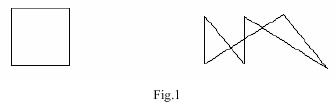
[Submit] [Go Back] [Status] [Discuss]


————————————————————我是分割线————————————————————————
绝世好题。
大体思路简单,细节能烦死人。
改了2天,看着题解才写出几个函数。55555........
本题根据平面图的欧拉定理求解区域个数r。
顶点个数:两两线段求交点,每个交点都是图中的顶点。
边数:在求交点时判断每个交点落在几条边上,若一个交点落在某条边上,则将这条边分裂成两条边,边数++。
之后运用欧拉定理求区域个数即可。
最后减的时候,把n处理成了点数,错的离谱......
 /*

     Problem:poj 2284

     OJ:     POJ

     User:   S.B.S.

     Time:   454 ms

     Memory: 3548 kb

     Length: 2643 b

 */

 #include<iostream>

 #include<cstdio>

 #include<cstring>

 #include<cmath>

 #include<algorithm>

 #include<queue>

 #include<cstdlib>

 #include<iomanip>

 #include<cassert>

 #include<climits>

 #include<vector>

 #include<list>

 #include<map>

 #define maxn 90001

 #define F(i,j,k) for(int i=j;i<k;i++)

 #define M(a,b) memset(a,b,sizeof(a))

 #define FF(i,j,k) for(int i=j;i>=k;i--)

 #define inf 0x7fffffff

 #define maxm 2016

 #define mod 1000000007

 #define eps 1e-10

 //#define LOCAL

 using namespace std;

 int read(){

     int x=,f=;char ch=getchar();

     while(ch<''||ch>''){if(ch=='-')f=-;ch=getchar();}

     while(ch>=''&&ch<=''){x=x*+ch-'';ch=getchar();}

     return x*f;

 }

 int n,m;

 struct POINT //点

 {

     double x;

     double y;

     POINT(double a=,double b=){x=a;y=b;}

 };

 struct EDGE //线段

 {

     POINT u;

     POINT v;

     EDGE(POINT A,POINT B) {u=A;v=B;}

 };

 struct LINE //直线

 {

     double a;

     double b;

     double c;

 };

 bool operator < (POINT A,POINT B)

 {

     return A.x<B.x || A.x==B.x && A.y<B.y;

 }

 bool operator == (POINT a,POINT b)

 {

     return abs(a.x-b.x)<eps && abs(a.y-b.y)<eps;

 }

 bool online(EDGE a,POINT b)

 {

     return abs((a.v.x-a.u.x)*(b.y-a.u.y)-(b.x-a.u.x)*(a.v.y-a.u.y))<eps && (b.x-a.u.x)*(b.x-a.v.x)<eps && (b.y-a.u.y)*(b.y-a.v.y)<eps;

 }

 LINE makeline(POINT a,POINT b)

 {//将线段延长成直线

     LINE l;

     l.a=(b.y>a.y) ? b.y-a.y : a.y-b.y;                //y方向差值

     l.b=(b.y>a.y) ? a.x-b.x : b.x-a.x;                //x方向差值

     l.c=(b.y>a.y) ? a.y*b.x-a.x*b.y : a.x*b.y-a.y*b.x;//与水平线夹角

     return l;    //返回直线

 }

 bool lcross(LINE a,LINE b,POINT &p)

 {//判断直线是否相交

     double d=a.a*b.b-b.a*a.b;

     if(abs(d)<eps) return false;

     //求交点

     p.x=(b.c*a.b-a.c*b.b)/d;

     p.y=(b.a*a.c-a.a*b.c)/d;

     return true;

 }

 bool ecross(EDGE a,EDGE b,POINT &p)

 {

     LINE l1,l2;

     l1=makeline(a.u,a.v);

     l2=makeline(b.u,b.v);

     if(lcross(l1,l2,p)) return online(a,p) && online(b,p);

     else return false;

 }

 POINT p[maxn],in[maxn];

 int cur,cnt,ans;

 int main()

 {

     std::ios::sync_with_stdio(false);//cout<<setiosflags(ios::fixed)<<setprecision(1)<<y;

     #ifdef LOCAL

     freopen("data.in","r",stdin);

     freopen("data.out","w",stdout);

     #endif

     int t=;

     while(cin>>n&&n)

     {

         t++;m=cur=;

         for(int i=;i<n;i++) cin>>p[i].x>>p[i].y;

         for(int i=;i<n;i++)

          for(int j=;j<n;j++){

             EDGE l1(p[i],p[(i+)%n]),l2(p[j],p[(j+)%n]);

             POINT pp;

             if(ecross(l1,l2,pp)) in[cur++]=pp;

         }

         sort(in,in+cur);

         cur=unique(in,in+cur)-in;

         for(int i=;i<cur;i++)

          for(int j=;j<n;j++){

             EDGE ll(p[j],p[(j+)%n]);

             if(online(ll,in[i]) && !(ll.u==in[i])) m++;

         }

         cout<<"Case "<<t<<": There are "<<+m-cur<<" pieces."<<endl;

     }

     return ;

 }
poj 2284
poj 2284 That Nice Euler Circuit 解题报告的更多相关文章
- ●POJ 2284 That Nice Euler Circuit
题链: http://poj.org/problem?id=2284 题解: 计算几何,平面图的欧拉定理 欧拉定理:设平面图的定点数为v,边数为e,面数为f,则有 v+f-e=2 即 f=e-v+2 ...
- POJ 2284 That Nice Euler Circuit (LA 3263 HDU 1665)
http://poj.org/problem?id=2284 https://icpcarchive.ecs.baylor.edu/index.php?option=com_onlinejudge&a ...
- pku 2284 That Nice Euler Circuit
题意: 给你n个点第n个点保证与第0个点相交,然后求这n个点组成的图形可以把整个平面分成几个面 思路: 这里的解题关键是知道关于多面体的欧拉定理 多面体: 设v为顶点数,e为棱数,f是面数,则v-e+ ...
- poj 1094 Sorting It All Out 解题报告
题目链接:http://poj.org/problem?id=1094 题目意思:给出 n 个待排序的字母 和 m 种关系,问需要读到第 几 行可以确定这些字母的排列顺序或者有矛盾的地方,又或者虽然具 ...
- Poj 1953 World Cup Noise之解题报告
World Cup Noise Time Limit: 1000MS Memory Limit: 30000K Total Submissions: 16369 Accepted: 8095 ...
- Poj 2081 Recaman's Sequence之解题报告
...
- POJ 1308 Is It A Tree? 解题报告
Is It A Tree? Time Limit: 1000MS Memory Limit: 10000K Total Submissions: 32052 Accepted: 10876 D ...
- POJ 1958 Strange Towers of Hanoi 解题报告
Strange Towers of Hanoi 大体意思是要求\(n\)盘4的的hanoi tower问题. 总所周知,\(n\)盘3塔有递推公式\(d[i]=dp[i-1]*2+1\) 令\(f[i ...
- POJ 1001 解题报告 高精度大整数乘法模版
题目是POJ1001 Exponentiation 虽然是小数的幂 最终还是转化为大整数的乘法 这道题要考虑的边界情况比较多 做这道题的时候,我分析了 网上的两个解题报告,发现都有错误,说明OJ对于 ...
随机推荐
- Caffe训练AlexNet网络模型——问题一
训练AlexNet网络时,出现Check failed:datum_height >= crop_size (size vs. 227)错误,具体如下图所示: 根据提示,问题是crop_size ...
- css盒子垂直居中
首先父盒子包住子盒子 <body> <div class="outbox"> <div class="box"></d ...
- poj1970 The Game(DFS)
题目链接 http://poj.org/problem?id=1970 思路 题目的意思是判断五子棋棋局是否有胜者,有的话输出胜者的棋子类型,并且输出五个棋子中最左上的棋子坐标:没有胜者输出0. 这道 ...
- Think PHP 3.2 界面及JS多语言实现
1.多语言实现的原理在实现多语言的时候需要调用L()函数.那么L函数是如何实现多语言的输出呢?在L函数内部有一个静态变量$_lang一维数组.所有的语言数据都存在在这个数组中.系统在加载的时候根据选择 ...
- 20169211《Linux内核原理与分析》 第九周作业
一.Linux内核虚拟文件系统学习总结 Linux支持各种文件系统,Linux内核通过虚拟文件系统了对各种文件系统共性的进行抽象,并对外提供统一接口,从面向对象编程的角度来看,称为抽象文件系统更为合适 ...
- poi类包对比
- <泛> C++3D数学库设计详解 向量篇
// 注:本内容为作者原创,禁止在其他网站复述内容以及用于商业盈利,如需引用,请标明出处:http://www.cnblogs.com/lv_anchoret/ Preface 为了支持光线追踪的学习 ...
- HTTP请求的GET与POST方式的区别
Form中的get和post方法,在数据传输过程中分别对应了HTTP协议中的GET和POST方法.二者主要区别如下: 1)Get是用来从服务器上获得数据,而Post是用来向服务器上传递数据: 2)Ge ...
- Wireshark数据抓包教程之认识捕获分析数据包
Wireshark数据抓包教程之认识捕获分析数据包 认识Wireshark捕获数据包 当我们对Wireshark主窗口各部分作用了解了,学会捕获数据了,接下来就该去认识这些捕获的数据包了.Wiresh ...
- 我们不能把JavaScript作为一个全功能的编程语言。它缺乏以下重要特征
客户端JavaScript不允许读或写文件.这已被保存的安全原因. JavaScript不能用于网络的应用,因为没有这样的支持. JavaScript没有任何多线程或多处理器的能力.