
苏浪浪 201771010120《面向对象程序设计(java)》第八周学习总结
1、实验目的与要求
(1) 掌握接口定义方法;
(2) 掌握实现接口类的定义要求;
(3) 掌握实现了接口类的使用要求;
(4) 掌握程序回调设计模式;
(5) 掌握Comparator接口用法;
(6) 掌握对象浅层拷贝与深层拷贝方法;
(7) 掌握Lambda表达式语法;
(8) 了解内部类的用途及语法要求。
2、实验内容和步骤
实验1: 导入第6章示例程序,测试程序并进行代码注释。
测试程序1:
l 编辑、编译、调试运行阅读教材214页-215页程序6-1、6-2,理解程序并分析程序运行结果;
l 在程序中相关代码处添加新知识的注释。
l 掌握接口的实现用法;
l 掌握内置接口Compareable的用法。
package interfaces;

import java.util.*;

/**

 * This program demonstrates the use of the Comparable interface.

 * @version 1.30 2004-02-27

 * @author Cay Horstmann

 */

public class EmployeeSortTest

{

   public static void main(String[] args)

   {

      Employee[] staff = new Employee[3];

      staff[0] = new Employee("Harry Hacker", 35000);

      staff[1] = new Employee("Carl Cracker", 75000);

      staff[2] = new Employee("Tony Tester", 38000);

      Arrays.sort(staff);

      // 打印所有员工对象的信息

      for (Employee e : staff)

         System.out.println("name=" + e.getName() + ",salary=" + e.getSalary());

   }

}
package interfaces;

public class Employee implements Comparable<Employee>

{

   private String name;

   private double salary;

   public Employee(String name, double salary)

   {

      this.name = name;

      this.salary = salary;

   }

   public String getName()

   {

      return name;

   }

   public double getSalary()

   {

      return salary;

   }

   public void raiseSalary(double byPercent)

   {

      double raise = salary * byPercent / 100;

      salary += raise;

   }

   /**

    * Compares employees by salary

    * @param other another Employee object

    * @return a negative value if this employee has a lower salary than

    * otherObject, 0 if the salaries are the same, a positive value otherwise

    */

   public int compareTo(Employee other)//用这个对象与other作比较

   {

      return Double.compare(salary, other.salary);

   }

}

测试程序2:
l 编辑、编译、调试以下程序,结合程序运行结果理解程序;
|
interface A { double g=9.8; void show( ); } class C implements A { public void show( ) {System.out.println("g="+g);} } class InterfaceTest { public static void main(String[ ] args) { A a=new C( ); a.show( ); System.out.println("g="+C.g); } } |
package e;
interface A
{
double g=9.8;
void show( );
}
class C implements A
{
public void show( )
{System.out.println("g="+g);}
}
class InterfaceTest
{
public static void main(String[ ] args)
{
A a=new C( );//声明接口变量
a.show( );
System.out.println("g="+C.g);
}
}

测试程序3:
l 在elipse IDE中调试运行教材223页6-3,结合程序运行结果理解程序;
l 26行、36行代码参阅224页,详细内容涉及教材12章。
l 在程序中相关代码处添加新知识的注释。
l 掌握回调程序设计模式;
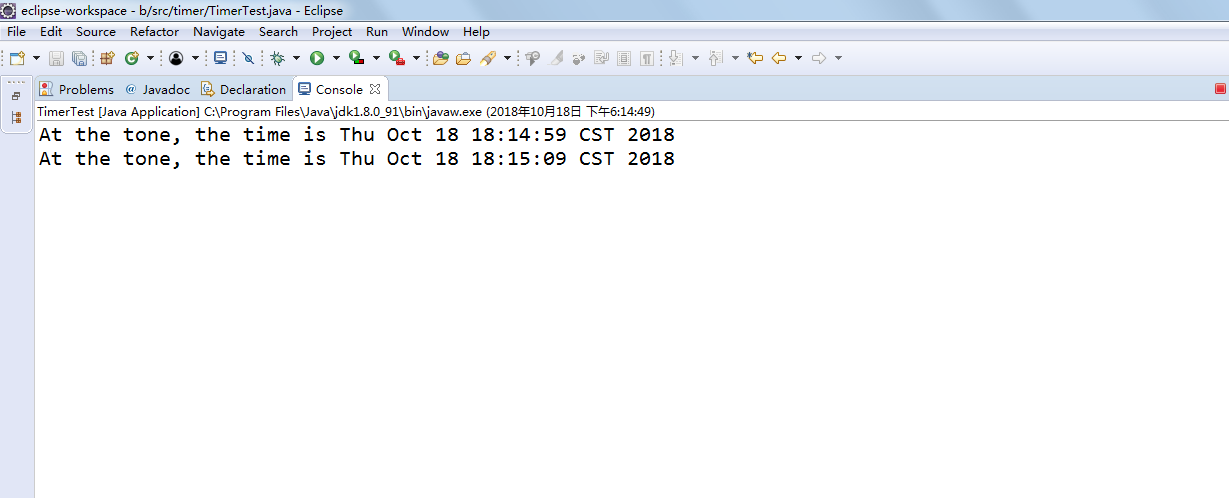
package timer;

/**

   @version 1.01 2015-05-12

   @author Cay Horstmann

*/

import java.awt.*;

import java.awt.event.*;

import java.util.*;

import javax.swing.*;

import javax.swing.Timer;

// 用JavaUTIL计时器解决冲突

public class TimerTest

{

   public static void main(String[] args)

   {

      ActionListener listener = new TimePrinter();

      // 构建一个调用侦听器的计时器

      // 每10秒一次

      Timer t = new Timer(10000, listener);

      t.start();

      JOptionPane.showMessageDialog(null, "Quit program?");

      System.exit(0);

   }

}

class TimePrinter implements ActionListener

{

   public void actionPerformed(ActionEvent event)

   {

      System.out.println("At the tone, the time is " + new Date());

      Toolkit.getDefaultToolkit().beep();

   }

}
测试程序4:
l 调试运行教材229页-231页程序6-4、6-5,结合程序运行结果理解程序;
l 在程序中相关代码处添加新知识的注释。
l 掌握对象克隆实现技术;
l 掌握浅拷贝和深拷贝的差别。
package clone;

/**

 * This program demonstrates cloning.

 * @version 1.10 2002-07-01

 * @author Cay Horstmann

 */

public class CloneTest

{

   public static void main(String[] args)

   {

      try

      {

         Employee original = new Employee("John Q. Public", 50000);

         original.setHireDay(2000, 1, 1);

         Employee copy = original.clone();

         copy.raiseSalary(10);

         copy.setHireDay(2002, 12, 31);

         System.out.println("original=" + original);

         System.out.println("copy=" + copy);

      }

      catch (CloneNotSupportedException e)

      {

         e.printStackTrace();

      }

   }

}
package clone;

import java.util.Date;

import java.util.GregorianCalendar;

public class Employee implements Cloneable//实现Cloneable接口

{

   private String name;

   private double salary;

   private Date hireDay;

   public Employee(String name, double salary)

   {

      this.name = name;

      this.salary = salary;

      hireDay = new Date();

   }

   public Employee clone() throws CloneNotSupportedException//定义一个克隆方法

   {

      // call Object.clone()

      Employee cloned = (Employee) super.clone();// 继承object类

      // clone mutable fields

      cloned.hireDay = (Date) hireDay.clone();

      //cloned.name=(String)name.clone();String不具有克隆功能;

      return cloned;

   }

   /**

    * Set the hire day to a given date.

    * @param year the year of the hire day

    * @param month the month of the hire day

    * @param day the day of the hire day

    */

   public void setHireDay(int year, int month, int day)

   {

      Date newHireDay = new GregorianCalendar(year, month - 1, day).getTime();

      // Example of instance field mutation

      hireDay.setTime(newHireDay.getTime());

   }

   public void raiseSalary(double byPercent)

   {

      double raise = salary * byPercent / 100;

      salary += raise;

   }

   public String toString()

   {

      return "Employee[name=" + name + ",salary=" + salary + ",hireDay=" + hireDay + "]";

   }

}

实验2: 导入第6章示例程序6-6,学习Lambda表达式用法。
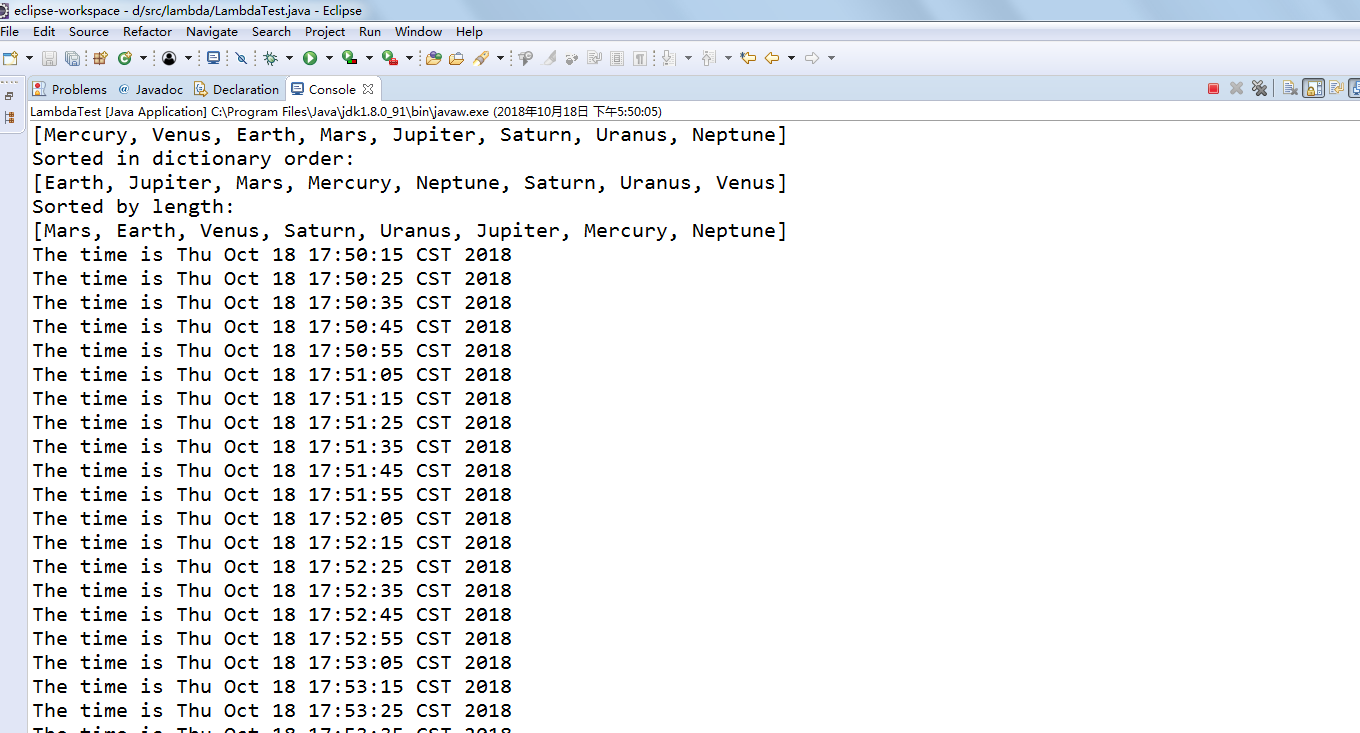
l 调试运行教材233页-234页程序6-6,结合程序运行结果理解程序;
l 在程序中相关代码处添加新知识的注释。
l 将27-29行代码与教材223页程序对比,将27-29行代码与此程序对比,体会Lambda表达式的优点。
package lambda;

import java.util.*;

import javax.swing.*;

import javax.swing.Timer;

/**

 * This program demonstrates the use of lambda expressions.

 * @version 1.0 2015-05-12

 * @author Cay Horstmann

 */

public class LambdaTest

{

   public static void main(String[] args)

   {

      String[] planets = new String[] { "Mercury", "Venus", "Earth", "Mars",

            "Jupiter", "Saturn", "Uranus", "Neptune" };

      System.out.println(Arrays.toString(planets));

      System.out.println("Sorted in dictionary order:");

      Arrays.sort(planets);

      System.out.println(Arrays.toString(planets));

      System.out.println("Sorted by length:");

      Arrays.sort(planets, (first, second) -> first.length() - second.length());

      System.out.println(Arrays.toString(planets));

      Timer t = new Timer(1000, event ->

         System.out.println("The time is " + new Date()));

      //event ->System.out.println("The time is " + new Date()));lambda表达式;

      t.start();

      // keep program running until user selects "Ok"

      JOptionPane.showMessageDialog(null, "Quit program?");

      System.exit(0);

   }

}
注:以下实验课后完成
实验3: 编程练习
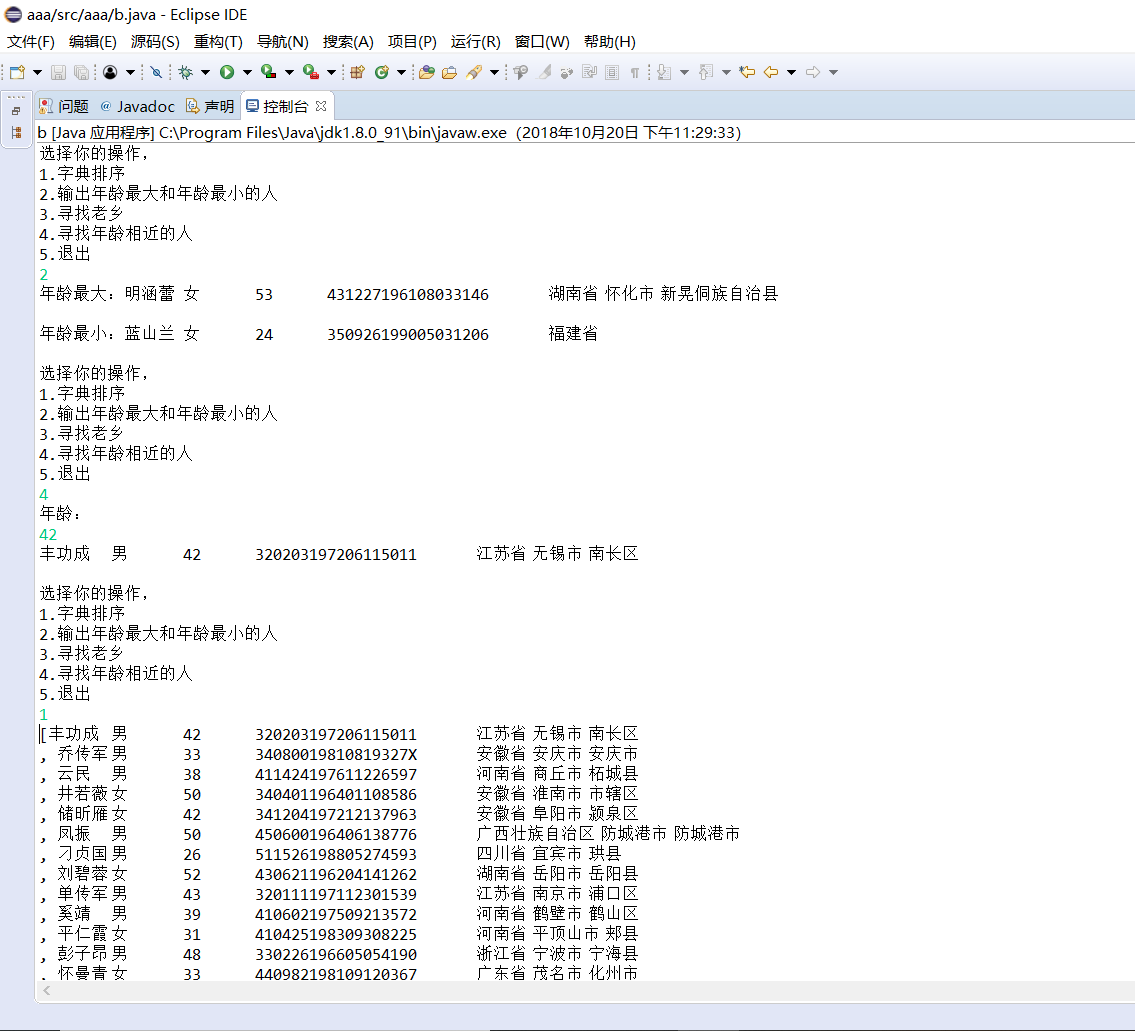
l 编制一个程序,将身份证号.txt 中的信息读入到内存中;
l 按姓名字典序输出人员信息;
l 查询最大年龄的人员信息;
l 查询最小年龄人员信息;
l 输入你的年龄,查询身份证号.txt中年龄与你最近人的姓名、身份证号、年龄、性别和出生地;
l 查询人员中是否有你的同乡。
package aaa;

import java.io.BufferedReader;

import java.io.File;

import java.io.FileInputStream;

import java.io.FileNotFoundException;

import java.io.IOException;

import java.io.InputStreamReader;

import java.util.ArrayList;

import java.util.Arrays;

import java.util.Collections;

import java.util.Scanner;

public class b{

    private static ArrayList<Student> studentlist;

    public static void main(String[] args) {

        studentlist = new ArrayList<>();

        Scanner scanner = new Scanner(System.in);

        File file = new File("E:身份证号.txt");

        try {

            FileInputStream fis = new FileInputStream(file);

            BufferedReader in = new BufferedReader(new InputStreamReader(fis));

            String temp = null;

            while ((temp = in.readLine()) != null) {

                Scanner linescanner = new Scanner(temp);

                linescanner.useDelimiter(" ");

                String name = linescanner.next();

                String number = linescanner.next();

                String sex = linescanner.next();

                String age = linescanner.next();

                String province =linescanner.nextLine();

                Student student = new Student();

                student.setName(name);

                student.setnumber(number);

                student.setsex(sex);

                int a = Integer.parseInt(age);

                student.setage(a);

                student.setprovince(province);

                studentlist.add(student);

            }

        } catch (FileNotFoundException e) {

            System.out.println("学生信息文件找不到");

            e.printStackTrace();

        } catch (IOException e) {

            System.out.println("学生信息文件读取错误");

            e.printStackTrace();

        }

        boolean isTrue = true;

        while (isTrue) {

            System.out.println("选择你的操作, ");

            System.out.println("1.字典排序  ");

            System.out.println("2.输出年龄最大和年龄最小的人  ");

            System.out.println("3.寻找老乡  ");

            System.out.println("4.寻找年龄相近的人  ");

            System.out.println("5.退出 ");

            String m = scanner.next();

            switch (m) {

            case "1":

                Collections.sort(studentlist);

                System.out.println(studentlist.toString());

                break;

            case "2":

                 int max=0,min=100;

                 int j,k1 = 0,k2=0;

                 for(int i=1;i<studentlist.size();i++)

                 {

                     j=studentlist.get(i).getage();

                 if(j>max)

                 {

                     max=j;

                     k1=i;

                 }

                 if(j<min)

                 {

                   min=j;

                   k2=i;

                 }

                 }

                 System.out.println("年龄最大:"+studentlist.get(k1));

                 System.out.println("年龄最小:"+studentlist.get(k2));

                break;

            case "3":

                 System.out.println("地址?");

                 String find = scanner.next();

                 String place=find.substring(0,3);

                 for (int i = 0; i <studentlist.size(); i++)

                 {

                     if(studentlist.get(i).getprovince().substring(1,4).equals(place))

                         System.out.println("老乡"+studentlist.get(i));

                 }

                 break;

            case "4":

                System.out.println("年龄:");

                int yourage = scanner.nextInt();

                int near=agenear(yourage);

                int value=yourage-studentlist.get(near).getage();

                System.out.println(""+studentlist.get(near));

                break;

            case "5 ":

                isTrue = false;

                System.out.println("退出程序!");

                break;

                default:

                System.out.println("输入有误");

            }

        }

    }

        public static int agenear(int age) {

        int j=0,min=53,value=0,ok=0;

         for (int i = 0; i < studentlist.size(); i++)

         {

             value=studentlist.get(i).getage()-age;

             if(value<0) value=-value;

             if (value<min)

             {

                min=value;

                 ok=i;

             }

          }

         return ok;

      }

}
package aaa;

public class Student implements Comparable<Student> {

    private String name;

    private String number ;

    private String sex ;

    private int age;

    private String province;

    public String getName() {

        return name;

    }

    public void setName(String name) {

        this.name = name;

    }

    public String getnumber() {

        return number;

    }

    public void setnumber(String number) {

        this.number = number;

    }

    public String getsex() {

        return sex ;

    }

    public void setsex(String sex ) {

        this.sex =sex ;

    }

    public int getage() {

        return age;

        }

        public void setage(int age) {

            // int a = Integer.parseInt(age);

        this.age= age;

        }

    public String getprovince() {

        return province;

    }

    public void setprovince(String province) {

        this.province=province ;

    }

    public int compareTo(Student o) {

       return this.name.compareTo(o.getName());

    }

    public String toString() {

        return  name+"\t"+sex+"\t"+age+"\t"+number+"\t"+province+"\n";

    }

}
实验4:内部类语法验证实验
实验程序1:
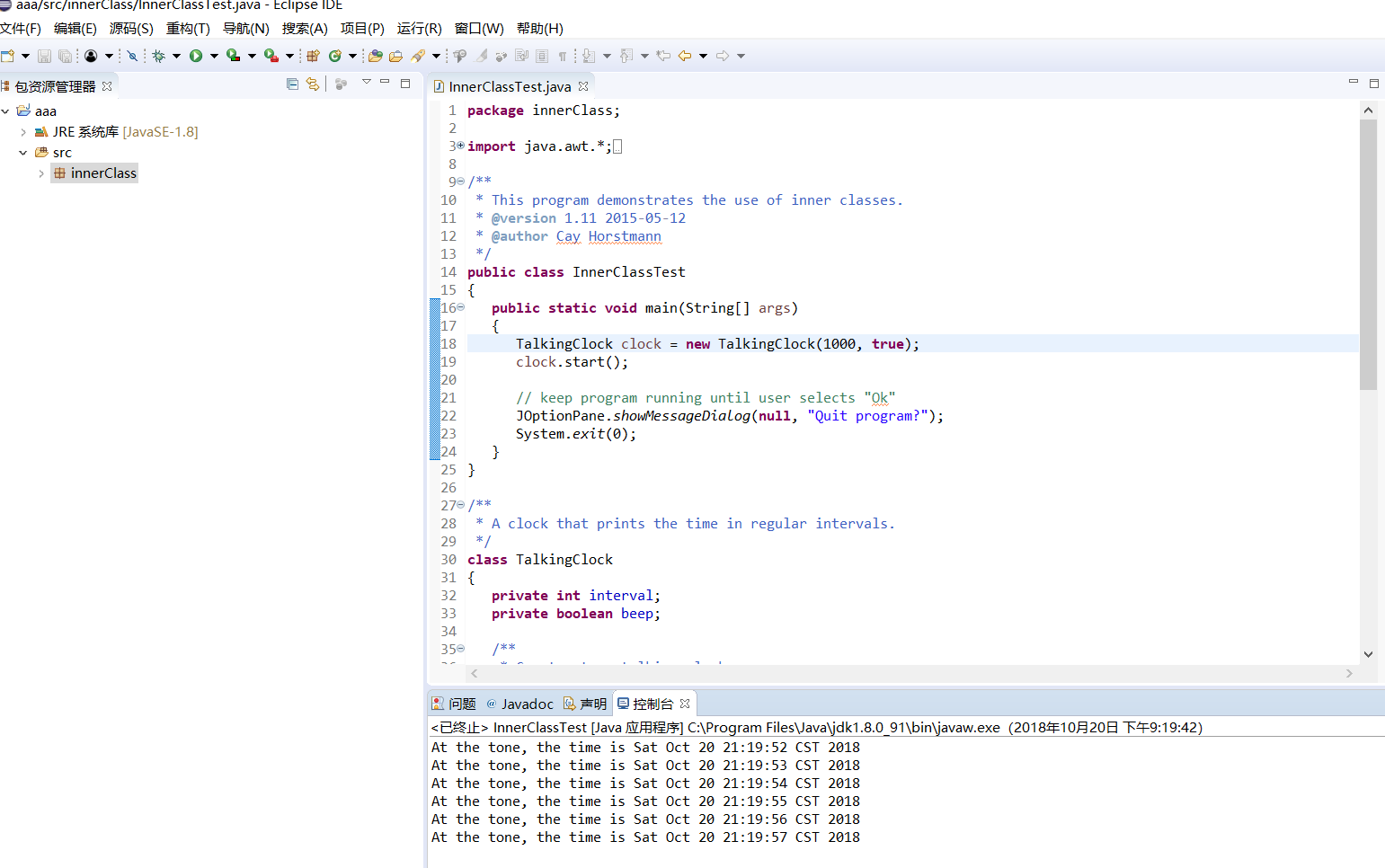
l 编辑、调试运行教材246页-247页程序6-7,结合程序运行结果理解程序;
l 了解内部类的基本用法。
package innerClass;

import java.awt.*;

import java.awt.event.*;

import java.util.*;

import javax.swing.*;

import javax.swing.Timer;

/**

 * This program demonstrates the use of inner classes.

 * @version 1.11 2015-05-12

 * @author Cay Horstmann

 */

public class InnerClassTest

{

   public static void main(String[] args)

   {

      TalkingClock clock = new TalkingClock(1000, true);

      clock.start();

      // keep program running until user selects "Ok"

      JOptionPane.showMessageDialog(null, "Quit program?");

      System.exit(0);

   }

}

/**

 * A clock that prints the time in regular intervals.

 */

class TalkingClock

{

   private int interval;

   private boolean beep;

   /**

    * Constructs a talking clock

    * @param interval the interval between messages (in milliseconds)

    * @param beep true if the clock should beep

    */

   public TalkingClock(int interval, boolean beep)

   {

      this.interval = interval;

      this.beep = beep;

   }

   /**

    * Starts the clock.

    */

   public void start()

   {

      ActionListener listener = new TimePrinter();

      Timer t = new Timer(interval, listener);

      t.start();

   }

   public class TimePrinter implements ActionListener

   {

      public void actionPerformed(ActionEvent event)

      {

         System.out.println("At the tone, the time is " + new Date());

         if (beep) Toolkit.getDefaultToolkit().beep();

      }

   }

}
实验程序2:
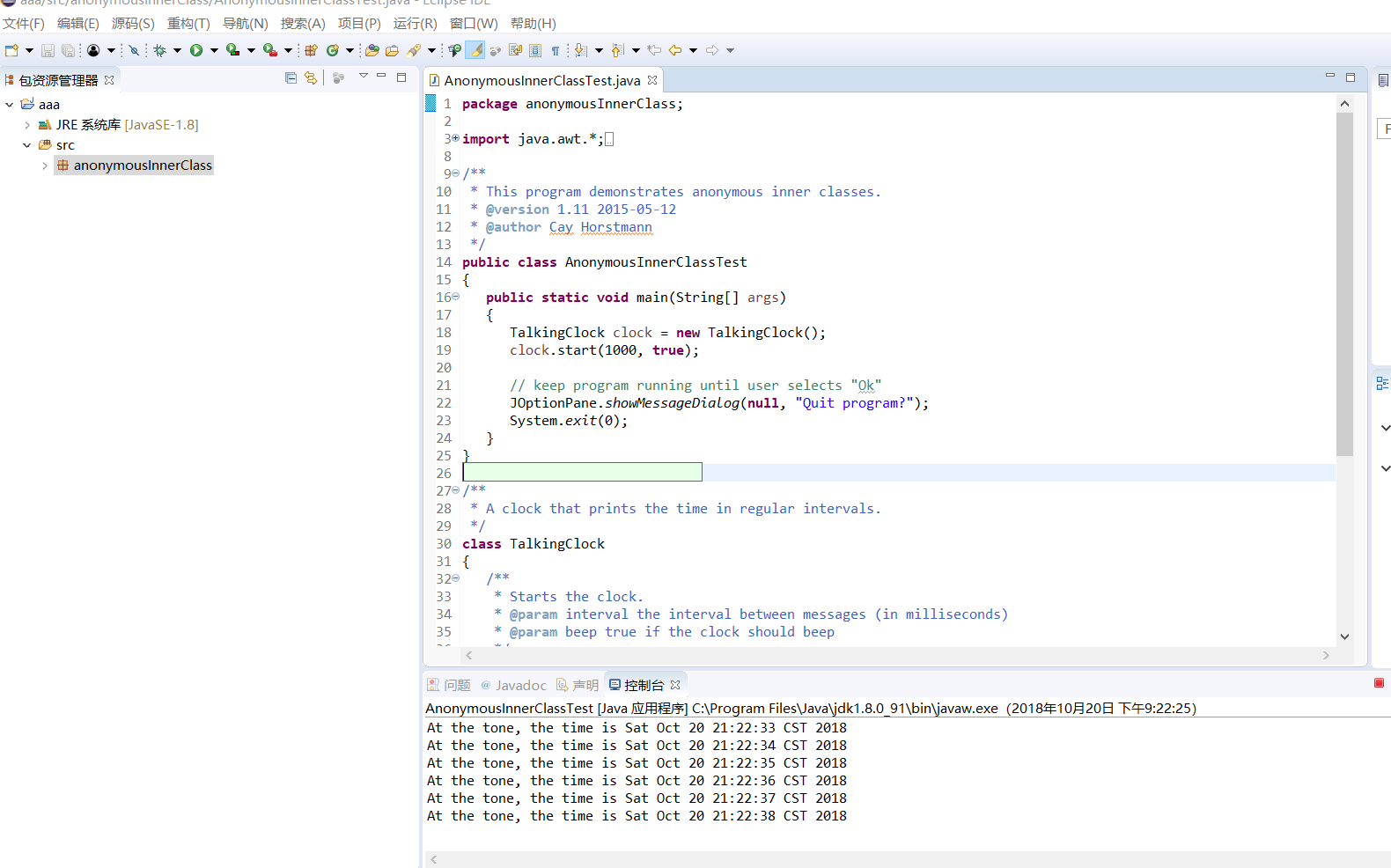
l 编辑、调试运行教材254页程序6-8,结合程序运行结果理解程序;
l 了解匿名内部类的用法。
package anonymousInnerClass;

import java.awt.*;

import java.awt.event.*;

import java.util.*;

import javax.swing.*;

import javax.swing.Timer;

/**

 * This program demonstrates anonymous inner classes.

 * @version 1.11 2015-05-12

 * @author Cay Horstmann

 */

public class AnonymousInnerClassTest

{

   public static void main(String[] args)

   {

      TalkingClock clock = new TalkingClock();

      clock.start(1000, true);

      // keep program running until user selects "Ok"

      JOptionPane.showMessageDialog(null, "Quit program?");

      System.exit(0);

   }

}

/**

 * A clock that prints the time in regular intervals.

 */

class TalkingClock

{

   /**

    * Starts the clock.

    * @param interval the interval between messages (in milliseconds)

    * @param beep true if the clock should beep

    */

   public void start(int interval, boolean beep)

   {

      ActionListener listener = new ActionListener()

         {

            public void actionPerformed(ActionEvent event)

            {

               System.out.println("At the tone, the time is " + new Date());

               if (beep) Toolkit.getDefaultToolkit().beep();

            }

         };

      Timer t = new Timer(interval, listener);

      t.start();

   }

}
实验程序3:
l 在elipse IDE中调试运行教材257页-258页程序6-9,结合程序运行结果理解程序;
l 了解静态内部类的用法。
package staticInnerClass;

/**

 * This program demonstrates the use of static inner classes.

 * @version 1.02 2015-05-12

 * @author Cay Horstmann

 */

public class StaticInnerClassTest

{

   public static void main(String[] args)

   {

      double[] d = new double[20];

      for (int i = 0; i < d.length; i++)

         d[i] = 100 * Math.random();

      ArrayAlg.Pair p = ArrayAlg.minmax(d);

      System.out.println("min = " + p.getFirst());

      System.out.println("max = " + p.getSecond());

   }

}

class ArrayAlg

{

   /**

    * A pair of floating-point numbers

    */

   public static class Pair

   {

      private double first;

      private double second;

      /**

       * Constructs a pair from two floating-point numbers

       * @param f the first number

       * @param s the second number

       */

      public Pair(double f, double s)

      {

         first = f;

         second = s;

      }

      /**

       * Returns the first number of the pair

       * @return the first number

       */

      public double getFirst()

      {

         return first;

      }

      /**

       * Returns the second number of the pair

       * @return the second number

       */

      public double getSecond()

      {

         return second;

      }

   }

   /**

    * Computes both the minimum and the maximum of an array

    * @param values an array of floating-point numbers

    * @return a pair whose first element is the minimum and whose second element

    * is the maximum

    */

   public static Pair minmax(double[] values)

   {

      double min = Double.POSITIVE_INFINITY;

      double max = Double.NEGATIVE_INFINITY;

      for (double v : values)

      {

         if (min > v) min = v;

         if (max < v) max = v;

      }

      return new Pair(min, max);

   }

}

实验总结:
(1) 掌握了接口定义方法、实现接口类的定义要求、实现了接口类的使用要求;能够理解 程序回调设计模式;熟悉了Comparator接口用法、对象浅层拷贝与深层拷贝方法; 掌握了Lambda表达式语法;了解了内部类的用途及语法要求。 在助教学长以及老师的帮助下了解了许多新的知识,通过实验也熟悉了新的知识。
苏浪浪 201771010120《面向对象程序设计(java)》第八周学习总结的更多相关文章
- 201771010134杨其菊《面向对象程序设计java》第九周学习总结
第九周学习总结 第一部分:理论知识 异常.断言和调试.日志 1.捕获 ...
- 201871010132-张潇潇《面向对象程序设计(java)》第一周学习总结
面向对象程序设计(Java) 博文正文开头 项目 内容 这个作业属于哪个课程 https://www.cnblogs.com/nwnu-daizh/ 这个作业的要求在哪里 https://www.cn ...
- 扎西平措 201571030332《面向对象程序设计 Java 》第一周学习总结
<面向对象程序设计(java)>第一周学习总结 正文开头: 项目 内容 这个作业属于哪个课程 https://www.cnblogs.com/nwnu-daizh/ 这个作业的要求在哪里 ...
- 杨其菊201771010134《面向对象程序设计Java》第二周学习总结
第三章 Java基本程序设计结构 第一部分:(理论知识部分) 本章主要学习:基本内容:数据类型:变量:运算符:类型转换,字符串,输入输出,控制流程,大数值以及数组. 1.基本概念: 1)标识符:由字母 ...
- 201871010124 王生涛《面向对象程序设计JAVA》第一周学习总结
项目 内容 这个作业属于哪个课程 https://www.cnblogs.com/nwnu-daizh/ 这个作业的要求在哪里 https://edu.cnblogs.com/campus/xbsf/ ...
- 201871010115——马北《面向对象程序设计JAVA》第二周学习总结
项目 内容 这个作业属于哪个课程 https://www.cnblogs.com/nwnu-daizh/ 这个作业的要求在哪里 https://www.cnblogs.com/nwnu-daizh/p ...
- 201771010123汪慧和《面向对象程序设计Java》第二周学习总结
一.理论知识部分 1.标识符由字母.下划线.美元符号和数字组成, 且第一个符号不能为数字.标识符可用作: 类名.变量名.方法名.数组名.文件名等.第二部分:理论知识学习部分 2.关键字就是Java语言 ...
- 201777010217-金云馨《面向对象程序设计(Java)》第二周学习总结
项目 内容 这个作业属于哪个课程 https://www.cnblogs.com/nwnu-daizh/ 这个作业的要求在哪里 https://www.cnblogs.com/nwnu-daizh/p ...
- 201871010132——张潇潇《面向对象程序设计JAVA》第二周学习总结
项目 内容 这个作业属于哪个课程 https://www.cnblogs.com/nwnu-daizh/ 这个作业的要求在哪里 https://www.cnblogs.com/nwnu-daizh/p ...
- 20155321 2016-2017-2 《Java程序设计》第八周学习总结
20155321 2016-2017-2 <Java程序设计>第八周学习总结 教材学习内容总结 创建Logger对象 static Logger getLogger(String name ...
随机推荐
- Decision tree——决策树
基本流程 决策树是通过分次判断样本属性来进行划分样本类别的机器学习模型.每个树的结点选择一个最优属性来进行样本的分流,最终将样本类别划分出来. 决策树的关键就是分流时最优属性$a$的选择.使用所谓信息 ...
- Hexo博客插入图片的方法
Hexo博客插入图片的方法 hexo图片blog hexo blog 插入图片的方法总结 hexo 的blog 内容是根据 markdown 文件的内容生成的html文件, 生成的文件全部在 /pub ...
- Lambda表达式最佳实践
简介 Lambda表达式java 8引入的函数式编程框架.之前的文章中我们也讲过Lambda表达式的基本用法. 本文将会在之前的文章基础上更加详细的讲解Lambda表达式在实际应用中的最佳实践经验. ...
- 【Linux常见命令】split命令
split - split a file into pieces 按照指定的行数或大小分割文件 语法: split [OPTION]... [INPUT [PREFIX]] Output fixed- ...
- Cisco 交换机启用netflow
Router2951#configure terminal //Creating Flow Record router2951(config)# flow record NTArecord route ...
- SVN签出,回退
2019独角兽企业重金招聘Python工程师标准>>> yum install -y subversion 安装SVN 签出代码 : [root@test svn]# svn che ...
- linux和windows互传文件、用户配置文件和密码配置文件、用户组管理、用户管理...
linux和windows互传文件 第一种:在linux主机上下载lrzsz软件包 1.yum install lrzsz 2.通过rz命令上传window的文件到linux主机上 用过sz 文件名下 ...
- Hadoop学习笔记(二)——插件安装和使用(Hadoop Eclipse)
1. Hadoop Eclipse @ 配置 需注意 在写Hadoop的根目录时,路径不能有空格 http://blog.sina.com.cn/s/blog_56d8111101014mlg.htm ...
- codeforce 272B Dima and Sequence
B. Dima and Sequence Dima got into number sequences. Now he's got sequence a1, a2, ..., an, consisti ...
- 能量项链(区间DP入门)
题面:能量项链https://www.luogu.com.cn/problem/P1063 乍一看和石子合并差不多,可是多了头值和尾值,看起来十分麻烦 我们画一张图,紫色表示头值,蓝色表示尾值.规定西 ...