
what's the python之内置函数
what's the 内置函数?
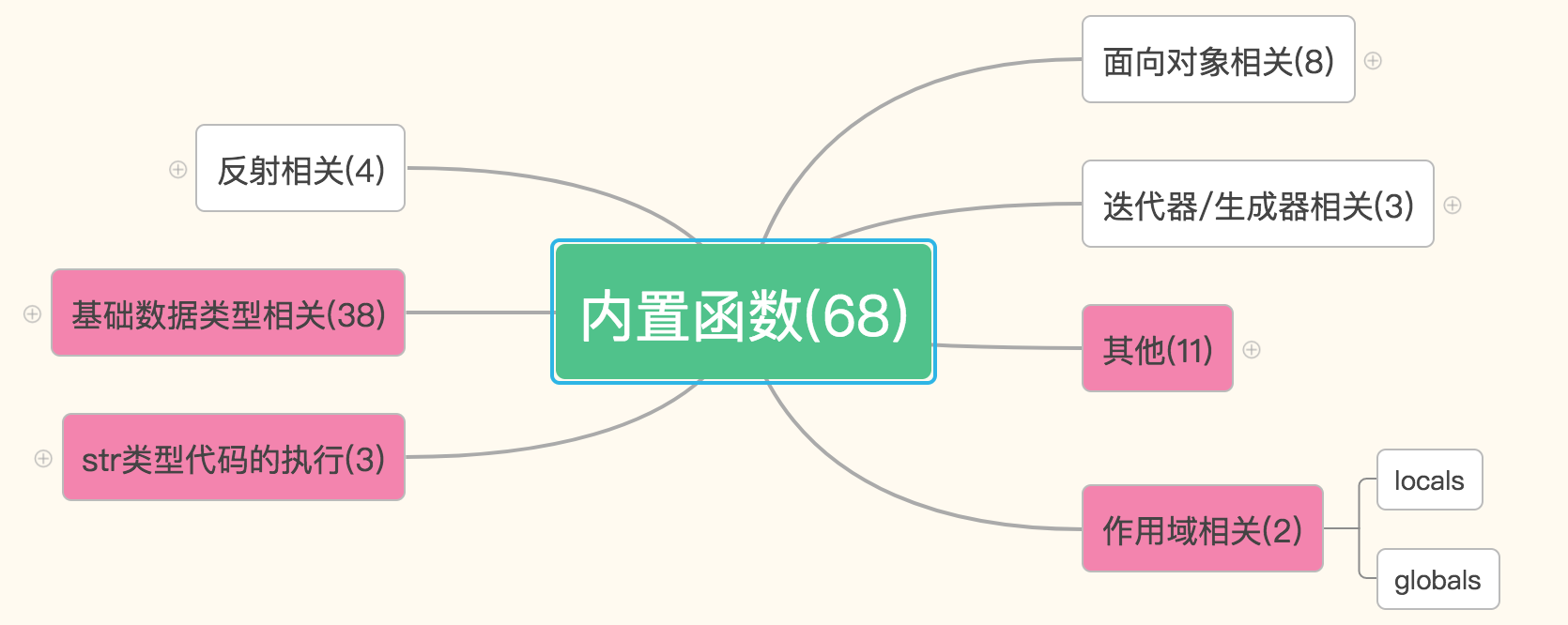
内置函数,内置函数就是python本身定义好的,我们直接拿来就可以用的函数。(python中一共有68中内置函数。)
|
下面我们由作用不同分别进行详述:(字体加粗的为重点要掌握的)
与作用域相关:global和local

- global——获取全局变量的字典
- local——获取执行本方法所在命名空间内的局部变量的字典
str类型代码的执行:eval、exec、compile
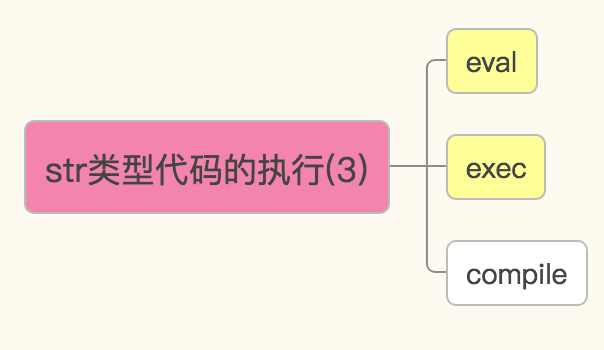
- eval()——将字符串类型的代码执行并返回结果
- exec()——将字符串类型的代码执行但不返回结果
- compile ——将字符串类型的代码编译。代码对象能够通过exec语句来执行或者eval()进行求值
>>> #流程语句使用exec

>>> code1 = 'for i in range(0,10): print (i)'

>>> compile1 = compile(code1,'','exec')

>>> exec (compile1)

1

3

5

7

9

>>> #简单求值表达式用eval

>>> code2 = '1 + 2 + 3 + 4'

>>> compile2 = compile(code2,'','eval')

>>> eval(compile2)

>>> #交互语句用single

>>> code3 = 'name = input("please input your name:")'

>>> compile3 = compile(code3,'','single')

>>> name #执行前name变量不存在

Traceback (most recent call last):

  File "<pyshell#29>", line 1, in <module>

    name

NameError: name 'name' is not defined

>>> exec(compile3) #执行时显示交互命令,提示输入

please input your name:'pythoner'

>>> name #执行后name变量有值

"'pythoner'"
与数字相关的:
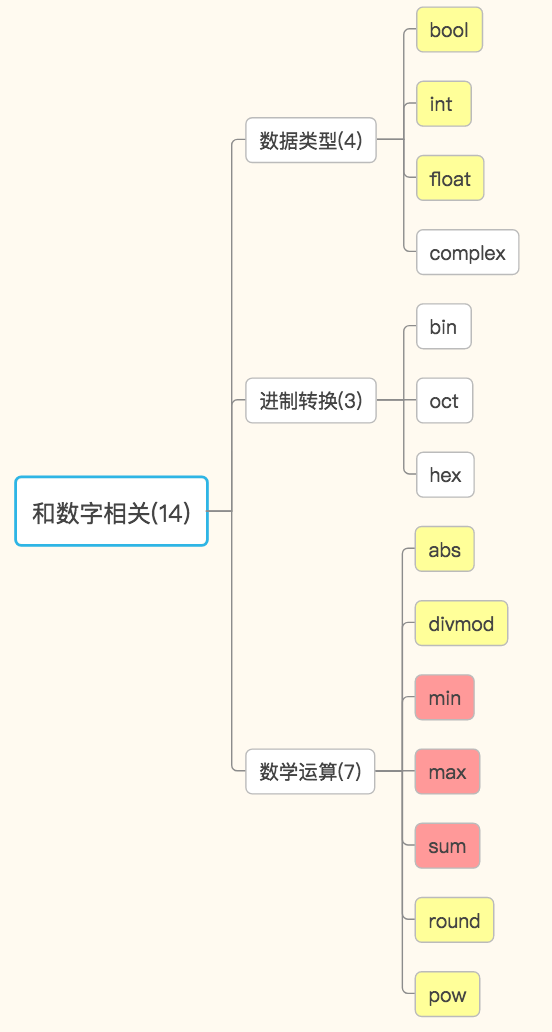
- 数字——数据类型相关:bool,int,float,complex
- 数字——进制转换相关:bin,oct,hex
- 数字——数学运算:abs(输出为数字的绝对值),divmod(使用方法即divmod(数字1,数字2),输出为(数字1整除数字2后得到的数,余数)),min,max,sum,round(精确的功能),pow(pow的使用方法即pow(数字1,数字2),数字1**数字2,即次方的形式)
print(divmod(7,3))#(2,1)

print(round(3.14159,2))#3.14

f = 4.197937590783291932703479  #-->二进制转换的问题

print(f)#4.197937590783292
与数据结构有关:
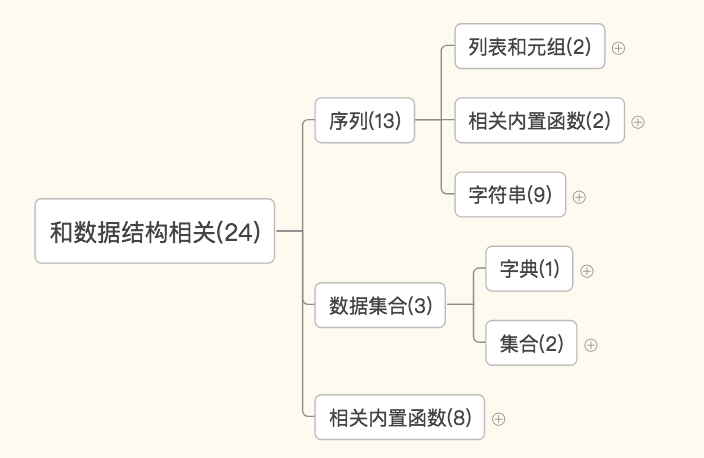
- 序列——列表和元组相关的:list和tuple
- 序列——字符串相关的:str,format,bytes,bytesarry,memoryview,ord(ord与chr互为倒数,不过这不需要掌握),chr(返回表示Unicode代码点为整数i的字符的字符串。例如,
chr(97)返回字符串'a',同时chr(8364)返回字符串'€'),ascii,repr - 序列:reversed(用l.reverse,将原列表翻转并赋值,用list(reversed(l)只是将原列表翻转看看,不改变原列表的值也就是说不覆盖),slice(切片的功能)
- 数据集合——字典和集合:dict,set,frozenset
- 数据集合:len,sorted(排序功能),enumerate(将一个列表的元素由“索引 值”的形式一一解包出来),all,any,zip,filter(一种过滤的功能),map(一种迭代的功能)
l2 = [1,3,5,-2,-4,-6]

print(sorted(l2,key=abs,reverse=True))#[-6, 5, -4, 3, -2, 1]

print(sorted(l2))#[-6, -4, -2, 1, 3, 5]

print(l2)#[1, 3, 5, -2, -4, -6]

l = ['a','b']

for i,j in enumerate(l,1):

    print(i,j)

#1 a

  2 b

L = [1,2,3,4]

def pow2(x):

    return x*x

l=map(pow2,L)

print(list(l))

# 结果:

[1, 4, 9, 16]

def is_odd(x):

    return x % 2 == 1

l=filter(is_odd, [1, 4, 6, 7, 9, 12, 17])

print(list(l))

# 结果:

[1, 7, 9, 17]
其他:

输入输出:input(),print()
- input——与用户交互用的
- print——打印
#print的源码分析:

def print(self, *args, sep=' ', end='\n', file=None): # known special case of print

    """

    print(value, ..., sep=' ', end='\n', file=sys.stdout, flush=False)

    file:  默认是输出到屏幕,如果设置为文件句柄,输出到文件

    sep:   打印多个值之间的分隔符,默认为空格

    end:   每一次打印的结尾,默认为换行符

    flush: 立即把内容输出到流文件,不作缓存

    """

#有关进度条打印的小知识

import time

import sys

for i in range(0,101,2):

     time.sleep(0.1)

     char_num = i//2      #打印多少个#

     per_str = '%s%% : %s\n' % (i, '*' * char_num) if i == 100 else '\r%s%% : %s'%(i,'*'*char_num)

     print(per_str,end='', file=sys.stdout, flush=True)

复制代码
- callable——查看参数是否能被调用
def func():pass

print(callable(func))  #参数是函数名,可调用,返回True

print(callable(123))   #参数是数字,不可调用,返回False
- dir——可用于查看一个数据类型的内置方法,类似于help,是一种帮助
附:可供参考的有关所有内置函数的文档https://docs.python.org/3/library/functions.html#object
what's the python之内置函数的更多相关文章
- Python之内置函数
内置函数 python里的内置函数.截止到python版本3.6.2,现在python一共为我们提供了68个内置函数.它们就是python提供给你直接可以拿来使用的所有函数. 分类学习内置函数: 总共 ...
- python之内置函数(一)
一.内置函数一1.内置函数总览 abs() dict() help() min() setattr()all() dir() hex() next() slice() any() divmod() i ...
- python之内置函数(二)与匿名函数、递归函数初识
一.内置函数(二)1.和数据结构相关(24)列表和元祖(2)list:将一个可迭代对象转化成列表(如果是字典,默认将key作为列表的元素).tuple:将一个可迭代对象转化成元组(如果是字典,默认将k ...
- python之内置函数与匿名函数
一内置函数 # print(abs(-1)) # print(all([1,2,'a',None])) # print(all([])) #bool值为假的情况:None,空,0,False # # ...
- python之内置函数,匿名函数
什么是内置函数? 就是Python给你提供的,拿来直接用的函数,比如print,input等等.其实就是我们在创建.py的时候python解释器所自动生成的内置的函数,就好比我们之前所学的作用空间 内 ...
- python之内置函数,匿名函数,递归函数
一. 内置函函数 什么是内置函数?就是Python给你提供的,拿来直接用的函数,比如print,input等等.截止到python版本3.6.2,现在python一共为我们提供了68个内置函数.它们就 ...
- python之内置函数(lambda,sorted,filter,map),递归,二分法
一.lambda匿名函数 为了解决一些简单需求而设计的一句话函数,lambda表示的是匿名函数,不需要用def来声明,一句话就可以声明出一个函数. 语法: 函数名 = lambda 参数 : 返回值 ...
- Python之内置函数一
一:绝对值,abs i = abs(-123) print(i) # 打印结果 123 二:判断真假,all,与any 对于all # 每个元素都为真,才是True # 假,0,None," ...
- python之内置函数:map ,filter ,reduce总结
map函数: #处理序列中的每个元素,得到的结果是一个'列表',该列表元素个数及位置与原来一样 filter函数: #遍历序列中的每个元素,判断每个元素得到一个布尔值,如果是true,则留下来 peo ...
随机推荐
- android 中文api
http://www.embeddedlinux.org.cn/androidapi/
- 10享元模式Flyweight
一.什么是享元模式 Flyweight模式也叫享元模式,是构造型模式之 一,它通过与其他类似对象共享数据来减小内存 占用. 二.享元模式的结构 三.享元模式的角色和职责 抽象享元角色: 所有具体享元类 ...
- nodejs 单线程 高并发
nodejs为什么是单线程且支持高并发的脚本语言呢? 1.node的优点:I/O密集型处理(node的I/O请求都是异步的,如:sql查询.文件流操作.http请求……):异步I/O?顾名思义就是异步 ...
- webpack之proxyTable配置
有两种情况: 一,有统一的项目名 config下index.js 配置如下: proxyTable: { '/tbt_user':{ target: 'http://47.98.216.251:80' ...
- MacOS install configure php-fpm
php-fpm 是预装在mac os上的,你只需要配置就好了.这个服务监听9000端口. 1. 为配置文件准备一些目录 mkdir -p /usr/share/php/var/run mkdir -p ...
- shell利用数组分割组合字符串
#!/bin/bash #接收脚本参数如[sh a.txt .0_3_4_f_u_c_k_8080] a=$ #把参数分割成数组 arr=(${a//_/ }) #显示数组长度 #echo ${#ar ...
- LinkedIn文本分析平台:主题挖掘的四大技术步骤
作者 Yongzheng (Tiger) Zhang ,译者 木环 ,本人只是备份一下.. LinkedIn前不久发布两篇文章分享了自主研发的文本分析平台Voices的概览和技术细节.LinkedIn ...
- Missing artifact com.h2database:h2:jar:1.4.197
之前OK的项目再次打开pom上报错: 一起出现的现象: maven库中这个包和H2数据库的包每次项目右键→maven→update project都会产生.lastupdate文件.原来是以前从mav ...
- 品尝阿里云容器服务:5个2核4G节点使用情况记载
使用5台2核4G非IO优化的ECS作为节点创建集群,节点操作系统是Ubuntu 16.04.2 LTS.创建后3个为mananger节点,2个为worker节点,每个节点默认会运行7个容器,其中3个s ...
- Python中的FTP通信模块ftplib的用法
Python中默认安装的ftplib模块定义了FTP类,其中函数有限,可用来实现简单的ftp客户端,用于上传或下载文件.FTP的工作流程及基本操作可参考协议RFC959. ftp登陆连接 from f ...