
android ——滑动菜单
一、DrawerLayout是一个拥有两个子控件的布局,第一个子控件是主屏幕中显示的内容,第二个子控件是滑动菜单中显示的内容:
 <android.support.v4.widget.DrawerLayout

     xmlns:android="http://schemas.android.com/apk/res/android"

     xmlns:app="http://schemas.android.com/apk/res-auto"

     android:id="@+id/drawer_layout"

     android:layout_width="match_parent"

     android:layout_height="match_parent"

     >

     <FrameLayout

         android:layout_width="match_parent"

         android:layout_height="match_parent">

         <android.support.v7.widget.Toolbar

             android:id="@+id/toolbar"

             android:layout_width="match_parent"

             android:layout_height="?attr/actionBarSize"

             android:background="?attr/colorPrimary"

             android:theme="@style/ThemeOverlay.AppCompat.Dark.ActionBar"

             app:popupTheme="@style/ThemeOverlay.AppCompat.Light"/>

     </FrameLayout>

     <TextView

         android:layout_width="match_parent"

         android:layout_height="match_parent"

         android:layout_gravity="start"

         android:text="这是一个菜单"

         android:textSize="30sp"

         android:background="#FFF"/>

 </android.support.v4.widget.DrawerLayout>
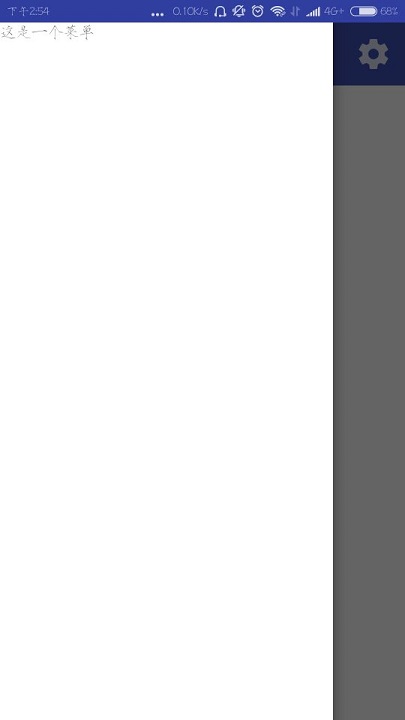
要注意的地方是第二个子控件TextView的layout_gravity属性指定的是滑动菜单是在屏幕的左边还是右边,属性值使用right或者left,这里使用start表示根据系统语言进行判断。
这里的效果是这样:
然后在标题栏上加入一个导航按钮,点击导航按钮也能打开滑动菜单,具体实现原理是,标题栏左方本来就有一个叫作HomeAsup的按钮,它默认的图标是一个返回的箭头,含义是返回上一个活动,所以只需要将它显示出来,修改它的图标和点击事件即可。
具体java代码:
 public class MainActivity extends AppCompatActivity {

     private DrawerLayout mDrawerLayout;

     @Override

     protected void onCreate(Bundle savedInstanceState) {

         super.onCreate(savedInstanceState);

         setContentView(R.layout.activity_main);

         Toolbar toolbar = (Toolbar) findViewById(R.id.toolbar);

         setSupportActionBar(toolbar);

         mDrawerLayout = (DrawerLayout) findViewById(R.id.drawer_layout);

         ActionBar actionBar = getSupportActionBar();

         if(actionBar != null){

             //让ActionBar的HomeAsUp按钮显示出来

             actionBar.setDisplayHomeAsUpEnabled(true);

             //改变HomeAsUp按钮的图标

             actionBar.setHomeAsUpIndicator(R.drawable.ic_action_name);

         }

     }

     ...

     public boolean onOptionsItemSelected(MenuItem item){

         switch (item.getItemId()){

             case android.R.id.home:

                 mDrawerLayout.openDrawer(GravityCompat.START);

                 break;

     ...

             default:

                 break;

         }

         return true;

     }

 }
HomeAsup的id永远都是android.R.id.home,mDrawerLayout.openDrawer(GravityCompat.START)调用这个方法就可以打开滑动菜单。
二、 在滑动菜单中定制任意的布局——使用NavigationView
使用这个NavigationView先要添加一个库,
compile 'com.android.support:design:26.0.0-alpha1'
这里为了一个图片圆形化的功能我又添加了另一个库
compile 'de.hdodenhof:circleimageview:2.1.0'
把DrawerLayout的第二个子控件换成NavigationView,具体代码如下:
 <android.support.v4.widget.DrawerLayout

     xmlns:android="http://schemas.android.com/apk/res/android"

     xmlns:app="http://schemas.android.com/apk/res-auto"

     android:id="@+id/drawer_layout"

     android:layout_width="match_parent"

     android:layout_height="match_parent"

     >

     <FrameLayout

         android:layout_width="match_parent"

         android:layout_height="match_parent">

         <android.support.v7.widget.Toolbar

             android:id="@+id/toolbar"

             android:layout_width="match_parent"

             android:layout_height="?attr/actionBarSize"

             android:background="?attr/colorPrimary"

             android:theme="@style/ThemeOverlay.AppCompat.Dark.ActionBar"

             app:popupTheme="@style/ThemeOverlay.AppCompat.Light"/>

     </FrameLayout>

     <android.support.design.widget.NavigationView

         android:id="@+id/nav_view"

         android:layout_width="match_parent"

         android:layout_height="match_parent"

         android:layout_gravity="start"

         app:menu="@menu/nav_menu"

         app:headerLayout="@layout/nav_header">

     </android.support.design.widget.NavigationView>

 </android.support.v4.widget.DrawerLayout>
app:menu和app:headerLayout两个属性分别指定了NavigationView的具体菜单项和头部布局,这里只是先写好一个名字,还需要去创建这样两个布局文件:
菜单项:
 <menu xmlns:app="http://schemas.android.com/apk/res-auto"

     xmlns:android="http://schemas.android.com/apk/res/android">

     <group android:checkableBehavior="single">

         <item

             android:id="@+id/nav_call"

             android:icon="@drawable/nav_call"

             android:title="Call" />

         <item

             android:id="@+id/nav_friend"

             android:icon="@drawable/nav_friend"

             android:title="Friend" />

         <item

             android:id="@+id/nav_location"

             android:icon="@drawable/nav_location"

             android:title="Location" />

         <item

             android:id="@+id/nav_mail"

             android:icon="@drawable/nav_mail"

             android:title="Mail" />

         <item

             android:id="@+id/nav_task"

             android:icon="@drawable/nav_task"

             android:title="Task" />

     </group>

 </menu>
</menu>里嵌套了一个</group>,然后将group的checkableBehavior属性设置为single表示所有的菜单只能单选。
然后是头部布局:
 <RelativeLayout xmlns:android="http://schemas.android.com/apk/res/android"

     android:orientation="vertical"

     android:layout_width="match_parent"

     android:layout_height="180dp"

     android:padding="10dp"

     android:background="?attr/colorPrimary">

     <de.hdodenhof.circleimageview.CircleImageView

         android:id="@+id/icon_image"

         android:layout_width="70dp"

         android:layout_height="70dp"

         android:src="@drawable/nac_icon"

         android:layout_centerInParent="true"/>

     <TextView

         android:id="@+id/mail"

         android:layout_width="wrap_content"

         android:layout_height="wrap_content"

         android:layout_alignParentBottom="true"

         android:text="943217258@qq.com"

         android:textSize="14sp"

         android:textColor="#FFF"/>

     <TextView

         android:id="@+id/username"

         android:layout_width="wrap_content"

         android:layout_height="wrap_content"

         android:layout_above="@id/mail"

         android:text="一个名字"

         android:textSize="14sp"

         android:textColor="#FFF"/>

 </RelativeLayout>
最终效果:

最后就是菜单项的点击事件了,直接改java代码就行:
  NavigationView navigationView = (NavigationView) findViewById(R.id.nav_view);

  navigationView.setNavigationItemSelectedListener(new NavigationView.OnNavigationItemSelectedListener() {

    @Override

      public boolean onNavigationItemSelected(MenuItem item) {

        switch (item.getItemId()){

            case R.id.nav_call:

                Intent intent = new Intent(MainActivity.this,Main2Activity.class);

                  startActivity(intent);

                  break;

             }

                return true;

         }

     });
android ——滑动菜单的更多相关文章
- Android滑动菜单框架完全解析,教你如何一分钟实现滑动菜单特效
转载请注明出处:http://blog.csdn.net/guolin_blog/article/details/8744400 之前我向大家介绍了史上最简单的滑动菜单的实现方式,相信大家都还记得.如 ...
- Android 滑动菜单SlidingMenu
首先我们看下面视图: 这种效果大家都不陌生,网上好多都说是仿人人网的,估计人家牛逼出来的早吧,我也参考了一一些例子,实现起来有三种方法,我下面简单介绍下: 方法一:其实就是对GestureDetect ...
- 它们的定义android滑动菜单
在这里实现了两个滑动菜单效果,的拖放内容的第一部分,菜单拖出像这样的效果感觉,另一种是拖动内容.后面的内容固定菜单.我感觉有层次感的效果,如下面 第一种效果的代码实现例如以下: package com ...
- Android 滑动菜单框架--SwipeMenuListView框架完全解析
SwipeMenuListView(滑动菜单) A swipe menu for ListView.--一个非常好的滑动菜单开源项目. Demo 一.简介 看了挺长时间的自定义View和事件分发,想找 ...
- Android滑动菜单特效实现,仿人人客户端侧滑效果,史上最简单的侧滑实现
http://blog.csdn.net/guolin_blog/article/details/8714621 http://blog.csdn.net/lmj623565791/article/d ...
- android 滑动菜单SlidingMenu的实现
首先我们看下面视图: 这种效果大家都不陌生,网上好多都说是仿人人网的,估计人家牛逼出来的早吧,我也参考了一一些例子,实现起来有三种方法,我下面简单介绍下: 方法一:其实就是对Gesture ...
- Android滑动菜单使用(MenuDrawer和SlidingMenu)
项目地址: https://github.com/gokhanakkurt/android-menudrawer https://github.com/jfeinstein10/SlidingMe ...
- Android双向滑动菜单完全解析,教你如何一分钟实现双向滑动特效
转载请注明出处:http://blog.csdn.net/guolin_blog/article/details/9671609 记得在很早之前,我写了一篇关于Android滑动菜单的文章,其中有一个 ...
- android 自定义ViewGroup和对view进行切图动画实现滑动菜单SlidingMenu[转]
http://blog.csdn.net/jj120522/article/details/8095852 示意图就不展示了,和上一节的一样,滑动菜单SlidingMenu效果如何大家都比较熟悉,在这 ...
随机推荐
- Anemic Model
In object-oriented programming, and especially in Domain-Driven Design, objects are said to be anemi ...
- String到底在内存中是如何存储的
String会出现在哪些地方 方法内的局部string 类内的字段String static string 容器中存储的string String数组 那么String的位置会影响其存储方式吗? 显然 ...
- android_activity_研究(一)
android中活动的概念(activity)是一个很重要的东东.这里有很多东东值得好好研究.最好的研究来源当然是官网啦,所以本人这里写一点对官网文章的研究心得. 一.活动(activity)的概念 ...
- 20190101.DDD笔记
建立领域模型步骤 根据提供的信息完善主要业务场景和业务流程: 根据业务流程识别领域事件并按照时序排列: 针对领域事件进行命令识别: 针对领域事件和命令进行聚合和子域的初步识别: 在识别的subdoma ...
- 【题解】长度为素数的路径个数-C++
Description 对于正整数n (3≤n<20),可以画出n阶的回形矩阵.下面画出的分别是3阶的,4阶的和7阶的回形矩阵: 对于n阶回形矩阵,从左上角出发,每步可以向右或向下走一格,走2* ...
- Lock和synchronized比较详解(转)
从Java5之后,在java.util.concurrent.locks包下提供了另外一种方式来实现同步访问,那就是Lock. 也许有朋友会问,既然都可以通过synchronized来实现同步访问了, ...
- python函数知识二 动态参数、函数的注释、名称空间、函数的嵌套、global,nonlocal
6.函数的动态参数 *args,**kwargs:能接受动态的位置参数和动态的关键字参数 *args -- tuple *kwargs -- dict 动态参数优先级:位置参数 > 动态位置参数 ...
- E11000 duplicate key error index
E11000 duplicate key error index mongodb插入报错,重复主键问题,有唯一键值重复 一般使用collection.insertOne(doc);插入一条已存在主键的 ...
- linux 反弹shell
Linux下反弹shell笔记 0x00 NC命令详解 在介绍如何反弹shell之前,先了解相关知识要点. nc全称为netcat,所做的就是在两台电脑之间建立链接,并返回两个数据流 可运行在TCP或 ...
- C语言入门3-C语言概述及数据类型
一. 计算机程序设计语言 (计算机语言的发展历史) 1. 机器语言 机器语言 二进制代码语言,由 0和1组成的. 特点是:计算机可以直接识别,不需要进行任何的翻译. 2 ...