
C++强制类型转换操作符 const_cast
const_cast也是一个强制类型转换操作符。《C++ Primer》中是这样描述它的:
1.将转换掉表达式的const性质。
2.只有使用const_cast才能将const性质性质转化掉。试图使用其他三种形式的强制转换都会导致编译时的错误。(添加const还可以用其他转换符,如static_const)
3.除了添加const或删除const特性,使用const_cast符来执行其他任何类型的转换都会引起编译错误。(volatile限定符也包括,不过我不怎么了解,本文主要说const)
对于第一点,转换掉表达式的const性质,意思是可以改变const对象的值了吗?一开始我的确是这样子认为的,于是我敲出了如下的代码:
int main()

{

    const int constant = ;

    const int* const_p = &constant;

    int* modifier = const_cast<int*>(const_p);

    *modifier = ;

    cout<< "constant:  "<<constant<<endl;

    cout<<"*modifier:  "<<*modifier<<endl;

    system("pause");

}
然而程序并没有像预想的那样输出两个3,运行结果是这样的:

看来C++还是很厚道的,对声明为const的变量来说,常量就是常量,任你各种转化,常量的值就是不会变。这是C++的一个承诺。
那既然const变量的值是肯定不会发生变化的,还需要这个const_cast类型转化有何用?这就引出了const_cast的最常用用法:
如果有一个函数,它的形参是non-const类型变量,而且函数不会对实参的值进行改动,这时我们可以使用类型为const的变量来调用函数,此时const_cast就派上用场了。
例如:
void InputInt(int * num)

{

    cout<<*num<<endl;

}

int main()

{

    const int constant = ;

    //InputInt(constant); //error C2664: “InputInt”: 不能将参数 1 从“const int”转换为“int *”

    InputInt(const_cast<int*>(&constant));

    system("pause");

}
除此之外,还有另外一种情况const指针能够派上用场。如果我们定义了一个非const的变量,却使用了一个指向const值的指针来指向它(这不是没事找事嘛),在程序的某处我们想改变这个变量的值了,但手头只持有指针,这是const_cast就可以用到了:
int main()

{

    int constant = ;

    const int* const_p = &constant;

    int* modifier = const_cast<int*>(const_p);

    *modifier = ;

    cout<< "constant:  "<<constant<<endl;

    cout<<"*modifier:  "<<*modifier<<endl;

    system("pause");

}
总结一下上文:const_cast绝对不是为了改变const变量的值而设计的!
在函数参数的传递上const_cast的作用才显现出来。
>>>>>>>>>>>>>>>>>> >>>分割线>>>>>>>>>>>>>>>>>>>>>>>>>
const_cast中的未定义行为
上面的第一段程序,输出变量constant与*modefier的地址后....
int main()

{

    const int constant = ;

    const int* const_p = &constant;

    int* modifier = const_cast<int*>(const_p);

    *modifier = ;

    cout<< "constant:  "<<constant<<"  adderss:  "<< &constant <<endl;

    cout<<"*modifier:  "<<*modifier<<"  adderss:  " << modifier<<endl;

    system("pause");

}
运行结果:
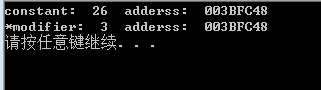
它们的地址是一样的,值却不同。具体原因我还是不大清除。在另外一些博客中看到, *modifier = 3; 这种操作属于一种“未定义行为”,也即是说操作结果C++并没有明确地定义,结果是怎样的完全由编译器的心情决定。对于未定义的行为,我们只能避免之。
关于const_cast是否安全的讨论
逛了一些网站,大致有如下观点:
const_cast is safe only if you're casting a variable that was originally non-const. For example, if you have a function that takes a parameter of a const char *, and you pass in a modifiable char *, it's safe to const_cast that parameter back to a char * and modify it. However, if the original variable was in fact const, then using const_cast will result in undefined behavior.

也即是上文中所说的const_cast的二种适用情况。
I would rather use static cast for the adding constness: static_cast<const sample*>(this). When I'm reading const_cast it means that the code is doing something potentially dangerous, so i try to avoid it's use when possible.

也有人认为const_cast本身就给潜在危险带来可能,所以还是尽可能不用它了。
当需要给变量添加const属性时,使用更为安全的static_cast来代替const_cast。

这里附上讨论链接。const_cast是否安全?
C++强制类型转换操作符 const_cast的更多相关文章
- C++强制类型转换操作符 static_cast
static_cast是一个强制类型转换操作符.强制类型转换,也称为显式转换,C++中强制类型转换操作符有static_cast.dynamic_cast.const_cast.reinterpert ...
- C++强制类型转换操作符 dynamic_cast
dynamic_cast是四个强制类型转换操作符中最特殊的一个,它支持运行时识别指针或引用. >>>>>>>>>>>编译器的RTTI设 ...
- c++强制类型转换(static_cast,const_cast,dynamic_cast,reinterpret_cast)
static_cast <typeid>(exdlvssion) static_cast 很像 C 语言中的旧式类型转换.它能进行基础类型之间的转换,也能将带有可被单参调用的构造函数或用户 ...
- c++强制类型转换:dynamic_cast、const_cast 、static_cast、reinterpret_cast
c++强制类型转换:dynamic_cast.const_cast .static_cast.reinterpret_cast 博客分类: C/C++ CC++C#编程数据结构 dynamic_ca ...
- C++强制类型转换:static_cast、dynamic_cast、const_cast、reinterpret_cast
1. c强制转换与c++强制转换 c语言强制类型转换主要用于基础的数据类型间的转换,语法为: (type-id)expression//转换格式1 type-id(expression)//转换格式2 ...
- 四种强制类型转换的总结(const_cast、static_cast、dynamic_cast、reinterpreter_cast)
四种强制类型转换的总结(const_cast.static_cast.dynamic_cast.reinterpreter_cast) 转载 2011年10月03日 23:59:05 标签: stru ...
- C++里的强制类型转换符reinterpret_cast、static_cast 、dynamic_cast、const_cast 区别
C 风格(C-style)强制转型如下: (T) exdivssion // cast exdivssion to be of type T 函数风格(Function-style)强制转型使用这样的 ...
- 类型转换操作符static_cast、const_cast、dynamic_cast、reinterpret_cast
一.static_cast 对于类型转换,我们常常这么做: (type) expression 引进了static_cast类型转换操作符后,我们只需这样做: static_cast<type& ...
- 《C#高效编程》读书笔记03-推荐使用is或as操作符而不是强制类型转换
在日常编码中,很多时候都要编写接受object作为参数的方法,接下来是将这些object转型成特定类型,要么类,要么接口.这时我们有两种选择,使用as操作符,或者使用强制类型转换. 正确的做法是,尽可 ...
随机推荐
- 使用Access-Control-Allow-Origin解决跨域
什么是跨域 当两个域具有相同的协议(如http), 相同的端口(如80),相同的host(如www.google.com),那么我们就可以认为它们是相同的域(协议,域名,端口都必须相同). 跨域就指着 ...
- SS命令和Netstat命令比较
在早期运维工作中,查看服务器连接数一般都会用netstat命令.其实,有一个命令比netstat更高效,那就是ss(Socket Statistics)命令!ss命令可以用来获取socket统计信息, ...
- php base64 原理
#include <stdio.h> #include <stdlib.h> #include <string.h> static const char base6 ...
- PHP中调用move_uploaded_file函数提示failed to open stream和 Unable to move
在做一个PHP文件上传系统的时候,使用move_uploaded_file进行文件上传,提示下面两个warning,不能成功上传文件 Warning: move_uploaded_file(uploa ...
- C#开源系统大汇总
一.AOP框架 Encase 是C#编写开发的为.NET平台提供的AOP框架.Encase 独特的提供了把方面(aspects)部署到运行时代码,而其它AOP框架依赖配置文件的方式.这种部署方面(as ...
- 异常检测算法--Isolation Forest
南大周志华老师在2010年提出一个异常检测算法Isolation Forest,在工业界很实用,算法效果好,时间效率高,能有效处理高维数据和海量数据,这里对这个算法进行简要总结. iTree 提到森林 ...
- 纯手工打造漂亮的垂直时间轴,使用最简单的HTML+CSS+JQUERY完成100个版本更新记录的华丽转身!
前言 FineUI控件库发展至今已经有 5 个年头,目前论坛注册的QQ会员 5000 多人,捐赠用户 500 多人(捐赠用户转化率达到10%以上,在国内开源领域相信这是一个梦幻数字!也足以证明Fine ...
- window.location.href = window.location.href 跳转无反应 a 超链接 onclick 点击跳转无反应
错误写法 , 主要是在 href="#"这里 <a href="#" id="send" onclick="return b ...
- opencv6.5-imgproc图像处理模块之轮廓
接opencv6.4-imgproc图像处理模块之直方图与模板 这部分的<opencv_tutorial>上都是直接上代码,没有原理部分的解释的. 十一.轮廓 1.图像中找轮廓 /// 转 ...
- 踩到一个Emit的坑,留个纪念
重现代码: var dmFoo = new DynamicMethod("Foo", typeof(void), Type.EmptyTypes); var ilFoo = dmF ...