
schedule与scheduleAtFixedRate之Timer源码分析
执行Timer任务调度方法有如下几种:
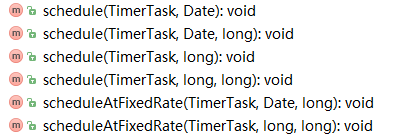
这些方法最后调用的都是这个方法:
private void sched(TimerTask task, long time, long period)
private void sched(TimerTask task, long time, long period) {

        if (time < 0)

            throw new IllegalArgumentException("Illegal execution time.");

        // Constrain value of period sufficiently to prevent numeric

        // overflow while still being effectively infinitely large.

        if (Math.abs(period) > (Long.MAX_VALUE >> 1))

            period >>= 1;

        synchronized(queue) {

            if (!thread.newTasksMayBeScheduled)

                throw new IllegalStateException("Timer already cancelled.");

            synchronized(task.lock) {

                if (task.state != TimerTask.VIRGIN)

                    throw new IllegalStateException(

                        "Task already scheduled or cancelled");

                task.nextExecutionTime = time;

                task.period = period;

                task.state = TimerTask.SCHEDULED;

            }

            queue.add(task);

            if (queue.getMin() == task)

                queue.notify();

        }

    }
public void run() {

        try {

            mainLoop();

        } finally {

            // Someone killed this Thread, behave as if Timer cancelled

            synchronized(queue) {

                newTasksMayBeScheduled = false;

                queue.clear();  // Eliminate obsolete references

            }

        }

    }

    /**

     * The main timer loop.  (See class comment.)

     */

    private void mainLoop() {

        while (true) {

            try {

                TimerTask task;

                boolean taskFired;

                synchronized(queue) {

                    // Wait for queue to become non-empty,等待被notify激活

                    while (queue.isEmpty() && newTasksMayBeScheduled)

                        queue.wait();

                    if (queue.isEmpty())

                        break; // Queue is empty and will forever remain; die

                    // Queue nonempty; look at first evt and do the right thing

                    long currentTime, executionTime;

                    task = queue.getMin();

                    synchronized(task.lock) {

                        if (task.state == TimerTask.CANCELLED) {

                            queue.removeMin();

                            continue;  // No action required, poll queue again

                        }

                        currentTime = System.currentTimeMillis();

                        executionTime = task.nextExecutionTime;

                // 任务执行时间已经到达

                        if (taskFired = (executionTime<=currentTime)) {

                            if (task.period == 0) { // 如果period=0,则任务进行一次便结束,并移出队列

                                queue.removeMin();

                                task.state = TimerTask.EXECUTED;

                            } else { // 设置下一次执行的时间

                                     // task.period<0 对应 scheduleAtFixedRate 方法

                                     // task.period>0 对应 schedule 方法

                                queue.rescheduleMin(

                                  task.period<0 ? currentTime   - task.period

                                                : executionTime + task.period);

                            }

                        }

                    }

                    // 任务执行时间没到,等待,直到下一次执行时间大于当前时间

                    if (!taskFired)

                        queue.wait(executionTime - currentTime);

                }

                // 执行任务时间到达,开始执行任务,没有加锁,并发执行

                if (taskFired)  // Task fired; run it, holding no locks

                    task.run();

            } catch(InterruptedException e) {

            }

        }

    }
schedule与scheduleAtFixedRate之Timer源码分析的更多相关文章
- Unity时钟定时器插件——Vision Timer源码分析之二
Unity时钟定时器插件——Vision Timer源码分析之二 By D.S.Qiu 尊重他人的劳动,支持原创,转载请注明出处:http.dsqiu.iteye.com 前面的已经介绍了vp_T ...
- 并发编程 —— Timer 源码分析
前言 在平时的开发中,肯定需要使用定时任务,而 Java 1.3 版本提供了一个 java.util.Timer 定时任务类.今天一起来看看这个类. 1.API 介绍 Timer 相关的有 3 个类: ...
- Java并发编程笔记之Timer源码分析
timer在JDK里面,是很早的一个API了.具有延时的,并具有周期性的任务,在newScheduledThreadPool出来之前我们一般会用Timer和TimerTask来做,但是Timer存在一 ...
- Unity时钟定时器插件——Vision Timer源码分析之一
因为项目中,UI的所有模块都没有MonBehaviour类(纯粹的C#类),只有像NGUI的基本组件的类是继承MonoBehaviour.因为没有继承MonoBehaviour,这也不能使用Updat ...
- storm定时器timer源码分析-timer.clj
storm定时器与java.util.Timer定时器比较相似.java.util.Timer定时器实际上是个线程,定时调度所拥有的TimerTasks:storm定时器也有一个线程负责调度所拥有的& ...
- JUC源码分析-线程池篇(三)Timer
JUC源码分析-线程池篇(三)Timer Timer 是 java.util 包提供的一个定时任务调度器,在主线程之外起一个单独的线程执行指定的计划任务,可以指定执行一次或者反复执行多次. 1. Ti ...
- Nimbus<二>storm启动nimbus源码分析-nimbus.clj
nimbus是storm集群的"控制器",是storm集群的重要组成部分.我们可以通用执行bin/storm nimbus >/dev/null 2>&1 &a ...
- python线程threading.Timer源码解读
threading.Timer的作用 官方给的定义是: """Call a function after a specified number of seconds: t ...
- [源码分析] 并行分布式任务队列 Celery 之 Timer & Heartbeat
[源码分析] 并行分布式任务队列 Celery 之 Timer & Heartbeat 目录 [源码分析] 并行分布式任务队列 Celery 之 Timer & Heartbeat 0 ...
随机推荐
- Sprint第一个冲刺(第十天)
一.Sprint介绍 更新工程部署文件:实现了云端登录:设计经营情况以及数据分析界面. 实验截图: 任务进度: 二.Sprint周期 看板: 燃尽图:
- 转:Excel导入SQL数据库完整代码
Excel导入SQL数据库完整代码 protected void studentload_Click(object sender, EventArgs e) {//批量添加学生信息 SqlConnec ...
- bzoj 3779 重组病毒——LCT维护子树信息
题目:https://www.lydsy.com/JudgeOnline/problem.php?id=3779 调了很久……已经懒得写题解了.https://www.cnblogs.com/Zinn ...
- bzoj 3671 [Noi2014]随机数生成器——贪心(时间复杂度分配)
题目:https://www.lydsy.com/JudgeOnline/problem.php?id=3671 设 x 为一个点的行号, y 为一个点的列号:原本想着判断一个点能不能选就是看选了的点 ...
- angular(mvc)指令的嵌套使用
关于指令嵌套的使用,取值问题. 原理类似于控制器中使用指令,父指令类似于控制器,子指令就类似于控制器中指令.通过传值方式‘=’,我们直接可以在父指令中获取数据 举一个例子: 有个指令parentDir ...
- Linux下定时执行任务(crontab命令)
1.循环执行的计划任务 linux下面有atd和crond两种计划任务,其中,atd服务使用的at命令只能执行一次,而crond服务使用的crontab定义的命令,是循环作用的,所以crond才符合我 ...
- CArray,CList,CMap如何实例化
1.定义一个CMap,向这个CMap中增加数据项(键-值对).CMap<CString, LPCTSTR, CString, LPCTSTR>m_ItemMap;CString strKe ...
- java代码----I/O流从控制台输入信息判断并抛出异常
package com.a.b; import java.io.*; public class Yu { public static void main(String[] args) throws I ...
- 利用nginx_push_stream_module实现服务器消息推送
NGiNX_HTTP_Push_Module 是一个 Nginx 的扩展模块,它实现了 HTTP Push 和Comet server的功能.HTTP Push 被经常用在网页上主动推的技术,例如一些 ...
- 第十章 Secret & Configmap (中)
10.3 在Pod中使用Secret 10.3.1 Volume方式 apiVersion: v1 kind: Pod metaata: name: mypod spec: containers: - ...