
深度学习之DCGAN
1、知识点
"""

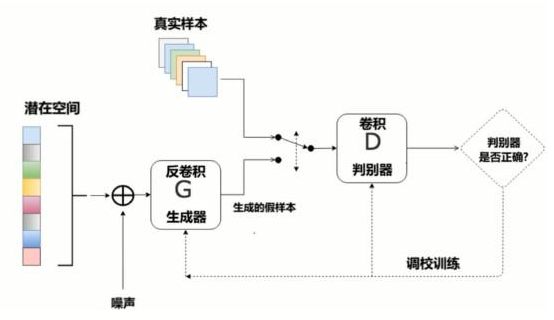
DCGAN:相比GAN而言,使用了卷积网络替代全连接

卷积:256*256*3 --- > 28*28*14  -->结果 ,即H,W变小,特征图变多

反卷积(就是把卷积的前向和反向传播完全颠倒了) :4*4*1024 ---> 28 * 28 *1  -->结果 即H,W变大,特征图变少

特点:

    1、判别模型:使用带步长的卷积(strided convolutions)取代了的空间池化(spatial pooling),容许网络学习自己的空间下采样(spatial downsampling)。

    2、生成模型:使用微步幅卷积(fractional strided),容许它学习自己的空间上采样(spatial upsampling)。

    3、激活函数: LeakyReLU

    4、Batch Normalization 批标准化:解决因糟糕的初始化引起的训练问题,使得梯度能传播更深层次。 Batch Normalization证明了生成模型初始化的重要性,避免生成模型崩溃:生成的所有样本都在一个点上(样本相同),这是训练GANs经常遇到的失败现象。


简而言之,DCGAN是利用数据生成图片的过程
"""
2、代码
# coding: utf-8

import numpy as np

import tensorflow as tf

import pickle

import matplotlib.pyplot as plt

get_ipython().run_line_magic('matplotlib', 'inline')

from tensorflow.examples.tutorials.mnist import input_data

mnist = input_data.read_data_sets('/MNIST_data/')

# ## 获得数据

# In[4]:

def get_inputs(noise_dim, image_height, image_width, image_depth):

    inputs_real = tf.placeholder(tf.float32, [None, image_height, image_width, image_depth], name='inputs_real')

    inputs_noise = tf.placeholder(tf.float32, [None, noise_dim], name='inputs_noise')

    return inputs_real, inputs_noise

# # 生成器

# In[5]:

def get_generator(noise_img, output_dim, is_train=True, alpha=0.01):

    with tf.variable_scope("generator", reuse=(not is_train)):

        # 100 x 1 to 4 x 4 x 512

        # 全连接层

        layer1 = tf.layers.dense(noise_img, 4*4*512)

        layer1 = tf.reshape(layer1, [-1, 4, 4, 512])

        # batch normalization

        layer1 = tf.layers.batch_normalization(layer1, training=is_train)

        # Leaky ReLU

        layer1 = tf.maximum(alpha * layer1, layer1)

        # dropout

        layer1 = tf.nn.dropout(layer1, keep_prob=0.8)

        # 4 x 4 x 512 to 7 x 7 x 256

        layer2 = tf.layers.conv2d_transpose(layer1, 256, 4, strides=1, padding='valid')

        layer2 = tf.layers.batch_normalization(layer2, training=is_train)

        layer2 = tf.maximum(alpha * layer2, layer2)

        layer2 = tf.nn.dropout(layer2, keep_prob=0.8)

        # 7 x 7 256 to 14 x 14 x 128

        layer3 = tf.layers.conv2d_transpose(layer2, 128, 3, strides=2, padding='same')

        layer3 = tf.layers.batch_normalization(layer3, training=is_train)

        layer3 = tf.maximum(alpha * layer3, layer3)

        layer3 = tf.nn.dropout(layer3, keep_prob=0.8)

        # 14 x 14 x 128 to 28 x 28 x 1

        logits = tf.layers.conv2d_transpose(layer3, output_dim, 3, strides=2, padding='same')

        # MNIST原始数据集的像素范围在0-1,这里的生成图片范围为(-1,1)

        # 因此在训练时,记住要把MNIST像素范围进行resize

        outputs = tf.tanh(logits)

        return outputs

# ## 判别器

# In[6]:

def get_discriminator(inputs_img, reuse=False, alpha=0.01):

    with tf.variable_scope("discriminator", reuse=reuse):

        # 28 x 28 x 1 to 14 x 14 x 128

        # 第一层不加入BN

        layer1 = tf.layers.conv2d(inputs_img, 128, 3, strides=2, padding='same')

        layer1 = tf.maximum(alpha * layer1, layer1)

        layer1 = tf.nn.dropout(layer1, keep_prob=0.8)

        # 14 x 14 x 128 to 7 x 7 x 256

        layer2 = tf.layers.conv2d(layer1, 256, 3, strides=2, padding='same')

        layer2 = tf.layers.batch_normalization(layer2, training=True)

        layer2 = tf.maximum(alpha * layer2, layer2)

        layer2 = tf.nn.dropout(layer2, keep_prob=0.8)

        # 7 x 7 x 256 to 4 x 4 x 512

        layer3 = tf.layers.conv2d(layer2, 512, 3, strides=2, padding='same')

        layer3 = tf.layers.batch_normalization(layer3, training=True)

        layer3 = tf.maximum(alpha * layer3, layer3)

        layer3 = tf.nn.dropout(layer3, keep_prob=0.8)

        # 4 x 4 x 512 to 4*4*512 x 1

        flatten = tf.reshape(layer3, (-1, 4*4*512))

        logits = tf.layers.dense(flatten, 1)

        outputs = tf.sigmoid(logits)

        return logits, outputs

# ## 目标函数

# In[7]:

def get_loss(inputs_real, inputs_noise, image_depth, smooth=0.1):

    g_outputs = get_generator(inputs_noise, image_depth, is_train=True)

    d_logits_real, d_outputs_real = get_discriminator(inputs_real)

    d_logits_fake, d_outputs_fake = get_discriminator(g_outputs, reuse=True)

    # 计算Loss

    g_loss = tf.reduce_mean(tf.nn.sigmoid_cross_entropy_with_logits(logits=d_logits_fake,

                                                                    labels=tf.ones_like(d_outputs_fake)*(1-smooth)))

    d_loss_real = tf.reduce_mean(tf.nn.sigmoid_cross_entropy_with_logits(logits=d_logits_real,

                                                                         labels=tf.ones_like(d_outputs_real)*(1-smooth)))

    d_loss_fake = tf.reduce_mean(tf.nn.sigmoid_cross_entropy_with_logits(logits=d_logits_fake,

                                                                         labels=tf.zeros_like(d_outputs_fake)))

    d_loss = tf.add(d_loss_real, d_loss_fake)

    return g_loss, d_loss

# ## 优化器

# In[8]:

def get_optimizer(g_loss, d_loss, beta1=0.4, learning_rate=0.001):

    train_vars = tf.trainable_variables()

    g_vars = [var for var in train_vars if var.name.startswith("generator")]

    d_vars = [var for var in train_vars if var.name.startswith("discriminator")]

    # Optimizer

    with tf.control_dependencies(tf.get_collection(tf.GraphKeys.UPDATE_OPS)):

        g_opt = tf.train.AdamOptimizer(learning_rate).minimize(g_loss, var_list=g_vars)

        d_opt = tf.train.AdamOptimizer(learning_rate).minimize(d_loss, var_list=d_vars)

    return g_opt, d_opt

# In[9]:

def plot_images(samples):

    fig, axes = plt.subplots(nrows=1, ncols=25, sharex=True, sharey=True, figsize=(50,2))

    for img, ax in zip(samples, axes):

        ax.imshow(img.reshape((28, 28)), cmap='Greys_r')

        ax.get_xaxis().set_visible(False)

        ax.get_yaxis().set_visible(False)

    fig.tight_layout(pad=0)

# In[10]:

def show_generator_output(sess, n_images, inputs_noise, output_dim):

    cmap = 'Greys_r'

    noise_shape = inputs_noise.get_shape().as_list()[-1]

    # 生成噪声图片

    examples_noise = np.random.uniform(-1, 1, size=[n_images, noise_shape])

    samples = sess.run(get_generator(inputs_noise, output_dim, False),

                       feed_dict={inputs_noise: examples_noise})

    result = np.squeeze(samples, -1)

    return result

# ## 训练网络

# In[11]:

# 定义参数

batch_size = 64

noise_size = 100

epochs = 5

n_samples = 25

learning_rate = 0.001

# In[12]:

def train(noise_size, data_shape, batch_size, n_samples):

    # 存储loss

    losses = []

    steps = 0

    inputs_real, inputs_noise = get_inputs(noise_size, data_shape[1], data_shape[2], data_shape[3])

    g_loss, d_loss = get_loss(inputs_real, inputs_noise, data_shape[-1])

    g_train_opt, d_train_opt = get_optimizer(g_loss, d_loss, beta1, learning_rate)

    with tf.Session() as sess:

        sess.run(tf.global_variables_initializer())

        # 迭代epoch

        for e in range(epochs):

            for batch_i in range(mnist.train.num_examples//batch_size):

                steps += 1

                batch = mnist.train.next_batch(batch_size)

                batch_images = batch[0].reshape((batch_size, data_shape[1], data_shape[2], data_shape[3]))

                # scale to -1, 1

                batch_images = batch_images * 2 - 1

                # noise

                batch_noise = np.random.uniform(-1, 1, size=(batch_size, noise_size))

                # run optimizer

                _ = sess.run(g_train_opt, feed_dict={inputs_real: batch_images,

                                                     inputs_noise: batch_noise})

                _ = sess.run(d_train_opt, feed_dict={inputs_real: batch_images,

                                                     inputs_noise: batch_noise})

                if steps % 101 == 0:

                    train_loss_d = d_loss.eval({inputs_real: batch_images,

                                                inputs_noise: batch_noise})

                    train_loss_g = g_loss.eval({inputs_real: batch_images,

                                                inputs_noise: batch_noise})

                    losses.append((train_loss_d, train_loss_g))

                    # 显示图片

                    samples = show_generator_output(sess, n_samples, inputs_noise, data_shape[-1])

                    plot_images(samples)

                    print("Epoch {}/{}....".format(e+1, epochs),

                          "Discriminator Loss: {:.4f}....".format(train_loss_d),

                          "Generator Loss: {:.4f}....". format(train_loss_g))

# In[13]:

with tf.Graph().as_default():

    train(noise_size, [-1, 28, 28, 1], batch_size, n_samples)
3、结构图
深度学习之DCGAN的更多相关文章
- 【神经网络与深度学习】DCGAN及其TensorFlow源码
上一节我们提到G和D由多层感知机定义.深度学习中对图像处理应用最好的模型是CNN,那么如何把CNN与GAN结合?DCGAN是这方面最好的尝试之一.源码:https://github.com/Newmu ...
- 【深度学习】--DCGAN从入门到实例应用
一.前述 DCGAN就是Deep Concolutions应用到GAN上,但是和传统的卷积应用还有一些区别,最大的区别就是没有池化层.本文将详细分析卷积在GAN上的应用. 二.具体 1.DCGAN和传 ...
- 深度学习算法 之DCGAN(写得不系统,后期再总结,大家可简单阅览一下)
目录 1.基本介绍 2.模型 3.优缺点/其他 参考 1.基本介绍 DCGAN是生成对抗网络GAN中一种常见的模型结构.其中的生成器和判别器都是神经网络模型. GAN是一种生成式对抗网络,即通过对抗的 ...
- GitHub 上 57 款最流行的开源深度学习项目
转载:https://www.oschina.net/news/79500/57-most-popular-deep-learning-project-at-github GitHub 上 57 款最 ...
- CNCC2017中的深度学习与跨媒体智能
CNCC2017中的深度学习与跨媒体智能 转载请注明作者:梦里茶 目录 机器学习与跨媒体智能 传统方法与深度学习 图像分割 小数据集下的深度学习 语音前沿技术 生成模型 基于贝叶斯的视觉信息编解码 珠 ...
- Hinton“深度学习之父”和“神经网络先驱”,新论文Capsule将推翻自己积累了30年的学术成果时
Hinton“深度学习之父”和“神经网络先驱”,新论文Capsule将推翻自己积累了30年的学术成果时 在论文中,Capsule被Hinton大神定义为这样一组神经元:其活动向量所表示的是特定实体类型 ...
- (zhuan) 126 篇殿堂级深度学习论文分类整理 从入门到应用
126 篇殿堂级深度学习论文分类整理 从入门到应用 | 干货 雷锋网 作者: 三川 2017-03-02 18:40:00 查看源网址 阅读数:66 如果你有非常大的决心从事深度学习,又不想在这一行打 ...
- (zhuan) 深度学习全网最全学习资料汇总之模型介绍篇
This blog from : http://weibo.com/ttarticle/p/show?id=2309351000224077630868614681&u=5070353058& ...
- Github上Stars最多的53个深度学习项目,TensorFlow遥遥领先
原文:https://github.com/aymericdamien/TopDeepLearning 项目名称 Stars 项目介绍 TensorFlow 29622 使用数据流图计算可扩展机器学习 ...
随机推荐
- Linux上jdk,mysql,tomcat安装
一:RPM(红帽软件包管理器):相当于windows的添加/卸载程序(控制面板),进行程序的安装.更新.卸载.查看: 本地程序安装:rpm -ivh 程序名 本地程序查看:rpm -qa 本地程序卸载 ...
- 用 Spark 处理复杂数据类型(Array、Map、JSON字符串等)
split 对列表进行切割,然后生产新的列表 from pyspark.sql.functions import split# 对 key列按照 0-9之间的数字进行风格 重新命名为 s df.se ...
- centos 最小化安装pycharm
首先找到安装地址 https://www.jetbrains.com/pycharm/download/#section=linux 选择linux. 打开浏览器的network监视,我用的chrom ...
- string::capacity string::size string::length string::max_size
size_t capacity() const noexcept; #include <iostream>#include <string> using namespace s ...
- appium连接Android真机,并调试
Android真机:华为pad2 Android和Windows连接同一个局域网 连接USB Android机设置: 打开USB调试 cmd>adb devices,显示Android序列号 , ...
- dcm4che-core导包失败! mvn pom文件导包总是失败
原因可能是所导的包不在共有项目中,可能在个人项目中,需要添加远程仓库 <!--远程仓库部署--><repositories> <repository> <id ...
- 洛谷P1282 多米诺骨牌【线性dp】
题目:https://www.luogu.org/problemnew/show/P1282 题意: 给定n个牌,每个牌有一个上点数和下点数.可以通过旋转改变交换上下点数. 问使得上点数之和和下点数之 ...
- nginx配置项
try_files location / { try_files $uri $uri/ /index.php?$query_string; } 当用户请求 http://host/instance时, ...
- 洛谷P1436 棋盘分割
洛谷题目链接 动态规划: 我们设状态$f[i][j][o][p][k]$表示一个矩形,左上角顶点坐标为$(i,j)$,右下角顶点坐标为$(o,p)$时分割了$k$次,也就是说现在是$k+1$块 我们考 ...
- Redis evalsha 命令
相当于根据sha1校验码,执行缓存在服务器的一段代码. 这个命令的使用方法类似eval--参数的传入方式等等 使用需要redis版本 >= 2.6.0 语法 *> evalsha sha1 ...