
Autofac实现拦截器和切面编程
Autofac.Annotation框架是我用.netcore写的一个注解式DI框架,基于Autofac参考 Spring注解方式所有容器的注册和装配,切面,拦截器等都是依赖标签来完成。
开源地址:https://github.com/yuzd/Autofac.Annotation
本期讲的是最新重构的功能,这个功能也是赋予了这个框架的无限可能,也是我觉得设计的比较好的地方, 今天来说说我是怎么设计的
切面和拦截器介绍
拦截器是什么?
可以帮助我们方便在执行目标方法的
前(Before) 后(After) 返回值时(AfterReturn) 抛错误时(AfterThrowing) 环绕(Around)
简单示例:
    //自己实现一个拦截器

    public class TestHelloBefore:AspectBefore

    {

        public override Task Before(AspectContext aspectContext)

        {

            Console.WriteLine("TestHelloBefore");

            return Task.CompletedTask;

        }

    }


    [Component]

    public class TestHello

    {

        [TestHelloBefore]//打上拦截器

        public virtual void Say()

        {

            Console.WriteLine("Say");

        }

    }
先执行 TestHelloBefor的Before方法再执行你的Say方法
更多使用示例请查看 Aspect拦截器
切面是什么?
定义一个切面(根据筛选器去实现满足条件的多个类的多个方法的“拦截器”
简单示例:
    [Component]

    public class ProductController

    {

        public virtual string GetProduct(string productId)

        {

            return "GetProduct:" + productId;

        }


        public virtual string UpdateProduct(string productId)

        {

            return "UpdateProduct:" + productId;

        }

    }


    [Component]

    public class UserController

    {

        public virtual string GetUser(string userId)

        {

            return "GetUser:" + userId;

        }


        public virtual string DeleteUser(string userId)

        {

            return "DeleteUser:" + userId;

        }

    }


    // *Controller 代表匹配 只要是Controller结尾的类都能匹配

    // Get* 代表上面匹配成功的类下 所以是Get打头的方法都能匹配

    [Pointcut(Class = "*Controller",Method = "Get*")]

    public class LoggerPointCut

    {

        [Around]

        public async Task Around(AspectContext context,AspectDelegate next)

        {

            Console.WriteLine("PointcutTest1.Around-start");

            await next(context);

            Console.WriteLine("PointcutTest1.Around-end");

        }

        [Before]

        public void Before()

        {

            Console.WriteLine("PointcutTest1.Before");


        }


        [After]

        public void After()

        {

            Console.WriteLine("PointcutTest1.After");


        }


        [AfterReturn(Returing = "value1")]

        public void AfterReturn(object value1)

        {

            Console.WriteLine("PointcutTest1.AfterReturn");

        }


        [AfterThrows(Throwing = "ex1")]

        public void Throwing(Exception ex1)

        {

            Console.WriteLine("PointcutTest1.Throwing");

        }

    }
更多示例请查看 Pointcut切面编程
如何实现的
分为3步
1.搜集拦截算子(比如Before/After等这个我们叫算子) 2.构造拦截器链(按照上面图的方式把算子链接起来) 3.生成代理类代理目标方法去执行上面构造的拦截器链
1.搜集拦截算子
因为拦截器的使用是约定了要继承 AspectInvokeAttribute
    /// <summary>

    ///     AOP拦截器 默认包含继承关系

    /// </summary>

    [AttributeUsage(AttributeTargets.Method | AttributeTargets.Class)]

    public class AspectInvokeAttribute : Attribute

    {

        /// <summary>

        ///     排序 值越低,优先级越高

        /// </summary>

        public int OrderIndex { get; set; }

        /// <summary>

        ///     分组名称

        /// </summary>

        public string GroupName { get; set; }

    }
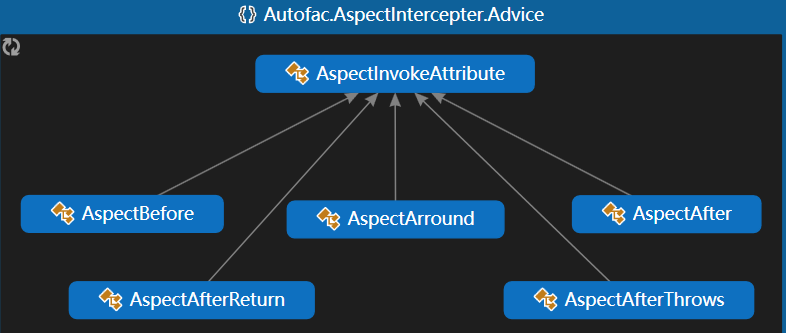
这一组注解是暴露给外部使用,来搜集哪些类的哪些方法需要增强
接下来需要去针对性去实现每一种增强器要做的事情
定义一个增强器接口IAdvice
    internal interface IAdvice

    {

        /// <summary>

        ///  拦截器方法

        /// </summary>

        /// <param name="aspectContext">执行上下文</param>

        /// <param name="next">下一个增强器</param>

        /// <returns></returns>

        Task OnInvocation(AspectContext aspectContext, AspectDelegate next);

    }

Before增强器
    /// <summary>

    /// 前置增强器

    /// </summary>

    internal class AspectBeforeInterceptor : IAdvice

    {

        private readonly AspectBefore _beforeAttribute;

        public AspectBeforeInterceptor(AspectBefore beforeAttribute)

        {

            _beforeAttribute = beforeAttribute;

        }

        public async Task OnInvocation(AspectContext aspectContext, AspectDelegate next)

        {

            //先执行Before逻辑

            await this._beforeAttribute.Before(aspectContext);

            //在走下一个增强器

            await next.Invoke(aspectContext);

        }

    }
After增强器
    /// <summary>

    /// 后置增强器

    /// </summary>

    internal class AspectAfterInterceptor : IAdvice

    {

        private readonly AspectAfter _afterAttribute;

        private readonly bool _isAfterAround;

        public AspectAfterInterceptor(AspectAfter afterAttribute, bool isAfterAround = false)

        {

            _afterAttribute = afterAttribute;

            _isAfterAround = isAfterAround;

        }

        public async Task OnInvocation(AspectContext aspectContext, AspectDelegate next)

        {

            try

            {

                if (!_isAfterAround) await next.Invoke(aspectContext);

            }

            finally

            {

                //不管成功还是失败都会执行的

                 await this._afterAttribute.After(aspectContext, aspectContext.Exception ?? aspectContext.ReturnValue);

            }

        }

    }
环绕增强器
    /// <summary>

    /// 环绕返回拦截处理器

    /// </summary>

    internal class AspectAroundInterceptor : IAdvice

    {

        private readonly AspectArround _aroundAttribute;

        private readonly AspectAfterInterceptor _aspectAfter;

        private readonly AspectAfterThrowsInterceptor _aspectThrows;

        public AspectAroundInterceptor(AspectArround aroundAttribute, AspectAfter aspectAfter, AspectAfterThrows chainAspectAfterThrows)

        {

            _aroundAttribute = aroundAttribute;

            if (aspectAfter != null)

            {

                _aspectAfter = new AspectAfterInterceptor(aspectAfter, true);

            }

            if (chainAspectAfterThrows != null)

            {

                _aspectThrows = new AspectAfterThrowsInterceptor(chainAspectAfterThrows, true);

            }

        }

        public async Task OnInvocation(AspectContext aspectContext, AspectDelegate next)

        {

            Exception exception = null;

            try

            {

                if (_aroundAttribute != null)

                {

                    await _aroundAttribute.OnInvocation(aspectContext, next);

                    return;

                }

            }

            catch (Exception ex)

            {

                exception = ex;

            }

            finally

            {

                if (exception == null && _aspectAfter != null) await _aspectAfter.OnInvocation(aspectContext, next);

            }

            try

            {

                if (exception != null && _aspectAfter != null)

                {

                    await _aspectAfter.OnInvocation(aspectContext, next);

                }

                if (exception != null && _aspectThrows != null)

                {

                    await _aspectThrows.OnInvocation(aspectContext, next);

                }

            }

            finally

            {

                if (exception != null) throw exception;

            }

        }

    }
返回值增强器
    /// <summary>

    /// 后置返值增强器

    /// </summary>

    internal class AspectAfterReturnInterceptor : IAdvice

    {

        private readonly AspectAfterReturn _afterAttribute;

        public AspectAfterReturnInterceptor(AspectAfterReturn afterAttribute)

        {

            _afterAttribute = afterAttribute;

        }

        public async Task OnInvocation(AspectContext aspectContext, AspectDelegate next)

        {

            await next.Invoke(aspectContext);

            //执行异常了不执行after 去执行Throw

            if (aspectContext.Exception != null)

            {

                return;

            }

            if (_afterAttribute != null)

            {

                await this._afterAttribute.AfterReturn(aspectContext, aspectContext.ReturnValue);

            }

        }

    }
异常返回增强器
    /// <summary>

    /// 异常返回增强器

    /// </summary>

    internal class AspectAfterThrowsInterceptor : IAdvice

    {

        private readonly AspectAfterThrows _aspectThrowing;

        private readonly bool _isFromAround;

        public AspectAfterThrowsInterceptor(AspectAfterThrows throwAttribute, bool isFromAround = false)

        {

            _aspectThrowing = throwAttribute;

            _isFromAround = isFromAround;

        }

        public async Task OnInvocation(AspectContext aspectContext, AspectDelegate next)

        {

            try

            {

                if (!_isFromAround) await next.Invoke(aspectContext);

            }

            finally

            {

                //只有目标方法出现异常才会走 增强的方法出异常不要走

                if (aspectContext.Exception != null)

                {

                    Exception ex = aspectContext.Exception;

                    if (aspectContext.Exception is TargetInvocationException targetInvocationException)

                    {

                        ex = targetInvocationException.InnerException;

                    }

                    if (ex == null)

                    {

                        ex = aspectContext.Exception;

                    }

                    var currentExType = ex.GetType();

                    if (_aspectThrowing.ExceptionType == null || _aspectThrowing.ExceptionType == currentExType)

                    {

                        await _aspectThrowing.AfterThrows(aspectContext, aspectContext.Exception);

                    }

                }

            }

        }

    }
2. 组装增强器们成为一个调用链

每一个node的有三个信息,如下
    /// <summary>

    /// 拦截node组装

    /// </summary>

    internal class AspectMiddlewareComponentNode

    {

        /// <summary>

        /// 下一个

        /// </summary>

        public AspectDelegate Next;

        /// <summary>

        /// 执行器

        /// </summary>

        public AspectDelegate Process;

        /// <summary>

        /// 组件

        /// </summary>

        public Func<AspectDelegate, AspectDelegate> Component;

    }
采用LinkedList来构建我们的拉链式调用, 我们把上面的每个增强器作为一个个middeware,添加进来。
    internal class AspectMiddlewareBuilder

    {

        private readonly LinkedList<AspectMiddlewareComponentNode> Components = new LinkedList<AspectMiddlewareComponentNode>();

        /// <summary>

        /// 新增拦截器链

        /// </summary>

        /// <param name="component"></param>

        public void Use(Func<AspectDelegate, AspectDelegate> component)

        {

            var node = new AspectMiddlewareComponentNode

            {

                Component = component

            };

            Components.AddLast(node);

        }

        /// <summary>

        /// 构建拦截器链

        /// </summary>

        /// <returns></returns>

        public AspectDelegate Build()

        {

            var node = Components.Last;

            while (node != null)

            {

                node.Value.Next = GetNextFunc(node);

                node.Value.Process = node.Value.Component(node.Value.Next);

                node = node.Previous;

            }

            return Components.First.Value.Process;

        }

        /// <summary>

        /// 获取下一个

        /// </summary>

        /// <param name="node"></param>

        /// <returns></returns>

        private AspectDelegate GetNextFunc(LinkedListNode<AspectMiddlewareComponentNode> node)

        {

            return node.Next == null ? ctx => Task.CompletedTask : node.Next.Value.Process;

        }

    }
然后build方法会构建成一个一层嵌套一层的pipeline管道(一个委托)

更多关于这种设计模式更多信息请参考我另外一篇文章: 中间件(middlewware)模式
按照我们的需求构建的完整执行示意图如下:
单个拦截器或者切面

多个拦截器或者切面

生成代理类代理目标方法去执行上面构造的拦截器链
这一步就简单了,如果检测到目标有打拦截器注解,则会给这个类动态创建一个proxy类,
生成代理类用的是castle.core的dynamic组件
默认的是Class+virtual的方式对目标方法进行拦截

注意:考虑到性能,在项目启动的时候把构建好进行缓存,然后再拦截器里面使用
好了,拦截器和切面介绍到此,更多教程请参考项目wiki(教程很详细哦,别忘记给个star)
https://github.com/yuzd/Autofac.Annotation/wiki
关注公众号一起学习

Autofac实现拦截器和切面编程的更多相关文章
- SpringBoot09 自定义servlet、注册自定义的servlet、过滤器、监听器、拦截器、切面、webmvcconfigureradapter过时问题
1 servlet简介 servlet是一种用于开发动态web资源的技术 参考博客:servlet基础知识 httpservlet详解 2 在springboot应用中添加servlet sp ...
- SpringBoot自定义servlet、注册自定义的servlet、过滤器、监听器、拦截器、切面、webmvcconfigureradapter过时问题
[转]https://www.cnblogs.com/NeverCtrl-C/p/8191920.html 1 servlet简介 servlet是一种用于开发动态web资源的技术 参考博客:serv ...
- Autofac的切面编程实现
*:first-child { margin-top: 0 !important; } .markdown-body>*:last-child { margin-bottom: 0 !impor ...
- C#使用Autofac实现控制反转IoC和面向切面编程AOP
Autofac是一个.net下非常优秀,性能非常好的IOC容器(.net下效率最高的容器),加上AOP简直是如虎添翼.Autofac的AOP是通过Castle(也是一个容器)项目的核心部分实现的,名为 ...
- .net core autofac asyncinterceptor 异步拦截器开发
autofac使用拦截器实现AOP,是基于Castle.Core的.然而Castle.Core并未提供原生异步支持.所以需要使用帮助类实现,这在autofac官方文档的已知问题中有详细说明: http ...
- .net core autofac asyncinterceptor 异步拦截器帮助包
autofac使用拦截器实现AOP,是基于Castle.Core的.然而Castle.Core并未提供原生异步支持.所以需要使用帮助类实现,这在autofac官方文档的已知问题中有详细说明: http ...
- struts2-第二章-拦截器
一,回顾 (1)默认action,404问题;<default-action-ref name="action 名称"/> (2)模块化,package,struts. ...
- 过滤器、拦截器和AOP的分析与对比
目录 一.过滤器(Filter) 1.1 简介 1.2 应用场景 1.3 源码分析 二.拦截器(Interceptor) 2.1 简介 2.2 应用场景 2.2 源码分析 三.面向切面编程(AOP) ...
- 面试题:struts 拦截器和过滤器
拦截器和过滤器的区别 过滤器是servlet规范中的一部分,任何java web工程都可以使用. 拦截器是struts2框架自己的,只有使用了struts2框架的工程才能用. 过滤器在url-patt ...
随机推荐
- 在mysql5.8中用json_extract函数解析json
背景:某个字段的数据中是JSON,需要提取其中的卡号部分,如: {"objType":"WARE","orderId":6771254073 ...
- VMware 打开虚拟机出现另一个程序已锁定文件的一部分,进程无法访问
打开虚拟机出现 另一个程序已锁定文件的一部分,进程无法访问 打不开磁盘"D:\Virtual Machines\CentOS 7 64 位\CentOS 7 64 位.vmdk"或 ...
- vsp配合Qt5开发,解决virtual void * __cdecl PopDialogManger::qt_metacast
Qt错误提示 virtual void * __cdecl PopDialogManger::qt_metacast(char const*)"(?qt_metacast@PopDialog ...
- 【LeetCode】624. Maximum Distance in Arrays 解题报告(C++)
作者: 负雪明烛 id: fuxuemingzhu 个人博客:http://fuxuemingzhu.cn/ 目录 题目描述 题目大意 解题方法 大根堆+小根堆 保存已有的最大最小 日期 题目地址:h ...
- 【LeetCode】112. 路径总和 Path Sum 解题报告(Java & Python)
作者: 负雪明烛 id: fuxuemingzhu 个人博客: http://fuxuemingzhu.cn/ 目录 题目描述 题目大意 解题方法 DFS 回溯 BFS 栈 日期 题目地址:https ...
- 【LeetCode】919. Complete Binary Tree Inserter 解题报告(Python & C++)
作者: 负雪明烛 id: fuxuemingzhu 个人博客: http://fuxuemingzhu.cn/ 目录 题目描述 题目大意 解题方法 日期 题目地址: https://leetcode. ...
- FreeBSD 物理机下显卡的配置
FreeBSD 已从 Linux 移植了显卡驱动,理论上,A 卡 N 卡均可在 amd64 架构上正常运行. 支持情况 对于 FreeBSD 11,支持情况同 Linux 内核 4.11: 对于 Fr ...
- IM2603 Type-C扩展坞电源管理 IC
IM2603 概述 用于带有集成降压转换器的 Type-C 外围应用的电源管理 IC IM2603 是一款主要用于 Type-C 外围应用的电源管理 IC. 它集成了一个带有内置高侧 MOSFET 的 ...
- CS5265完全替代兼容龙迅LT8711|Type-C/DP1.2 to HDMI2.0方案芯片|CS5265兼容TYPEC手机笔电
龙迅LT8711是一款Type-C/DP1.2 to HDMI2.0方案芯片.LT8711HE是一款高性能Type-C/DP1.2至HDMI2.0转换器,设计用于将USB typec或DP1.2源连接 ...
- 教你10分钟对接人大金仓EF Core 6.x
前言 目前.NET Core中据我了解到除了官方的EF Core外,还用的比较多的ORM框架(恕我孤陋寡闻哈,可能还有别的)有FreeSql.SqlSugar(排名不分先后).FreeSql和SqlS ...