
STL标准库-容器-deque
技术在于交流、沟通,本文为博主原创文章转载请注明出处并保持作品的完整性。
deque双向开口可进可出的容器
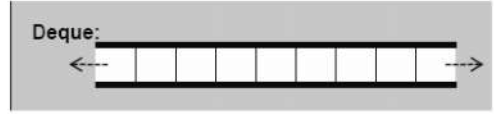
我们知道连续内存的容器不能随意扩充,因为这样容易扩充别人那去
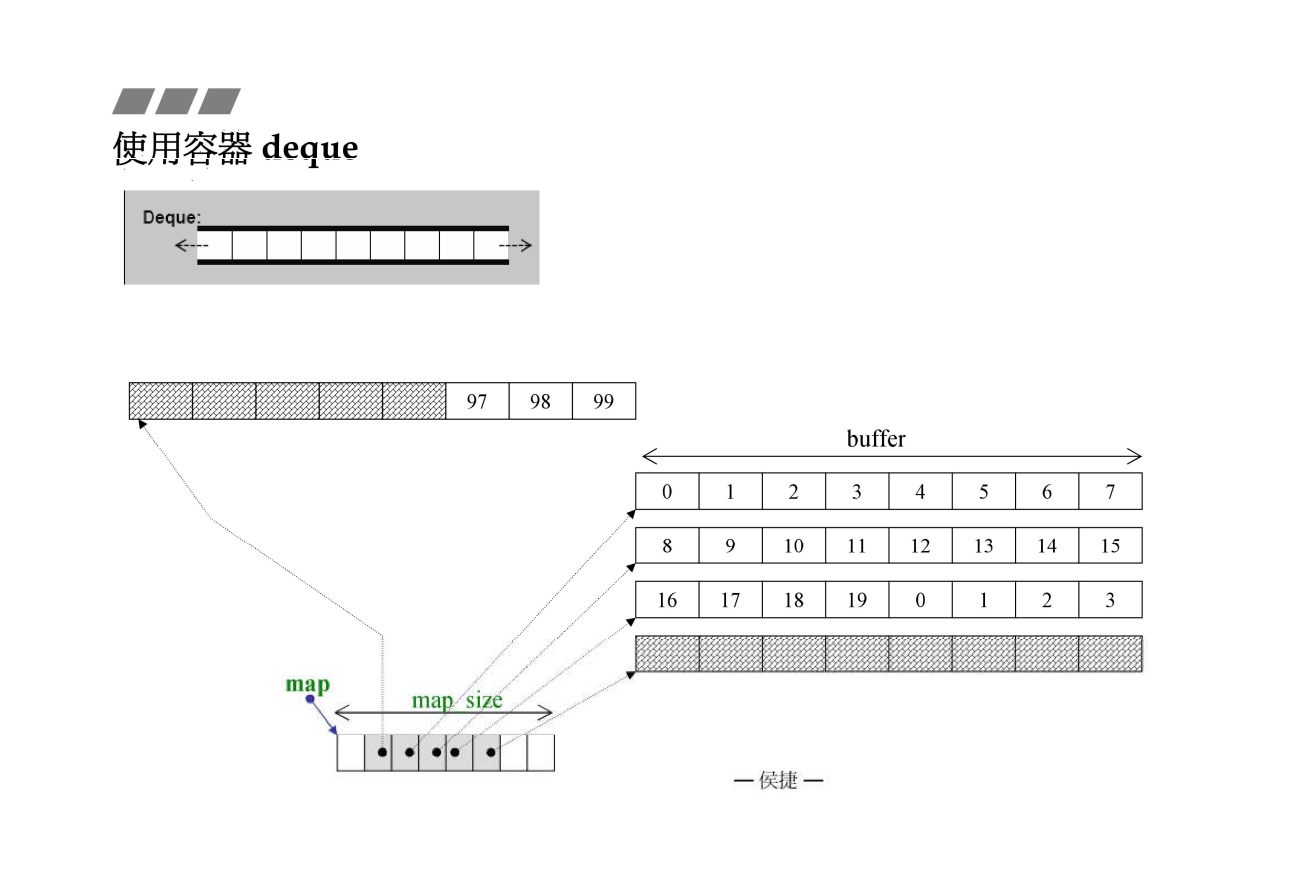
deque却可以,它创造了内存连续的假象.
其实deque由一段一段构成 ,他是分段连续,而不是内存连续 当走向段的尾端时候自动跳到下一段 所以支持迭代器++ 操作,自动跳到下一段的方法由operator++实现
deque每次扩充 申请一个段
一 定义
头文件 #include <deque>
int main_0() {

    //默认构造函数 创建一个空的deque

    deque<int> c;

    //拷贝构造

    deque<int> c1(c);

    //赋值拷贝

    deque<int> c2 = c1;

    //指定元素个数创建

    deque<int> c3 (,);

    for (auto i : c3) {

        cout<< i << ",";

    }

    cout << "deque(个数, 元素)"<<endl;

    //指定区间创建

    deque<int> c4(c3.begin()+, c3.begin()+);

    for (auto i : c4) {

        cout<< i << ",";

    }

    cout << "deque(区间, 区间)"<<endl;

    //指定初始化列表创建

    deque<int> c5({,,,});

    for (auto i : c5) {

        cout<< i << ",";

    }

    cout << "deque({})"<<endl;

    //指定初始化列表创建

    deque<int> c6 = {,,,};

    for (auto i : c6) {

        cout<< i << ",";

    }

    cout << "deque = {}" <<endl;

    cout<<endl;

    return ;

}
二 操作
int main()

{

    deque<int> c = {,,,,};

    deque<int> c1;

    // 赋值初始化

    c1.assign(c.begin(),c.end());

    for (auto i: c1) {

        cout<< i << ",";

    }

    cout << "assign()" <<endl;

    //在尾部插入

    c1.push_back();

    for (auto i: c1) {

        cout<< i << ",";

    }

    cout << "push_back()" <<endl;

    //头插入

    c1.push_front();

    for (auto i: c1) {

        cout<< i << ",";

    }

    cout << "push_front()" <<endl;

    //弹尾元素

    c1.pop_back();

    for (auto i: c1) {

        cout<< i << ",";

    }

    cout << "pop_back()" <<endl;

    //弹头元素

    c1.pop_front();

    for (auto i: c1) {

        cout<< i << ",";

    }

    cout << "pop_front()" <<endl;

    //指定位置插入元素

    c1.insert(c1.begin()+, );

    for (auto i: c1) {

        cout<< i << ",";

    }

    cout << "insert()" <<endl;

    //删除指定位置元素

    c1.erase(c1.begin()+);

    for (auto i: c1) {

        cout<< i << ",";

    }

    cout << "erase()" <<endl;

    //清空deque

    c.clear();

    for (auto i: c) {

        cout<< i << ",";

    }

    cout << "clear()" <<endl;

    //构造

    c1.emplace(c1.end(), );

    for (auto i: c1) {

        cout<< i << ",";

    }

    cout << "emplace()" <<endl;

    //头位置插入元素

    c1.emplace_front();

    for (auto i: c1) {

        cout<< i << ",";

    }

    cout << "emplace_front()" <<endl;

    //尾位置插入元素

    c1.emplace_back();

    for (auto i: c1) {

        cout<< i << ",";

    }

    cout << "emplace_back()" <<endl;

    //交换

    c.swap(c1);

    for (auto i: c) {

        cout<< i << ",";

    }

    cout << "swap()" <<endl;

    int tmp;

    tmp = c.front();

    cout<<"第一个元素"<< tmp << endl;

    tmp = c.back();

    cout<<"最后一个元素"<< tmp << endl;

    tmp = c.at();

    cout<<"指定下标元素"<< tmp << endl;

    tmp = c[];

    cout<<"指定[]下标元素"<< tmp << endl;

    return ;

}
三 内存
int main()

{

    deque<int> c = {,,,,};

    //元素个数

    cout<< "size(): " << c.size() <<endl;

    //重新设定deque大小 少退多补

    c.resize(, );

    for(auto i : c)

    {

        cout << i <<",";

    }

    cout << "resize()" << endl;

    //最大容量

    cout << "max_size(): " << c.max_size() <<endl;

    //是否为空

    cout << "empty: " << c.empty() << endl;

    //清空内存

    c.shrink_to_fit();

    return ;

}
五 与迭代器操作
int main()

{

    deque<int> c = {,,,,};

    //指向第一个元素的迭代器

    cout << *c.begin() << endl;

    //指向最后一个元素的下一个位置的迭代器

    cout << *c.end() << endl;

    //反向deque的第一个元素的迭代器

    cout << *c.rbegin() << endl;

    //反向deque的第一个元素的上一个位置迭代器

    cout << *c.rend() << endl;

    //指向第一个元素的迭代器

    cout << *c.cbegin() << endl;

    //指向最后一个元素的下一个位置的迭代器

    cout << *c.cend() << endl;

    //反向deque的第一个元素的迭代器

    cout << *c.crbegin() << endl;

    //反向deque的第一个元素的上一个位置迭代器

    cout << *c.crend() << endl;

    return ;

}
Soource Code
deque的类图如下,跟vector的类图结构相似

_Deque_base<_Tp>基类
    template<typename _Tp, typename _Alloc>

    class _Deque_base

    {

        ...

        struct _Deque_impl

        : public _Tp_alloc_type

        {

            _Tp** _M_map;

            size_t _M_map_size;

            iterator _M_start;

            iterator _M_finish;

        }

        ...

    }
_Deque_impl<_Tp>数据类
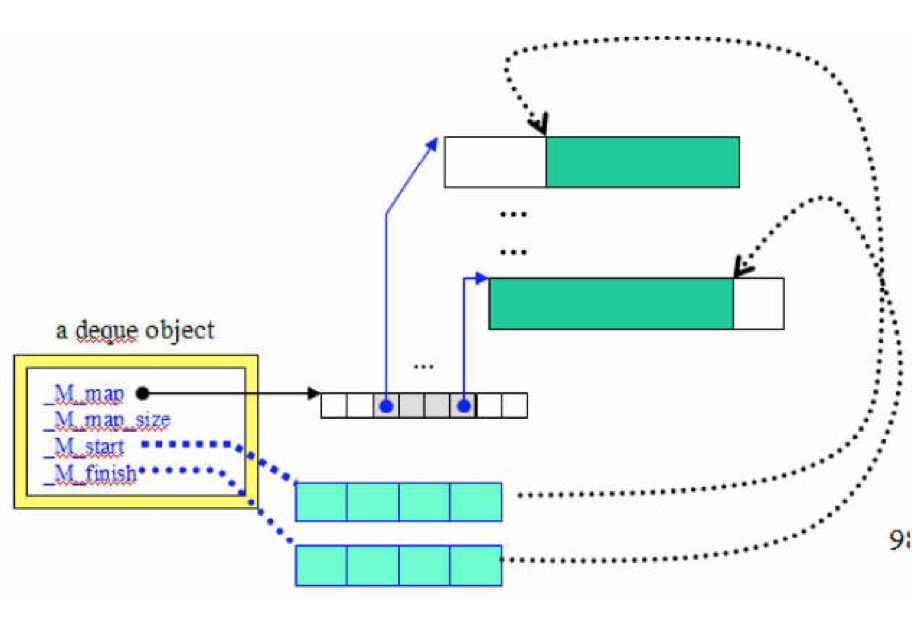
成员变量含义,如下图所示
_M_map指向存储 指向内存的指针 的连续内存
_M_map_size表示_M_map指向的内存大小(有多少个buffer)
_M_start指向_M_map指向内存起始点的迭代器
_M_finish指向_M_map指向内存结束点的迭代器
deque<_Tp>
    template<typename _Tp, typename _Alloc = std::allocator<_Tp> >

    class deque : protected _Deque_base<_Tp, _Alloc>

    {

        //成员变量含义与vector成员变量含义相似

    public:

        typedef _Tp                                        value_type;

        typedef typename _Tp_alloc_type::pointer           pointer;

        typedef typename _Tp_alloc_type::const_pointer     const_pointer;

        typedef typename _Tp_alloc_type::reference         reference;

        typedef typename _Tp_alloc_type::const_reference   const_reference;

        typedef typename _Base::iterator                   iterator;

        typedef typename _Base::const_iterator             const_iterator;

        typedef std::reverse_iterator<const_iterator>      const_reverse_iterator;

        typedef std::reverse_iterator<iterator>            reverse_iterator;

        typedef size_t                             size_type;

        typedef ptrdiff_t                          difference_type;

        typedef _Alloc                             allocator_type;

        ...

        //这个函数返回buffer大小

        static size_t _S_buffer_size() _GLIBCXX_NOEXCEPT

        { return __deque_buf_size(sizeof(_Tp)); }

    }

    //它的实现如下

#ifndef _GLIBCXX_DEQUE_BUF_SIZE

#define _GLIBCXX_DEQUE_BUF_SIZE 512

#endif

    inline size_t

    __deque_buf_size(size_t __size)

    { return (__size < _GLIBCXX_DEQUE_BUF_SIZE

        ? size_t(_GLIBCXX_DEQUE_BUF_SIZE / __size) : size_t()); }

    /*

     如果是deque<int>的话 上面的函数可以翻译成 4 < 512 ? size_t(512/4) " size_t(1)

     结果就是512/4 = 128

     那么每个buffer所含value_type的个数就128,即一个buffer能存128个int

     deque<double> 的话就是512/8 = 64 那么每个buffer的所含个数就是64

     如果>=512 就是每个buffer只能存1个 (class/array/struct)

    */
解析一个成员函数insert(),在解析之前介绍一下它的迭代器成员变量的含义
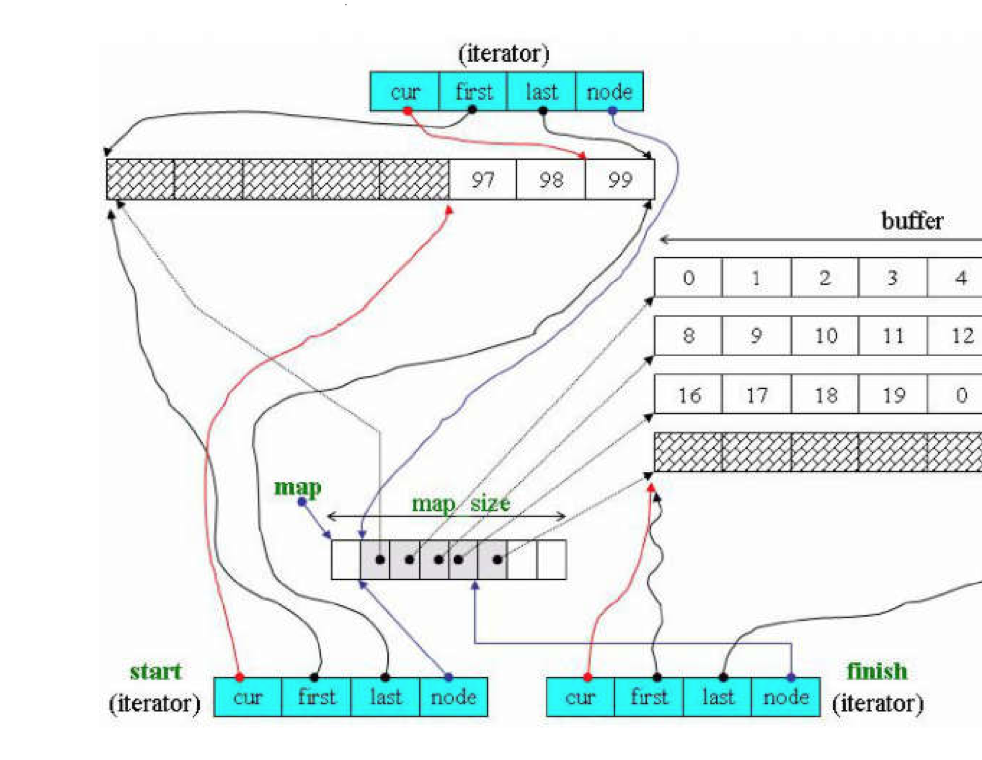
start 指向头的迭代器(_M_start)
finish 指向尾部的下一个位置的迭代器(_M_finish)
cur 指向当前元素
first 指向当前buffer内的第一个元素
last 指向单钱buffer的最后一个元素
node 指向当前buffer的指针
map_size node的个数
     insert(const_iterator __position, value_type&& __x)

     { return emplace(__position, std::move(__x)); }
empalce()
     template<typename _Tp, typename _Alloc>

     template<typename... _Args>

     typename deque<_Tp, _Alloc>::iterator

     deque<_Tp, _Alloc>::

     emplace(const_iterator __position, _Args&&... __args)

     {

     if (__position._M_cur == this->_M_impl._M_start._M_cur) //插入的位置是否在最前端

     {

     emplace_front(std::forward<_Args>(__args)...);

     return this->_M_impl._M_start;

     }

     else if (__position._M_cur == this->_M_impl._M_finish._M_cur)//插入的位置在最尾端

     {

     emplace_back(std::forward<_Args>(__args)...);

     iterator __tmp = this->_M_impl._M_finish;

     --__tmp;//迭代器指向的是最尾端的下一个位置

     return __tmp;

     }

     else

     return _M_insert_aux(__position._M_const_cast(),

     std::forward<_Args>(__args)...);

     }
emplace_front()
 template<typename _Tp, typename _Alloc>

     template<typename... _Args>

     void

     deque<_Tp, _Alloc>::

     emplace_front(_Args&&... __args)//插入在最前端

     {

     if (this->_M_impl._M_start._M_cur != this->_M_impl._M_start._M_first)//如果最前端的buffer内存够的话

     {

     this->_M_impl.construct(this->_M_impl._M_start._M_cur - ,

     std::forward<_Args>(__args)...);//直接在备用空间上构造元素

     --this->_M_impl._M_start._M_cur;//调整cur

     }

     else //如过内存不够

     _M_push_front_aux(std::forward<_Args>(__args)...);

     }

     #if __cplusplus >= 201103L

     template<typename... _Args>

     void

     deque<_Tp, _Alloc>::

     _M_push_front_aux(_Args&&... __args)

     #else

     void

     deque<_Tp, _Alloc>::

     _M_push_front_aux(const value_type& __t)

     #endif

     {

     _M_reserve_map_at_front();

     *(this->_M_impl._M_start._M_node - ) = this->_M_allocate_node();//申请空的头结点

     __try

     {

     this->_M_impl._M_start._M_set_node(this->_M_impl._M_start._M_node

     - ); //改变start,令其指向新节点

     this->_M_impl._M_start._M_cur = this->_M_impl._M_start._M_last - ; ////改变cur,

     #if __cplusplus >= 201103L

     this->_M_impl.construct(this->_M_impl._M_start._M_cur,

     std::forward<_Args>(__args)...);//复制

     #else

     this->_M_impl.construct(this->_M_impl._M_start._M_cur, __t);

     #endif

     }

     __catch(...)

     {

     ++this->_M_impl._M_start;

     _M_deallocate_node(*(this->_M_impl._M_start._M_node - ));

     __throw_exception_again;

     }

     }
_M_insert_aux
#if __cplusplus >= 201103L

     template<typename... _Args>

     typename deque<_Tp, _Alloc>::iterator

     deque<_Tp, _Alloc>::

     _M_insert_aux(iterator __pos, _Args&&... __args)

     {

     value_type __x_copy(std::forward<_Args>(__args)...); // XXX copy

     #else

     typename deque<_Tp, _Alloc>::iterator

     deque<_Tp, _Alloc>::

     _M_insert_aux(iterator __pos, const value_type& __x)

     {

     value_type __x_copy = __x; // XXX copy

     #endif

     difference_type __index = __pos - this->_M_impl._M_start;//重在operator- 返回距起始端距离 安插点之前的元素个数

     if (static_cast<size_type>(__index) < size() / )//若果插入点在整体内存的前半段,插入后整体内存前移

     {

     push_front(_GLIBCXX_MOVE(front()));//复制头buffer的一个元素

     iterator __front1 = this->_M_impl._M_start;//取出头迭代器位置,和下一个节点的起始点

     ++__front1;

     iterator __front2 = __front1;

     ++__front2;

     __pos = this->_M_impl._M_start + __index;

     iterator __pos1 = __pos;

     ++__pos1;

     _GLIBCXX_MOVE3(__front2, __pos1, __front1);//front1 到 front2 这段区间内的前pos1个元素向前移动一个单位 (留出一个单位给将插入的的元素)

     }

     else

     {

     push_back(_GLIBCXX_MOVE(back()));

     iterator __back1 = this->_M_impl._M_finish;

     --__back1;

     iterator __back2 = __back1;

     --__back2;

     __pos = this->_M_impl._M_start + __index;

     _GLIBCXX_MOVE_BACKWARD3(__pos, __back2, __back1);

     }

     *__pos = _GLIBCXX_MOVE(__x_copy); //复制元素

     return __pos;

     }
既然说deque是模仿内存连续,实现这种功能的主要功臣是deque的迭代器,说道迭代器 那么我们一定会联想到迭代器的操作符重载,下面我主要介绍迭代器的操作符重载
operator* 这个比较好理解 返回cur指向的元素
        reference

        operator*() const _GLIBCXX_NOEXCEPT

        { return *_M_cur; }

        pointer

        operator->() const _GLIBCXX_NOEXCEPT

        { return _M_cur; }
operator++()(前++)与operator++(int)
        _Self&

        operator++() _GLIBCXX_NOEXCEPT

        {

            ++_M_cur;

            if (_M_cur == _M_last)//如果++到达该节点尾端

      {

          _M_set_node(_M_node + );//跳至下一个节点

          _M_cur = _M_first;

      }

            return *this;

        }

        _Self

        operator++(int) _GLIBCXX_NOEXCEPT

        {

            _Self __tmp = *this;

            ++*this;//调用前++

            return __tmp;

        }
operator--()与operator--(int)
        _Self&

        operator--() _GLIBCXX_NOEXCEPT

        {

            if (_M_cur == _M_first)//如果--后到达头端

      {

          _M_set_node(_M_node - );//跳至前一个节点

          _M_cur = _M_last;

      }

            --_M_cur;

            return *this;

        }

        _Self

        operator--(int) _GLIBCXX_NOEXCEPT

        {

            _Self __tmp = *this;

            --*this;

            return __tmp;

        }
operator+=(itn) ,+,-=,-
        _Self&

        operator+=(difference_type __n) _GLIBCXX_NOEXCEPT

        {

            const difference_type __offset = __n + (_M_cur - _M_first);//查找位置

            if (__offset >=  && __offset < difference_type(_S_buffer_size()))//查找位置是否小于一个buffer的容量(在当前buffer内)

                _M_cur += __n;

            else

      {

          const difference_type __node_offset =

          __offset >  ? __offset / difference_type(_S_buffer_size())

          : -difference_type((-__offset - )

                             / _S_buffer_size()) - ;

          _M_set_node(_M_node + __node_offset);//切换至正确buffer

          _M_cur = _M_first + (__offset - __node_offset

                               * difference_type(_S_buffer_size()));

      }

            return *this;

        }

        _Self

        operator+(difference_type __n) const _GLIBCXX_NOEXCEPT

        {

            _Self __tmp = *this;

            return __tmp += __n;//调用+=

        }

        _Self&

        operator-=(difference_type __n) _GLIBCXX_NOEXCEPT

        { return *this += -__n; }//调用+=

        _Self

        operator-(difference_type __n) const _GLIBCXX_NOEXCEPT

        {

            _Self __tmp = *this;

            return __tmp -= __n;

        }
operator[],和_M_set_node
        reference

        operator[](difference_type __n) const _GLIBCXX_NOEXCEPT

        { return *(*this + __n); }

        /**

         *  Prepares to traverse new_node.  Sets everything except

         *  _M_cur, which should therefore be set by the caller

         *  immediately afterwards, based on _M_first and _M_last.

         */

        void

        _M_set_node(_Map_pointer __new_node) _GLIBCXX_NOEXCEPT//切换至正确buffer

        {

            _M_node = __new_node;

            _M_first = *__new_node;

            _M_last = _M_first + difference_type(_S_buffer_size());

        }
参考<<侯捷STL标准库>>
STL标准库-容器-deque的更多相关文章
- STL标准库-容器-deque 双端队列
头文件: #include<deque> 常用操作: https://www.cnblogs.com/LearningTheLoad/p/7450948.html
- STL标准库-容器-set与map
STL标准库-容器-set与multiset C++的set https://www.cnblogs.com/LearningTheLoad/p/7456024.html STL标准库-容器-map和 ...
- STL标准库-容器-set与multiset
技术在于交流.沟通,转载请注明出处并保持作品的完整性. set与multiset关联容器 结构如下 set是一种关联容器,key即value,value即key.它是自动排序,排序特点依据key se ...
- STL标准库-容器-vector
技术在于交流.沟通,本文为博主原创文章转载请注明出处并保持作品的完整性. 向量容器vector是一个动态数组,内存连续,它是动态分配内存,且每次扩张的原来的二倍. 他的结构如下 一 定义 vector ...
- STL标准库-容器-list
技术在于交流.沟通,本文为博主原创文章转载请注明出处并保持作品的完整性. list 表示非连续的内存区域,并通过一对指向首尾元素的指针双向链接起来,从而允许向前和向后两个方向进行遍历.在list 的任 ...
- STL标准库-容器适配器
技术在于交流.沟通,本文为博主原创文章转载请注明出处并保持作品的完整性 上一节介绍了仿函数适配器,这节主要介绍容器适配器和迭代器适配器的概念,其实容器适配器和迭代器其适配器就是封装了一些其他class ...
- STL标准库-容器-rb_tree
技术在于交流.沟通,本文为博主原创文章转载请注明出处并保持作品的完整性 红黑树,关联式容器底层实现(map set),在使用中基本运用不到,但是还是想了解一下他的运作方式 Red_Black tree ...
- STL标准库-容器-unordered_set
技术在于交流.沟通,本文为博主原创文章转载请注明出处并保持作品的完整性 unordered_set与与unordered_map相似,这次主要介绍unordered_set unordered_set ...
- STL标准库-容器-map和multimap
技术在于交流.沟通,本文为博主原创文章转载请注明出处并保持作品的完整性 map与multimap为关联容器,结构如下 map底层实现依然是rb_tree 他的data可以改,但是key不能改,因此ma ...
随机推荐
- MVC模式:python案例
quotes = ('A man is not complete until he is married. Then he is finished.', 'As I said before, I ne ...
- go-004-数据结构
在 Go 编程语言中,数据类型用于声明函数和变量. 数据类型的出现是为了把数据分成所需内存大小不同的数据,编程的时候需要用大数据的时候才需要申请大内存,就可以充分利用内存. Go 语言按类别有以下几种 ...
- nodejs中Async详解之一:流程控制
为了适应异步编程,减少回调的嵌套,我尝试了很多库.最终觉得还是async最靠谱. 地址:https://github.com/caolan/async Async的内容分为三部分: 流程控制:简化十种 ...
- HTML5-Canvas 图形变换+状态保存
1. 图形变换 canvas是基于状态绘制图形的.故此一般情况下,canvas的绘制的图形路径和状态时分离的. function drawShape(ctx){ // 绘制路径 shapePath(c ...
- 【Lua】模块与包
定义: 从用户观点来看,一个模块就是一个程序库,可以通过require来加载(require用于使用模块,module用于创建模块),然后便得到了一个全局变量,表示一个table,这个 ...
- linux服务器查看IO
为了方便各位和自己今后遇到此类问题能尽快解决,我这里将查看linux服务器硬盘IO访问负荷的方法同大家一起分享: 首先 .用top命令查看 top - 16:15:05 up 6 days, 6:2 ...
- js 中的[] {}是什么意思
<div id="aa1">aaaaa</div><div id="aa2">bbbb</div><div ...
- SQL学习笔记之项目中常用的19条MySQL优化
在写文章之前,首先感谢 飞友科技 陆老师提供的文档.. 声明一下:下面的优化方案都是基于 “ Mysql-索引-BTree类型 ” 的 0x00 EXPLAIN 做MySQL优化,我们要善用 EXPL ...
- SQL学习笔记三之MySQL表操作
阅读目录 一 存储引擎介绍 二 表介绍 三 创建表 四 查看表结构 五 数据类型 六 表完整性约束 七 修改表ALTER TABLE 八 复制表 九 删除表 一 存储引擎介绍 存储引擎即表类型,mys ...
- Vue.js 2.x中事件总线(EvevntBus)及element-ui中全屏loading的使用
事件总线(Event Bus)可以在vue项目的index.js文件中创建,也可以在一个独立的.vue文件中创建.使用时,在各个子组件中引入该组件即可. 项目中的全屏loading较多时,可以在根组件 ...