
Quality of Service (QoS) in LTE
Background: Why we need QoS ?
There are premium subscribers who always want to have better user experience on their 4G LTE device. These users are willing to pay more for high bandwidth and better network access on their devices. Not only the subscribers but some services itself need better priority handling in the network (e.g. VoIP call). To be able to full fill this, QOS plays the key role. QOS defines priorities for certain customers / services during the time of high congestion in the network
3GPP definition for QoS
between UE and PDN Gateway and is applied to a set of bearers. 'Bearer'
is basically a virtual concept and is a set of network configuration to
provide special treatment to set of traffic e.g. VoIP packets
are prioritized by network compared to web browser traffic.
In LTE, QoS is applied on Radio bearer, S1 bearer and S5/S8 bearer, collectively called as EPS bearer as shown in figure below.

bearer types and properties associated with each bearer
through hierarchical chart as shown below. First there are two types of
Bearer, i.e. Dedicated bearer and Default bearer. There is at-least one
default bearer established when UE is attached to LTE network while
dedicated bearer is always established when there is need to provide QoS
to specific service (like VoIP, video etc). Please go through the
article Default and Dedicated Bearer which hopefully will help to explain the concept in more detail.
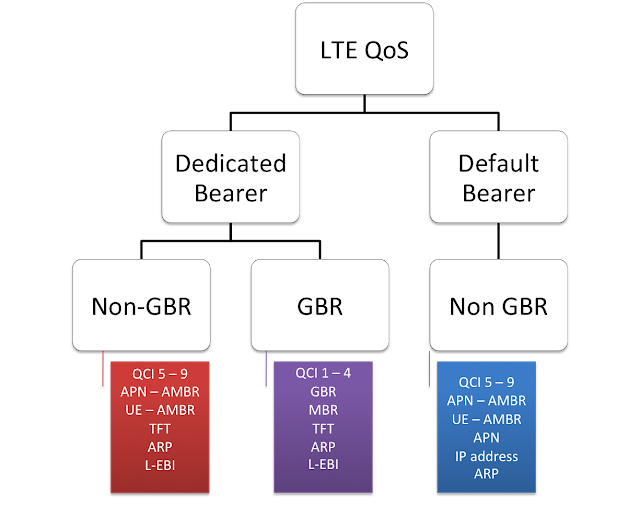
maximum bit rate is the maximum allowed total non-GBR throughput to
specific APN. It is specified interdependently for uplink an downlink
can only be non-GBR type. Some other important terms associated with
each bearer type are discussed below:
retention priority is basically used for deciding whether new bearer
modification or establishment request should be accepted considering the
current resource situation.
is always associated with dedicated bearer and while default bearer may
or may not have TFT. As mentioned earlier, dedicated bearer provides QoS
to special service or application and TFT defines rules so that UE and
Network knows which IP packet should be sent on particular dedicated
bearer. It usually has rules on the basis of IP packet
destination/source or protocol used.
EPS bearer ID. As I discussed in previous article about dedicated and
default bearer, we know that each dedicated bearer is always linked to
one of default bearers. L-EBI tells Dedicated bearer which default
bearer it is attached to.
bearer is attached to some PDN network and has its own IP address while
dedicated bearer does not need this since it is linked to default
bearer.
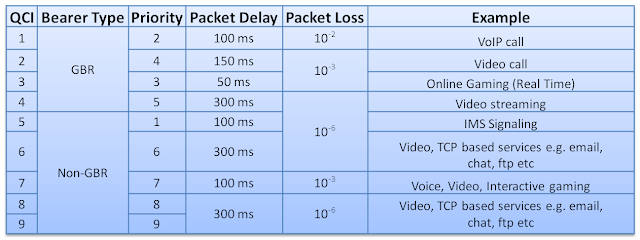
associated with all bearers i.e. QoS class of identifier (QCI).This
parameter basically defines IP level packets characteristics as shown
below
Default bearer 1: Used for signaling messages (sip signaling) related to IMS network. It uses qci 5
Dedicated bearer: Used for VoLTE VoIP traffic. It uses qci 1 and is linked to default bearer 1
Default bearer 2: Used for all other smartphone traffic (video, chat, email, browser etc), assuming qci 9 is used here
associated with IMS PDN and has specific IP address. It has throughput
limitations defined in terms of A-AMBR and UE-AMBR. Since it has qci 5
which means that its IP packets has the highest priority over other IP
packets and maximum delay as 100ms between UE and PGW with packet loss
percentage up to 10-6
internet PDN and has specific IP. It has throughput limitations defined
in terms of A-AMBR and UE-AMBR as well. Since it has qci 9 which means
that its IP packets has the lowest priority over other IP packets and
maximum delay possible as 300ms between UE and PGW with packet loss
percentage up to 10-6
Default bearer 1 with L-EBI and it also has TFT which basically defines
which IP packets should be allowed to travel on this bearer. It has
throughput limitations defined in terms of MBR and GBR. Since it is
using QCI 1, the IP packets traveling on this bearer have the second
highest priority. The maximum delay possible to IP packets on this
bearer is 100 ms and the percentage of packet loss will be under 10-2
Quality of Service (QoS) in LTE的更多相关文章
- [转] Quality Of Service In OpenStack
http://tropicaldevel.wordpress.com/2013/07/15/quality-of-service-in-openstack/ In this post I will b ...
- Quality of Service 0, 1 & 2
来自:http://www.hivemq.com/blog/mqtt-essentials-part-6-mqtt-quality-of-service-levels Quality of Servi ...
- Quality of service
w https://en.wikipedia.org/wiki/Quality_of_service Quality of service (QoS) is the overall performan ...
- MQTT协议QoS服务质量 (Quality of Service 0, 1 & 2)概念学习
什么是 QoS ? QoS (Quality of Service) 是发送者和接收者之间,对于消息传递的可靠程度的协商. QoS 的设计是 MQTT 协议里的重点.作为专为物联网场景设计的协议,MQ ...
- neutron qos Quality of Service
Quality of Service advanced service is designed as a service plugin. The service is decoupled from t ...
- [译]Ocelot - Quality of Service
原文 可以针对每个ReRoute设置对下游服务的熔断器circuit breaker.这部分是通过Polly实现的. 将下面的配置添加到一个ReRoute下面去. "QoSOptions&q ...
- Default Bearer, Dedicated Bearer... What exactly is bearer ?
Default Bearer, Dedicated Bearer... What exactly is bearer ? While trying to get a better understa ...
- LTE QOS
http://wenku.baidu.com/link?url=ziFIkdKaC7MU2RY-bTOp2bt87WFPw5_02bqmYs5W6w4ktOfPHEcWesK1U2T7YiyXjVSM ...
- Information Centric Networking Based Service Centric Networking
A method implemented by a network device residing in a service domain, wherein the network device co ...
随机推荐
- MyBatis总结(1)
MyBatis前身是ibatis,是一个数据持久层框架.封装优化了普通JDBC过程, 如数据库连接的创建.设置SQL语句参数.执行SQL语句.事务.结果映射以及资源释放等. MyBatis是一个支持普 ...
- Matlab数据类型的转换
Matlab中有15种基本数据类型,主要是整型.浮点.逻辑.字符.日期和时间.结构数组.单元格数组以及函数句柄等. 1.整型:(int8:uint8:int16:uint16:int32:uint32 ...
- last 列出登入系统的用户相关信息
Linux last 命令介绍 功能说明:列出目前与过去登入系统的用户相关信息. 语法: last [-adRx][-f <记录文件>][-n <显示列数>][帐号名称. ...
- Flask17 Flask_Script插件的使用
1 什么是Flask_Script 可以对flask应用做一些统一的操作 flask_script官网:点击前往 2 安装flask_script pip install -i https://pyp ...
- mac上如何查看gif
今天生成了一个gif,结果用mac自带的图片预览功能打开,图片被切成一张一张的,不是动图效果了.原以为还得下第三方看图软件,后来百度下发现mac本身也可以打开. 方法一: 鼠标右击图片,选择“快速查看 ...
- 将Linux 标准输出,错误输出重定向到文件
1.想要把make输出的全部信息,输出到某个文件中,最常见的办法就是: make xxx > build_output.txt 此时默认情况是没有改变2=stderr的输出方式,还是屏幕,所以, ...
- 在VM12中安装ubuntu系统下的VMTOOLS
转载自http://www.jb51.net/article/97387.htm 一.下载Ubuntu镜像: Ubuntu官网下载地址 二.创建虚拟机 打开VMware Workstation,点击创 ...
- URAL 2021 Scarily interesting! (贪心+题意)
题意:给定两个队伍的每个人的得分,让你安排怎么比赛才能使得观众知道冠军的时间最长. 析:贪心,很简单,就是先开始总分高的先出最差劲的,总分低的先出最厉害的,这个题当时实在是读的不明白啊,WA了好多次. ...
- android开源项目:图片下载缓存库picasso
picasso是Square公司开源的一个Android图形缓存库,地址http://square.github.io/picasso/,可以实现图片下载和缓存功能. picasso有如下特性: 在a ...
- get与post方法(吴老师整理)
Get方式:(用get方式请求时就是调用Servlet中的doGet方法) 1.第一种: 2.第二种:(<a>标签是一种get方式提交) 1.通过GET提交数据,用户名和密码将明文出现在U ...