NAT, Network Address Translation,即网络地址转换。当内部网络的主机想要访问外网,但是又不想直接暴露给公网,可以通过NAT节点来访问外网。这样做有两个好处,第一是内网的主机无需拥有公网IP就可访问网络(NAT节点需要公网IP),节约了公网IP;第二是内网的主机由于没有公网IP,所以公网的电脑无法访问到它,这样就可以隐藏自己。一个很经典的示例是假如你有一台数据库服务器放置在内网中,为在同一个内网中的web服务器提供数据服务,为了安全性考虑你不会把它直接暴露在公网中。但是数据库服务器有时候自己是需要访问公网的,比如需要升级数据库服务器中的某些软件等。采用NAT方案可以很好的解决这个问题。

下图是NAT节点的功能示意图。
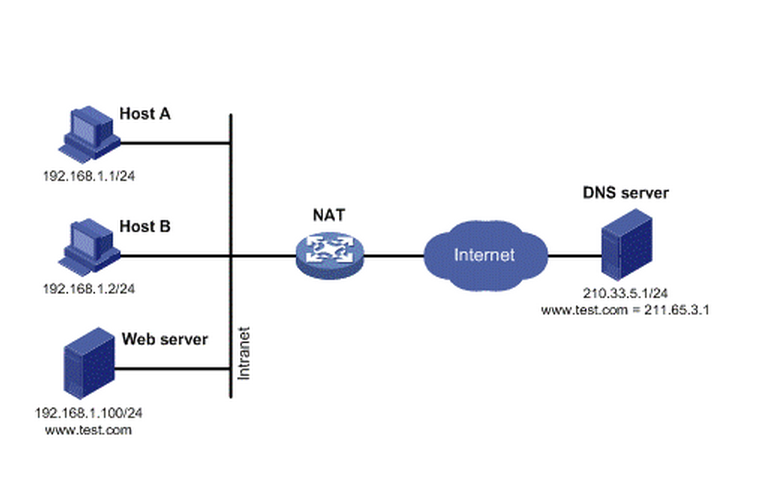
一些路由器或者装有特定软件的主机都可以作为NAT节点。在AWS中如果你想创建一个NAT节点的话那是非常的方便,因为AWS直接提供了预装了NAT软件的AMI,你只需直接使用该AMI在你的公共子网中实例化一台机器,并进行相应的配置即可。

下面的图展示了在AWS中的一个经典的VPC架构。该VPC里面建立了两个子网,一个是公共子网,通过Intenet Geteway和公网连接;一个是私有子网,无法直接访问公网。然后在公共子网中建立了一个EC2机器,使用的是AWS提供的具有NAT功能的AMI,并为它分配了一个弹性IP,这样该EC2就是一个NAT节点。在私有子网的所有机器都具有了通过该NAT节点访问外网的能力。
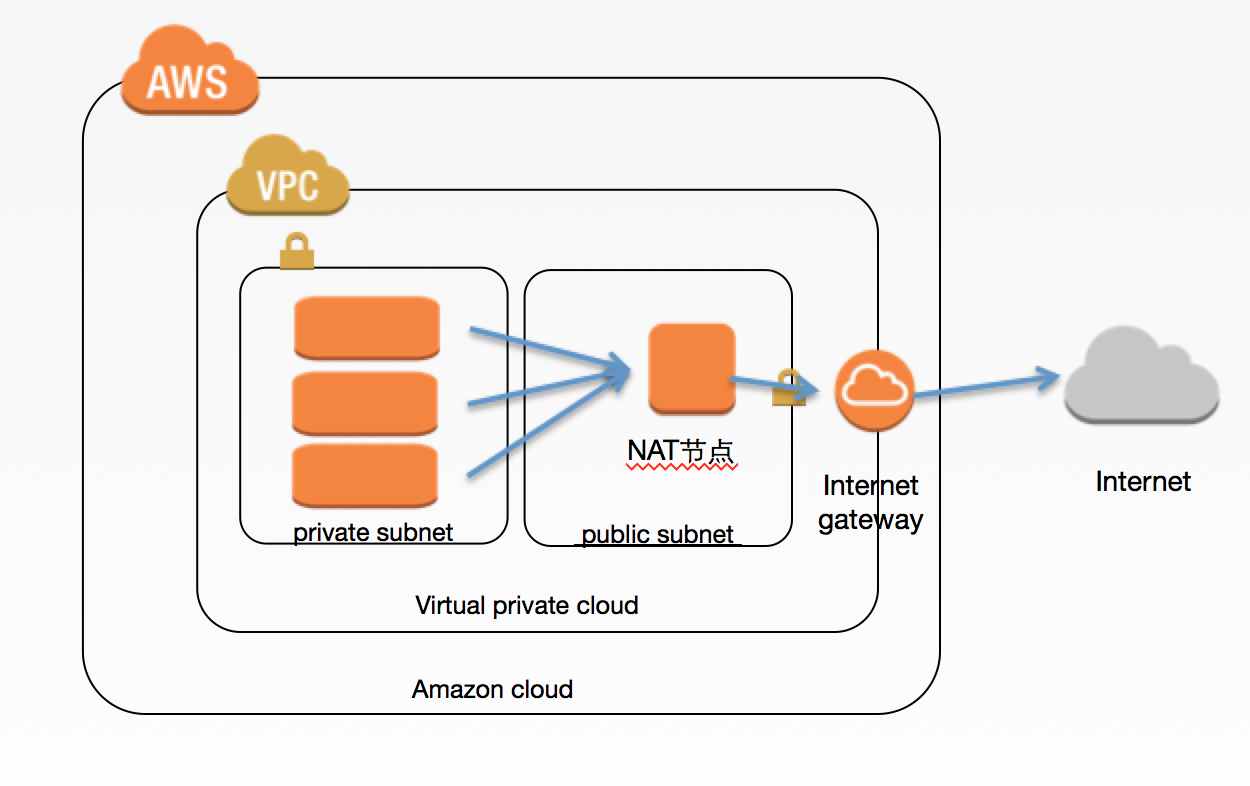
为了创建这样一套网络及机器,最简便的方式当然是使用AWS提供的CloudFormation了。如果不了解CloudFormation,可以看我以前写过的一篇文章 《亚马逊云服务之CloudFormation》。下面展示的是创建该整个VPC的CloudFormation脚本。

1
2
3
4
5
6
7
8
9
10
11
12
13
14
15
16
17
18
19
20
21
22
23
24
25
26
27
28
29
30
31
32
33
34
35
36
37
38
39
40
41
42
43
44
45
46
47
48
49
50
51
52
53
54
55
56
57
58
59
60
61
62
63
64
65
66
67
68
69
70
71
72
73
74
75
76
77
78
79
80
81
82
83
84
85
86
87
88
89
90
91
92
93
94
95
96
97
98
99
100
101
102
103
104
105
106
107
108
109
110
111
112
113
114
115
116
117
118
119
120
121
122
123
124
125
126
127
128
129
130
131
132
133
134
135
136
137
138
139
140
141
142
143
144
145
146
147
148
149
150
151
152
153
154
155
156
157
158
159
160
161
162
163
164
165
166
167
168
169
170
171
172
173
174
175
176
177
178
179
180
181
182
183
184
185
186
187
188
189
190
191
192
193
194
195
196
197
198
199
200
201
202
203
204
205
206
207
208
209
210
211
212
213
214
215
216
217
218
219
220
221
222
223
224
225
226
227
228
229
230
231
232
233
234
235
236
237
238
239
240
241
242
243
244
245
246
247
248
249
250
251
252
253
254
255
256
257
258
259
260
261
262
263
264
265
266
267
268
269
270
271
272
273
274
275
276
277
278
279
280
281
282
283
284
285
286
287
288
289
290
291
292
293
294
295
296
297
298
299
300
301
302
303
304
305
306
307
308
309
310
311
312
313
314
315
316
317
318
319
320
321
322
323
324
{
"AWSTemplateFormatVersion": "2010-09-09",
"Description": "Setup a vpc, which contains two subnets and one NAT machine",
"Parameters": {
"KeyName": {
"Description": "Name of and existing EC2 KeyPair to enable SSH access to the instance",
"Type": "String"
},
"VpcCidr": {
"Description": "CIDR address for the VPC to be created.",
"Type": "String",
"Default": "10.2.0.0/16"
},
"AnyCidr": {
"Description": "CIDR address for Any Where.",
"Type": "String",
"Default": "0.0.0.0/0"
},
"AvailabilityZone1": {
"Description": "First AZ.",
"Type": "String",
"Default": "cn-north-1a"
},
"PublicSubnetCidr": {
"Description": "Address range for a public subnet to be created in AZ1.",
"Type": "String",
"Default": "10.2.1.0/24"
},
"PrivateSubnetCidr": {
"Description": "Address range for private subnet.",
"Type": "String",
"Default": "10.2.2.0/24"
},
"NATInstanceType": {
"Description": "Instance type for NAT",
"Type": "String",
"Default": "t1.micro"
}
},
"Mappings": {
"AWSNATAMI": {
"cn-north-1": {
"AMI": "ami-eab220d3"
}
}
},
"Resources": {
"VPC": {
"Type": "AWS::EC2::VPC",
"Properties": {
"CidrBlock": {
"Ref": "VpcCidr"
},
"Tags": [
{
"Key": "Name",
"Value": "VPC"
}
]
}
},
"InternetGateWay": {
"Type": "AWS::EC2::InternetGateway",
"Properties": {
"Tags": [
{
"Key": "Name",
"Value": "INTERNET_GATEWAY"
}
]
}
},
"GatewayToInternet": {
"Type": "AWS::EC2::VPCGatewayAttachment",
"Properties": {
"InternetGatewayId": {
"Ref": "InternetGateWay"
},
"VpcId": {
"Ref": "VPC"
}
}
},
"PublicSubnet": {
"Type": "AWS::EC2::Subnet",
"Properties": {
"CidrBlock": {
"Ref": "PublicSubnetCidr"
},
"AvailabilityZone": {
"Ref": "AvailabilityZone1"
},
"Tags": [
{
"Key": "Name",
"Value": "PUBLIC_SUBNET"
}
],
"VpcId": {
"Ref": "VPC"
}
}
},
"PrivateSubnet": {
"Type": "AWS::EC2::Subnet",
"Properties": {
"CidrBlock": {
"Ref": "PrivateSubnetCidr"
},
"AvailabilityZone": {
"Ref": "AvailabilityZone1"
},
"Tags": [
{
"Key": "Name",
"Value": "PRIVATE_SUBNET"
}
],
"VpcId": {
"Ref": "VPC"
}
}
},
"DefaultSecurityGroup": {
"Type": "AWS::EC2::SecurityGroup",
"Properties": {
"GroupDescription": "Default Instance SecurityGroup",
"SecurityGroupIngress": [
{
"IpProtocol": "-1",
"CidrIp": {
"Ref": "VpcCidr"
}
}
],
"Tags": [
{
"Key": "Name",
"Value": "DEFAULT_SECURITY_GROUP"
}
],
"VpcId": {
"Ref": "VPC"
}
}
},
"PublicRouteTable": {
"Type": "AWS::EC2::RouteTable",
"Properties": {
"VpcId": {
"Ref": "VPC"
},
"Tags": [
{
"Key": "Name",
"Value": "PUBLIC_ROUTE_TABLE"
}
]
}
},
"PublicRoute": {
"Type": "AWS::EC2::Route",
"Properties": {
"DestinationCidrBlock": {
"Ref": "AnyCidr"
},
"GatewayId": {
"Ref": "InternetGateWay"
},
"RouteTableId": {
"Ref": "PublicRouteTable"
}
}
},
"PublicSubnetRouteTableAssociation": {
"Type": "AWS::EC2::SubnetRouteTableAssociation",
"Properties": {
"RouteTableId": {
"Ref": "PublicRouteTable"
},
"SubnetId": {
"Ref": "PublicSubnet"
}
}
},
"NATEIP": {
"Type": "AWS::EC2::EIP",
"Properties": {
"InstanceId": {
"Ref": "NATInstance"
}
}
},
"NATInstance": {
"Type": "AWS::EC2::Instance",
"Properties": {
"InstanceType": {
"Ref": "NATInstanceType"
},
"KeyName": {
"Ref": "KeyName"
},
"SubnetId": {
"Ref": "PublicSubnet"
},
"SourceDestCheck": false,
"ImageId": {
"Fn::FindInMap": [
"AWSNATAMI",
{
"Ref": "AWS::Region"
},
"AMI"
]
},
"Tags": [
{
"Key": "Name",
"Value": "NAT"
}
],
"SecurityGroupIds": [
{
"Ref": "NATSecurityGroup"
}
]
}
},
"PrivateSubnetRouteTable": {
"Type": "AWS::EC2::RouteTable",
"Properties": {
"VpcId": {
"Ref": "VPC"
},
"Tags": [
{
"Key": "Name",
"Value": "PRIVATE_SUBNET_ROUTE_TABLE"
}
]
}
},
"PrivateSubnetRoute": {
"Type": "AWS::EC2::Route",
"Properties": {
"DestinationCidrBlock": {
"Ref": "AnyCidr"
},
"InstanceId": {
"Ref": "NATInstance"
},
"RouteTableId": {
"Ref": "PrivateSubnetRouteTable"
}
}
},
"PrivateSubnetRouteTableAssociation": {
"Type": "AWS::EC2::SubnetRouteTableAssociation",
"Properties": {
"RouteTableId": {
"Ref": "PrivateSubnetRouteTable"
},
"SubnetId": {
"Ref": "PrivateSubnet"
}
}
},
"NATSecurityGroup": {
"Type": "AWS::EC2::SecurityGroup",
"Properties": {
"GroupDescription": "NAT Instance SecurityGroup",
"SecurityGroupIngress": [
{
"IpProtocol": "-1",
"CidrIp": {
"Ref": "VpcCidr"
}
}
],
"Tags": [
{
"Key": "Name",
"Value": "NAT_SECURITY_GROUP"
}
],
"VpcId": {
"Ref": "VPC"
}
}
}
},
"Outputs": {
"VPCId": {
"Description": "VPC id",
"Value": {
"Ref": "VPC"
}
},
"PublicSubnetId": {
"Description": "public subnet id",
"Value": {
"Ref": "PublicSubnet"
}
},
"PrivateSubnetId": {
"Description": "private subnet id",
"Value": {
"Ref": "PrivateSubnet"
}
},
"NATSecurityGroupId": {
"Description": "NAT SG id",
"Value": {
"Ref": "NATSecurityGroup"
}
},
"NATEIP": {
"Description": "NAT Server EIP.",
"Value": {
"Ref": "NATEIP"
}
}
}
}

你可以通过AWS提供的图形化界面AWS Management Console来使用该CloudFormation脚本,也可以通过AWS CLI来使用。使用以上的CloudFormation脚本创建的VPC可以一键创建你AWS中的基础网络架构。从此再也不用为配置网络发愁了。

在AWS中创建NAT节点的更多相关文章

  1. linux中创建gpio节点

    转自:http://blog.chinaunix.net/uid-29165999-id-4296162.html #define GPIO_MAJOR 230 // major device NO. ...

  2. Labview中创建属性节点和调用节点的用法

    创建属性节点 个人感觉有点像C中的指针 创建调用节点

  3. javascript中创建新节点的方法 标签: javascript 2016-12-25 11:38 55人阅读 评论(0)

    一. var newnode=document.createElement("i"); var newnodeText=document.createTextNode(" ...

  4. platform型设备在/dev目录下自动创建设备节点的分析【转】

    转自:http://blog.csdn.net/rockrockwu/article/details/7357648 系统启动过程中platform设备.驱动注册完毕,为什么在/dev目录下就自动创建 ...

  5. js中创建html标签、加入select下默认的option的value和text、删除select元素节点下全部的OPTION节点

    <pre name="code" class="java"> jsp 中的下拉框标签: <s:select name="sjx&qu ...

  6. jQuery中的查找节点、创建节点、插入节点、删除节点、替换节点、复制节点操作方法

    jQuery操作节点我们可以分六点来讲,查找节点.创建节点.插入节点.删除节点.替换节点.复制节点. 一.查找节点 text() - 设置或返回所选元素的文本内容   ,html() - 设置或返回所 ...

  7. js动态创建style节点(js文件中添加css)

    ie6 不能 document.createElement('style') 然后append到head标签里.所以就找到这样个好文章 --------------------- 有很多提供动态创建 ...

  8. 在AWS中部署OpenShift平台

    OpenShift是RedHat出品的PAAS平台.OpenShift做为PAAS平台最大的特点是它是完全容器化的PAAS平台,底层封装了Docker和Kubernetes,上层暴露了对开发者友好的接 ...

  9. aws中的路由表

    参考官方文档: 由表中包含一系列被称为路由的规则,可用于判断网络流量的导向目的地. 在您的 VPC 中的每个子网必须与一个路由表关联:路由表控制子网的路由.一个子网一次只能与一个路由表关联,但您可以将 ...

随机推荐

  1. java学习教程

    java依然是目前比较流行的语言.虽然,本人是C#开发者,但是由于公司决定使用java开发,所以只好开始学习java.在学校时候只是接触过没有过深的学习过,而且参加工作后基本也一直在搞C#.好在,现在 ...

  2. Sql Server 常用操作

    --DDL触发器CREATE   TRIGGER [TR_create_drop_alter_Table] ON DATABASE FOR CREATE_TABLE,DROP_table,ALTER_ ...

  3. NOIP2014 总结

    想了很久,才开始动笔. 怎么说,感觉挺对不起自己的.愚蠢的失误让我正好卡着一等线,真希望不要是二等奖. 最难过的是,努力全葬送在愚蠢上面了. 不过也好,学会平静自己也是一种能力. 半期考试也遭的一塌糊 ...

  4. Yosemite 快速搭建 自带Apache+PHP5.6+MySQL 开发环境

    1.安装homebrew ruby -e "$(curl -fsSL https://raw.github.com/mxcl/homebrew/go/install)" 2.安装h ...

  5. Redis小结

    一. Redis简介 Redis是一个速度非常快的高性能的key-value存储系统.redis的出现,很大程度补偿了memcached这类key/value存储的不足.Redis支持存储五种valu ...

  6. JS 前端格式化JSON字符串工具

    JSON格式化工具,简易实现.作为技术宅,直接上代码,供大家使用.前提:一定要引入jquery哦. <!DOCTYPE html> <html lang="en" ...

  7. protobuf坑1

    或者说特性吧,没仔细看protobuf代码,也许我还理解不够. 按照陈硕大牛的这篇帖子的介绍,“它包含了程序编译的时候所链接的全部 protobuf Message types” 实际开发过程中发现必 ...

  8. FMDB浅析

    一.FMDB介绍 FMDB是一种第三方的开源库,FMDB就是对SQLite的API进行了封装,加上了面向对象的思想,让我们不必使用繁琐的C语言API函数,比起直接操作SQLite更加方便. FMDB优 ...

  9. 如何判断UIPanGestureRecognizer的拖动方向

    最近做一个项目,需要用到UIPanGestureRecognizer做一个侧滑菜单,需求是不能向右侧拖动(点击按钮右滑),但可以向左侧手势拖动收回:于是需要判断拖动的方向,百度了一下,网上大部分的答案 ...

  10. 网络请求报错:The resource could not be loaded because the App Transport Security policy requires the use of a secure connection.

    iOS9引入了新特性App Transport Security (ATS).详情:App Transport Security (ATS) 如果你想设置不阻止任何网络,只需要在info.plist文 ...