
Spring 通过XML配置装配Bean
使用XML装配Bean需要定义对于的XML,需要引入对应的XML模式(XSD)文件,这些文件会定义配置Spring Bean的一些元素,简单的配置如下:
<?xml version="1.0" encoding="UTF-8"?>

<beans xmlns="http://www.springframework.org/schema/beans"

       xmlns:xsi="http://www.w3.org/2001/XMLSchema-instance"

       xsi:schemaLocation="http://www.springframework.org/schema/beans http://www.springframework.org/schema/beans/spring-beans.xsd">

</beans>
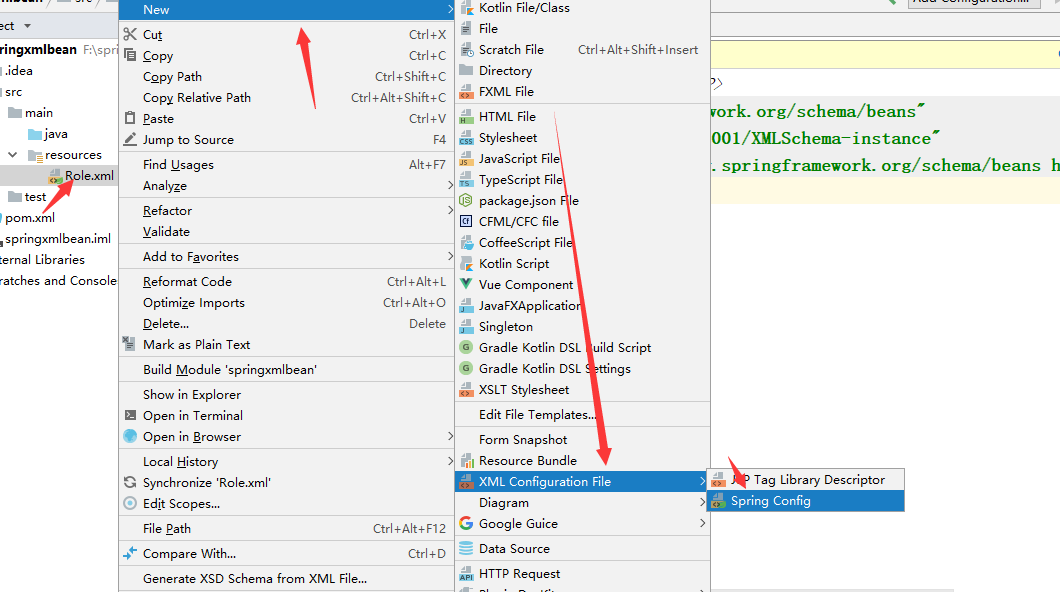
创建角色类Role
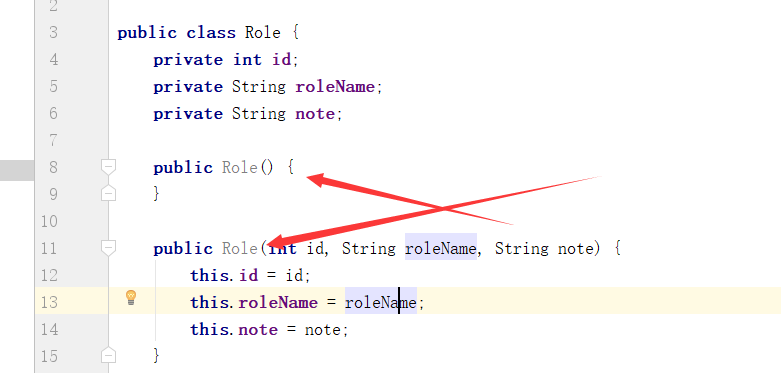
类构造器有参与无参
代码:
Role:
package com.wbg.springxmlbean.entity;

public class Role {

    private int id;

    private String roleName;

    private String note;

    @Override

    public String toString() {

        return "Role{" +

                "id=" + id +

                ", roleName='" + roleName + '\'' +

                ", note='" + note + '\'' +

                '}';

    }

    public Role() {

    }

    public Role(int id, String roleName, String note) {

        this.id = id;

        this.roleName = roleName;

        this.note = note;

    }

    public int getId() {

        return id;

    }

    public void setId(int id) {

        this.id = id;

    }

    public String getRoleName() {

        return roleName;

    }

    public void setRoleName(String roleName) {

        this.roleName = roleName;

    }

    public String getNote() {

        return note;

    }

    public void setNote(String note) {

        this.note = note;

    }

}
User:
package com.wbg.springxmlbean.entity;

public class User {

    private int id;

    private Role role;

    @Override

    public String toString() {

        return "User{" +

                "id=" + id +

                ", role=" + role +

                ", name='" + name + '\'' +

                ", age=" + age +

                '}';

    }

    public Role getRole() {

        return role;

    }

    public void setRole(Role role) {

        this.role = role;

    }

    public int getId() {

        return id;

    }

    public void setId(int id) {

        this.id = id;

    }

    public String getName() {

        return name;

    }

    public void setName(String name) {

        this.name = name;

    }

    public int getAge() {

        return age;

    }

    public void setAge(int age) {

        this.age = age;

    }

    private String name;

    private int age;

}
xml进行配置:
1、装备简易值
  <!--

    id:属性是Spring找到的这个Bean的编号,不是必须的,如果没有Spring会采用:

        "全限定名#{number}"的格式生成编号

        列如: <bean class="com.wbg.springxmlbean.entity.Role">

         Spring会生成编号为:"com.wbg.springxmlbean.entity.Role#1"

    class:是一个类的全限定名

         -->

    <bean id="role1" class="com.wbg.springxmlbean.entity.Role">

       <!-- property元素是定义类的属性,name属性定义的是属性名称 value是值

        相当于:

        Role role=new Role();

        role.setId(1);

        role.setRoleName("高级工程师");

        role.setNote("重要人员");-->

        <property name="id" value="1"/>

        <property name="roleName" value="高级工程师"/>

        <property name="note" value="重要人员"/>

    </bean>

    <bean id="rolew" class="com.wbg.springxmlbean.entity.Role">

     <!--   constructor-arg元素,index代表参数索引, value是值

         相当于:

        Role role=new Role(1,"高级工程师","重要人员");-->

       <constructor-arg index="0" value="1"/>

        <constructor-arg index="1" value="高级工程师"/>

        <constructor-arg index="2" value="重要人员"/>

    </bean>
<bean id="user" class="com.wbg.springxmlbean.entity.User">

        <property name="id" value="1"/>

        <property name="age" value="18"/>

        <property name="name" value="韦邦杠"/>

        <!--name是属性名称 ref是对应的Bean-->

        <property name="role" ref="role1"/>

    </bean>
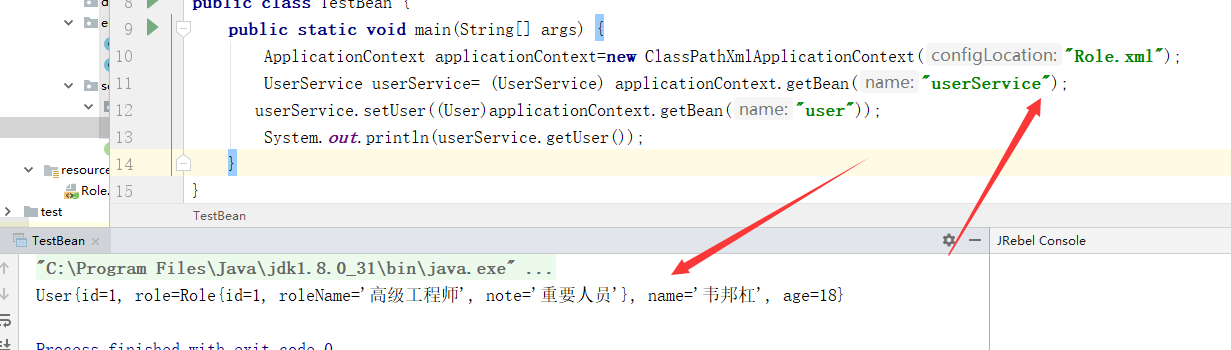
测试:
public static void main(String[] args) {

        ApplicationContext applicationContext=new ClassPathXmlApplicationContext("Role.xml");

        UserService userService= (UserService) applicationContext.getBean("userService");

       userService.setUser((User)applicationContext.getBean("user"));

        System.out.println(userService.getUser());

    }
2、装配集合
定义类:
package com.wbg.springxmlbean.entity;

import java.util.*;

public class ComplexAssembly {

    private Long id;

    private List<String> list;

    private Map<String,String> map;

    private Properties properties;

    private Set<String> set;

    private String[] array;

    @Override

    public String toString() {

        return "ComplexAssembly{" +

                "id=" + id +

                ", list=" + list +

                ", map=" + map +

                ", properties=" + properties +

                ", set=" + set +

                ", array=" + Arrays.toString(array) +

                '}';

    }

    public Long getId() {

        return id;

    }

    public void setId(Long id) {

        this.id = id;

    }

    public List<String> getList() {

        return list;

    }

    public void setList(List<String> list) {

        this.list = list;

    }

    public Map<String, String> getMap() {

        return map;

    }

    public void setMap(Map<String, String> map) {

        this.map = map;

    }

    public Properties getProperties() {

        return properties;

    }

    public void setProperties(Properties properties) {

        this.properties = properties;

    }

    public Set<String> getSet() {

        return set;

    }

    public void setSet(Set<String> set) {

        this.set = set;

    }

    public String[] getArray() {

        return array;

    }

    public void setArray(String[] array) {

        this.array = array;

    }

}
xml:
<bean id="complexAssembly" class="com.wbg.springxmlbean.entity.ComplexAssembly">

        <property name="id" value="1"/>

        <property name="list">

            <!--List属性对应list元素进行装配,然后通过多个value设值-->

            <list>

                <value>value-list-1</value>

                <value>value-list-2</value>

                <value>value-list-3</value>

                <value>value-list-4</value>

            </list>

        </property>

        <property name="map">

            <!--Map属性对应map元素进行装配,然后通过多个entry设值,只是entry包含有key和value值设值-->

            <map>

                <entry key="key1" value="value1"/>

                <entry key="key2" value="value2"/>

                <entry key="key3" value="value3"/>

                <entry key="key4" value="value4"/>

            </map>

        </property>

        <property name="properties">

            <!--Properties属性,对应props进行装配,然后通过prop元素数值,只是prop有一个必填的key,然后设值-->

            <props>

                <prop key="prop1">value-prop-1</prop>

                <prop key="prop2">value-prop-2</prop>

                <prop key="prop3">value-prop-3</prop>

                <prop key="prop4">value-prop-4</prop>

            </props>

        </property>

        <property name="set">

            <!--Set属性对应set元素进行装配,然后通过多个value设值-->

            <set>

                <value>value-set-1</value>

                <value>value-set-2</value>

                <value>value-set-3</value>

                <value>value-set-4</value>

            </set>

        </property>

        <property name="array">

            <!--Array属性对应array元素进行装配,然后通过多个value设值-->

            <array>

                <value>value-array-1</value>

                <value>value-array-2</value>

                <value>value-array-3</value>

                <value>value-array-4</value>

            </array>

        </property>

    </bean>
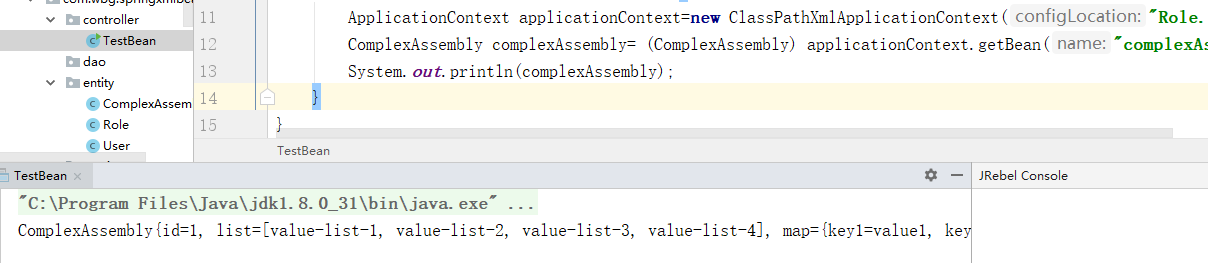
测试:
  ApplicationContext applicationContext=new ClassPathXmlApplicationContext("Role.xml");

        ComplexAssembly complexAssembly= (ComplexAssembly) applicationContext.getBean("complexAssembly");

        System.out.println(complexAssembly);
3、装配用户和角色
类:MapUserRole
package com.wbg.springxmlbean.entity;

import java.util.Map;

public class MapUserRole {

    private Map<User,Role> map;

    @Override

    public String toString() {

        return "MapUserRole{" +

                "map=" + map +

                '}';

    }

    public Map<User, Role> getMap() {

        return map;

    }

    public void setMap(Map<User, Role> map) {

        this.map = map;

    }

}
xml:
 <bean id="u2" class="com.wbg.springxmlbean.entity.User">

        <property name="id" value="1"/>

        <property name="name" value="小邦哥"/>

        <property name="age" value="20"/>

    </bean>

    <bean id="u1" class="com.wbg.springxmlbean.entity.User">

        <property name="id" value="2"/>

        <property name="name" value="邦杠"/>

        <property name="age" value="21"/>

    </bean>

    <bean id="r1" class="com.wbg.springxmlbean.entity.Role">

        <constructor-arg index="0" value="1"/>

        <constructor-arg index="1" value="中级工程师"/>

        <constructor-arg index="2" value="普通人员"/>

    </bean>

    <bean id="r2" class="com.wbg.springxmlbean.entity.Role">

        <constructor-arg index="0" value="2"/>

        <constructor-arg index="1" value="高级工程师"/>

        <constructor-arg index="2" value="重要人员"/>

    </bean>

    <bean id="mapUserRole" class="com.wbg.springxmlbean.entity.MapUserRole">

        <property name="map">

            <map>

                <entry key-ref="u1" value-ref="r1"/>

                <entry key-ref="u2" value-ref="r2"/>

            </map>

        </property>

    </bean>
测试:

demo:https://github.com/weibanggang/springXmlBean
Spring 通过XML配置装配Bean的更多相关文章
- Spring基础篇——通过Java注解和XML配置装配bean
自动化装配的确有很大的便利性,但是却并不能适用在所有的应用场景,比如需要装配的组件类不是由自己的应用程序维护,而是引用了第三方的类库,这个时候自动装配便无法实现,Spring对此也提供了相应的解决方案 ...
- Spring基础篇——通过Java注解和XML配置装配bean(转载)
作者:陈本布衣 出处:http://www.cnblogs.com/chenbenbuyi 本文版权归作者和博客园共有,欢迎转载分享,但必须保留此段声明,且在文章页面明显位置给出原文链接,否则保留 ...
- Spring实战3:装配bean的进阶知识
主要内容: Environments and profiles Conditional bean declaration 处理自动装配的歧义 bean的作用域 The Spring Expressio ...
- Spring实战2:装配bean—依赖注入的本质
主要内容 Spring的配置方法概览 自动装配bean 基于Java配置文件装配bean 控制bean的创建和销毁 任何一个成功的应用都是由多个为了实现某个业务目标而相互协作的组件构成的,这些组件必须 ...
- Spring框架(3)---IOC装配Bean(注解方式)
IOC装配Bean(注解方式) 上面一遍文章讲了通过xml来装配Bean,那么这篇来讲注解方式来讲装配Bean对象 注解方式需要在原先的基础上重新配置环境: (1)Component标签举例 1:导入 ...
- spring+mybaits xml配置解析----转
一.项目中spring+mybaits xml配置解析 一般我们会在datasource.xml中进行如下配置,但是其中每个配置项原理和用途是什么,并不是那么清楚,如果不清楚的话,在使用时候就很有可能 ...
- spring的xml配置声明以及相应的问题处理
spring的xml配置声明: xml配置声明 Code 问题处理 问题1 xml报错: cvc-elt.1: Cannot find the declaration of element 'bea ...
- spring中用xml配置构造注入的心得
spring中用xml配置构造注入时,如果 <constructor-arg> 属性都是 ref ,则不用理会参数顺序 <constructor-arg ref="kill ...
- Spring框架(2)---IOC装配Bean(xml配置方式)
IOC装配Bean (1)Spring框架Bean实例化的方式提供了三种方式实例化Bean 构造方法实例化(默认无参数,用的最多) 静态工厂实例化 实例工厂实例化 下面先写这三种方法的applicat ...
随机推荐
- Spring Cloud实战之初级入门(四)— 利用Hystrix实现服务熔断与服务监控
目录 1.环境介绍 2.服务监控 2.1 加入依赖 2.2 修改配置文件 2.3 修改启动文件 2.4 监控服务 2.5 小结 3. 利用hystrix实现消费服务熔断 3.1 加入服务熔断 3.2 ...
- 关于使用flying-saucer-pdf,实现xhtml2pdf
@author Guoguo 2013.11.24 关于flying-saucer-pdf 是一个XML/CSS渲染器,flying-saucer-pdf工具以XML标准文件作为输入,CSS进行排版. ...
- Could not open php://output for writing.问题解决
这是一个自己在项目中遇到的问题. 由于一直以来,公司都是用的Linux服务器,这次为客户做项目,换成了winserver. 项目中有一项功能是Excel导出,采用PHPEXCEL类库实现.由于是个小项 ...
- springMVC @Component-@Resource-@Repository-@Service-@Controller的区别和理解
作用: @Component------------------------泛指组件,当组件不好归类的时候,我们可以使用这个注解进行标注.(Component-------成分; 组分; 零件) @R ...
- JS学习-基础运动
多物体运动 多个物体用同一个函数时,函数里定义的定时器应该要每个物体对应一个定时器名称,不然会导致未完成运动就被关闭了,因为定时器名称一样,而开启定时器前会清除一下. obj.timer 多值同时运动 ...
- Canvas中的save方法和restore方法
初学者也许会误认为canvas中save方法是用来保存绘图状态的图形,而restore方法是用来还原之前保存的绘图状态的图形,其实不然. save():保存当前的绘图状态. restore():恢复之 ...
- MySQL数据库(4)----生成统计信息
MySQL最有用的一项功能就是,能够对大量原始数据进行归纳统计. 1.在一组值里把各个唯一的值找出来,这是一项典型的统计工作,可以使用DISTINCT 关键字清楚查询结果里重复出现的行.例如,下面的查 ...
- Codeforces Round #413 A. Carrot Cakes
A. Carrot Cakes time limit per test 1 second memory limit per test 256 megabytes In some game ...
- 07_Redis事务
[简述] 事务是指一系列的操作步骤,着一些列的操作步骤,要么完全地执行,要不完全地不执行. 比如微博中: A用户关注了B用户,那么A的关注列表里就会有B用户,B用户的粉丝列表里就会有A用户. 这个关注 ...
- 形象解释C#、Net、Asp.net
下文是写给计算机小白的,尽量用形象的语言来让她们明白这些比较抽象的概念. -------------------------------------- C#: 你和美国人说话要说英语 和中国人说话说汉 ...