
What is Double Spending & How Does Bitcoin Handle It?
https://coinsutra.com/bitcoin-double-spending/
Bitcoin is gaining rapid popularity and adoption across the globe. It is re-defining the way we use money by being the world’s first fully functional digital currency.
You might be surprised to know that even before Bitcoin, there were attempts to create a sustainable digital monetary system. But all those attempts failed because an obvious problem with digital money is that transactions can be copied and spent twice.
Let me simply the concept…
Bitcoin has been able to survive and thrive because it solves the “double spending”problem.
What Does Double Spending Mean?
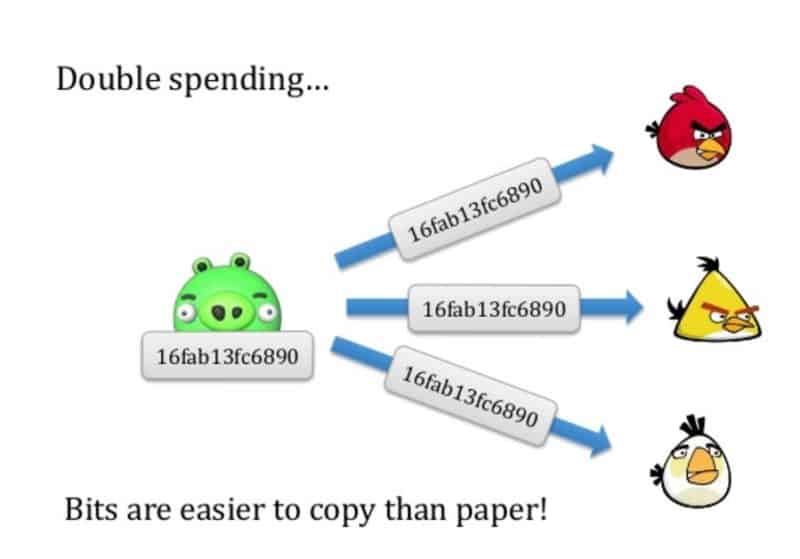
Double spending means spending the same money twice.
Let’s consider this example:
You go to Starbucks and order a cappuccino worth $10. You pay in cash. Now that $10 in cash is in the cash vault of Starbucks. By all means, you simply cannot spend the same $10 somewhere else to make another purchase.
Unless you steal it…!!!
As you paid with your $10 bill, the service provider at Starbucks instantly confirmed that you have paid, and you received your coffee in exchange for the money.
But Bitcoin is digital money, not physical cash. Hence, Bitcoin transactions have a possibility of being copied and rebroadcasted. This opens up the possibility that the same BTC could be spent twice by its owner.
How?
In our Starbucks example, you paid cash, so the payment was confirmed and verified instantly by another human. But with digital currency like BTC, if this verification mechanism is missing, it can lead to double spending.
Anyone can just copy that digital money and pay somewhere else.
And here is where the unique invention lies…
Bitcoin, although being digital currency, solves the problem of being copied and getting spent twice.
How Bitcoin Handles The Double Spending Problem

Bitcoin manages the double spending problem by implementing a confirmation mechanism and maintaining a universal ledger (called “blockchain”), similar to the traditional cash monetary system.
Bitcoin’s blockchain maintains a chronologically-ordered, time-stamped transaction ledger from the very start of its operation in 2009.
Every 10 mins, a block (i.e. a group of transactions) is added to the ledger. And all the nodes on the Bitcoin network keep a copy of this global ledger (the blockchain).
Let’s see how the Bitcoin network prevents double spending:
Let’s suppose you have 1 BTC which you try to spend twice.
You made the 1 BTC transaction to a merchant. Now, you again sign and send the same 1 BTC on another Bitcoin address to try and trick the merchant.
Both transactions go into the unconfirmed pool of transactions. But only your first transaction got confirmations and was verified by miners in the next block. Your second transaction could not get enough confirmations because the miners judged it as invalid, so it was pulled from the network.
But wait… what if both the transactions are taken simultaneously by the miners?
When miners pull the transactions simultaneously from the pool, then whichever transaction gets the maximum number of confirmations from the network will be included in the blockchain, and the other one will be discarded.
You might say that this is unfair for the merchant, as the transaction might fail in getting confirmations. Yeah, this can happen!!!
That’s why it is recommended for merchants to wait for a minimum of 6 confirmations.
Here, “6 confirmations” simply means that after a transaction was added to the blockchain, 6 more blocks containing several other transactions were added after it.
“Confirmations” are nothing but more blocks containing more transactions being added to the blockchain. Each transaction and blocks are mathematically related to the previous one.
All these confirmations and transactions are time-stamped on the blockchain, making them irreversible and impossible to tamper with.
So if a merchant receives his/her minimum number of confirmations, he/she can be positive it was not a double spend by the sender.
Why can the merchant be assured?
Because to be able to double spend that coin, the sender has to go back and reverse all transactions in the 6 blocks that have been added after their transaction, which is computationally impossible.
How Double-Spend Attacks Can Happen
- Attack 51%
If somehow an attacker captures 51% of the hash power of the network, double spending can happen.
“Hash power” means the computational power which verifies transactions and blocks. If an attacker has this control, he/she can reverse any transaction and make a private blockchain which everyone will consider as real.
But so far, no such attack has happened because controlling 51% of the network is highly cost intensive. It depends on the present difficulty of mining, the hardware price, and the electricity cost, all of which is infeasible to acquire.
- Race Attack
When an attacker sends the same coin in rapid succession to two different addresses, the obvious outcome is that only one of them will get included.
Now, if you as a merchant don’t wait for confirmations of payment, then in a case like this, there’s a 50% chance you got the double spent coin (and you won’t receive that money).
Let’s see how…
Your customer can trick you if he/she sends the same coins again to his/her address.
Once the customer does both transactions, both transactions go to an unconfirmed pool of transactions. Whichever transaction gets verified first and gets 6 confirmations will be accepted, and the other will be discarded.
As a merchant, you might get the 6 confirmations first, but if the attacker gets the confirmations first, then you won’t receive your funds. That’s why it is said to wait for a minimum of 6 confirmations.
So far, in the 8-year history of Bitcoin, no such attack has been successful. The Bitcoin mechanism of maintaining a universal transaction ledger based on confirmations has yet to be tricked.
What is Double Spending & How Does Bitcoin Handle It?的更多相关文章
- Bitcoin: A Peer-to-Peer Electronic Cash System
Bitcoin: A Peer-to-Peer Electronic Cash System Satoshi Nakamoto October 31, 2008 Abstract A purely p ...
- How the Bitcoin protocol actually works
sklearn实战-乳腺癌细胞数据挖掘(博客主亲自录制视频教程) https://study.163.com/course/introduction.htm?courseId=1005269003&a ...
- 比特币_Bitcoin 简介
2008-11 Satoshi Nakamoto Bitcoin: A Peer-to-Peer Electronic Cash System http://p2pbucks.com/?p=99 ...
- p3.BTC-协议
数字货币是文件,难伪造,但是容易复制,不像实体货币,花出去就没了,数字货币存在double spending attack,双花攻击. 去中心化的货币,需要解决两个问题: 1.货币的发行 挖矿 2.交 ...
- Blockchain technology and Application
BTC-密码学原理 比特币本质:crypto currency[加密货币] 比特币用到的两个功能: 1.哈希 crypto graphic hash function 2.签名(非对称加密) 哈希cr ...
- Block Chain Learning Notes
区块链是什么 区块链技术是由比特币创造的,本文也将从比特币开始进行引导,一步一步告诉大家什么是区块链.如果你想立马知道区块链是什么,也可以直接转到文章末尾的区块链定义. 区块链,可能是当下最有前景又充 ...
- [No00009E]几种常见的命名规则
变量命名规则 必须遵循的命名规则 1. 变量名首字母必须为字母(a-z A-Z),下划线(_),或者美元符号($)开始php编程中所有变量必须以$开始. 2. 变量名只能是字母(a-z A ...
- effectiveC++ 内存管理 学习笔记
1.尽量使用初始化列表而不要再构造函数里赋值,初始化顺序和声明的顺序一致,一些类型如const,引用等,必须使用初始化.对于非内部数据类型成员对象应当采用初始化表,以获取更高的效率.example:B ...
- Delphi编程建议遵守的规范2---命名规范
1.1.形参命名建议 所有形参的名称都应当表达出它的用途.如果合适的话,形参的名称最好以字母a 为前缀,例如: procedure SomeProc(aUserName:string; aUserAg ...
随机推荐
- [Luogu 2341] HAOI2006 受欢迎的牛
[Luogu 2341] HAOI2006 受欢迎的牛 智能推的水题,一看是省选题就给做了,做一半才发现 Tarjan 算法忘干净了. Tarjan 求出SCC,算出每一个 SCC 包含原图的点数(s ...
- asp.net SimpleImpersonation使用身份模拟访问局域网共享目录
mvc中默认账户的权限很低,缺省情况下,ASP.NET应用程序以本机的ASPNET帐号运行,该帐号属于普通用户组,权限受到一定的限制,以保障ASP.NET应用程序运行的安全.但是有时需要某个ASP.N ...
- MVP应用在android app上
使用MVP模式来解耦activity中业务代码和界面代码.在activity中,将其中的业务抽象到presenter层:将其中的界面代码抽象到View层. MVP模式: 一个软件被划分成三层,View ...
- 「6月雅礼集训 2017 Day10」perm(CodeForces 698F)
[题目大意] 给出一个$n$个数的序列$\{a_n\}$,其中有些地方的数为0,要求你把这个序列填成一个1到$n$的排列,使得: $(a_i, a_j) = 1$,当且仅当$(i, j) = 1$.多 ...
- 【NOIP】普及组2011 表达式的值
[算法]动态规划+后缀表达式 [题解] 先把算式转为后缀表达式后进行DP 令f[s][0]表示使表达式答案为0的方案数 f[s][1]表示使表达式答案为1的方案数 (加法) f[a+b][1]=f[a ...
- HDU 1574 RP问题 (dp)
题目链接 Problem Description 在人类社会中,任何个体都具有人品,人品有各种不同的形式,可以从一种形式转换为另一种形式,从一个个体传递给另一个个体,在转换和传递的过程中,人品不会消失 ...
- js 作用域链&内存回收&变量&闭包
闭包主要涉及到js的几个其他的特性:作用域链,垃圾(内存)回收机制,函数嵌套,等等 一.作用域链:函数在定义的时候创建的,用于寻找使用到的变量的值的一个索引,而他内部的规则是,把函数自身的本地变量放在 ...
- error 0152: No Entity Framework provider found for the ADO.NET provider with invariant name 'System.Data.SqlClient'
error 0152: No Entity Framework provider found for the ADO.NET provider with invariant name 'System. ...
- Coursera在线学习---第九节(2).推荐系统
一.基于内容的推荐系统(Content Based Recommendations) 所谓基于内容的推荐,就是知道待推荐产品的一些特征情况,将产品的这些特征作为特征变量构建模型来预测.比如,下面的电影 ...
- vue路由-编程式导航
除了使用 <router-link> 创建 a 标签来定义导航链接,我们还可以借助 router 的实例方法,通过编写代码来实现. router.push(location, onComp ...