
Golang 中操作 Mongo Update 的方法
MongoDB 中有一种时间格式数据 ISODate,参考如下:

如果在 Golang 中查询这条记录,Golang用什么类型的变量来保存呢?
查找 ISODate 时间字段
在 Golang 中可以使用 time.Time 数据类型来保存 MongoDB 中的 ISODate 时间。
type Model struct {

    Id   bson.ObjectId `bson:"_id,omitempty"`

    Time time.Time     `bson:"time"`

}

m := Model{}

err := c.Find(bson.M{"_id": bson.ObjectIdHex("572f3c68e43001d2c1703aa7")}).One(&m)

if err != nil {

    panic(err)

}

fmt.Printf("%+v\n", m)

// output: {Id:ObjectIdHex("572f3c68e43001d2c1703aa7") Time:2015-07-08 17:29:14.002 +0800 CST}- 1
- 2
- 3
- 4
- 5
- 6
- 7
- 8
- 9
- 10
- 11
从输出中可以看到 Golang 输出的时间格式是 CST 时区,Golang 在处理的过程中将 ISO 时间转换成了 CST 时间,从时间面板上来看也比 MongoDB 中的快上 8 个小时,这个是正常的。
那么 Golang 做插入操作和或者时间比较操作的时候需要自己转换时间戳吗?答案是不需要的,来看下插入的例子。
插入时间
重新插入一条记录,记录的Time字段为当前时间,在golang中可以通过time.Now获取当前时间,查看输出可以看到是CST的时间格式
now := time.Now()

fmt.Printf("%+v\n", now)

// output: 2016-05-12 14:34:00.998011694 +0800 CST

err = c.Insert(Model{Time: now})

if err != nil {

    panic(err)

}- 1
- 2
- 3
- 4
- 5
- 6
- 7
查看 MongoDB 中的记录
插入当前时间到 MongoDB:
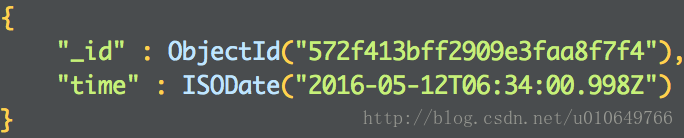
可以看到存储到 MongoDB 中时间的自动转换为了 ISO 时间,时间少了 8 个小时。小结一下就是 Golang 和 MongoDB 中的时间交互不需要考虑额外的东西,因为驱动都进行了转换。
时间字符串转成 time.Time
有时我们会将 time.Time 的时间以字符串的形式存储,那么要和 MongoDB 交互的时候就需要转换 time.Time 格式
// 时间字符串转到到time.Time格式

// 使用time.Parse方法进行转换

timeString := "2016-05-12 14:34:00.998011694 +0800 CST"

t, err := time.Parse("2006-01-02 15:04:05.999999999 -0700 MST", timeString)

if err != nil {

    panic(err)

}

fmt.Printf("%+v\n", t)- 1
- 2
- 3
- 4
- 5
- 6
- 7
- 8
代码中比较难理解的就是 time.Parse 的第一个参数,这个其实是 Golang 当中的定义,详细看下 time.Time.String() 的源码就会明白了。
这篇博客主要记录下 Golang 中引入 Mongo 数据库对 Mongo 的修改操作的方法。
使用gopkg.in/mgo.v2库操作,修改操作主要使用mongodb中Collection对象的Update、UpdateAll、UpdateId、Upsert、UpsertId方法。
统一封装下getDB方法
package main

import (

    "fmt"

    "gopkg.in/mgo.v2"

    "gopkg.in/mgo.v2/bson"

)

// get mongodb db

func getDB() *mgo.Database {

    session, err := mgo.Dial("127.0.0.1:27017")

    if err != nil {

        panic(err)

    }

    session.SetMode(mgo.Monotonic, true)

    db := session.DB("test")

    return db

}- 1
- 2
- 3
- 4
- 5
- 6
- 7
- 8
- 9
- 10
- 11
- 12
- 13
- 14
- 15
- 16
- 17
- 18
- 19
Update修改单条记录
func (c *Collection) Update(selector interface{}, update interface{}) error- 1
和mysql不同,Update函数只能用来修改单条记录,即使条件能匹配多条记录,也只会修改第一条匹配的记录。
selector := bson.M{"_id": bson.ObjectIdHex("56fdce98189df8759fd61e5b")}

data := bson.M{"age": 21}

err := getDB().C("user").Update(selector, data)

if err != nil {

    panic(err)

}- 1
- 2
- 3
- 4
- 5
- 6
类似于mongodb语法:
db.getCollection('user').update(

      { "_id": ObjectId("56fdce98189df8759fd61e5b") },

      { "age": 21}

)- 1
- 2
- 3
- 4
这边有一个小坑,就是这种写法的修改数据会更新整个文档为 {“age”: 21},而不是只更新age的值。
 更新前数据:

    {

        "_id" : ObjectId("56fdce98189df8759fd61e5b"),

        "name" : "Tom",

        "age" : 20

    }

 更新后数据:

    {

        "_id" : ObjectId("56fdce98189df8759fd61e5b"),

        "age" : 21

}- 1
- 2
- 3
- 4
- 5
- 6
- 7
- 8
- 9
- 10
- 11
如果需要只更新age的值,则需要使用$set关键词:
selector := bson.M{"_id": bson.ObjectIdHex("571de968a99cff2c68264807")}

data := bson.M{"$set": bson.M{"age": 21}}

err := getDB().C("user").Update(selector, data)

if err != nil {

    panic(err)

}
- 1
- 2
- 3
- 4
- 5
- 6
- 7
如果更新的数据不存在,则会报一个not found的错误:
// 更新不存在的数据

selector := bson.M{"_id": bson.ObjectIdHex("16fdce98189df8759fd61e5b")}

data := bson.M{"age": 21}

err := getDB().C("user").Update(selector, data)

if err != nil {

    fmt.Println(err == mgo.ErrNotFound)

    // output: true

}- 1
- 2
- 3
- 4
- 5
- 6
- 7
- 8
由于Update只能更新一条数据,如果需要批量更新则需要使用UpdateAll函数
UpdateAll批量更新
func (c *Collection) UpdateAll(selector interface{}, update interface{}) (info *ChangeInfo, err error)
- 1
- 2
selector := bson.M{"name": "Tom"}

data := bson.M{"$set": bson.M{"age": 22}}

changeInfo, err := getDB().C("user").UpdateAll(selector, data)

if err != nil {

    panic(err)

}

fmt.Printf("%+v\n", changeInfo)

// output: &{Updated:2 Removed:0 UpsertedId:<nil>}
- 1
- 2
- 3
- 4
- 5
- 6
- 7
- 8
- 9
UpdateId根据Id更新
和Update函数类似,就是条件直接换成了objectid,这个使用也挺频繁的。
func (c *Collection) UpdateId(id interface{}, update interface{}) error

类似

err := collection.Update(bson.M{"_id": id}, update) - 1
- 2
- 3
id := bson.ObjectIdHex("571de968a99cff2c68264807")

data := bson.M{"$set": bson.M{"age": 30}}

err := getDB().C("user").UpdateId(id, data)

if err != nil {

    panic(err)

}- 1
- 2
- 3
- 4
- 5
- 6
Upsert更新或者插入数据
这个函数就是如果数据存在就更新,否则就新增一条记录。这个函数也挺常用的。
func (c *Collection) Upsert(selector interface{}, update interface{}) (info *ChangeInfo, err error)- 1
selector := bson.M{"key": "max"}

data := bson.M{"$set": bson.M{"value": 30}}

changeInfo, err := getDB().C("config").Upsert(selector, data)

if err != nil {

    panic(err)

}

fmt.Printf("%+v\n", changeInfo)

// 首次执行output: &{Updated:0 Removed:0 UpsertedId:ObjectIdHex("571df02ea99cff2c6826480a")}

// 再次执行output: &{Updated:1 Removed:0 UpsertedId:<nil>}- 1
- 2
- 3
- 4
- 5
- 6
- 7
- 8
- 9
UpsertId按照更新或者插入数据
 func (c *Collection) UpsertId(id interface{}, update interface{}) (info *ChangeInfo, err error)

 类似

info, err := collection.Upsert(bson.M{"_id": id}, update)- 1
- 2
- 3
id := bson.ObjectIdHex("571df02ea99cff2c6826480b")

data := bson.M{"$set": bson.M{"key": "max", "value": 30}}

changeInfo, err := getDB().C("config").UpsertId(id, data)

if err != nil {

    panic(err)

}

fmt.Printf("%+v\n", changeInfo)

// 首次执行output: &{Updated:0 Removed:0 UpsertedId:ObjectIdHex("571df02ea99cff2c6826480b")}

// 再次执行output: &{Updated:1 Removed:0 UpsertedId:<nil>}
Golang 中操作 Mongo Update 的方法的更多相关文章
- JQuery中操作Css样式的方法
JQuery中操作Css样式的方法//1.获取和设置样式 $("#tow").attr("class")获取ID为tow的class属性 $("#tw ...
- 【转发】JQuery中操作Css样式的方法
JQuery中操作Css样式的方法 //1.获取和设置样式 $("#tow").attr("class")获取ID为tow的class属性 $("#t ...
- 在Python中操作文件之truncate()方法的使用教程
在Python中操作文件之truncate()方法的使用教程 这篇文章主要介绍了在Python中操作文件之truncate()方法的使用教程,是Python入门学习中的基础知识,需要的朋友可以参考下 ...
- 六、golang中的结构体和方法、接口
结构体: 1.用来自定义复杂数据结构 2.struct里面可以包含多个字段(属性) 3.struct类型可以定义方法,注意和函数的区分 4.strucr类型是值类型 5.struct类型可以嵌套 6. ...
- android4.0以上访问网络不能在主线程中进行以及在线程中操作UI的解决方法
MONO 调用一个线程操作UI 然后报Only the original thread that created a view hierarchy can touch its views.错误 goo ...
- Flex中操作XML的E4X方法
用于处理 XML 的 E4X 方法 Flash Player 9 和更高版本,Adobe AIR 1.0 和更高版本 ECMAScript for XML 规范定义了一组用于使用 XML 数据的类 ...
- 关于js中操作数组的一些方法
网上找的通篇看了一遍讲的很透收藏了! 转自(https://www.cnblogs.com/blogs-8888/p/6518683.html) 1.锁定数组的长度(让数组的长度变成只读). 1 2 ...
- vue中操作Dom节点的方法
1.vue中ref操作dom节点 <template> <div id="app"> <div </div> <button @cl ...
- 【golang】golang中结构体的初始化方法(new方法)
准备工作: 定义结构体:Student import ( "fmt" "reflect") type Student struct { StudentId st ...
随机推荐
- [ES6] 01. Intro to ES6 and traceur compiler
---恢复内容开始--- ES6 is ECMAScript version 6, which JavaScript is based on. The next version of JavaScri ...
- C++ 11 - STL - 函数对象(Function Object) (中)
我们再来看一个复杂的例子 需求: 我们需要对集合内每个元素加上一个特定的值 代码如下: AddInt.h class AddInt { private: int theValue; // the va ...
- Cocos2d-x -- 图片菜单按钮
Scene* MainMenu::createScene() { // 'scene' is an autorelease object auto scene = Scene::create(); / ...
- edge中断分析
眼下正在调试msix中断,在測试过程中发现会概率性的丢失中断.Msix中断默认是edge触发的中断,edge触发的中断是在中断相应pin发生电平信号跳变的时候,会发出一个中断请求. 由于跳变是一瞬间的 ...
- iOS-字符串拼接
// // main.m // /* 将两个字符串 NSString * str1 = @"123"; NSString * str2 = @"abc"; 拼接 ...
- Python——Shell编程关于Sha-Bang(#!)
Q. #!的名字为什么叫Sha-Bang? A. Sha-Bang是Sharp和Bang的组合词.Sharp for #, Bang for ! 类似的情况是,C#通常被称为C Sharp Q. Sh ...
- js&jquery获取指定table指定行里面的内容
js&jquery获取指定table指定行里面的内容 CreateTime--2018年5月18日11:46:04 Author:Marydon 1.展示 代码展示 <table s ...
- 铁通网络没有一个真实的公网IP,NAT转换能不能解决?
铁通网络没有一个真实的公网IP,NAT转换能不能解决? 我的是铁通宽带,现在想用自己的机子做一个动态主机,可是因为铁通垃圾网络的NAT转发问题,使用cn99qdns手动更新动态域名IP后公网能 ...
- 【转帖】为什么不要把ZooKeeper用于服务发现
http://www.infoq.com/cn/news/2014/12/zookeeper-service-finding ZooKeeper是Apache基金会下的一个开源的.高可用的分布式应用协 ...
- 在eclipse中将android工程打包生成apk文件
1.)生成keystore 按照下面的命令行 在C:\Program Files\Java\jdk1.6.0_10\bin>目录下,输入keytool -genkey -alias androi ...