
【Zookeeper】源码分析之Watcher机制(三)之Zookeeper
一、前言
前面已经分析了Watcher机制中的大多数类,本篇对于ZKWatchManager的外部类Zookeeper进行分析。
二、ZooKeeper源码分析
2.1 类的内部类
ZooKeeper的内部类框架图如下图所示
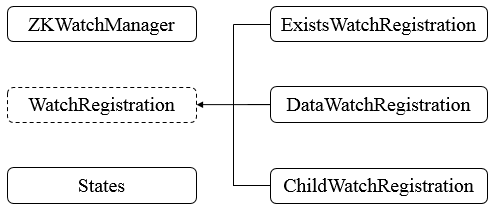
说明:
· ZKWatchManager,Zookeeper的Watcher管理者,其源码在之前已经分析过,不再累赘。
· WatchRegistration,抽象类,用作watch注册。
· ExistsWatchRegistration,存在性watch注册。
· DataWatchRegistration,数据watch注册。
· ChildWatchRegistration,子节点注册。
· States,枚举类型,表示服务器的状态。
1. WatchRegistration
接口类型,表示对路径注册监听。
    abstract class WatchRegistration {

        // Watcher

        private Watcher watcher;

        // 客户端路径

        private String clientPath;

        // 构造函数

        public WatchRegistration(Watcher watcher, String clientPath)

        {

            this.watcher = watcher;

            this.clientPath = clientPath;

        }

        // 获取路径到Watchers集合的键值对,由子类实现

        abstract protected Map<String, Set<Watcher>> getWatches(int rc);

        /**

         * Register the watcher with the set of watches on path.

         * @param rc the result code of the operation that             attempted to

         * add the watch on the path.

         */

        // 注册

        public void register(int rc) {

            if (shouldAddWatch(rc)) { // 应该添加监听

                // 获取路径到Watchers集合的键值对,工厂模式

                Map<String, Set<Watcher>> watches = getWatches(rc);

                synchronized(watches) { // 同步块

                    // 通过路径获取watcher集合

                    Set<Watcher> watchers = watches.get(clientPath);

                    if (watchers == null) { // watcher集合为空

                        // 新生成集合

                        watchers = new HashSet<Watcher>();

                        // 将路径和watchers集合存入

                        watches.put(clientPath, watchers);

                    }

                    // 添加至watchers集合

                    watchers.add(watcher);

                }

            }

        }

        /**

         * Determine whether the watch should be added based on return code.

         * @param rc the result code of the operation that attempted to add the

         * watch on the node

         * @return true if the watch should be added, otw false

         */

        // 判断是否需要添加,判断rc是否为0

        protected boolean shouldAddWatch(int rc) {

            return rc == 0;

        }

    }
说明:可以看到WatchRegistration包含了Watcher和clientPath字段,表示监听和对应的路径,值得注意的是getWatches方式抽象方法,需要子类实现,而在register方法中会调用getWatches方法,实际上调用的是子类的getWatches方法,这是典型的工厂模式。register方法首先会判定是否需要添加监听,然后再进行相应的操作,在WatchRegistration类的默认实现中shouldAddWatch是判定返回码是否为0。
2. ExistsWatchRegistration
    class ExistsWatchRegistration extends WatchRegistration {

        // 构造函数

        public ExistsWatchRegistration(Watcher watcher, String clientPath) {

            // 调用父类构造函数

            super(watcher, clientPath);

        }

        @Override

        protected Map<String, Set<Watcher>> getWatches(int rc) {

            // 根据rc是否为0确定返回dataWatches或existsWatches

            return rc == 0 ?  watchManager.dataWatches : watchManager.existWatches;

        }

        @Override

        protected boolean shouldAddWatch(int rc) {

            // 判断rc是否为0或者rc是否等于NONODE的值

            return rc == 0 || rc == KeeperException.Code.NONODE.intValue();

        }

    }
说明:ExistsWatchRegistration 表示对存在性监听的注册,其实现了getWatches方法,并且重写了shouldAddWatch方法,getWatches方法是根据返回码的值确定返回dataWatches或者是existWatches。
3. DataWatchRegistration
    class DataWatchRegistration extends WatchRegistration {

        // 构造函数

        public DataWatchRegistration(Watcher watcher, String clientPath) {

            // 调用父类构造函数

            super(watcher, clientPath);

        }

        @Override

        protected Map<String, Set<Watcher>> getWatches(int rc) {

            // 直接返回dataWatches

            return watchManager.dataWatches;

        }

    }
说明:DataWatchRegistration表示对数据监听的注册,其实现了getWatches方法,返回dataWatches。
4. ChildWatchRegistration
    class ChildWatchRegistration extends WatchRegistration {

        // 构造函数

        public ChildWatchRegistration(Watcher watcher, String clientPath) {

            // 调用父类构造函数

            super(watcher, clientPath);

        }

        @Override

        protected Map<String, Set<Watcher>> getWatches(int rc) {

            // 直接返回childWatches

            return watchManager.childWatches;

        }

    }
说明:ChildWatchRegistration表示对子节点监听的注册,其实现了getWatches方法,返回childWatches。
5. States
    public enum States {

        // 代表服务器的状态

        CONNECTING, ASSOCIATING, CONNECTED, CONNECTEDREADONLY,

        CLOSED, AUTH_FAILED, NOT_CONNECTED;

        // 是否存活

        public boolean isAlive() {

            // 不为关闭状态并且未认证失败

            return this != CLOSED && this != AUTH_FAILED;

        }

        /**

         * Returns whether we are connected to a server (which

         * could possibly be read-only, if this client is allowed

         * to go to read-only mode)

         * */

        // 是否连接

        public boolean isConnected() {

            // 已连接或者只读连接

            return this == CONNECTED || this == CONNECTEDREADONLY;

        }

    }
说明:States为枚举类,表示服务器的状态,其有两个方法,判断服务器是否存活和判断客户端是否连接至服务端。
2.2 类的属性
public class ZooKeeper {

    // 客户端Socket

    public static final String ZOOKEEPER_CLIENT_CNXN_SOCKET = "zookeeper.clientCnxnSocket";

    // 客户端,用来管理客户端与服务端的连接

    protected final ClientCnxn cnxn;

    // Logger日志

    private static final Logger LOG;

    static {

        //Keep these two lines together to keep the initialization order explicit

        // 初始化

        LOG = LoggerFactory.getLogger(ZooKeeper.class);

        Environment.logEnv("Client environment:", LOG);

    }

  private final ZKWatchManager watchManager = new ZKWatchManager();

}
说明:ZooKeeper类存维护一个ClientCnxn类,用来管理客户端与服务端的连接。
2.3 类的构造函数
1. ZooKeeper(String connectString, int sessionTimeout, Watcher watcher, boolean canBeReadOnly)型构造函数
    public ZooKeeper(String connectString, int sessionTimeout, Watcher watcher,

            boolean canBeReadOnly)

        throws IOException

    {

        LOG.info("Initiating client connection, connectString=" + connectString

                + " sessionTimeout=" + sessionTimeout + " watcher=" + watcher);

        // 初始化默认Watcher

        watchManager.defaultWatcher = watcher;

        // 对传入的connectString进行解析

        // connectString 类似于127.0.0.1:3000,127.0.0.1:3001,127.0.0.1:3002未指定根空间的字符串

        // 或者是127.0.0.1:3000,127.0.0.1:3001,127.0.0.1:3002/app/a指定根空间的字符串,根为/app/a

        ConnectStringParser connectStringParser = new ConnectStringParser(

                connectString);

        // 根据服务器地址列表生成HostProvider

        HostProvider hostProvider = new StaticHostProvider(

                connectStringParser.getServerAddresses());

        // 生成客户端管理

        cnxn = new ClientCnxn(connectStringParser.getChrootPath(),

                hostProvider, sessionTimeout, this, watchManager,

                getClientCnxnSocket(), canBeReadOnly);

        // 启动

        cnxn.start();

    }
说明:该构造函数会初始化WatchManager的defaultWatcher,同时会解析服务端地址和端口号,之后根据服务端的地址生成HostProvider(其会打乱服务器的地址),之后生成客户端管理并启动,注意此时会调用getClientCnxnSocket函数,其源码如下
    private static ClientCnxnSocket getClientCnxnSocket() throws IOException {

        // 查看是否在系统属性中进行了设置

        String clientCnxnSocketName = System

                .getProperty(ZOOKEEPER_CLIENT_CNXN_SOCKET);

        if (clientCnxnSocketName == null) { // 若未进行设置,取得ClientCnxnSocketNIO的类名

            clientCnxnSocketName = ClientCnxnSocketNIO.class.getName();

        }

        try {

            // 使用反射新生成实例然后返回

            return (ClientCnxnSocket) Class.forName(clientCnxnSocketName)

                    .newInstance();

        } catch (Exception e) {

            IOException ioe = new IOException("Couldn't instantiate "

                    + clientCnxnSocketName);

            ioe.initCause(e);

            throw ioe;

        }

    }
说明:该函数会利用反射创建ClientCnxnSocketNIO实例
2. public ZooKeeper(String connectString, int sessionTimeout, Watcher watcher, long sessionId, byte[] sessionPasswd, boolean canBeReadOnly) throws IOException型构造函数
    public ZooKeeper(String connectString, int sessionTimeout, Watcher watcher,

            long sessionId, byte[] sessionPasswd, boolean canBeReadOnly)

        throws IOException

    {

        LOG.info("Initiating client connection, connectString=" + connectString

                + " sessionTimeout=" + sessionTimeout

                + " watcher=" + watcher

                + " sessionId=" + Long.toHexString(sessionId)

                + " sessionPasswd="

                + (sessionPasswd == null ? "<null>" : "<hidden>"));

        // 初始化默认Watcher

        watchManager.defaultWatcher = watcher;

        // 对传入的connectString进行解析

        // connectString 类似于127.0.0.1:3000,127.0.0.1:3001,127.0.0.1:3002未指定根空间的字符串

        // 或者是127.0.0.1:3000,127.0.0.1:3001,127.0.0.1:3002/app/a指定根空间的字符串,根为/app/a

        ConnectStringParser connectStringParser = new ConnectStringParser(

                connectString);

        // 根据服务器地址列表生成HostProvider

        HostProvider hostProvider = new StaticHostProvider(

                connectStringParser.getServerAddresses());

        // 生成客户端时使用了session密码

        cnxn = new ClientCnxn(connectStringParser.getChrootPath(),

                hostProvider, sessionTimeout, this, watchManager,

                getClientCnxnSocket(), sessionId, sessionPasswd, canBeReadOnly);

        // 设置客户端的seenRwServerBefore字段为true(因为用户提供了sessionId,表示肯定已经连接过)

        cnxn.seenRwServerBefore = true; // since user has provided sessionId

        // 启动

        cnxn.start();

    }
说明:此型构造函数和之前构造函数的区别在于本构造函数提供了sessionId和sessionPwd,这表明用户已经之前已经连接过服务端,所以能够获取到sessionId,其流程与之前的构造函数类似,不再累赘。
2.4 核心函数分析
1. create函数
函数签名:public String create(final String path, byte data[], List<ACL> acl, CreateMode createMode) throws KeeperException, InterruptedException
    public String create(final String path, byte data[], List<ACL> acl,

            CreateMode createMode)

        throws KeeperException, InterruptedException

    {

        final String clientPath = path;

        // 验证路径是否合法

        PathUtils.validatePath(clientPath, createMode.isSequential());

        // 添加根空间

        final String serverPath = prependChroot(clientPath);

        // 新生请求头

        RequestHeader h = new RequestHeader();

        // 设置请求头类型

        h.setType(ZooDefs.OpCode.create);

        // 新生创建节点请求

        CreateRequest request = new CreateRequest();

        // 新生创建节点响应

        CreateResponse response = new CreateResponse();

        // 设置请求的数据

        request.setData(data);

        // 设置请求对应的Flag

        request.setFlags(createMode.toFlag());

        // 设置服务器路径

        request.setPath(serverPath);

        if (acl != null && acl.size() == 0) { // ACL不为空但是大小为0,抛出异常

            throw new KeeperException.InvalidACLException();

        }

        // 设置请求的ACL列表

        request.setAcl(acl);

        // 提交请求

        ReplyHeader r = cnxn.submitRequest(h, request, response, null);

        if (r.getErr() != 0) { // 请求的响应的错误码不为0,则抛出异常

            throw KeeperException.create(KeeperException.Code.get(r.getErr()),

                    clientPath);

        }

        if (cnxn.chrootPath == null) { // 根空间为空

            // 则返回响应中的路径

            return response.getPath();

        } else {

            // 除去根空间后返回

            return response.getPath().substring(cnxn.chrootPath.length());

        }

    }
说明:该create函数是同步的,主要用作创建节点,其大致步骤如下
① 验证路径是否合法,若不合法,抛出异常,否则进入②
② 添加根空间,生成请求头、请求、响应等,并设置相应字段,进入③
③ 通过客户端提交请求,判断返回码是否为0,若不是,则抛出异常,否则,进入④
④ 除去根空间后,返回响应的路径
其中会调用submitRequest方法,其源码如下
    public ReplyHeader submitRequest(RequestHeader h, Record request,

            Record response, WatchRegistration watchRegistration)

            throws InterruptedException {

        // 新生响应头

        ReplyHeader r = new ReplyHeader();

        // 新生Packet包

        Packet packet = queuePacket(h, r, request, response, null, null, null,

                    null, watchRegistration);

        synchronized (packet) { // 同步

            while (!packet.finished) { // 如果没有结束

                // 则等待

                packet.wait();

            }

        }

        // 返回响应头

        return r;

    }
说明:submitRequest会将请求封装成Packet包,然后一直等待packet包响应结束,然后返回;若没结束,则等待。可以看到其是一个同步方法。
2. create函数
函数签名:public void create(final String path, byte data[], List<ACL> acl, CreateMode createMode, StringCallback cb, Object ctx)
    public void create(final String path, byte data[], List<ACL> acl,

            CreateMode createMode,  StringCallback cb, Object ctx)

    {

        final String clientPath = path;

        // 验证路径是否合法

        PathUtils.validatePath(clientPath, createMode.isSequential());

        // 添加根空间

        final String serverPath = prependChroot(clientPath);

        // 新生请求头

        RequestHeader h = new RequestHeader();

        // 设置请求头类型

        h.setType(ZooDefs.OpCode.create);

        // 新生创建节点请求

        CreateRequest request = new CreateRequest();

        // 新生创建节点响应

        CreateResponse response = new CreateResponse();

        // 新生响应头

        ReplyHeader r = new ReplyHeader();

        // 设置请求的数据

        request.setData(data);

        // 设置请求对应的Flag

        request.setFlags(createMode.toFlag());

        // 设置服务

        request.setPath(serverPath);

        // 设置ACL列表

        request.setAcl(acl);

        // 封装成packet放入队列,等待提交

        cnxn.queuePacket(h, r, request, response, cb, clientPath,

                serverPath, ctx, null);

    }
说明:该create函数是异步的,其大致步骤与同步版的create函数相同,只是最后其会将请求打包成packet,然后放入队列等待提交。
3. delete函数
函数签名:public void delete(final String path, int version) throws InterruptedException, KeeperException
    public void delete(final String path, int version)

        throws InterruptedException, KeeperException

    {

        final String clientPath = path;

        // 验证路径的合法性

        PathUtils.validatePath(clientPath);

        final String serverPath;

        // maintain semantics even in chroot case

        // specifically - root cannot be deleted

        // I think this makes sense even in chroot case.

        if (clientPath.equals("/")) { // 判断是否是"/",即zookeeper的根目录,根目录无法删除

            // a bit of a hack, but delete(/) will never succeed and ensures

            // that the same semantics are maintained

            //

            serverPath = clientPath;

        } else { // 添加根空间

            serverPath = prependChroot(clientPath);

        }

        // 新生请求头

        RequestHeader h = new RequestHeader();

        // 设置请求头类型

        h.setType(ZooDefs.OpCode.delete);

        // 新生删除请求

        DeleteRequest request = new DeleteRequest();

        // 设置路径

        request.setPath(serverPath);

        // 设置版本号

        request.setVersion(version);

        // 新生响应头

        ReplyHeader r = cnxn.submitRequest(h, request, null, null);

        if (r.getErr() != 0) { // 判断返回码

            throw KeeperException.create(KeeperException.Code.get(r.getErr()),

                    clientPath);

        }

    }
说明:该函数是同步的,其流程与create流程相似,不再累赘。
4. delete函数
函数签名:public void delete(final String path, int version, VoidCallback cb, Object ctx)
    public void delete(final String path, int version, VoidCallback cb,

            Object ctx)

    {

        final String clientPath = path;

        // 验证路径是否合法

        PathUtils.validatePath(clientPath);

        final String serverPath;

        // maintain semantics even in chroot case

        // specifically - root cannot be deleted

        // I think this makes sense even in chroot case.

        if (clientPath.equals("/")) { // 判断是否是"/",即zookeeper的根目录,根目录无法删除

            // a bit of a hack, but delete(/) will never succeed and ensures

            // that the same semantics are maintained

            serverPath = clientPath;

        } else {

            serverPath = prependChroot(clientPath);

        }

        // 新生请求头

        RequestHeader h = new RequestHeader();

        // 设置请求头类型

        h.setType(ZooDefs.OpCode.delete);

        // 新生删除请求

        DeleteRequest request = new DeleteRequest();

        // 设置路径

        request.setPath(serverPath);

        // 设置版本号

        request.setVersion(version);

        // 封装成packet放入队列,等待提交

        cnxn.queuePacket(h, new ReplyHeader(), request, null, cb, clientPath,

                serverPath, ctx, null);

    }
说明:该函数是异步的,其流程也相对简单,不再累赘。
5. multi函数
    public List<OpResult> multi(Iterable<Op> ops) throws InterruptedException, KeeperException {

        for (Op op : ops) { // 验证每个操作是否合法

            op.validate();

        }

        // reconstructing transaction with the chroot prefix

        // 新生事务列表

        List<Op> transaction = new ArrayList<Op>();

        for (Op op : ops) { // 将每个操作添加根空间后添加到事务列表中

            transaction.add(withRootPrefix(op));

        }

        // 调用multiInternal后返回

        return multiInternal(new MultiTransactionRecord(transaction));

    }
说明:该函数用于执行多个操作或者不执行,其首先会验证每个操作的合法性,然后将每个操作添加根空间后加入到事务列表中,之后会调用multiInternal函数,其源码如下
    protected List<OpResult> multiInternal(MultiTransactionRecord request)

        throws InterruptedException, KeeperException {

        // 新生请求头

        RequestHeader h = new RequestHeader();

        // 设置请求头类型

        h.setType(ZooDefs.OpCode.multi);

        // 新生多重响应

        MultiResponse response = new MultiResponse();

        // 新生响应头

        ReplyHeader r = cnxn.submitRequest(h, request, response, null);

        if (r.getErr() != 0) { // 判断返回码是否为0

            throw KeeperException.create(KeeperException.Code.get(r.getErr()));

        }

        // 获取响应的结果集

        List<OpResult> results = response.getResultList();

        ErrorResult fatalError = null;

        for (OpResult result : results) { // 遍历结果集

            if (result instanceof ErrorResult && ((ErrorResult)result).getErr() != KeeperException.Code.OK.intValue()) { //判断结果集中是否出现了异常

                fatalError = (ErrorResult) result;

                break;

            }

        }

        if (fatalError != null) { // 出现了异常

            // 新生异常后抛出

            KeeperException ex = KeeperException.create(KeeperException.Code.get(fatalError.getErr()));

            ex.setMultiResults(results);

            throw ex;

        }

        // 返回结果集

        return results;

    }
说明:multiInternal函数会提交多个操作并且等待响应结果集,然后判断结果集中是否有异常,若有异常则抛出异常,否则返回响应结果集。
6. exists函数
函数签名:public Stat exists(final String path, Watcher watcher) throws KeeperException, InterruptedException
    public Stat exists(final String path, Watcher watcher)

        throws KeeperException, InterruptedException

    {

        final String clientPath = path;

        // 验证路径是否合法

        PathUtils.validatePath(clientPath);

        // the watch contains the un-chroot path

        WatchRegistration wcb = null;

        if (watcher != null) { // 生成存在性注册

            wcb = new ExistsWatchRegistration(watcher, clientPath);

        }

        // 添加根空间

        final String serverPath = prependChroot(clientPath);

        // 新生请求头

        RequestHeader h = new RequestHeader();

        // 设置请求头类型

        h.setType(ZooDefs.OpCode.exists);

        // 新生节点存在请求

        ExistsRequest request = new ExistsRequest();

        // 设置路径

        request.setPath(serverPath);

        // 设置Watcher

        request.setWatch(watcher != null);

        // 新生设置数据响应

        SetDataResponse response = new SetDataResponse();

        // 提交请求

        ReplyHeader r = cnxn.submitRequest(h, request, response, wcb);

        if (r.getErr() != 0) { // 判断返回码

            if (r.getErr() == KeeperException.Code.NONODE.intValue()) {

                return null;

            }

            throw KeeperException.create(KeeperException.Code.get(r.getErr()),

                    clientPath);

        }

        // 返回结果的状态

        return response.getStat().getCzxid() == -1 ? null : response.getStat();

    }
说明:该函数是同步的,用于判断指定路径的节点是否存在,值得注意的是,其会对指定路径的结点进行注册监听。
7. exists
函数签名:public void exists(final String path, Watcher watcher, StatCallback cb, Object ctx)
    public void exists(final String path, Watcher watcher,

            StatCallback cb, Object ctx)

    {

        final String clientPath = path;

        // 验证路径是否合法

        PathUtils.validatePath(clientPath);

        // the watch contains the un-chroot path

        WatchRegistration wcb = null;

        if (watcher != null) { // 生成存在性注册

            wcb = new ExistsWatchRegistration(watcher, clientPath);

        }

        // 添加根空间

        final String serverPath = prependChroot(clientPath);

        // 新生请求头

        RequestHeader h = new RequestHeader();

        // 设置请求头类型

        h.setType(ZooDefs.OpCode.exists);

        // 新生节点存在请求

        ExistsRequest request = new ExistsRequest();

        // 设置路径

        request.setPath(serverPath);

        // 设置Watcher

        request.setWatch(watcher != null);

        // 新生设置数据响应

        SetDataResponse response = new SetDataResponse();

        // 将请求封装成packet,放入队列,等待执行

        cnxn.queuePacket(h, new ReplyHeader(), request, response, cb,

                clientPath, serverPath, ctx, wcb);

    }
说明:该函数是异步的,与同步的流程相似,不再累赘。
之后的getData、setData、getACL、setACL、getChildren函数均类似,只是生成的响应类别和监听类别不相同,大同小异,不再累赘。
三、总结
本篇博文分析了Watcher机制的ZooKeeper类,该类包括了对服务器的很多事务性操作,并且包含了同步和异步两个版本,但是相对来说,较为简单,也谢谢各位园友的观看~
【Zookeeper】源码分析之Watcher机制(三)之Zookeeper的更多相关文章
- 【Zookeeper】源码分析之Watcher机制(一)
一.前言 前面已经分析了Zookeeper持久话相关的类,下面接着分析Zookeeper中的Watcher机制所涉及到的类. 二.总体框图 对于Watcher机制而言,主要涉及的类主要如下. 说明: ...
- 【Zookeeper】源码分析之Watcher机制(二)
一.前言 前面已经分析了Watcher机制中的第一部分,即在org.apache.zookeeper下的相关类,接着来分析org.apache.zookeeper.server下的WatchManag ...
- 【Zookeeper】源码分析之Watcher机制(二)之WatchManager
一.前言 前面已经分析了Watcher机制中的第一部分,即在org.apache.zookeeper下的相关类,接着来分析org.apache.zookeeper.server下的WatchManag ...
- zookeeper源码分析之六session机制
zookeeper中session意味着一个物理连接,客户端连接服务器成功之后,会发送一个连接型请求,此时就会有session 产生. session由sessionTracker产生的,sessio ...
- Zookeeper 源码分析-启动
Zookeeper 源码分析-启动 博客分类: Zookeeper 本文主要介绍了zookeeper启动的过程 运行zkServer.sh start命令可以启动zookeeper.入口的main ...
- zookeeper源码分析之五服务端(集群leader)处理请求流程
leader的实现类为LeaderZooKeeperServer,它间接继承自标准ZookeeperServer.它规定了请求到达leader时需要经历的路径: PrepRequestProcesso ...
- zookeeper源码分析之四服务端(单机)处理请求流程
上文: zookeeper源码分析之一服务端启动过程 中,我们介绍了zookeeper服务器的启动过程,其中单机是ZookeeperServer启动,集群使用QuorumPeer启动,那么这次我们分析 ...
- zookeeper源码分析之三客户端发送请求流程
znode 可以被监控,包括这个目录节点中存储的数据的修改,子节点目录的变化等,一旦变化可以通知设置监控的客户端,这个功能是zookeeper对于应用最重要的特性,通过这个特性可以实现的功能包括配置的 ...
- 【JUC】JDK1.8源码分析之ArrayBlockingQueue(三)
一.前言 在完成Map下的并发集合后,现在来分析ArrayBlockingQueue,ArrayBlockingQueue可以用作一个阻塞型队列,支持多任务并发操作,有了之前看源码的积累,再看Arra ...
随机推荐
- Python 100例(下)
如果你坚持到这了,哪就为自己鼓掌吧!坚持,你一定可以. 实例51: 题目:学习使用按位与&. #!/usr/bin/env python# --*--coding:utf-8 --*--'' ...
- php 内置的 webserver 研究。
今天,试了一下通过 php5.4.45 内置的webserver , 在Windows XP 上面能够跑起公司的一个项目,完全无压力.哈哈,只要一个php 就可以,不需要 Apache , Nginx ...
- Fragmen和Activity之间的通信--接口和实现的分离(转)
Fragmen和Activity之间的通信--接口和实现的分离(转) 分类: Android平台 在平板的开发过程中通常都会采用多个Fragment的实现方式,通常有一个为list的Fragm ...
- [转] Eclipse中已安装的插件如何卸载
转自 : http://blog.csdn.net/macong01/article/details/7631105 最近在Eclipse中安装了一个插件,导致Eclipse使用的时候有些问题,就找了 ...
- hbuilder 手机app开发系列(一)
最佳答案好水啊,实在看不过眼,首先apicloud是一个框架,hbuidler是ide工具,两者没什么可比性.我来推荐一个国外免费开源的项目吧,Ionic framework,我之所以推荐它是因为它支 ...
- CodeForces 618B Guess the Permutation
只要找出当前没用过的数字中,大于或等于当前这一列的最大值就可以 #include<cstdio> #include<cstring> #include<cmath> ...
- Tomcat 静态部署 二步特别注意
一.修改server.xml 在Host 节点添加如下配置 <!-- path 为请求url地址 docBase 为项目文件绝对地址制定到WebContent根目录下 --> <Co ...
- P3197 [HNOI2008]越狱
题目描述 监狱有连续编号为1...N的N个房间,每个房间关押一个犯人,有M种宗教,每个犯人可能信仰其中一种.如果相邻房间的犯人的宗教相同,就可能发生越狱,求有多少种状态可能发生越狱 输入输出格式 输入 ...
- CSS 弹性盒子布局
学习地址:https://developer.mozilla.org/zh-CN/docs/Web/CSS/CSS_Flexible_Box_Layout
- HTML CSS基础(三)
3种列表:有序列表.无序列表和定义列表 表1 3种列表记忆 标签 语义 说明 ol ordered list 有序列表 ul unordered list 无序列表 dl definition lis ...