
Leedcode算法专题训练(链表)
1.发现两个链表的交点
160.两个链表的交集(容易)
public class Solution {

    public ListNode getIntersectionNode(ListNode headA, ListNode headB) {

        ListNode curA=headA;

        ListNode curB=headB;

        while(curA!=curB){

            if(curA==null){

                curA=headB;

            }else{

               curA=curA.next;

            }

            if(curB==null){

                curB=headA;

            }

            else{

                curB=curB.next;

            }

        }

        return curA;

    }

}
2. 链表反转
206. Reverse Linked List (Easy)
方法一:迭代
class Solution {

    public ListNode reverseList(ListNode head) {

        ListNode pre=null;

        ListNode next=null;

        while(head!=null){

            next=head.next;

            head.next=pre;

            pre=head;

            head=next;

        }

        return pre;

    }

}
方法二:递归
class Solution {

    public ListNode reverseList(ListNode head) {

        if(head==null||head.next==null){

            return head;

        }

        ListNode next= head.next;

        ListNode cur=reverseList(next);

        next.next=head;

        head.next=null;

        return cur;

    }

}
3. 归并两个有序的链表
21. Merge Two Sorted Lists (Easy)
class Solution {

    public ListNode mergeTwoLists(ListNode l1, ListNode l2) {

        ListNode head=new ListNode(0);

        ListNode cur=head;

        while(l1!=null&&l2!=null){

            if(l1.val<l2.val){

                cur.next=l1;

                l1=l1.next;

            }

            else{

                cur.next=l2;

                l2=l2.next;

            }

            cur=cur.next;

        }

        cur.next=l1!=null?l1:l2;

        return head.next;

    }

}
4. 从有序链表中删除重复节点
83. Remove Duplicates from Sorted List (Easy)
class Solution {

    public ListNode deleteDuplicates(ListNode head) {

        ListNode cur=head;

        while(cur!=null&&cur.next!=null){

            if(cur.next.val==cur.val){

                cur.next=cur.next.next;

            }

            else cur=cur.next;

        }

        return head;

    }

}
5. 删除链表的倒数第 n 个节点
19. Remove Nth Node From End of List (Medium)
这个题目一次遍历的方法挺好的,就是双指针的方式
class Solution {

    public ListNode removeNthFromEnd(ListNode head, int n) {

        ListNode first =head;

        while(n-->0){

            first=first.next;

        }

        if(first==null)return head.next;

        ListNode second =head;

        while(first.next!=null){

            first=first.next;

            second=second.next;

        }

        second.next=second.next.next;

        return head;

    }

}
6. 交换链表中的相邻结点
24. Swap Nodes in Pairs (Medium)
Given 1->2->3->4, you should return the list as 2->1->4->3.这题目没做出来需要好好思考,两个指针是可以进行互换的但是需要有个temp节点来记录前一个节点
非递归的解法
class Solution {

    public ListNode swapPairs(ListNode head) {

      	//终止条件:链表只剩一个节点或者没节点了,没得交换了。返回的是已经处理好的链表

        if(head == null || head.next == null){

            return head;

        }

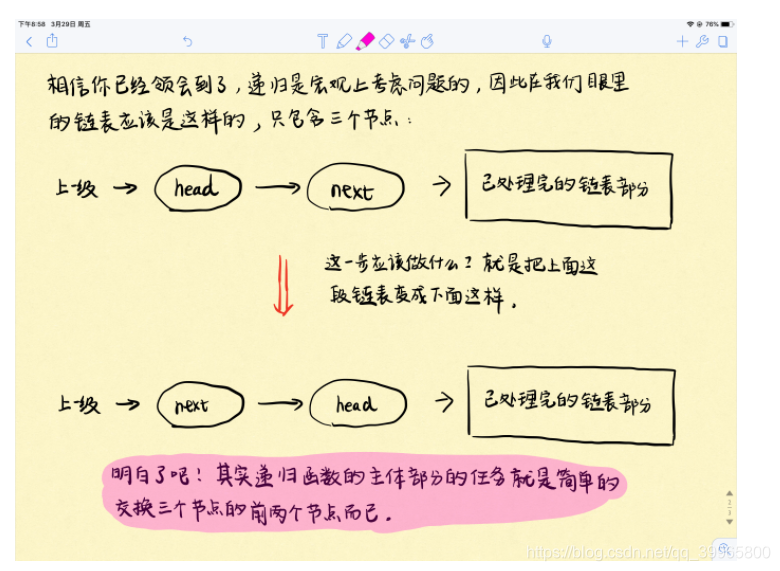
      	//一共三个节点:head, next, swapPairs(next.next)

      	//下面的任务便是交换这3个节点中的前两个节点

        ListNode next = head.next;

        head.next = swapPairs(next.next);

        next.next = head;

      	//根据第二步:返回给上一级的是当前已经完成交换后,即处理好了的链表部分

        return next;

    }

}
递归解法,需要重视的是递归解法需要重视单个递归函数做了什么, 而不是下一层函数做了什么,因此我们只需要关注一级递归的解决过程即可。
因此,也就有了我们解递归题的三部曲:
- 找整个递归的终止条件:递归应该在什么时候结束?
- 找返回值:应该给上一级返回什么信息?
- 本级递归应该做什么:在这一级递归中,应该完成什么任务?
7. 链表求和
445. Add Two Numbers II (Medium)
Input: (7 -> 2 -> 4 -> 3) + (5 -> 6 -> 4)

Output: 7 -> 8 -> 0 -> 7
题目要求:不能修改原始链表。
class Solution {

    public ListNode addTwoNumbers(ListNode l1, ListNode l2) {

        Stack<Integer> stack1 = new Stack<>();

        Stack<Integer> stack2 = new Stack<>();

        while(l1!=null){

            stack1.push(l1.val);

            l1=l1.next;

        }

        while(l2!=null){

            stack2.push(l2.val);

            l2=l2.next;

        }

        int carry=0;

        ListNode head=null;

        while(!stack1.isEmpty()||!stack2.isEmpty()||carry!=0){

            int a=stack1.isEmpty()?0:stack1.pop();

            int b=stack2.isEmpty()?0:stack2.pop();

            int cur=a+b+carry;

            carry=cur/10;

            cur%=10;

            ListNode curnode =new ListNode(cur);

            curnode.next=head;

            head=curnode;

        }

        return head;

    }

}
8. 回文链表
234. Palindrome Linked List (Easy)
题目要求:以 O(1) 的空间复杂度来求解。
切成两半,把后半段反转,然后比较两半是否相等。
/**

 * Definition for singly-linked list.

 * public class ListNode {

 *     int val;

 *     ListNode next;

 *     ListNode(int x) { val = x; }

 * }

 */

class Solution {

    public boolean isPalindrome(ListNode head) {

        ListNode cur=head;

        ArrayList<Integer> arr=new ArrayList<>();

        while(cur!=null){

            arr.add(cur.val);

            cur=cur.next;

        }

        int count=arr.size();

        for(int i=0;i<count;i++){

            if(!arr.get(i).equals(arr.get(count-i-1)))return false;

        }

        return true;

    }

}
get()方法对127以内的整形数值会直接封装成值返回,但是对大于127的值会返回对象,因此你的比较是进行对象地址的比较,实际上是不对的。你得用equals()方法比较。
class Solution {

    ListNode temp;

    public boolean isPalindrome(ListNode head) {

        temp=head;

        return check(head);

    }

    private boolean check(ListNode head){

        if(head==null){

            return true;

        }

        boolean res=check(head.next)&&(temp.val==head.val);

        temp=temp.next;

        return res;

    }

}
这个递归太帅了,太有技巧性了
9. 分隔链表
725. Split Linked List in Parts(Medium)
Input:

root = [1, 2, 3, 4, 5, 6, 7, 8, 9, 10], k = 3

Output: [[1, 2, 3, 4], [5, 6, 7], [8, 9, 10]]

Explanation:

The input has been split into consecutive parts with size difference at most 1, and earlier parts are a larger size than the later parts.
题目描述:把链表分隔成 k 部分,每部分的长度都应该尽可能相同,排在前面的长度应该大于等于后面的。
class Solution {

    public ListNode[] splitListToParts(ListNode root, int k) {

        ListNode cur=root;

        int count=0;

        while(cur!=null){

            count++;

            cur=cur.next;

        }

        int m=count/k;

        int n=count%k;

        ListNode[] arr=new ListNode[k];

        cur=root;

        for(int i=0;i<k&&cur!=null;i++){

            arr[i]=cur;

            int cursize=m+(n-->0?1:0);

            for(int j=0;j<cursize-1;j++){

                cur=cur.next;

            }

            ListNode next=cur.next;

            cur.next=null;

            cur=next;

        }

        return arr;

    }

}
10. 链表元素按奇偶聚集
328. Odd Even Linked List (Medium)
class Solution {

    public ListNode oddEvenList(ListNode head) {

        if(head==null){

            return head;

        }

        ListNode odd=head, even =head.next,evenhead=even;

        while(even!=null&&even.next!=null){

            odd.next=odd.next.next;

            odd=odd.next;

            even.next=even.next.next;

            even=even.next;

        }

        odd.next=evenhead;

        return head;

    }

}
Leedcode算法专题训练(链表)的更多相关文章
- Leedcode算法专题训练(双指针)
算法思想 双指针 167. 两数之和 II - 输入有序数组 双指针的典型用法 如果两个指针指向元素的和 sum == target,那么得到要求的结果: 如果 sum > target,移动较 ...
- Leedcode算法专题训练(树)
递归 一棵树要么是空树,要么有两个指针,每个指针指向一棵树.树是一种递归结构,很多树的问题可以使用递归来处理. 1. 树的高度 104. Maximum Depth of Binary Tree (E ...
- Leedcode算法专题训练(搜索)
BFS 广度优先搜索一层一层地进行遍历,每层遍历都是以上一层遍历的结果作为起点,遍历一个距离能访问到的所有节点.需要注意的是,遍历过的节点不能再次被遍历. 第一层: 0 -> {6,2,1,5} ...
- Leedcode算法专题训练(分治法)
归并排序就是一个用分治法的经典例子,这里我用它来举例描述一下上面的步骤: 1.归并排序首先把原问题拆分成2个规模更小的子问题. 2.递归地求解子问题,当子问题规模足够小时,可以一下子解决它.在这个例子 ...
- Leedcode算法专题训练(二分查找)
二分查找实现 非常详细的解释,简单但是细节很重要 https://www.cnblogs.com/kyoner/p/11080078.html 正常实现 Input : [1,2,3,4,5] key ...
- Leedcode算法专题训练(排序)
排序 快速排序 用于求解 Kth Element 问题,也就是第 K 个元素的问题. 可以使用快速排序的 partition() 进行实现.需要先打乱数组,否则最坏情况下时间复杂度为 O(N2). 堆 ...
- Leedcode算法专题训练(贪心)
1. 分配饼干 455. 分发饼干 题目描述:每个孩子都有一个满足度 grid,每个饼干都有一个大小 size,只有饼干的大小大于等于一个孩子的满足度,该孩子才会获得满足.求解最多可以获得满足的孩子数 ...
- Leedcode算法专题训练(位运算)
https://www.cnblogs.com/findbetterme/p/10787118.html 看这个就完事了 1. 统计两个数的二进制表示有多少位不同 461. Hamming Dista ...
- Leedcode算法专题训练(数组与矩阵)
1. 把数组中的 0 移到末尾 283. Move Zeroes (Easy) Leetcode / 力扣 class Solution { public void moveZeroes(int[] ...
随机推荐
- 高倍币VAST了解一下,如何掀起算力挖矿新热潮?
随着比特币.以太坊等主流数字货币的起起落落,市场对于数字货币交易似乎进入了冷却期.很多生态建设者开启了观望态度,机构以及巨鲸们也开始纷纷着手分散投资.就在此时,一个新的概念逐步露出头角,吸引了大众关注 ...
- 微信附近的人,用redis也能实现?(GEO)
相信微信附近的人的功能大家都应该用过 我可以很随意的通过我自己的定位能看到我附近的人,并且能看到那个人距离我的距离,大家有没有思考过这个是怎么实现的? 作为一个程序猿任何问题应该都有一个思考的过程,而 ...
- Ubuntu 下安装Anaconda + 显卡驱动 + CUDA + CUDNN + 离线安装环境
写来给自己备忘,并不是什么教程- .- 下载安装包 Anaconda:https://mirrors.tuna.tsinghua.edu.cn/anaconda/archive/ 显卡驱动:https ...
- HBase ——Shell操作
HBase --Shell操作 Q:你觉得HBase是什么? A:一种结构化的分布式数据存储系统,它基于列来存储数据. 基于HBase,可以实现以廉价PC机器集群存储海量数据的分布式数据库的解决方案. ...
- Java基础语法:基本数据类型
Java是一种强类型语言,每个变量都必须声明其类型. Java的数据类型 分为两大类:基本类型(primitive type)和引用类型(reference type). Java的所有八种基本类型的 ...
- Java基础语法:注释
书写注释是一个非常好的习惯. 注释并不会被执行,是给我们写代码的人看的. Java中的注释有三种: 单行注释(Line comment) 多行注释(Block comment) 文档注释(JavaDo ...
- for、while的循环套用和函数的递归
一.集成开发工具Eclipse 1.1 下载 官网下载 https://www.eclipse.org/downloads/download.php?file=/technology/epp/down ...
- 剑指 Offer 04. 二维数组中的查找 (思维)
剑指 Offer 04. 二维数组中的查找 题目链接 本题的解法是从矩阵的右上角开始寻找目标值. 根据矩阵的元素分布特性, 当目标值大于当前位置的值时将row行号++,因为此时目标值一定位于当前行的下 ...
- 面试官:不会sql优化?出门右转顺便带上门,谢谢
导读 作为一个后端程序员,数据库这个东西是绕不开的,特别是写sql的能力,如果您参加过多次面试,那么一定会从面试复盘中发现面试官总是会考察到sql优化这个东西. 我在之前的多次面试中最常遇到的一个问题 ...
- 【odoo14】odoo 14 Development Cookbook【目录篇】
网上已经有大佬翻译过odoo12并且在翻译odoo14了.各位着急的可以自行搜索下... 这本书是为了让自己从odoo12转odoo14学习.也是为了锻炼下自己... odoo 14 Developm ...