
What is SolrCloud? (And how does it compare to master-slave?)
What is SolrCloud?
(And how does it compare to master-slave?)
SolrCloud is a set of new features and functionality added in Solr 4.0 to enable a new way of creating durable, highly available Solr clusters with commodity hardware. While similar in many ways to master-slave, SolrCloud automates a lot of the manual labor required in master-slave through using ZooKeeper nodes to monitor the state of the cluster as well as additional Solr features that understand how to interact with other machines in their Solr cluster.
In short, where master-slave requires manual effort to change the role of a node in a given cluster and to add new nodes to a cluster, SolrCloud aims to automate a lot of that work and allow seamless addition of new nodes to a cluster and to work around downed nodes with minimal oversight.
//master-slave模式需要手工管理节点的角色(master/slave),SolrCloud能自动感知集群的状态(节点挂掉/恢复、或者新节点加入等)
What does a SolrCloud look like compared to master-slave?
On the surface, the primary difference between SolrCloud and master-slave is the additional requirement of at least three ZooKeeper (ZK) nodes. Effectively, this means the minimum size of a SolrCloud cluster is larger than for master-slave, but the ZK nodes do not need to be particularly powerful. As their only role is to monitor and maintain the state of nodes in the SolrCloud, latency is more important than computing power so the ZooKeeper nodes can be fairly minimal machines, so long as they are dedicated to the purpose.
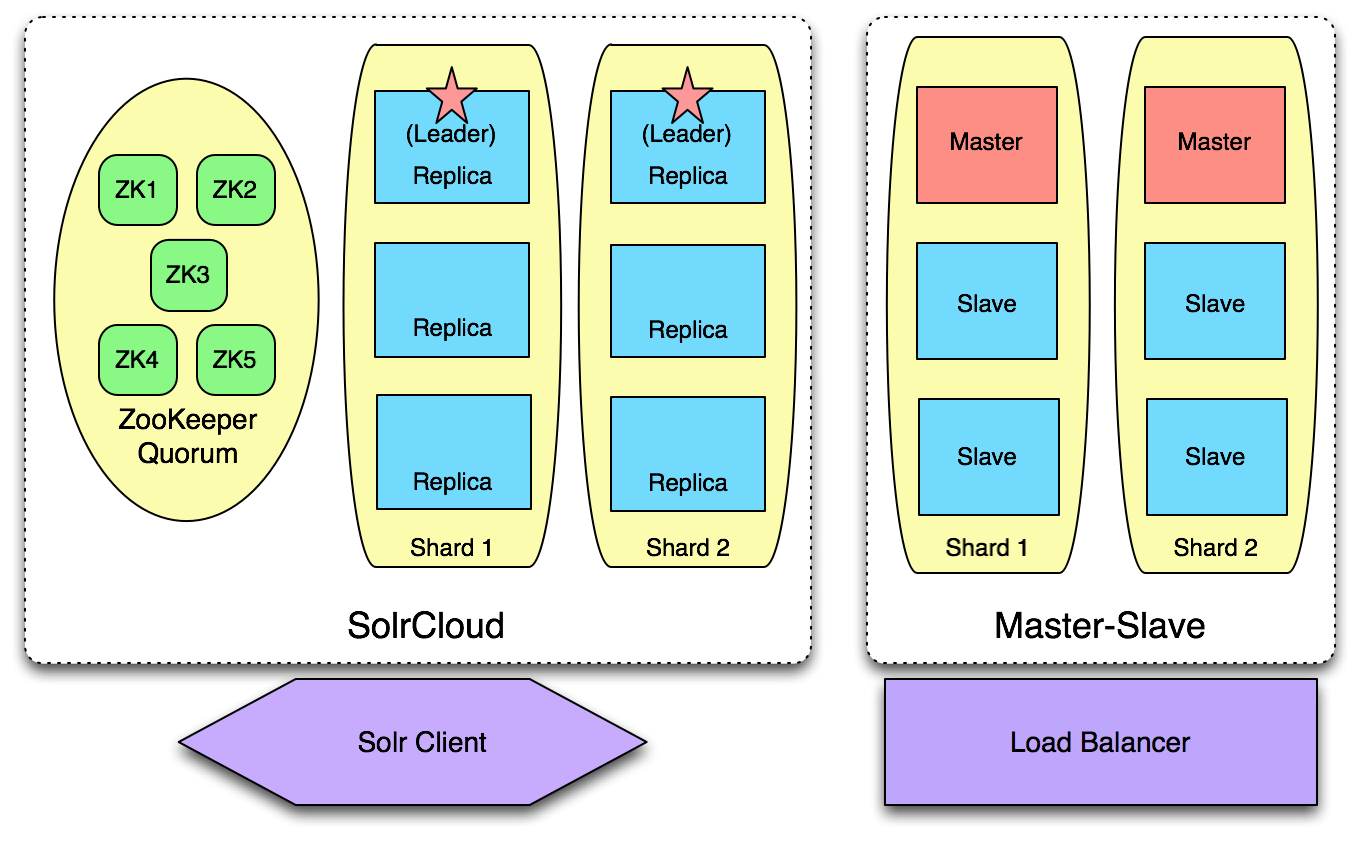
Why would I need SolrCloud or master-slave at all?
SolrCloud and master-slave both address four particular issues:
- Sharding
- Near Real Time (NRT) search and incremental indexing
- Query distribution and load balancing
- High Availability (HA)
What is sharding?
Sharding is the act of splitting a single Solr index across multiple machines, also known as shards or slices in Solr terminology. Sharding is most often needed because an index has grown too large to fit on a single server. A given shard can contain multiple physical/virtual servers, meaning that all the machines/replicas on that shard contain the same index data and serve queries for that data.
Through sharding, you can split your index across multiple machines and continue to grow without running into problems. More information can be found here: http://docs.lucidworks.com/display/solr/Shards+and+Indexing+Data+in+SolrCloud
Near Real Time search and incremental indexing:
Master-slave operates with every shard having a single master which takes care of all indexing. All other nodes in the shard are slaves, and upon entering the shard are given the current state of the index using SolrReplication (http://wiki.apache.org/solr/SolrReplication). Once a slave has been replicated, the slave's pollInterval determines how often it will contact the shard master to receive index updates.
SolrCloud similarly has a leader in every shard but the leader is largely the same as any other replica, both indexing documents and serving queries. The only additional responsibility of the leader is to distribute documents to be indexed to all other replicas in the shard, and to then report that all replicas have confirmed receiving a given document. Any document sent into SolrCloud is re-routed to the leader of the appropriate shard, who then performs this responsibility. When a replica receives a document, it adds the document to its transaction log and it will send a response to the leader. In this way, updates to SolrCloud indexes are performed in a distributed manner and are durable.
Once a document has been added to the transaction logs, it is available via a RealTimeGet (http://wiki.apache.org/solr/RealTimeGet), but is not available via search until a soft commit or hard commit with openSearcher=true has been executed. A manual soft commit or hard commit will make all documents in the transaction log available for search. One can also use the autoCommit and autoSoftCommit parameters to trigger commits from individual nodes on a regular basis.
Query distribution and load balancing:
In master-slave, querying a single node will only bring you results from that node, which in most cases is equivalent to querying one slice of your data. In order to generate a query for your entire sharded index, you must use a Distributed Search (http://wiki.apache.org/solr/DistributedSearch) to query one node per shard. In the event that one of those nodes is unable to respond, an error will be given and the query will not be fulfilled. This being the case, trying to load balance queries across a master-slave cluster can be problematic. Master-slave also does not provide any load balancing, and thus requires an external load balancer.
With SolrCloud, distributed searching is handled automatically by the nodes in the cloud: querying any node will cause that node to send the query out to one node in all other shards, returning a response only when it has aggregated the results from all shards. Furthermore, ZooKeeper and all replicas are aware of any non-responding nodes, and therefore won't direct queries to nodes that are considered dead. In the event that a downed node has not yet been detected by ZK and is sent a query, the querying node will report the node as down to ZK, and resend the query to another node. In this way, queries to a SolrCloud are quite durable and will almost never be interrupted by a downed node.
SolrCloud can handle its own load balancing if you use a smart client such as Solrj (http://wiki.apache.org/solr/Solrj). Solrj will use a simple round robin load balancer, distributing queries evenly to all nodes in SolrCloud. Furthermore, Solrj is ZooKeeper aware and thus will never send a query to a node that is known as down.
High Availability:
In the event of a downed master in a master-slave cluster, the shard can continue to serve queries, but will no longer be able to index until a new master is instated. The process of promoting a slave to a master is manual, though it can be scripted. Any updates to the master's index since the last replication are lost, and those documents will have to be resubmitted. When a slave disconnects from the cluster and then rejoins, it will automatically retrieve any missed updates/index segments from the master before it is considered ready to serve queries.
In SolrCloud, when ZooKeeper detects a leader has gone down, it will initiate the leader election process instantaneously, selecting a new leader to begin distributing documents again. Since the transaction log ensures that all nodes in the shard are in sync, all updates are durable and never lost when a leader goes down. Similar to master-slave, when a replica rejoins the cluster it simply replays the transaction log to bring itself up to date with other machines in the shard. In some cases if a replica has missed too many updates, it will perform a standard replication as well as replaying the transaction log before serving queries.
Both SolrCloud and master-slave take advantage of SolrReplication, but SolrCloud automatically handles rerouting and recovery when any node in the cluster goes down, whereas master-slave requires some manual work in the event a master becomes unresponsive. As a result, turning a master-slave cluster into a HA solution requires a fair amount of work in scripting and case checking, to ensure no documents are lost and that queries are accurate. By contrast, SolrCloud will never lose updates and will automatically route around any unresponsive nodes.
See also: https://support.lucidworks.com/entries/22180608-Solr-HA-DR-overview-3-x-and-4-0-SolrCloud-
-------------------------------
https://support.lucidworks.com/hc/en-us/sections/200314327-Lucene-Solr
http://www.solr.cc/blog/?p=99
What is SolrCloud? (And how does it compare to master-slave?)的更多相关文章
- Solr4.8.0源码分析(24)之SolrCloud的Recovery策略(五)
Solr4.8.0源码分析(24)之SolrCloud的Recovery策略(五) 题记:关于SolrCloud的Recovery策略已经写了四篇了,这篇应该是系统介绍Recovery策略的最后一篇了 ...
- SolrCloud:依据Solr Wiki的译文
本文是作者依据Apache Solr Document的译文.翻译不对或者理解不到位的地方欢迎大家指正!谢谢! Nodes, Cores, Cluster and Leaders Nodes and ...
- compare across commits online
https://gist.github.com/nevik/5689882 Examples: https://github.com/octocat/Spoon-Knife/compare/ed122 ...
- 缓存、队列(Memcached、redis、RabbitMQ)
本章内容: Memcached 简介.安装.使用 Python 操作 Memcached 天生支持集群 redis 简介.安装.使用.实例 Python 操作 Redis String.Hash.Li ...
- PHP7函数大全(4553个函数)
转载来自: http://www.infocool.net/kb/PHP/201607/168683.html a 函数 说明 abs 绝对值 acos 反余弦 acosh 反双曲余弦 addcsla ...
- Learn Git and GitHub without any code!
What is GitHub? GitHub is a code hosting platform for version control and collaboration.代码托管平台. repo ...
- show master/slave status求根溯源
show master/slave status分别是查看主数据库以及副数据库的状态,是一种能查看主从复制运行情况的方式. 这里仅仅讨论linux下的nysql5.7.13版本的执行情况 一.show ...
- Stack Overflow: The Architecture - 2016 Edition
To get an idea of what all of this stuff “does,” let me start off with an update on the average day ...
- GitHub入门教程 Hello World for GitHub
Intro 1.简介 What is GitHub? 2.什么是github? Create a Reposi ...
随机推荐
- Blender设置界面语言
新安装的Blender默认是英文, 可通过如下方法修改界面语言: 1. 点开文件菜单{File},选择用户首选项{User Preferences}: 2. 在用户首选项{User Preferenc ...
- C++学习(三十一)(C语言部分)之 栈和队列(括号匹配示例)
括号匹配测试代码笔记如下: #include<stdio.h> #include<string.h> #include <stdlib.h> #define SIZ ...
- MVVM在WPF中应用(1)
在软件行业浸润了这么多年,第一次在MES的工厂里从事软件开发. 在这里的感觉就是安静.宽松,比在那些专门以软件为主的企业中轻松自在.在这里的第一个项目是关于数据的导入和导出,还有数据的比较这些功能. ...
- Gravitee.io alert 引擎架构
alert 在我们的实际开发中应用的场景很多,我们需要进行系统状态的查看,以及特殊异常请求的处理 参考架构图 从下图可以看出,还是很方便的,同时支持slack email... 的实时消息通知,而且我 ...
- skipper http router 简单试用
说明: 使用源码编译,注意需要FQ,以及golang版本的问题,新版使用的是go mod 进行依赖管理 环境准备 clone 代码 git clone https://github.com/zalan ...
- VBA: 怎样批量数据从Excel派出到Visio
上周派到了个case, 是批量从Excel导出数据导Visio每个图形中. 花了些时间实现了这个功能. 原理如下: 打开Excel 新建/打开表单 指向所选择的表单 遍历所在列的所有数据 打开Visi ...
- LoadRunner 压测场景制定以及报告分析
这里,我们利用 LoadRunner 来制定场景,且以测试 tps 值为导向,主要介绍手工场景 单服务器的业务请求处理能力 tps 值在 10~200 是合理的:如果是访问单接口不走关系型数据库的,访 ...
- Percona XtraDB Cluster高可用与状态快照传输(PXC 5.7 )
Percona XtraDB Cluster(下称PXC)高可用集群支持任意节点在运行期间的重启,升级或者意外宕机,即它解决了单点故障问题.那在这个意外宕机或者重启期间,该节点丢失的数据如何再次进行同 ...
- webpack 4:默认配置
webpack 4:默认配置 entry 默认: ./src/index.js(注意: 路径必须带上./): entry: './src/index.js', output 默认最后路径: ./dis ...
- java直接量(literal)
直接量就是代码中直接使用的值,如 int i = 7; char c = 'a'; boolean b = false; 7.'a'.false就是直接量. java有三种类型的直接量:基本类型. ...