
Depth-first search and Breadth-first search 深度优先搜索和广度优先搜索
Depth-first search
Depth-first search (DFS) is an algorithm for traversing or searching tree or graph data structures.
The algorithm starts at the root node (selecting some arbitrary node as the root node in the case of a graph) and explores as far as possible along each branch before backtracking 回溯.
For the following graph:
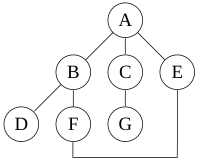
a depth-first search starting at A,
assuming that the left edges in the shown graph are chosen before right edges,
and assuming the search remembers previously visited nodes and will not repeat them (since this is a small graph),
will visit the nodes in the following order: A, B, D, F, E, C, G.
The edges traversed in this search form a Trémaux tree, a structure with important applications in graph theory.
Performing the same search without remembering previously visited nodes results in visiting nodes in the order A, B, D, F, E, A, B, D, F, E, etc. forever, caught in the A, B, D, F, E cycle and never reaching C or G.
Iterative deepening is one technique to avoid this infinite loop and would reach all nodes.
深度优先的算法实现
Input: A graph G and a vertex v of G
Output: All vertices reachable from v labeled as discovered
A recursive implementation of DFS:[5]
1  procedure DFS(G,v):

2      label v as discovered

3      for all edges from v to w in G.adjacentEdges(v) do

4          if vertex w is not labeled as discovered then

5              recursively call DFS(G,w)
The order in which the vertices are discovered by this algorithm is called the lexicographic order.
A non-recursive implementation of DFS with worst-case space complexity O(|E|):[6] (使用栈,先进后出)
1  procedure DFS-iterative(G,v):

2      let S be a stack

3      S.push(v)

4      while S is not empty

5          v = S.pop()

6          if v is not labeled as discovered:

7              label v as discovered

8              for all edges from v to w in G.adjacentEdges(v) do

9                  S.push(w)
These two variations of DFS visit the neighbors of each vertex in the opposite order from each other: the first neighbor of v visited by the recursive variation is the first one in the list of adjacent edges, while in the iterative variation the first visited neighbor is the last one in the list of adjacent edges. The recursive implementation will visit the nodes from the example graph in the following order: A, B, D, F, E, C, G. The non-recursive implementation will visit the nodes as: A, E, F, B, D, C, G.
The non-recursive implementation is similar to breadth-first search but differs from it in two ways:
- it uses a stack instead of a queue, and
- it delays checking whether a vertex has been discovered until the vertex is popped from the stack rather than making this check before adding the vertex.
Breadth-first search
Breadth-first search (BFS) is an algorithm for traversing or searching tree or graph data structures.
It starts at the tree root (or some arbitrary node of a graph, sometimes referred to as a 'search key'[1]), and explores all of the neighbor nodes at the present depth prior to moving on to the nodes at the next depth level.
It uses the opposite strategy as depth-first search, which instead explores the highest-depth nodes first before being forced to backtrack回溯 and expand shallower nodes.
shallower是shallow的比较级,较浅的
广度优先的实现 (使用队列,先进先出)
Input: A graph Graph and a starting vertex顶点 root of Graph
Output: Goal state. The parent links trace the shortest path back to root
1  procedure BFS(G,start_v):

2      let S be a queue

3      S.enqueue(start_v)

4      while S is not empty

5          v = S.dequeue()

6          if v is the goal:

7              return v

8          for all edges from v to w in G.adjacentEdges(v) do

9              if w is not labeled as discovered:

10                 label w as discovered

11                 w.parent = v

12                 S.enqueue(w)
More details
This non-recursive implementation is similar to the non-recursive implementation of depth-first search, but differs from it in two ways:
- it uses a queue (First In First Out) instead of a stack and
- it checks whether a vertex顶点 has been discovered before enqueueing the vertex rather than delaying this check until the vertex is dequeued from the queue.
The Q queue contains the frontier along which the algorithm is currently searching.
Nodes can be labelled as discovered by storing them in a set, or by an attribute on each node, depending on the implementation.
Note that the word node is usually interchangeable with the word vertex.
The parent attribute of each vertex is useful for accessing the nodes in a shortest path, for example by backtracking from the destination node up to the starting node, once the BFS has been run, and the predecessors nodes have been set.
Breadth-first search produces a so-called breadth first tree. You can see how a breadth first tree looks in the following example.
Depth-first search and Breadth-first search 深度优先搜索和广度优先搜索的更多相关文章
- DFS_BFS(深度优先搜索 和 广度优先搜索)
package com.rao.graph; import java.util.LinkedList; /** * @author Srao * @className BFS_DFS * @date ...
- 【Python排序搜索基本算法】之深度优先搜索、广度优先搜索、拓扑排序、强联通&Kosaraju算法
Graph Search and Connectivity Generic Graph Search Goals 1. find everything findable 2. don't explor ...
- 【js数据结构】图的深度优先搜索与广度优先搜索
图类的构建 function Graph(v) {this.vertices = v;this.edges = 0;this.adj = []; for (var i = 0; i < this ...
- DFS或BFS(深度优先搜索或广度优先搜索遍历无向图)-04-无向图-岛屿数量
给定一个由 '1'(陆地)和 '0'(水)组成的的二维网格,计算岛屿的数量.一个岛被水包围,并且它是通过水平方向或垂直方向上相邻的陆地连接而成的.你可以假设网格的四个边均被水包围. 示例 1: 输入: ...
- 深度优先搜索DFS和广度优先搜索BFS简单解析(新手向)
深度优先搜索DFS和广度优先搜索BFS简单解析 与树的遍历类似,图的遍历要求从某一点出发,每个点仅被访问一次,这个过程就是图的遍历.图的遍历常用的有深度优先搜索和广度优先搜索,这两者对于有向图和无向图 ...
- 深度优先搜索(DFS)和广度优先搜索(BFS)
深度优先搜索(DFS) 广度优先搜索(BFS) 1.介绍 广度优先搜索(BFS)是图的另一种遍历方式,与DFS相对,是以广度优先进行搜索.简言之就是先访问图的顶点,然后广度优先访问其邻接点,然后再依次 ...
- 深度优先搜索DFS和广度优先搜索BFS简单解析
转自:https://www.cnblogs.com/FZfangzheng/p/8529132.html 深度优先搜索DFS和广度优先搜索BFS简单解析 与树的遍历类似,图的遍历要求从某一点出发,每 ...
- Unity中通过深度优先算法和广度优先算法打印游戏物体名
前言:又是一个月没写博客了,每次下班都懒得写,觉得浪费时间.... 深度优先搜索和广度优先搜索的定义,网络上已经说的很清楚了,我也是看了网上的才懂的,所以就不在这里赘述了.今天讲解的实例,主要是通过自 ...
- 广度优先搜索(Breadth First Search, BFS)
广度优先搜索(Breadth First Search, BFS) BFS算法实现的一般思路为: // BFS void BFS(int s){ queue<int> q; // 定义一个 ...
随机推荐
- django admim后台不转义提交的html
autoescape¶ Controls the current auto-escaping behavior. This tag takes either on or off as an argum ...
- C# 调用.bat 提示该命令不是内部命令或外部命令
前提:双击.bat文件可以执行成功,用C#调用提示该命令不是内部命令或外部命令...... 解决方法:下面代码的红色标注,既要设置.bat文件的文件名FileName,也要设置.bat文件所在的文件夹 ...
- WebConfig类
package com.ssm.yjblogs.config; import java.util.ArrayList; import java.util.List; import java.util. ...
- pymysql 数据库操控
模块安装 pip install pymysql 执行sql语句 import pymysql #添加数据 conn = pymysql.connect(host='127.0.0.1', port= ...
- uvalive 3353 Optimal Bus Route Design
题意: 给出n个点,以及每个点到其他点的有向距离,要求设计线路使得每一个点都在一个环中,如果设计的线路拥有最小值,那么这个线路就是可选的.输出这个最小值或者说明最小线路不存在. 思路: 在DAG的最小 ...
- 【Scala学习之一】 Scala基础语法
环境 虚拟机:VMware 10 Linux版本:CentOS-6.5-x86_64 客户端:Xshell4 FTP:Xftp4 jdk1.8 scala-2.10.4(依赖jdk1.8) spark ...
- 【Hadoop UI学习】Hue
环境 虚拟机:VMware 10 Linux版本:CentOS-6.5-x86_64 客户端:Xshell4 FTP:Xftp4 jdk8 zookeeper-3.4.11 Hue是一个开源的Apac ...
- 解决 samba 服务器 windows 多重连接
samba连接,用户名密码均正确.失败提示:不允许一个用户使用一个以上用户名与一个服务器或共享资源的多重连接. 事实上,这个不是samba的限制.是Windows的限制. 在打开存在public = ...
- SQLServer 创建自己的数据库
1)进入数据库服务器,创建自己的数据库 use master go create database Dt_Devtest on primary(name=[Dt_new_data],filename= ...
- Java Socket入门
Java Socket底层采用TCP/IP协议通信,通信细节被封装,我们仅仅需要指定IP.端口,便能轻易地创建TCP或UDP连接,进行网络通信.数据的读写,可以使用我们熟悉的stream进行操作. T ...