
201871020225-牟星源《面向对象程序设计(java)》第七周学习总结
201871020225-牟星源《面向对象程序设计(java)》第七周学习总结
博文正文开头:
|
项目 |
内容 |
|
这个作业属于哪个课程 |
https://www.cnblogs.com/nwnu-daizh/ |
|
这个作业的要求在哪里 |
https://www.cnblogs.com/nwnu-daizh/p/11435127.html |
|
作业学习目标 |
|
随笔博文正文内容:
实验内容和步骤
实验1:在“System.out.println(...);”语句处按注释要求设计代码替换...,观察代码录入中IDE提示,以验证四种权限修饰符的用法。
(1)程序代码
实验代码:
class Parent {
private String p1 = "这是Parent的私有属性";
public String p2 = "这是Parent的公有属性";
protected String p3 = "这是Parent受保护的属性";
String p4 = "这是Parent的默认属性";
private void pMethod1() {
System.out.println("我是Parent用private修饰符修饰的方法");
}
public void pMethod2() {
System.out.println("我是Parent用public修饰符修饰的方法");
}
protected void pMethod3() {
System.out.println("我是Parent用protected修饰符修饰的方法");
}
void pMethod4() {
System.out.println("我是Parent无修饰符修饰的方法");
}
}
class Son extends Parent{
private String s1 = "这是Son的私有属性";
public String s2 = "这是Son的公有属性";
protected String s3 = "这是Son受保护的属性";
String s4 = "这是Son的默认属性";
public void sMethod1() {
System.out.println(p2);//分别尝试显示Parent类的p1、p2、p3、p4值
System.out.println("我是Son用public修饰符修饰的方法");
}
private void sMethod2() {
System.out.println("我是Son用private修饰符修饰的方法");
}
protected void sMethod3() {
System.out.println("我是Son用protected修饰符修饰的方法");
}
void sMethod4() {
System.out.println("我是Son无修饰符修饰的方法");
}
}
public class Demo {
public static void main(String[] args) {
Parent parent=new Parent();
Son son=new Son();
parent.pMethod2() ; //分别尝试用parent调用Paren类的方法、用son调用Son类的方法
}
}
parent代码:
package mxy;
public class Parent {
private String p1 = "这是Parent的私有属性";
public String p2 = "这是Parent的公有属性";
protected String p3 = "这是Parent受保护的属性";
String p4 = "这是Parent的默认属性";
private void pMethod1() {
System.out.println("我是Parent用private修饰符修饰的方法");
}
public void pMethod2() {
System.out.println("我是Parent用public修饰符修饰的方法");
}
protected void pMethod3() {
System.out.println("我是Parent用protected修饰符修饰的方法");
}
void pMethod4() {
System.out.println("我是Parent无修饰符修饰的方法");
}
}
son代码:
package first;
import mxy.Parent;
public class Son extends Parent{
private String s1 = "这是Son的私有属性";
public String s2 = "这是Son的公有属性";
protected String s3 = "这是Son受保护的属性";
String s4 = "这是Son的默认属性";
public void sMethod1() {
System.out.println(p2);//分别尝试显示Parent类的p1、p2、p3、p4值
System.out.println("我是Son用public修饰符修饰的方法");
}
private void sMethod2() {
System.out.println("我是Son用private修饰符修饰的方法");
}
protected void sMethod3() {
System.out.println("我是Son用protected修饰符修饰的方法");
}
void sMethod4() {
System.out.println("我是Son无修饰符修饰的方法");
}
}
(2)运行结果如下:
Parent1:
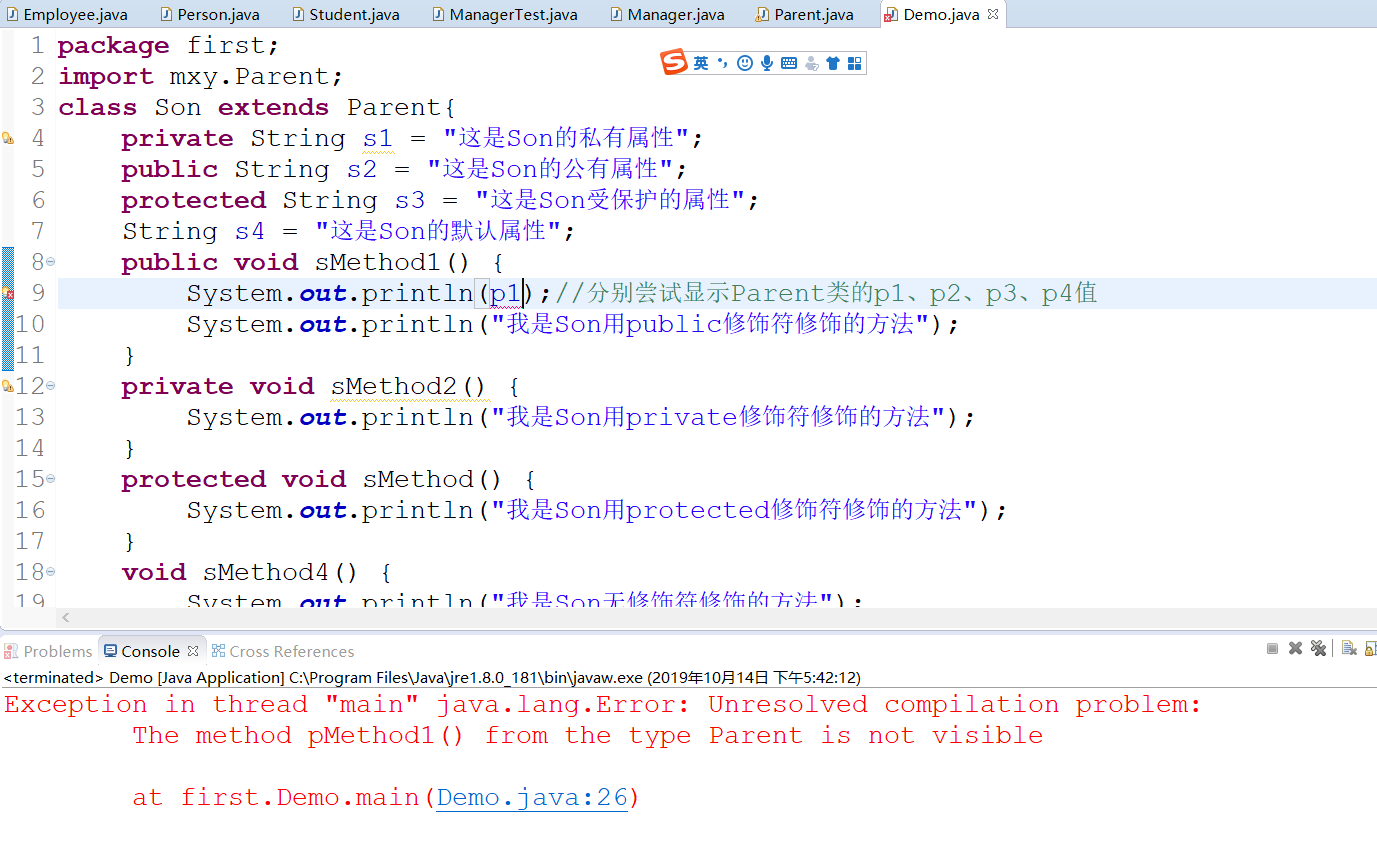
Parent2:
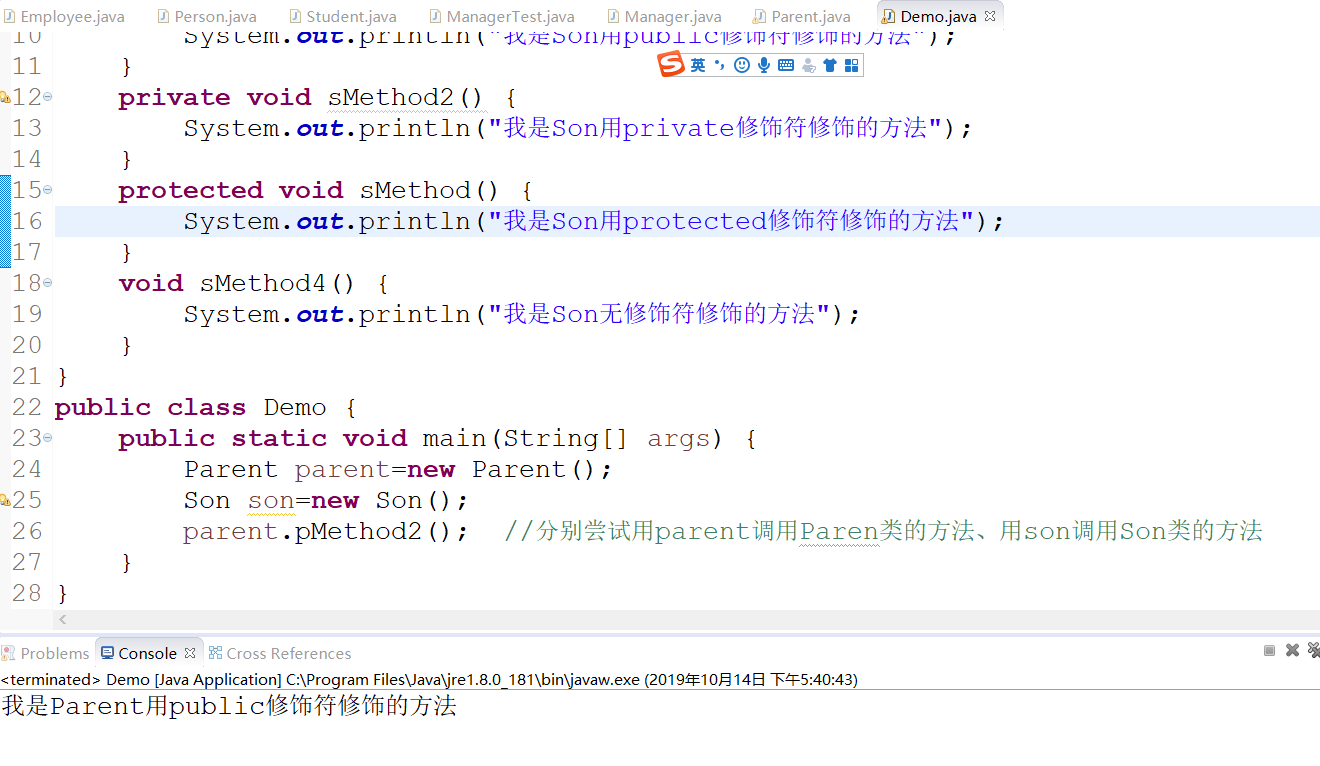
Parent3:
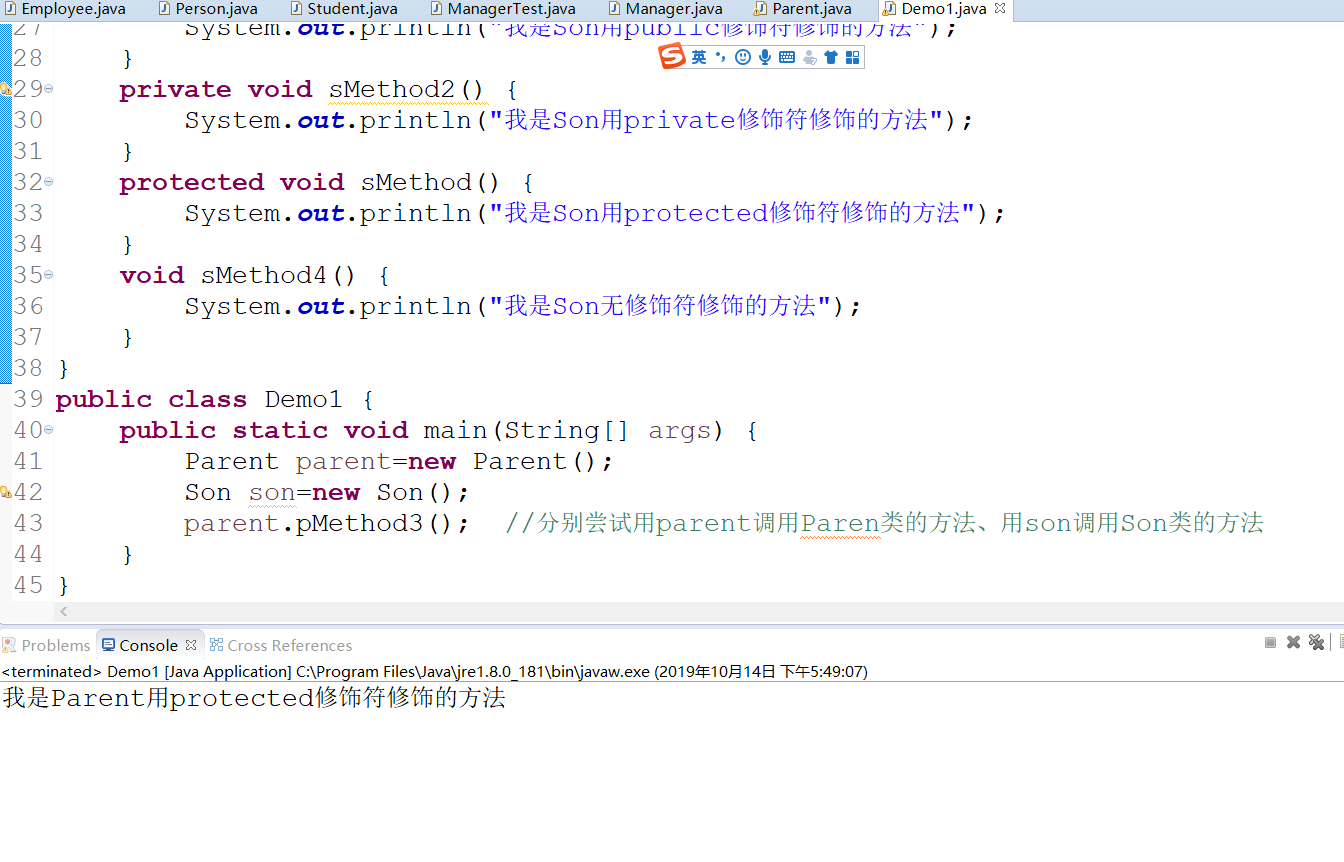
Parent4:
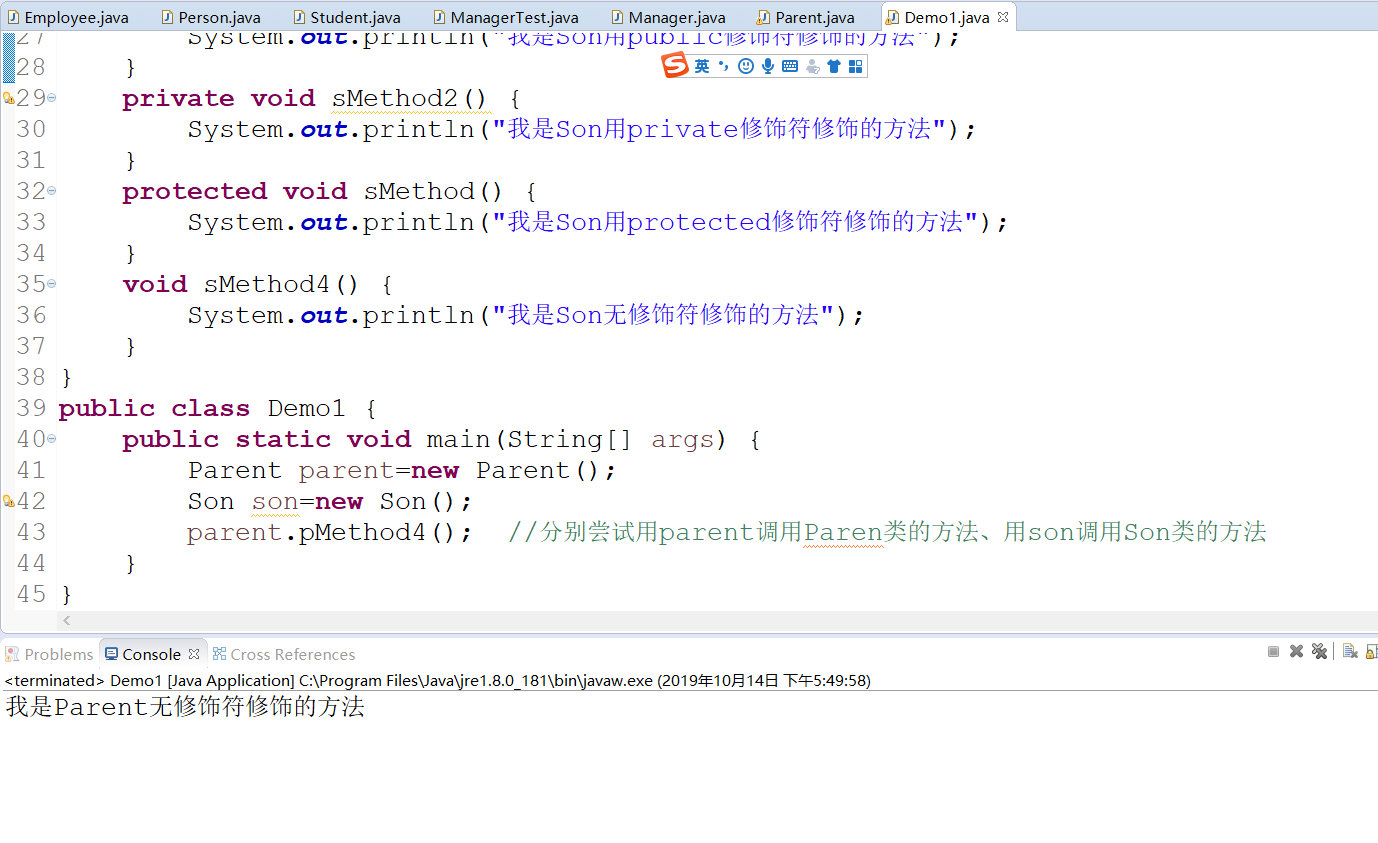
Son1:
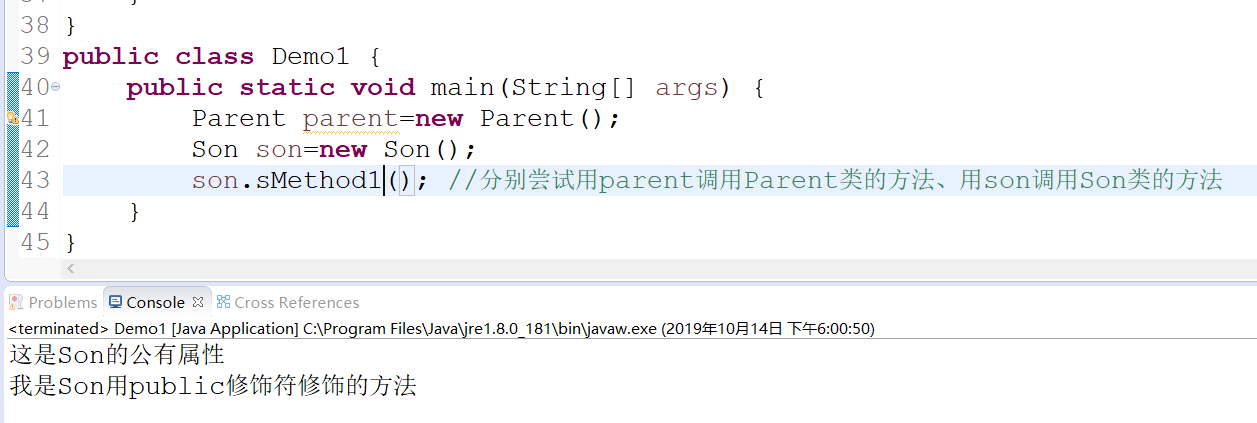
Son2:
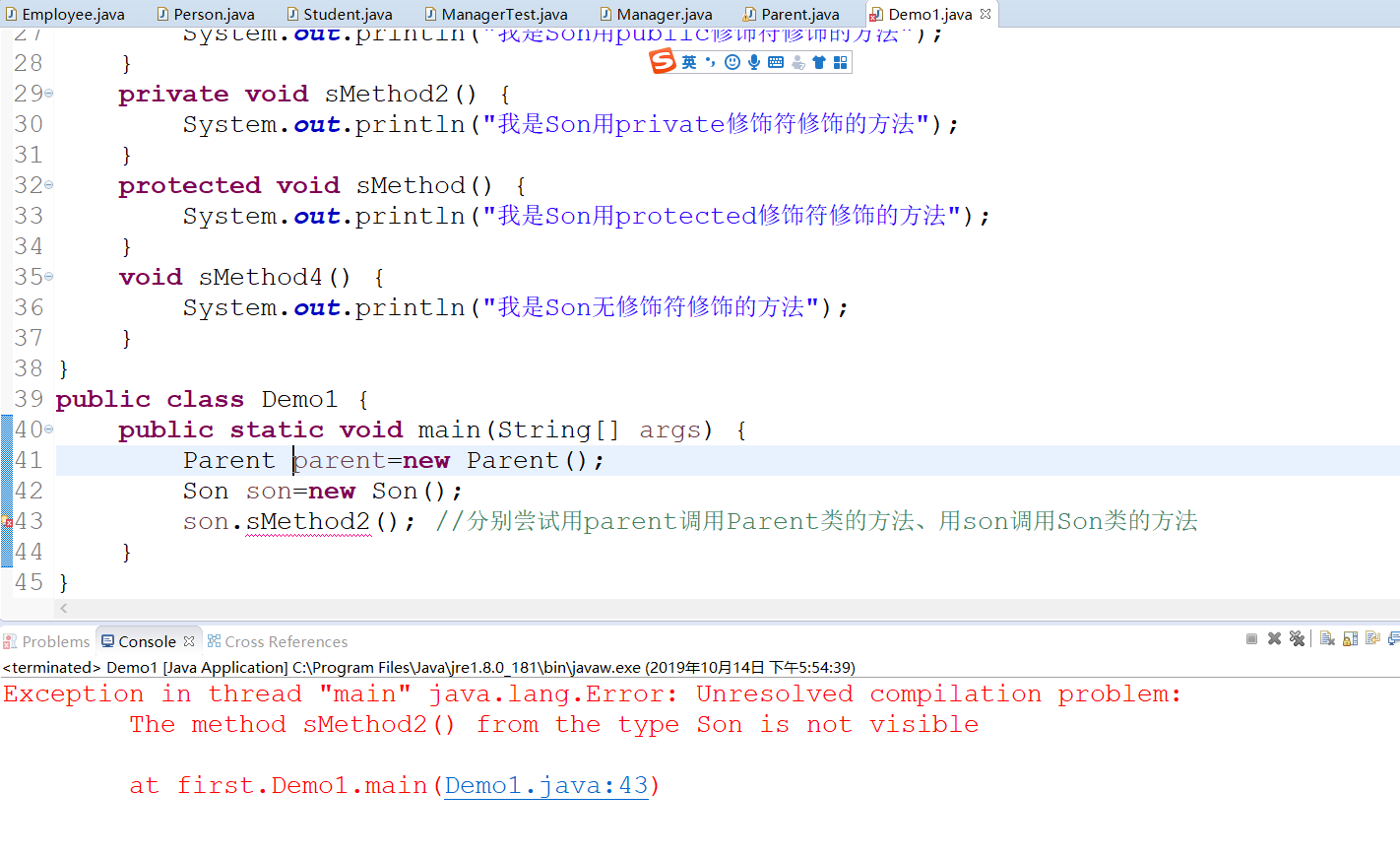
Son3:
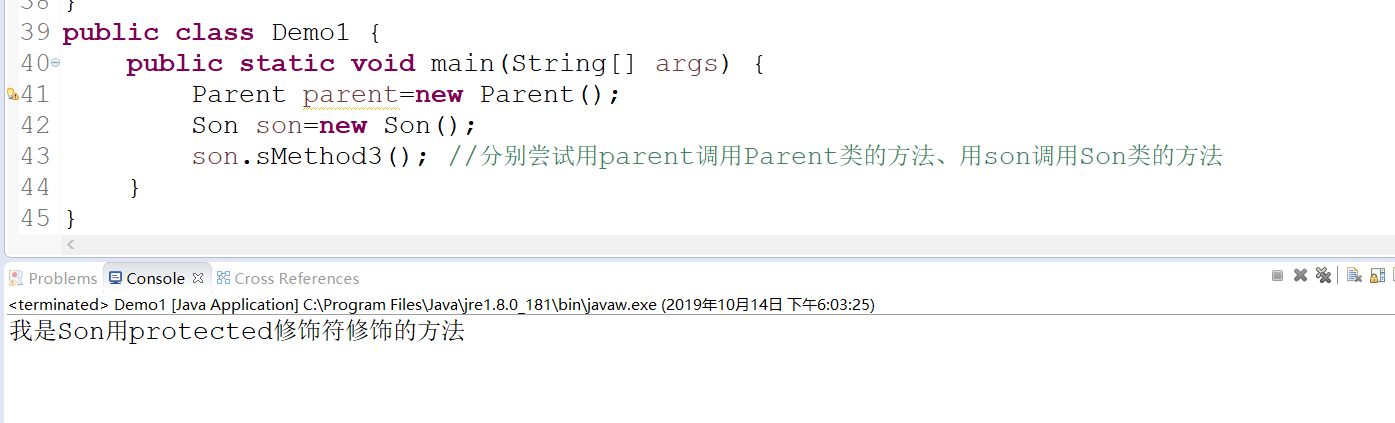
Son4:
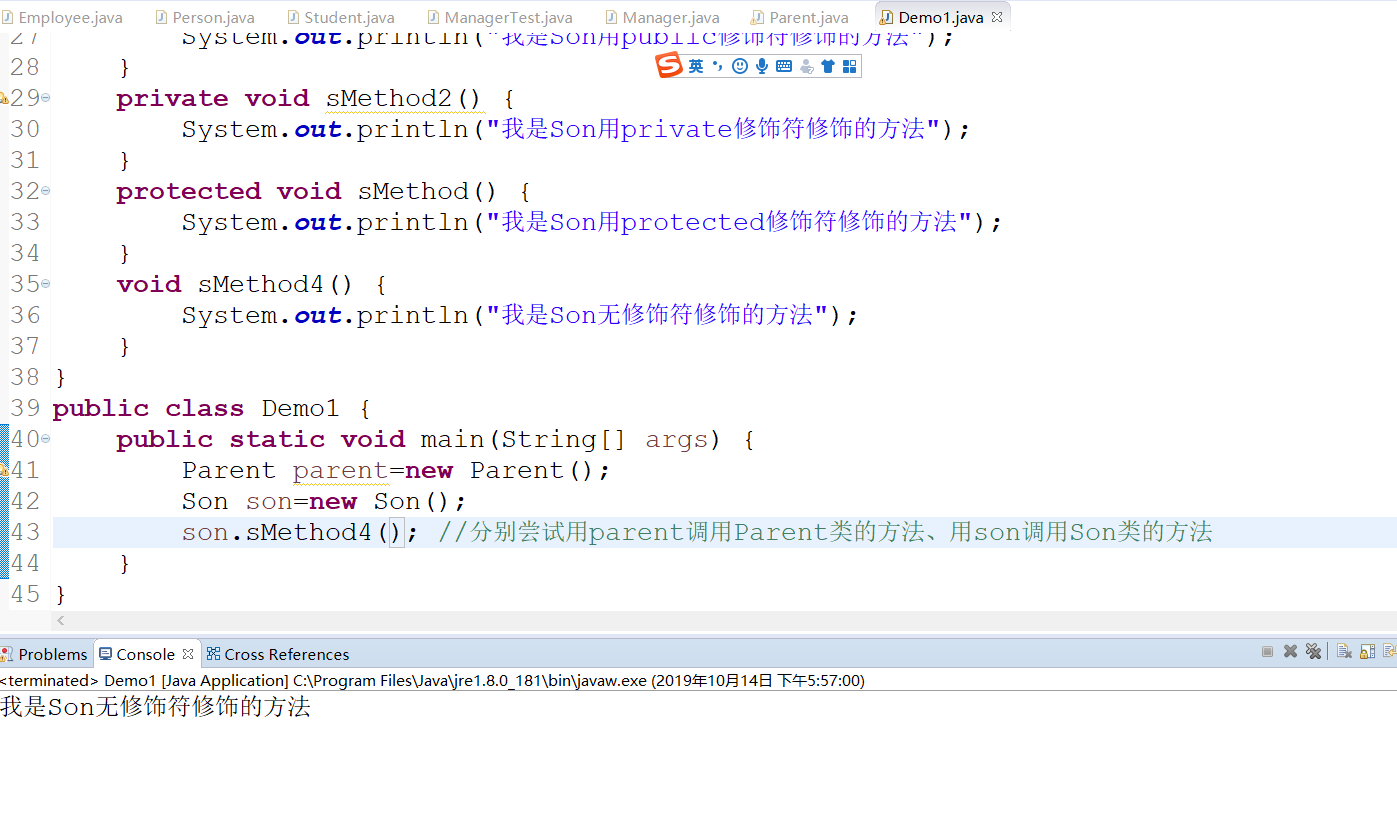
实验2:导入第5章以下示例程序,测试并进行代码注释。
实验2:测试程序1
l 运行教材程序5-8、5-9、5-10,结合程序运行结果理解程序(教材174页-177页);
5.8代码:
package equals;
/**
* This program demonstrates the equals method.
* @version 1.12 2012-01-26
* @author Cay Horstmann
*/
public class EqualsTest
{
public static void main(String[] args)
{
Employee alice1 = new Employee("Alice Adams", 75000, 1987, 12, 15);
Employee alice2 = alice1;
Employee alice3 = new Employee("Alice Adams", 75000, 1987, 12, 15);
Employee bob = new Employee("Bob Brandson", 50000, 1989, 10, 1);
System.out.println("alice1 == alice2: " + (alice1 == alice2));
System.out.println("alice1 == alice3: " + (alice1 == alice3));
System.out.println("alice1.equals(alice3): " + alice1.equals(alice3));
System.out.println("alice1.equals(bob): " + alice1.equals(bob));
System.out.println("bob.toString(): " + bob);
Manager carl = new Manager("Carl Cracker", 80000, 1987, 12, 15);
Manager boss = new Manager("Carl Cracker", 80000, 1987, 12, 15);
boss.setBonus(5000);
System.out.println("boss.toString(): " + boss);
System.out.println("carl.equals(boss): " + carl.equals(boss));
System.out.println("alice1.hashCode(): " + alice1.hashCode());
System.out.println("alice3.hashCode(): " + alice3.hashCode());
System.out.println("bob.hashCode(): " + bob.hashCode());
System.out.println("carl.hashCode(): " + carl.hashCode());
}
}
5.9代码:
package equals;
import java.time.*;
import java.util.Objects;
public class Employee
{
private String name;
private double salary;
private LocalDate hireDay;
public Employee(String name, double salary, int year, int month, int day)
{
this.name = name;
this.salary = salary;
hireDay = LocalDate.of(year, month, day);
}
public String getName()
{
return name;
}
public double getSalary()
{
return salary;
}
public LocalDate getHireDay()
{
return hireDay;
}
public void raiseSalary(double byPercent)
{
double raise = salary * byPercent / 100;
salary += raise;
}
public boolean equals(Object otherObject)
{
// a quick test to see if the objects are identical
if (this == otherObject) return true;
// must return false if the explicit parameter is null
if (otherObject == null) return false;
// if the classes don't match, they can't be equal
if (getClass() != otherObject.getClass()) return false;
// now we know otherObject is a non-null Employee
Employee other = (Employee) otherObject;
// test whether the fields have identical values
return Objects.equals(name, other.name)
&& salary == other.salary && Objects.equals(hireDay, other.hireDay);
}
public int hashCode()
{
return Objects.hash(name, salary, hireDay);
}
public String toString()
{
return getClass().getName() + "[name=" + name + ",salary=" + salary + ",hireDay="
+ hireDay + "]";
}
}
5.10代码:
package equals;
public class Manager extends Employee
{
private double bonus;
public Manager(String name, double salary, int year, int month, int day)
{
super(name, salary, year, month, day);
bonus = 0;
}
public double getSalary()
{
double baseSalary = super.getSalary();
return baseSalary + bonus;
}
public void setBonus(double bonus)
{
this.bonus = bonus;
}
public boolean equals(Object otherObject)
{
if (!super.equals(otherObject)) return false;
Manager other = (Manager) otherObject;
// super.equals checked that this and other belong to the same class
return bonus == other.bonus;
}
public int hashCode()
{
return java.util.Objects.hash(super.hashCode(), bonus);
}
public String toString()
{
return super.toString() + "[bonus=" + bonus + "]";
}
}
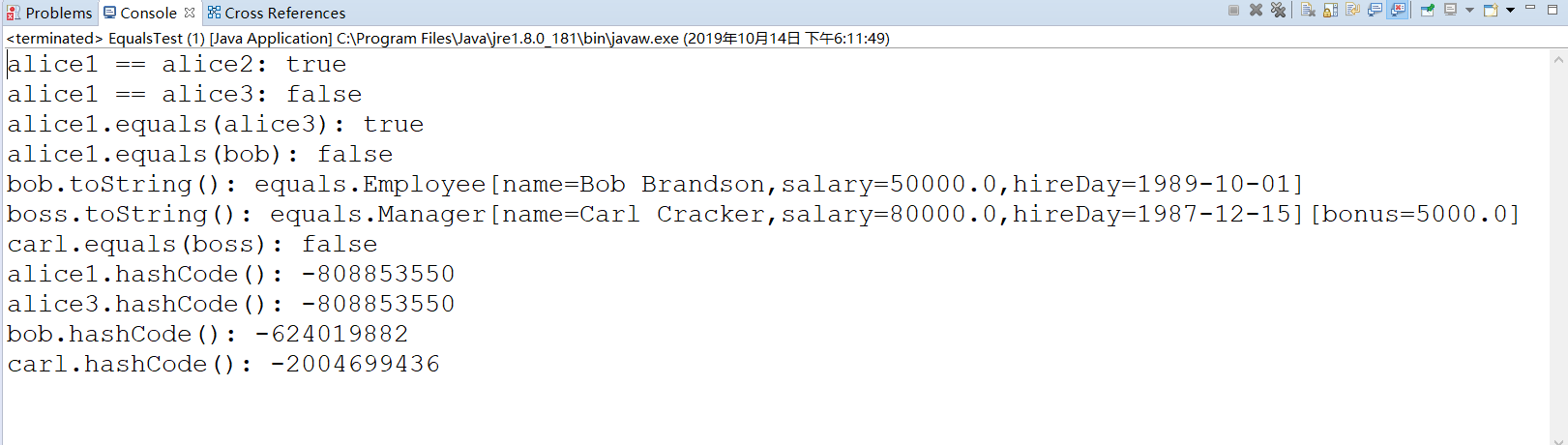
运行结果:
l 删除程序中Employee类、Manager类中的equals()、hasCode()、toString()方法,背录删除方法,在代码录入中理解类中重写Object父类方法的技术要点。
(1)代码
Employee类重写后代码如下:
package equals;
import java.time.*;
import java.util.Objects;
public class Employee
{
private String name; //创建三个私有属性
private double salary;
private LocalDate hireDay;
public Employee(String name, double salary, int year, int month, int day)
{
this.name = name;
this.salary = salary;
hireDay = LocalDate.of(year, month, day);
}
public String getName()
{
return name;
}
public double getSalary()
{
return salary;
}
public LocalDate getHireDay()
{
return hireDay;
}
public void raiseSalary(double byPercent)
{
double raise = salary * byPercent / 100; //定义局部变量
salary += raise;
}
@Override
public int hashCode() { //重写hashCode方法,使相等的两个对象获取的HashCode也相等
// TODO Auto-generated method stub
return Objects.hash(name, salary, hireDay);
}
@Override
public boolean equals(Object obj) {
// TODO Auto-generated method stub
if (this == obj) return true; //快速测试几个类的根是否相同,即是否是同一个超类。这个if语句判断两个引用是否是同一个,如果是同一个,那么这两个对象肯定相等。
if (obj == null) return false; //如果显示参数为空,则返回false
if (getClass() !=obj.getClass()) return false; //用getClass()方法得到对象的类。如果几个类不匹配,则它们不相等
//其他对象是非空Employee类
//在以上判断完成,再将得到的参数对象强制转换为该对象,考虑到父类引用子类的对象的出现,然后再判断对象的属性是否相同
Employee other = (Employee) obj;
//测试字段是否具有相同的值
return Objects.equals(name, other.name) && salary == other.salary && Objects.equals(hireDay, other.hireDay);
}
@Override
public String toString() { //把其他类型的数据转为字符串类型的数据(toString方法可以自动生成)
// TODO Auto-generated method stub
return getClass().getName() + "[name=" + name + ",salary=" + salary + ",hireDay=" + hireDay + "]";
}
}
Manager类重写之后代码如下:
package equals;
public class Manager extends Employee //子类:Manager类继承Employee类
{
private double bonus; //创建私有属性bouns
public Manager(String name, double salary, int year, int month, int day)
{
super(name, salary, year, month, day); //子类直接调用超类中已创建的属性
bonus = 0; //给bouns赋初值为空
}
public double getSalary()//访问器
{
double baseSalary = super.getSalary();
return baseSalary + bonus;
}
public void setBonus(double bonus) //更改器
{
this.bonus = bonus;
}
public boolean equals(Object otherObject) //快速测试几个类的根是否相同,即是否是同一个超类
{
if (!super.equals(otherObject)) return false;
Manager other = (Manager) otherObject;
//使用super.equals检查这个类和其他是否属于同一个类
return bonus == other.bonus;
}
public int hashCode() //重写hashCode方法,使相等的两个对象获取的HashCode也相等
{
return java.util.Objects.hash(super.hashCode(), bonus);
}
public String toString() //把其他类型的数据转为字符串类型的数据(toString方法可以自动生成)
{
return super.toString() + "[bonus=" + bonus + "]";
}
}
EmployeeTest类代码如下:
package equals;
/**
* This program demonstrates the equals method.
* @version 1.12 2012-01-26
* @author Cay Horstmann
*/
public class EqualsTest
{
public static void main(String[] args)
{
Employee alice1 = new Employee("Alice Adams", 75000, 1987, 12, 15);
Employee alice2 = alice1;
Employee alice3 = new Employee("Alice Adams", 75000, 1987, 12, 15);
Employee bob = new Employee("Bob Brandson", 50000, 1989, 10, 1);
System.out.println("alice1 == alice2: " + (alice1 == alice2));
System.out.println("alice1 == alice3: " + (alice1 == alice3));
System.out.println("alice1.equals(alice3): " + alice1.equals(alice3));
System.out.println("alice1.equals(bob): " + alice1.equals(bob));
System.out.println("bob.toString(): " + bob);
Manager carl = new Manager("Carl Cracker", 80000, 1987, 12, 15);
Manager boss = new Manager("Carl Cracker", 80000, 1987, 12, 15);
boss.setBonus(5000);
System.out.println("boss.toString(): " + boss);
System.out.println("carl.equals(boss): " + carl.equals(boss));
System.out.println("alice1.hashCode(): " + alice1.hashCode());
System.out.println("alice3.hashCode(): " + alice3.hashCode());
System.out.println("bob.hashCode(): " + bob.hashCode());
System.out.println("carl.hashCode(): " + carl.hashCode());
}
}
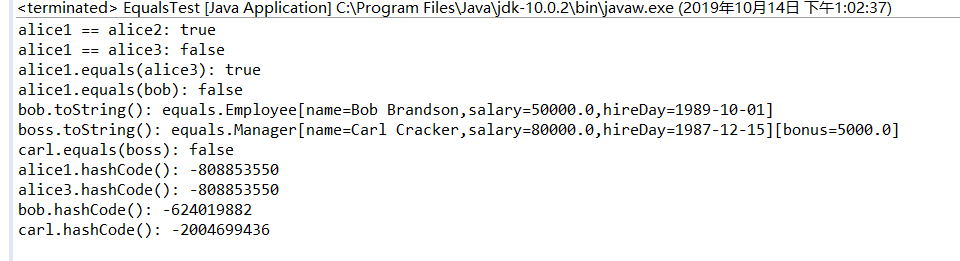
(2)运行结果如下:
实验2:测试程序2
l 在elipse IDE中调试运行程序5-11(教材182页),结合程序运行结果理解程序;
l 掌握ArrayList类的定义及用法;
l 在程序中相关代码处添加新知识的注释;
5.11代码:
package arrayList;
import java.util.*;
/**
* This program demonstrates the ArrayList class.
* @version 1.11 2012-01-26
* @author Cay Horstmann
*/
public class ArrayListTest
{
public static void main(String[] args)
{
// fill the staff array list with three Employee objects
ArrayList staff = new ArrayList<Employee>();
staff.add(new Employee("Carl Cracker", 75000, 1987, 12, 15));
staff.add(new Employee("Harry Hacker", 50000, 1989, 10, 1));
staff.add(new Employee("Tony Tester", 40000, 1990, 3, 15));
// raise everyone's salary by 5%
for (Employee e : staff)
e.raiseSalary(5);
// print out information about all Employee objects
for (Employee e : staff)
System.out.println("name=" + e.getName() + ",salary=" + e.getSalary() + ",hireDay="
+ e.getHireDay());
}
}
package arrayList;
import java.time.*;
public class Employee
{
private String name;
private double salary;
private LocalDate hireDay;
public Employee(String name, double salary, int year, int month, int day)
{
this.name = name;
this.salary = salary;
hireDay = LocalDate.of(year, month, day);
}
public String getName()
{
return name;
}
public double getSalary()
{
return salary;
}
public LocalDate getHireDay()
{
return hireDay;
}
public void raiseSalary(double byPercent)
{
double raise = salary * byPercent / 100;
salary += raise;
}
}
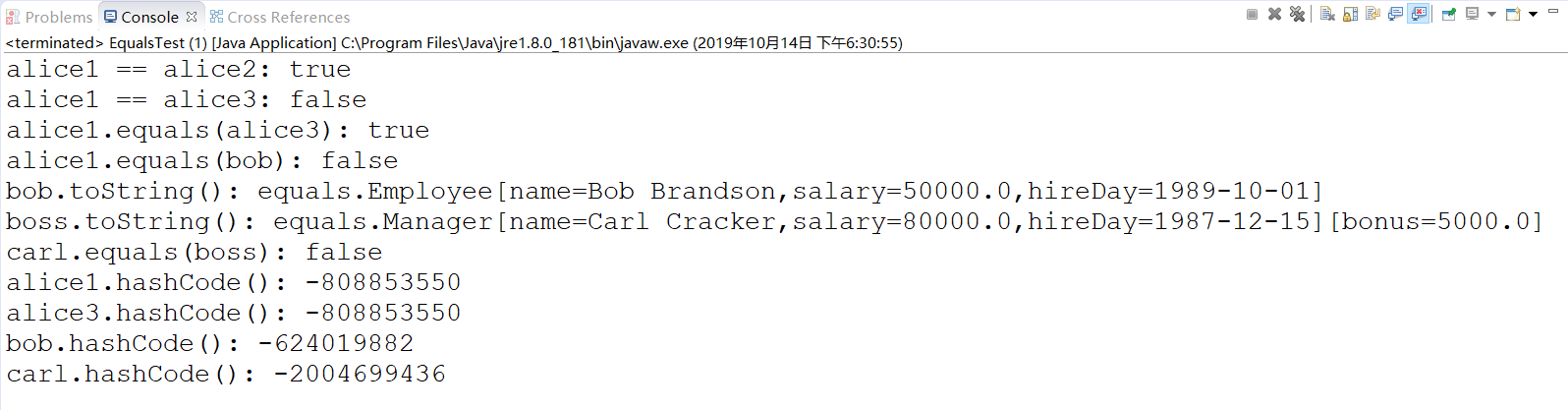
运行结果:
l 设计适当的代码,测试ArrayList类的set()、get()、remove()、size()等方法的用法。
代码为:
package arrayList;
import java.util.*;
/**
* This program demonstrates the ArrayList class.
* @version 1.11 2012-01-26
* @author Cay Horstmann
*/
public class ArrayListTest
{
private static final Employee element = null;
private static final int index = 0;
public static void main(String[] args)
{
// fill the staff array list with three Employee objects
ArrayList<Employee> staff = new ArrayList<Employee>(); //用三个Employee对象填充数组
staff.add(new Employee("Carl Cracker", 75000, 1987, 12, 15));
staff.add(new Employee("Harry Hacker", 50000, 1989, 10, 1));
staff.add(new Employee("Tony Tester", 40000, 1990, 3, 15));
ArrayList<Employee> list = new ArrayList<Employee>();
//size()的用法
int size=staff.size();
System.out.println("arrayList中的元素个数是:"+size);
for(int i=0;i<staff.size();i++)
{
//get()的用法
Employee e=staff.get(i);
System.out.println("name=" + e.getName() + ",salary=" + e.getSalary() + ",hireDay="
+ e.getHireDay());
}
//set()的用法
staff.set(0, new Employee("llx", 20000, 1999, 11, 06));
Employee e=staff.get(0);
System.out.println("修改后的数据为:name=" + e.getName() + ",salary=" + e.getSalary() + ",hireDay="
+ e.getHireDay());
//remove()的用法
staff.remove(2);
System.out.println("将第一个数据删除后:");
int size1=staff.size();
System.out.println("arrayList中的元素个数是:"+size1);
for(int i=0;i<staff.size();i++)
{
Employee p=staff.get(i);
System.out.println("name=" + p.getName() + ",salary=" + p.getSalary() + ",hireDay="
+ p.getHireDay());
}
// raise everyone's salary by 5%
for (Employee e1 : staff) //把每个人的薪资提高%5
e1.raiseSalary(5);
// print out information about all Employee objects
for (Employee e1 : staff) //输出所有雇员对象的信息
System.out.println("name=" + e1.getName() + ",salary=" + e1.getSalary() + ",hireDay="
+ e1.getHireDay()); //利用getName(),getSalary() 和getHireDay()方法输出所有雇员对象的信息
}
}
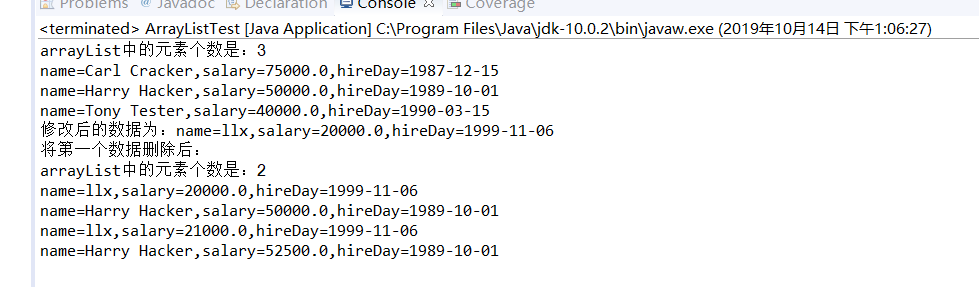
运行结果:
实验2:测试程序3
l 编辑、编译、调试运行程序5-12(教材189页),结合运行结果理解程序;
l 掌握枚举类的定义及用法;
l 在程序中相关代码处添加新知识的注释;
代码为:
package enums;
import java.util.*;
/**
* This program demonstrates enumerated types.
* @version 1.0 2004-05-24
* @author Cay Horstmann
*/
public class EnumTest
{
public static void main(String[] args)
{
Scanner in = new Scanner(System.in);
System.out.print("Enter a size: (SMALL, MEDIUM, LARGE, EXTRA_LARGE) ");
String input = in.next().toUpperCase();
Size size = Enum.valueOf(Size.class, input);
System.out.println("size=" + size);
System.out.println("abbreviation=" + size.getAbbreviation());
if (size == Size.EXTRA_LARGE)
System.out.println("Good job--you paid attention to the _.");
}
}
enum Size
{
SMALL("S"), MEDIUM("M"), LARGE("L"), EXTRA_LARGE("XL");
private Size(String abbreviation) { this.abbreviation = abbreviation; }
public String getAbbreviation() { return abbreviation; }
private String abbreviation;
}
运行结果为:

l 删除程序中Size枚举类,背录删除代码,在代码录入中掌握枚举类的定义要求。
代码为:
package enums;
import java.util.*;
/**
* This program demonstrates enumerated types.
* @version 1.0 2004-05-24
* @author Cay Horstmann
*/
public class EnumTest
{
public static void main(String[] args)
{
var in = new Scanner(System.in);
System.out.print("Enter a size: (SMALL, MEDIUM, LARGE, EXTRA_LARGE) ");
String input = in.next().toUpperCase();
Size size = Enum.valueOf(Size.class, input); //静态values方法返回枚举的所有值的数组
System.out.println("size=" + size);
System.out.println("abbreviation=" + size.getAbbreviation());
if (size == Size.EXTRA_LARGE)
System.out.println("Good job--you paid attention to the _.");
}
}
enum Size
{
SMALL("S"), MEDIUM("M"), LARGE("L"), EXTRA_LARGE("XL");
private Size(String abbreviation) { this.abbreviation = abbreviation; }
public String getAbbreviation() { return abbreviation; }
private String abbreviation;
}//调用构造函数
运行结果为:

实验2:测试程序4
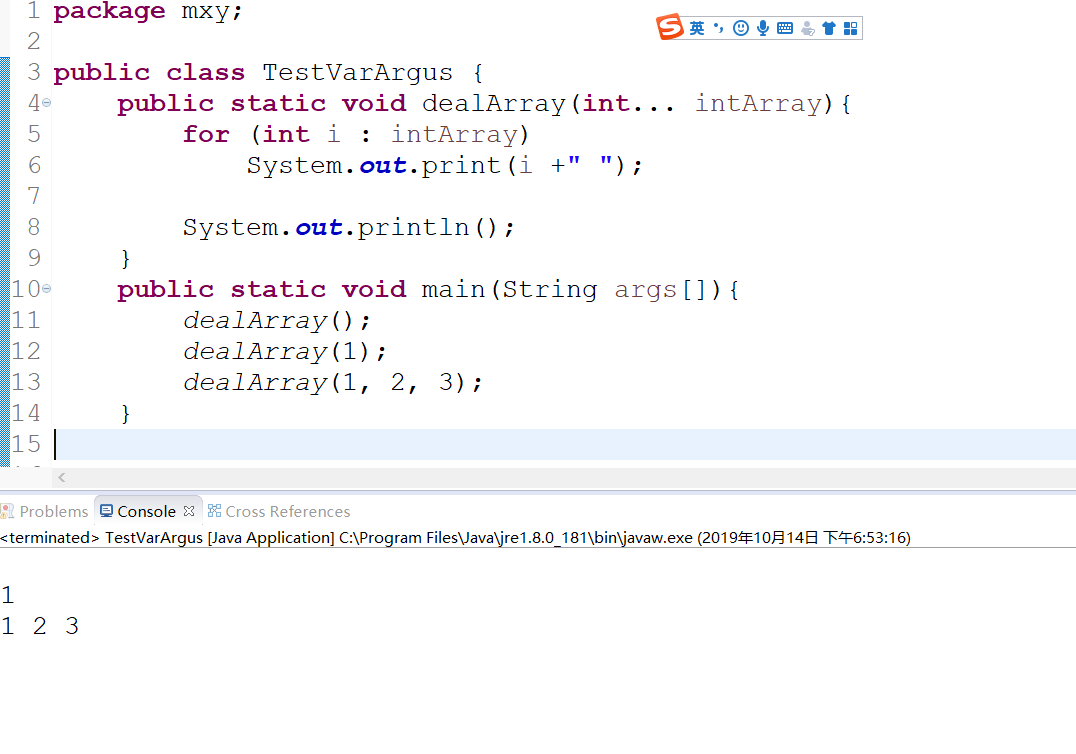
录入以下代码,结合程序运行结果了解方法的可变参数用法
|
public class TestVarArgus { public static void dealArray(int... intArray){ for (int i : intArray) System.out.print(i +" "); System.out.println(); } public static void main(String args[]){ dealArray(); dealArray(1); dealArray(1, 2, 3); } } |
代码为:
public class TestVarArgus {
public static void dealArray(int... intArray){
for (int i : intArray)
System.out.print(i +" ");
System.out.println();
}
public static void main(String args[]){
dealArray();
dealArray(1);
dealArray(1, 2, 3);
}
}
运行结果:
实验3:编程练习
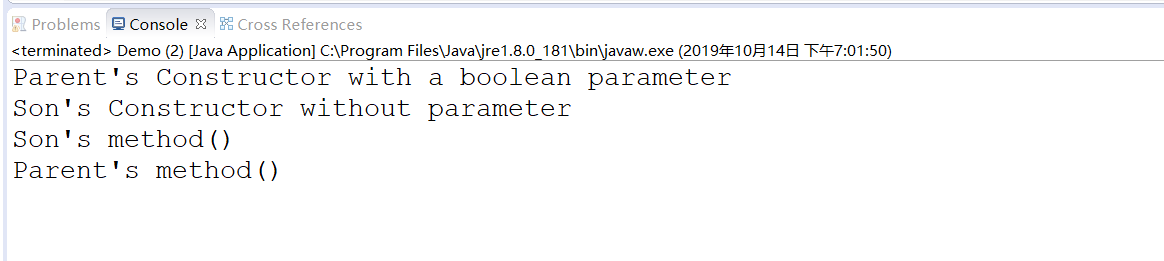
参照输出样例补全程序,使程序输出结果与输出样例一致。
|
public class Demo { public static void main(String[] args) { Son son = new Son(); son.method(); } } class Parent { Parent() { System.out.println("Parent's Constructor without parameter"); } Parent(boolean b) { System.out.println("Parent's Constructor with a boolean parameter"); } public void method() { System.out.println("Parent's method()"); } } class Son extends Parent { //补全本类定义 } |
程序运行结果如下:
Parent's Constructor with a boolean parameter
Son's Constructor without parameter
Son's method()
Parent's method()
代码为:
public class TestVarArgus {
public static void dealArray(int... intArray){
for (int i : intArray)
System.out.print(i +" ");
System.out.println();
}
public static void main(String args[]){
dealArray();
dealArray(1);
dealArray(1, 2, 3);
}
}
运行结果为:
3. 实验总结:(15分)
本次试验学习了访问修饰符有四种public protected 默认的不写的 private,public 访问权限最大,同包(同文件夹)里面的类绝对是可以互相访问的,不同包中的类只要经过import得到了路径后也是可以通过类的对象访问的,protected 和 默认的比public访问权限都要小(不能在其他包中被访问除非继承这里是指protected)但他们两之间有细微的区别就是在不同包中的类继承protected和 默认的时候 ,继承的类能够访问用protected修饰的成员而不能访问默认即不写修饰符的成员,private 范围最小 只能在类内部的成员之间进行访问,外部的类是绝对没有办法通过对象访问到私有成员的,继承的类也不会继承private的成员在Java中,ArrayList类可以解决运行时动态更改数组的问题。ArrayList使用起来有点像数组,但是在添加或删除元素时,具有自动调节数组容量的功能,而不需要为此编写任何代码。在今后的学习中要多思考,多去理解代码,理解各种参数的使用方法。多进行编程练习,以提高编程能力。
201871020225-牟星源《面向对象程序设计(java)》第七周学习总结的更多相关文章
- 201771010134杨其菊《面向对象程序设计java》第九周学习总结
第九周学习总结 第一部分:理论知识 异常.断言和调试.日志 1.捕获 ...
- 201871010132-张潇潇《面向对象程序设计(java)》第一周学习总结
面向对象程序设计(Java) 博文正文开头 项目 内容 这个作业属于哪个课程 https://www.cnblogs.com/nwnu-daizh/ 这个作业的要求在哪里 https://www.cn ...
- 扎西平措 201571030332《面向对象程序设计 Java 》第一周学习总结
<面向对象程序设计(java)>第一周学习总结 正文开头: 项目 内容 这个作业属于哪个课程 https://www.cnblogs.com/nwnu-daizh/ 这个作业的要求在哪里 ...
- 杨其菊201771010134《面向对象程序设计Java》第二周学习总结
第三章 Java基本程序设计结构 第一部分:(理论知识部分) 本章主要学习:基本内容:数据类型:变量:运算符:类型转换,字符串,输入输出,控制流程,大数值以及数组. 1.基本概念: 1)标识符:由字母 ...
- 201871010124 王生涛《面向对象程序设计JAVA》第一周学习总结
项目 内容 这个作业属于哪个课程 https://www.cnblogs.com/nwnu-daizh/ 这个作业的要求在哪里 https://edu.cnblogs.com/campus/xbsf/ ...
- 201871010115——马北《面向对象程序设计JAVA》第二周学习总结
项目 内容 这个作业属于哪个课程 https://www.cnblogs.com/nwnu-daizh/ 这个作业的要求在哪里 https://www.cnblogs.com/nwnu-daizh/p ...
- 201777010217-金云馨《面向对象程序设计(Java)》第二周学习总结
项目 内容 这个作业属于哪个课程 https://www.cnblogs.com/nwnu-daizh/ 这个作业的要求在哪里 https://www.cnblogs.com/nwnu-daizh/p ...
- 201871010132——张潇潇《面向对象程序设计JAVA》第二周学习总结
项目 内容 这个作业属于哪个课程 https://www.cnblogs.com/nwnu-daizh/ 这个作业的要求在哪里 https://www.cnblogs.com/nwnu-daizh/p ...
- 201771010123汪慧和《面向对象程序设计Java》第二周学习总结
一.理论知识部分 1.标识符由字母.下划线.美元符号和数字组成, 且第一个符号不能为数字.标识符可用作: 类名.变量名.方法名.数组名.文件名等.第二部分:理论知识学习部分 2.关键字就是Java语言 ...
- 201521123061 《Java程序设计》第七周学习总结
201521123061 <Java程序设计>第七周学习总结 1. 本周学习总结 2. 书面作业 ArrayList代码分析 1.1 解释ArrayList的contains源代码 贴上源 ...
随机推荐
- session:
内容回顾: 多对多 class Pulisher(models.Model): name = models.CharField(max_length=32) class Book(models ...
- LG2375/LOJ2246 「NOI2014」动物园 KMP改造
问题描述 LG2375 LOJ2246 题解 看了题解,需要回看,需要继续通过本题深入理解KMP. 为了将 \(\mathrm{KMP}\) 和只插入了一个模式串的\(\mathrm{AC}\)自动机 ...
- angular 使用ng-zorro的from组件 运行报错
emplate parse errors: Can't bind to 'formGroup' since it isn't a known property of 'form'. 原因:没有导入表单 ...
- Python实现网络多人聊天室 - Windows
项目名称:多人聊天室项目结构: client.py server.py settings.py项目思路:服务端接收客户端连接,客户端发送信息给服务端,服务端将信息发送给所有客户端.项目实现:主进程负责 ...
- VScode Python 虚拟环境
安装python环境 在VScode里设置Python 虚拟环境查找路径(Settings -> Extensions -> Python Configurations -> Env ...
- 【转】UML之类图和对象图
思路呈现 什么是类图? 描述类.接口.协作及他们之间的关系的图.显示系统中类的静态结构. 有什么作用? 描述软件系统的静态结构 ①对系统的词汇建模 ②对简单协作建模 ③对逻辑数据库模式建模 什么是对象 ...
- vscode配置python环境-运行调试-windows环境
官方文件介绍 https://code.visualstudio.com/docs/languages/python 准备: vscode下载安装 python3版本下载(安装时可以选择添加环境变量, ...
- 【Java语言特性学习之五】版本差异新特性
- 源码详解系列(五) ------ C3P0的使用和分析(包括JNDI)
简介 c3p0是用于创建和管理连接,利用"池"的方式复用连接减少资源开销,和其他数据源一样,也具有连接数控制.连接可靠性测试.连接泄露控制.缓存语句等功能.目前,hibernate ...
- 你真的了解nginx重定向URI?-rewrite和alias指令
未经允许不得转载!最近发现有博主转载我的文章,并没有跟我打招呼,也没有注明出处!!!! 熟悉Nginx的同学都知道Nginx可以用来做负载均衡和反向代理,非常好用.做前后端分离也是非常的方便. 今天我 ...