
介绍css 的3D 变换(3D transform)
https://desandro.github.io/3dtransforms/docs/card-flip.html
---------------------------------------------------------------------------------------------------
Card Flip
We now have all the tools to start making 3D objects. Let’s get started with the basics, flipping a card.
Here’s the basic markup we’ll need:
<section class="container">

  <div id="card">

    <figure class="front">1</figure>

    <figure class="back">2</figure>

  </div>

</section>
The .container will house the 3D space. The #card acts as a wrapper for the 3D object. Two separate elements for both faces of the card, .front and .back. Even for such a simple object, I recommend using this same pattern for any 3D transform. Keeping the 3D space element and the object separate element establishes a paradigm that is simple to understand and easier to style.
We’re ready for some 3D stylin’. First, apply necessary perspective to the parent 3D space, along with any size or positioning styles.
.container {

  width: 200px;

  height: 260px;

  position: relative;

  perspective: 800px;

}
Now the #card element can be transformed in its parent’s 3D space. We’re using absolute/relative positioning so the 3D object is removed from the flow of the document. We’ll also add @width: 100%; and height: 100%;@. This ensures the object’s transform-origin will occur in the center of container. More on transform-origin later.
Let’s add a CSS3 transition so users can see the transform take effect.
#card {

  width: 100%;

  height: 100%;

  position: absolute;

  transform-style: preserve-3d;

  transition: transform 1s;

}
The .container’s perspective only applies to direct descendant children, in this case #card. In order for subsequent children to inherit a parent’s perspective, and live in the same 3D space, the parent can pass along its perspective with transform-style: preserve-3d. Without 3D transform-style, the faces of the card would be flattened with its parents and the back face’s rotation would be nullified.
To position the faces in 3D space, we’ll need to reset their positions in 2D with position: absolute. In order to hide the back-side of the faces when they are faced away from the viewer, we use backface-visibility: hidden.
#card figure {

  margin: 0;

  display: block;

  position: absolute;

  width: 100%;

  height: 100%;

  backface-visibility: hidden;

}
To flip the .back face, we add a basic 3D transform of rotateY( 180deg ).
#card .front {

  background: red;

}

#card .back {

  background: blue;

  transform: rotateY( 180deg );

}
With the faces in place, the #card requires a corresponding style for when it is flipped.
#card.flipped {

  transform: rotateY( 180deg );

}
Now we have a working 3D object. To flip the card, we can toggle the flipped class. When .flipped, the #card will rotate 180 degrees, thus exposing the .back face.
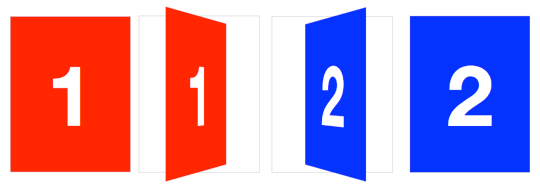
Slide-flip
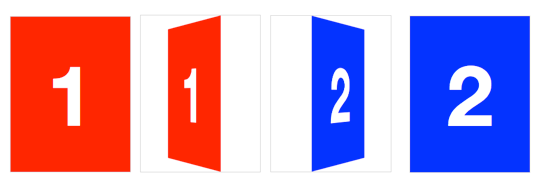
Take another look at the Weather App 3D transition. You’ll notice that it’s not quite the same effect as our previous demo. If you follow the right edge of the card, you’ll find that it stays flush with the container. Instead of pivoting from the horizontal center, it pivots on that right edge. But the transition is not just a rotation – the edge moves horizontally from right to left. We can reproduce this transition just by modifying a couple lines of CSS from our original card flip demo.
The pivot point for the rotation occurs at the right side of the card. By default, the transform-origin of an element is at its horizontal and vertical center (50% 50% or center center). Let’s change it to the right side:
#card { transform-origin: right center; }That flip now needs some horizontal movement with translateX. We’ll set the rotation to -180deg so it flips right side out.
#card.flipped {

  transform: translateX( -100% ) rotateY( -180deg );

}
介绍css 的3D 变换(3D transform)的更多相关文章
- CSS3 3D变换实例 滚动的正方体
笔记: 2D变换 transform 位移 translateX() translateY() 简写:translate(X值,Y值) 正值向右,负值向左 旋转 rotate() rotat ...
- css之3D变换
3D变换的x,y,z轴是分别效果是: x轴旋转的话,就是头和脚进行转动 y轴旋转的话,就是左右手进行转动 z轴旋转的话,就是整个身体平铺在旋转. 上面是针对旋转的意思去,但是对于其他的类似一样,就是这 ...
- 基本3D变换之World Transform, View Transform and Projection Transform
作者:i_dovelemon 来源:CSDN 日期:2014 / 9 / 28 主题:World Transform, View Transform , Projection Transform 引言 ...
- CSS3 3D变换
可以这么说,3D变换是基于三维坐标系的.以下是“盗用”的图 CSS3中的3D变换主要包括以下几个功能函数: 3D位移:包括translateZ()和translate3d(): 3D旋转:包括rota ...
- CSS3之3D变换实例详解
CSS3的3D效果很赞,本文实现简单的两种3D翻转效果.首先看效果和源代码,文末是文绉绉的总结部分^_^ 以下CSS代码为了简洁没有添加前缀,请视情况自行添加(自动化时代推荐使用其他的一些方法,如gu ...
- (一一九)通过CALayer实现阴影、圆角、边框和3D变换
在每个View上都有一个CALayer作为父图层,View的内容作为子层显示,通过layer的contents属性决定了要显示的内容,通过修改过layer的一些属性可以实现一些华丽的效果. [阴影和圆 ...
- CSS3之3d变换与关键帧
3d变换是在transform基础上实现的 transform-style:preserve-3d; 建立3d空间 perspective:; 景深(设置用户看的距离) perspective-ori ...
- OpenGL学习进程(12)第九课:矩阵乘法实现3D变换
本节是OpenGL学习的第九个课时,下面将详细介绍OpenGL的多种3D变换和如何操作矩阵堆栈. (1)3D变换: OpenGL中绘制3D世界的空间变换包括:模型变换.视图变换.投影变换和视口 ...
- [OpenGL ES 03]3D变换:模型,视图,投影与Viewport
[OpenGL ES 03]3D变换:模型,视图,投影与Viewport 罗朝辉 (http://blog.csdn.net/kesalin) 本文遵循“署名-非商业用途-保持一致”创作公用协议 系列 ...
- 第1部分: 游戏引擎介绍, 渲染和构造3D世界
原文作者:Jake Simpson译者: 向海Email:GameWorldChina@myway.com ---------------------------------------------- ...
随机推荐
- 习水医院12C RAC 数据库安装文档
环境介绍 OS: Oracle Enterprise Linux 6.4 (For RAC Nodes) DB: GI and Database 12.1.0.2 所需介质 p17694377 ...
- Okhttp3发送xml、json、文件的请求方法
1.引入依赖 <dependency> <groupId>com.squareup.okhttp3</groupId> <artifactId>okht ...
- python 需求分析
第三章: 需求分析需求分析任务: ??? 功能分析性能分析EG: 相应时间.主存容量.磁盘容量.安全性.等可靠性和可用性出错处理需求系统发现错误时采取的行动,主要在系统关键部分设置接口需求用户接口.硬 ...
- jQuery 开始动画,停止动画
<!DOCTYPE html> <html lang="en"> <head> <meta charset="UTF-8&quo ...
- CE工具里自带的学习工具--第二关
图解:
- ansible基础配置
1.基础配置 1.1.环境 主机配置 ansible版本:2.7.4 控制端:centos7.4,IP:192.168.1.213,主机名:operation 被控制端: centos6.5,IP:1 ...
- jquery.form.min.js
/*! * jQuery Form Plugin * version: 3.51.0-2014.06.20 * Requires jQuery v1.5 or later * Copyright (c ...
- sql分组和连接
SELECT mr.member_id, mr.username, GROUP_CONCAT(DISTINCT jb.company,jb.start_time,jb.end_time)company ...
- thinkphp 5.0整合阿里大于验证码短信发送接口,含完整模型验证实例DEMO
为大家分享一个阿里大于短信发送接口: 首先创建一个发送模型(Send.php): <?php namespace app\index\model; use think\Validate; cla ...
- mysql负载均衡
一.docker安装haproxy:docker pull haproxy 二.配置haproxy(参考url:https://zhangge.net/5125.html),vim /usr/loca ...