
csharp: ODP.NET,System.Data.OracleClient(.net 4.0) and System.Data.OleDb读取Oracle g 11.2.0的区别
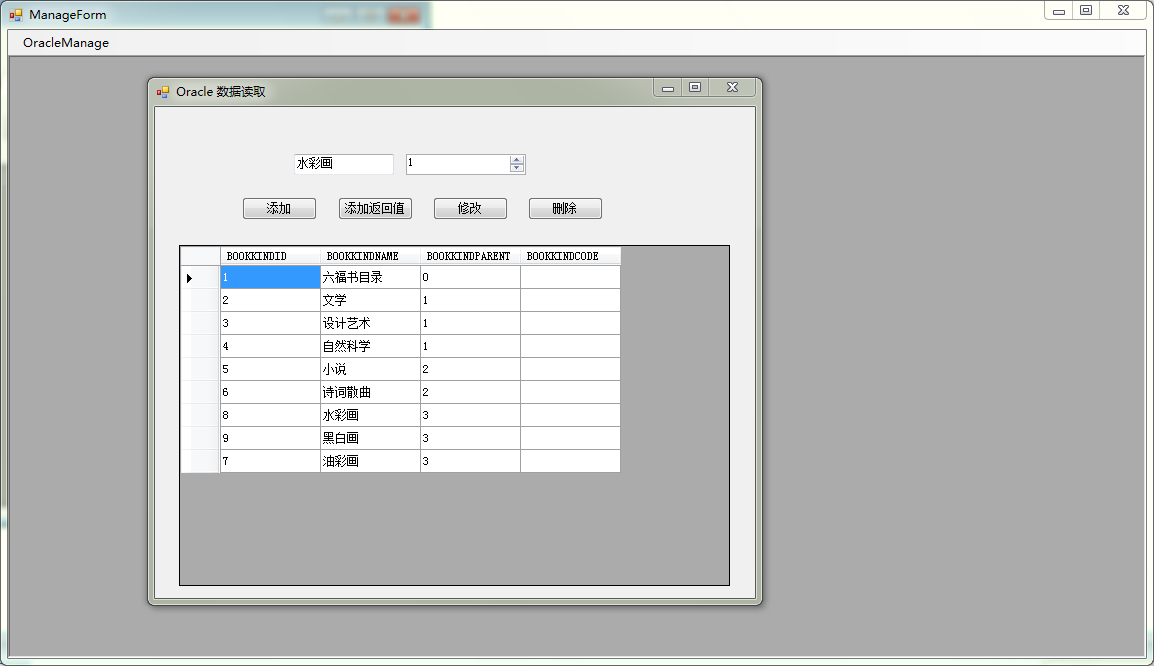
ODP.NET:
引用:
using Oracle.DataAccess; //Oracle g 11.2.0

using Oracle.DataAccess.Client;

using Oracle.DataAccess.Types;

//下载 http://www.oracle.com/technetwork/topics/dotnet/downloads/net-downloads-160392.html

//引用:D:\app\geovindu\product\11.2.0\dbhome_1\ODP.NET\bin

//用法参考

//

//http://docs.oracle.com/cd/B28359_01/appdev.111/b28844/procedures_dot_net.htm

//http://docs.oracle.com/cd/B19306_01/win.102/b14307/OracleDataAdapterClass.htm //.net 4.0

//https://docs.oracle.com/cd/B19306_01/server.102/b14220/schema.htm
数据库连接字符串:
public string connectionString = @"DATA SOURCE=oracle11g;USER ID=geovin;password=geovindu;";
/// <summary>

    /// 20160918 涂聚文

    /// Geovin Du

    /// </summary>

    public class BookKindListDAL : IBookKindList

    {

        ///<summary>

        /// 追加记录

        ///</summary>

        ///<param name="BookKindListInfo"></param>

        ///<returns></returns>

        public int InsertBookKindList(BookKindListInfo bookKindList)

        {

            int ret = 0;

            try

            {

                OracleParameter[] par = new OracleParameter[]{

				new OracleParameter("temTypeName",OracleDbType.NVarchar2,1000),

				new OracleParameter("temParent",OracleDbType.Int32,4),

				};

                par[0].Value = bookKindList.BookKindName;

                par[1].Value = bookKindList.BookKindParent;

                ret = OracleHelper.ExecuteSql("proc_Insert_BookKindList", CommandType.StoredProcedure, par);

            }

            catch (OracleException ex)

            {

                throw ex;

            }

            return ret;

        }

        /// <summary>

        /// 追加记录返回

        /// </summary>

        /// <param name="authorList"></param>

        /// <param name="authorID"></param>

        /// <returns></returns>

        public int InsertBookKindOutput(BookKindListInfo bookKindList, out int bookKindLID)

        {

            bookKindLID = 0;

            int ret = 0;

            try

            {

                OracleParameter[] par = new OracleParameter[]{

				new OracleParameter("temTypeName",OracleDbType.NVarchar2,1000),

                new OracleParameter("temParent",OracleDbType.Int32,4),

                new OracleParameter("temId",OracleDbType.Int32,4),

				};

                par[0].Value = bookKindList.BookKindName;

                par[1].Value = bookKindList.BookKindParent;

                par[2].Direction = ParameterDirection.Output;

                ret = OracleHelper.ExecuteSql("proc_Insert_BookKindOut", CommandType.StoredProcedure, par);

                if (ret > 0)

                {

                    bookKindLID =int.Parse(par[2].Value.ToString());

                }

            }

            catch (OracleException ex)

            {

                throw ex;

            }

            return ret;

        }

        ///<summary>

        ///修改记录

        ///</summary>

        ///<param name="BookKindListInfo"></param>

        ///<returns></returns>

        public int UpdateBookKindList(BookKindListInfo bookKindList)

        {

            int ret = 0;

            try

            {

                OracleParameter[] par = new OracleParameter[]{

				new OracleParameter("BookKindID",OracleDbType.Int32,4),

				new OracleParameter("BookKindName",OracleDbType.NVarchar2,1000),

				new OracleParameter("BookKindParent",OracleDbType.Int32,4),

				};

                par[0].Value = bookKindList.BookKindID;

                par[1].Value = bookKindList.BookKindName;

                par[2].Value = bookKindList.BookKindParent;

                ret = OracleHelper.ExecuteSql("proc_Update_BookKindList", CommandType.StoredProcedure, par);

            }

            catch (OracleException ex)

            {

                throw ex;

            }

            return ret;

        }

        ///<summary>

        /// 删除记录

        ///</summary>

        ///<param name="bookKindIDInfo"></param>

        ///<returns></returns>

        public bool DeleteBookKindList(int bookKindID)

        {

            bool ret = false;

            try

            {

                OracleParameter par = new OracleParameter("BookKindID", bookKindID);

                int temp = 0;

                temp = OracleHelper.ExecuteSql("proc_Delete_BookKindList", CommandType.StoredProcedure, par);

                if (temp != 0)

                {

                    ret = true;

                }

            }

            catch (OracleException ex)

            {

                throw ex;

            }

            return ret;

        }

        ///<summary>

        /// 查询记录

        ///</summary>

        ///<param name="bookKindIDInfo"></param>

        ///<returns></returns>

        public BookKindListInfo SelectBookKindList(int bookKindID)

        {

            BookKindListInfo bookKindList = null;

            try

            {

                OracleParameter par = new OracleParameter("BookKindID", bookKindID);

                using (OracleDataReader reader = OracleHelper.GetReader("proc_Select_BookKindList", CommandType.StoredProcedure, par))

                {

                    if (reader.Read())

                    {

                        bookKindList = new BookKindListInfo();

                        bookKindList.BookKindID = (!object.Equals(reader["BookKindID"], null)) ? (int)reader["BookKindID"] : 0;

                        bookKindList.BookKindName = (!object.Equals(reader["BookKindName"], null)) ? (string)reader["BookKindName"] : "";

                        bookKindList.BookKindParent = (!object.Equals(reader["BookKindParent"], null)) ? (int)reader["BookKindParent"] : 0;

                    }

                }

            }

            catch (OracleException ex)

            {

                throw ex;

            }

            return bookKindList;

        }

        ///<summary>

        /// 查询所有记录

        ///</summary>

        ///<returns></returns>

        public List<BookKindListInfo> SelectBookKindListAll()

        {

            List<BookKindListInfo> list = new List<BookKindListInfo>();

            BookKindListInfo bookKindList = null;

            try

            {

                using (OracleDataReader reader = OracleHelper.GetReader("proc_Select_BookKindListAll", CommandType.StoredProcedure, null))

                {

                    while (reader.Read())

                    {

                        bookKindList = new BookKindListInfo();

                        bookKindList.BookKindID = (!object.Equals(reader["BookKindID"], null)) ? (int)reader["BookKindID"] : 0;

                        bookKindList.BookKindName = (!object.Equals(reader["BookKindName"], null)) ? (string)reader["BookKindName"] : "";

                        bookKindList.BookKindParent = (!object.Equals(reader["BookKindParent"], null)) ? (int)reader["BookKindParent"] : 0;

                        list.Add(bookKindList);

                    }

                }

            }

            catch (OracleException ex)

            {

                throw ex;

            }

            return list;

        }

        ///<summary>

        /// 查询所有记录

        ///</summary>

        ///<returns></returns>

        public DataTable SelectBookKindListDataTableAll()

        {

            DataTable dt = new DataTable();

            try

            {

                using (DataTable reader = OracleHelper.GetTable("proc_Select_BookKindListAll", CommandType.StoredProcedure, null))

                {

                    dt = reader;

                }

            }

            catch (OracleException ex)

            {

                throw ex;

            }

            return dt;

        }

    }
System.Data.OracleClient(.net 4.0)
引用:
using System.Collections;

using System.Data;

using System.Configuration;

using System.Data.OracleClient;//.net 4.0

//用法参考

//https://msdn.microsoft.com/en-us/library/system.data.oracleclient.oracledataadapter(v=vs.110).aspx

//http://blog.csdn.net/chinawn/article/details/336904

//C:\Program Files\Reference Assemblies\Microsoft\Framework\.NETFramework\v4.0\System.Data.OracleClient.dll
数据库连接字符串:
public string connectionString = @"Data Source=(DESCRIPTION = (ADDRESS_LIST= (ADDRESS = (PROTOCOL = TCP)(HOST = localhost)(PORT = 1521))) (CONNECT_DATA = (SERVICE_NAME = oracle11g)));user id=geovin;password=geovindu;Persist Security Info=True;";
/// <summary>

    /// 20160918 涂聚文

    /// Geovin Du

    /// </summary>

    public class BookKindListDAL : IBookKindList

    {

        ///<summary>

        /// 追加记录

        ///</summary>

        ///<param name="BookKindListInfo"></param>

        ///<returns></returns>

        public int InsertBookKindList(BookKindListInfo bookKindList)

        {

            int ret = 0;

            try

            {

                OracleParameter[] par = new OracleParameter[]{

				new OracleParameter("temTypeName",OracleType.NVarChar,1000),

				new OracleParameter("temParent",OracleType.Number,4),

				};

                par[0].Value = bookKindList.BookKindName;

                par[1].Value = bookKindList.BookKindParent;

                ret = OracleHelper.ExecuteSql("proc_Insert_BookKindList", CommandType.StoredProcedure, par);

            }

            catch (OracleException ex)

            {

                throw ex;

            }

            return ret;

        }

        /// <summary>

        /// 追加记录返回

        /// </summary>

        /// <param name="authorList"></param>

        /// <param name="authorID"></param>

        /// <returns></returns>

        public int InsertBookKindOutput(BookKindListInfo bookKindList, out int bookKindLID)

        {

            bookKindLID = 0;

            int ret = 0;

            try

            {

                OracleParameter[] par = new OracleParameter[]{

				new OracleParameter("temTypeName",OracleType.NVarChar,1000),

                new OracleParameter("temParent",OracleType.Number,4),

                new OracleParameter("temId",OracleType.Number,4),

				};

                par[0].Value = bookKindList.BookKindName;

                par[1].Value = bookKindList.BookKindParent;

                par[2].Direction = ParameterDirection.Output;

                ret = OracleHelper.ExecuteSql("proc_Insert_BookKindOut", CommandType.StoredProcedure, par);

                if (ret > 0)

                {

                    bookKindLID =int.Parse(par[2].Value.ToString());

                }

            }

            catch (OracleException ex)

            {

                throw ex;

            }

            return ret;

        }

        ///<summary>

        ///修改记录

        ///</summary>

        ///<param name="BookKindListInfo"></param>

        ///<returns></returns>

        public int UpdateBookKindList(BookKindListInfo bookKindList)

        {

            int ret = 0;

            try

            {

                OracleParameter[] par = new OracleParameter[]{

				new OracleParameter("BookKindID",OracleType.Number,4),

				new OracleParameter("BookKindName",OracleType.NVarChar,1000),

				new OracleParameter("BookKindParent",OracleType.Number,4),

				};

                par[0].Value = bookKindList.BookKindID;

                par[1].Value = bookKindList.BookKindName;

                par[2].Value = bookKindList.BookKindParent;

                ret = OracleHelper.ExecuteSql("proc_Update_BookKindList", CommandType.StoredProcedure, par);

            }

            catch (OracleException ex)

            {

                throw ex;

            }

            return ret;

        }

        ///<summary>

        /// 删除记录

        ///</summary>

        ///<param name="bookKindIDInfo"></param>

        ///<returns></returns>

        public bool DeleteBookKindList(int bookKindID)

        {

            bool ret = false;

            try

            {

                OracleParameter par = new OracleParameter("BookKindID", bookKindID);

                int temp = 0;

                temp = OracleHelper.ExecuteSql("proc_Delete_BookKindList", CommandType.StoredProcedure, par);

                if (temp != 0)

                {

                    ret = true;

                }

            }

            catch (OracleException ex)

            {

                throw ex;

            }

            return ret;

        }

        ///<summary>

        /// 查询记录

        ///</summary>

        ///<param name="bookKindIDInfo"></param>

        ///<returns></returns>

        public BookKindListInfo SelectBookKindList(int bookKindID)

        {

            BookKindListInfo bookKindList = null;

            try

            {

                OracleParameter par = new OracleParameter("BookKindID", bookKindID);

                using (OracleDataReader reader = OracleHelper.GetReader("proc_Select_BookKindList", CommandType.StoredProcedure, par))

                {

                    if (reader.Read())

                    {

                        bookKindList = new BookKindListInfo();

                        bookKindList.BookKindID = (!object.Equals(reader["BookKindID"], null)) ? (int)reader["BookKindID"] : 0;

                        bookKindList.BookKindName = (!object.Equals(reader["BookKindName"], null)) ? (string)reader["BookKindName"] : "";

                        bookKindList.BookKindParent = (!object.Equals(reader["BookKindParent"], null)) ? (int)reader["BookKindParent"] : 0;

                    }

                }

            }

            catch (OracleException ex)

            {

                throw ex;

            }

            return bookKindList;

        }

        ///<summary>

        /// 查询所有记录

        ///</summary>

        ///<returns></returns>

        public List<BookKindListInfo> SelectBookKindListAll()

        {

            List<BookKindListInfo> list = new List<BookKindListInfo>();

            BookKindListInfo bookKindList = null;

            try

            {

                using (OracleDataReader reader = OracleHelper.GetReader("proc_Select_BookKindListAll", CommandType.StoredProcedure, null))

                {

                    while (reader.Read())

                    {

                        bookKindList = new BookKindListInfo();

                        bookKindList.BookKindID = (!object.Equals(reader["BookKindID"], null)) ? (int)reader["BookKindID"] : 0;

                        bookKindList.BookKindName = (!object.Equals(reader["BookKindName"], null)) ? (string)reader["BookKindName"] : "";

                        bookKindList.BookKindParent = (!object.Equals(reader["BookKindParent"], null)) ? (int)reader["BookKindParent"] : 0;

                        list.Add(bookKindList);

                    }

                }

            }

            catch (OracleException ex)

            {

                throw ex;

            }

            return list;

        }

        ///<summary>

        /// 查询所有记录

        ///</summary>

        ///<returns></returns>

        public DataTable SelectBookKindListDataTableAll()

        {

            DataTable dt = new DataTable();

            try

            {

                using (DataTable reader = OracleHelper.GetTable("proc_Select_BookKindListAll", CommandType.StoredProcedure, null))

                {

                    dt = reader;

                }

            }

            catch (OracleException ex)

            {

                throw ex;

            }

            return dt;

        }

    }
System.Data.OleDb
 string connString = "Provider=OraOLEDB.Oracle.1;User ID=geovin;Password=geovindu;Data Source=(DESCRIPTION = (ADDRESS_LIST= (ADDRESS = (PROTOCOL = TCP)(HOST = localhost)(PORT = 1521))) (CONNECT_DATA = (SERVICE_NAME = oracle11g)))";

            OleDbConnection conn = new OleDbConnection(connString);

            try

            {

                conn.Open();

                MessageBox.Show(conn.State.ToString());

                DataTable dt = conn.GetSchema(this.comboBox1.Text.Trim());

                this.dataGridView1.DataSource = dt;

                this.textBox1.Text = GetColumnNames(dt);

            }

            catch (Exception ex)

            {

                MessageBox.Show(ex.Message.ToString());

            }

            finally

            {

                conn.Close();

            }
oracle package sql:
/**创建一个名为pkgBookKinds的包查所表中所有内容**/

create or replace package pkg_BookKinds is

--定义一个公有的游标类型cursor_pdt

--ref 可以在程序间传递结果集

--一个程序里打开游标变量,在另外的程序里处理数据

type cursor_pdt is ref cursor;

--声明一个存储过程 ,游标类型参数为输出类型

procedure proc_GetAllBookKind(cur_set out cursor_pdt);

end pkg_BookKinds;

/**创建一个包体**/

create or replace package body pkg_BookKinds is

  --实现包中没有实现的存储过程

  procedure proc_GetAllBookKind(cur_set out cursor_pdt) as

    begin

      --打开游标,由于定义游标时使用ref处理游标可以推迟到客户端

      open cur_set for select * from BookKindList;

      end;

end;

/**使用过程测试定义的存储过程**/

declare

--定义游标类型的变量

cur_set pkg_BookKinds.cursor_pdt;

--定义行类型

pdtrow BookKindList%rowtype;

begin

  --执行存储过程

  pkg_BookKinds.proc_GetAllBookKind(cur_set);

  --遍历游标中的数据

       LOOP

         --取当前行数据存入pdtrow

           FETCH cur_set INTO pdtrow;

           --如果未获取数据就结束循环

           EXIT WHEN cur_set%NOTFOUND;

           --输出获取到的数据

           DBMS_OUTPUT.PUT_LINE (pdtrow.BookKindID||','||pdtrow.BookKindName);

         END LOOP;

         CLOSE cur_set;

  end;
--创建包以游标的形式返回BookKindList的结果集

create or replace package pkg_BookKindList is

-- Author  : geovindu

  type mycur is ref cursor;

  procedure fun_GetRecords(cur_return out mycur);

end pkg_BookKindList;

create or replace package body pkg_BookKindList is

  -- Function and procedure implementations

 procedure fun_GetRecords(cur_return out mycur)

  is

  begin

   open cur_return for select * from BookKindList;

  end fun_GetRecords;

end pkg_BookKindList;

declare

--定义游标类型的变量

cur_return pkg_BookKindList.mycur;

--定义行类型

pdtrow BookKindList%rowtype;

begin

  --执行存储过程

  pkg_BookKindList.fun_GetRecords(cur_return);

  --遍历游标中的数据

       LOOP

         --取当前行数据存入pdtrow

           FETCH cur_return INTO pdtrow;

           --如果未获取数据就结束循环

           EXIT WHEN cur_return%NOTFOUND;

           --输出获取到的数据

           DBMS_OUTPUT.PUT_LINE (pdtrow.BookKindID||','||pdtrow.BookKindName);

         END LOOP;

         CLOSE cur_return;

end;
C# 3.5 调用查询:
 /// <summary>

        ///

        /// </summary>

        /// <param name="sender"></param>

        /// <param name="e"></param>

        private void Form3_Load(object sender, EventArgs e)

        {

            BindGridView();

        }

        /// <summary>

        ///

        /// </summary>

        private void BindGridView()

        {

            OracleConnection conn = new OracleConnection(connectionString);

            //ConfigurationManager.ConnectionStrings["ConnectionString"].ConnectionString

            OracleCommand comm = new OracleCommand("pkg_BookKindList.fun_GetRecords", conn);

            comm.Parameters.Add("cur_return", OracleType.Cursor).Direction = ParameterDirection.Output;

            comm.CommandType = CommandType.StoredProcedure;

            DataSet ds = new DataSet();

            using (OracleDataAdapter da = new OracleDataAdapter(comm))

            {

                da.Fill(ds);

            }

            this.dataGridView1.DataSource = ds.Tables[0].DefaultView;

        }
 /// <summary>

        ///

        /// </summary>

        private void BindGridViewOther()

        {

            OracleConnection conn = new OracleConnection(connectionString);

            //ConfigurationManager.ConnectionStrings["ConnectionString"].ConnectionString

            OracleCommand comm = new OracleCommand("pkg_BookKindList.fun_GetRecords", conn);

            comm.CommandType = CommandType.StoredProcedure;

            //定义参数,注意参数名必须与存储过程定义时一致,且类型为OracleType.Cursor

            OracleParameter cur_set = new OracleParameter("cur_return", OracleType.Cursor);

            //设置参数为输出类型

            cur_set.Direction = ParameterDirection.Output;

            //添加参数

            comm.Parameters.Add(cur_set);

            DataSet ds = new DataSet();

            using (OracleDataAdapter da = new OracleDataAdapter(comm))

            {

                da.Fill(ds);

            }

            this.dataGridView1.DataSource = ds.Tables[0].DefaultView;

        }
Oracle sql:
---某条记录的字段

drop PROCEDURE proc_Select_BookKindName;

CREATE OR REPLACE PROCEDURE proc_Select_BookKindName(kind_id IN BookKindList.BookKindID%type) AS

    --声明语句段

    v_name varchar2(20);

BEGIN

    --执行语句段

    SELECT o.BookKindName INTO v_name FROM BookKindList o where o.BookKindID=kind_id;

    dbms_output.put_line(v_name);

EXCEPTION

    --异常处理语句段

    WHEN NO_DATA_FOUND THEN dbms_output.put_line('NO_DATA_FOUND');

END;

--测试

begin

proc_Select_BookKindName(1);

end;

---一条记录

--创建包:

create or replace package pack_BookKindId is

       type cur_BookKindId is ref cursor;

end pack_BookKindId;

--创建存储过程

create or replace procedure proc_curBookKindId(p_id in number,p_cur out pack_BookKindId.cur_BookKindId)

is

       v_sql varchar2(400);

begin

       if p_id = 0 then

          open p_cur for select * from BookKindList;

       else

          v_sql := 'select * from BookKindList where BookKindID =: p_id';

          open p_cur for v_sql using p_id;

       end if;

end proc_curBookKindId;

--测试查询一条记录存储过程

-- Test statements here

set serveroutput on

declare

 v_id number := 1; --0 时,所有记录

 v_row BookKindList%rowtype;   --注意这里是表名

 p_cur pack_BookKindId.cur_BookKindId;

begin

 proc_curBookKindId(v_id, p_cur);

 loop

    fetch p_cur into v_row;

    exit when p_cur%notfound;

    DBMS_OUTPUT.PUT_LINE(v_row.BookKindName||'='||v_row.BookKindID);

 end loop;

 close p_cur;

end;
ODP.NET:
  ///<summary>

        /// 查询所有记录

        ///</summary>

        ///<returns></returns>

        public List<BookKindListInfo> SelectBookKindListAll()

        {

            List<BookKindListInfo> list = new List<BookKindListInfo>();

            BookKindListInfo bookKindList = null;

            try

            {

                //定义参数,注意参数名必须与存储过程定义时一致,且类型为OracleType.Cursor

                OracleParameter cur_set = new OracleParameter("cur_return", OracleDbType.RefCursor);

                //设置参数为输出类型

                cur_set.Direction = ParameterDirection.Output;

                //OracleHelper.ExecuteReader(connectionString, CommandType.StoredProcedure, "pkg_Select_BookKindListAll.proc_Select_BookKindListAll", cur_set)

                using (OracleDataReader reader = OracleHelper.GetReader("pkg_Select_BookKindListAll.proc_Select_BookKindListAll", CommandType.StoredProcedure, cur_set))

                {

                    while (reader.Read())

                    {

                        bookKindList = new BookKindListInfo();

                        string s = reader["BookKindID"].ToString();

                        bookKindList.BookKindID = (!object.Equals(reader["BookKindID"], null)) ? (decimal)reader["BookKindID"] : 0;

                        bookKindList.BookKindName = (!object.Equals(reader["BookKindName"], null)) ? (string)reader["BookKindName"] : "";

                        bookKindList.BookKindParent = (!object.Equals(reader["BookKindParent"], null)) ? (decimal)reader["BookKindParent"] : 0;

                        list.Add(bookKindList);

                    }

                }

            }

            catch (OracleException ex)

            {

                throw ex;

            }

            return list;

        }

        ///<summary>

        /// 查询所有记录

        ///</summary>

        ///<returns></returns>

        public DataTable SelectBookKindListDataTableAll()

        {

            DataTable dt = new DataTable();

            try

            {

                //定义参数,注意参数名必须与存储过程定义时一致,且类型为OracleType.Cursor

                OracleParameter cur_set = new OracleParameter("cur_return", OracleDbType.RefCursor);

                //设置参数为输出类型

                cur_set.Direction = ParameterDirection.Output;

                //添加参数

                //comm.Parameters.Add(cur_set);

                using (DataTable reader = OracleHelper.GetTable("pkg_Select_BookKindListAll.proc_Select_BookKindListAll", CommandType.StoredProcedure, cur_set))

                {

                    dt = reader;

                }

            }

            catch (OracleException ex)

            {

                throw ex;

            }

            return dt;

        }
csharp: ODP.NET,System.Data.OracleClient(.net 4.0) and System.Data.OleDb读取Oracle g 11.2.0的区别的更多相关文章
- System.Data.Oracleclient需要Oracle客户端软件Version8.1.7或更高版本问题
C#连接ORACLE报System.Data.Oracleclient需要Oracle客户端软件Version8.1.7或更高版本问题: 开始Webservice在32位系统ORACLE10g库中we ...
- vs2010:【“System.Data.OracleClient.OracleConnection”已过时】警告
在oracle 安装目录下 找到 Oracle.DataAccess.dll添加引用,然后 using Oracle.DataAccess.Client;其他的都不用动,即可.连接字符串中 如有 用的 ...
- ORACLE 11.2.0.4 Single To Single Data Guard 安装 physical standby
[root@ORACLE ~]# su - oracle [oracle@ORACLE ~]$ sqlplus / as sysdba . 查看主库归档模式: SQL> select log_m ...
- 11.2.0.4 ORA-15025 ORA-27041 IBM AIX RISC System/6000 Error: 13: Permission denied
ASM device error ORA-27041 ORA-15025 ORA-15081 (Doc ID 1487475.1) 描述总结:数据库的alert中发现大量ORA-27041 ORA-1 ...
- C#连接Oracle数据库的方法(System.Data.OracleClient、Oracle.DataAccess.Client也叫ODP.net、Oracle.ManagedDataAccess.dll)
官方下载地址(ODP.net)(中文):http://www.oracle.com/technetwork/cn/topics/dotnet/downloads/index.html 官方下载地址(O ...
- 微軟将从 .NET 4 以后的版本弃用 System.Data.OracleClient 以及Oracle 的各种连接方法
这是微软官方 ADO.NET Team Blog 去年就公布的消息: http://blogs.msdn.com/adonet/archive/2009/06/15/system-data-oracl ...
- System.Data.OracleClient.OracleConnection已过时
解决办法如下: 1.把原来的using System.Data.OracleClient;去掉 2.在oracle安装目录下找到Oracle.DataAccess.dll 添加引用:using Ora ...
- C# VS2010中,用微软自带的System.Data.OracleClient来连接Oracle数据库
由于微软在.Net框架4.0中已经决定撤销使用System.Data.OracleClient,造成在VS2010中无法连接Oracle数据库,但它还依旧存在于.Net架构中,我们可以通过自己引用 C ...
- 微軟将弃用 System.Data.OracleClient
http://www.cnblogs.com/WizardWu/archive/2010/05/17/1737009.html 微軟将从 .NET 4 以后的版本弃用 System.Data.Orac ...
随机推荐
- iOS开发系列--让你的应用“动”起来
--iOS核心动画 概览 在iOS中随处都可以看到绚丽的动画效果,实现这些动画的过程并不复杂,今天将带大家一窥iOS动画全貌.在这里你可以看到iOS中如何使用图层精简非交互式绘图,如何通过核心动画创建 ...
- Sublime Text(2/3)编译lua
想在subLime text 3中集成编译Lua(或其他语言)功能,只需要在Tool->Build System -> New Build System中将原来的 { "shel ...
- iOS开发--应用崩溃日志揭秘(二)
场景 4: 吃棒棒糖时闪退! 用户邮件说, “当rage master吃棒棒糖时应用就闪退…” 另一用户说, “我让rage master 吃棒棒糖,没几次应用就闪退了!”崩溃日志如下: Incide ...
- UIwebView 和 H5交互详情
背景: 最近公司准备上一个只有原生登录界面 + H5网页 ,并且支持ios7.0 以上系统的混合app;这可把我难住了,原生的UI界面我可以正写反写各种style把界面搭建起来.而要这个app的难点在 ...
- 编译异常 Caused by: java.lang.UnsupportedClassVersionError:
Caused by: java.lang.UnsupportedClassVersionError: com/sumingk/platform/service/impl/ServiceSysPerso ...
- 推荐两款简单好用的图片放大jquery插件
一.zoomfiy.js 推荐可以从这里下载 使用说明: 使用该jquery 插件引入该插件的js:zoomfiy.js 或 min引入该插件的css:zoomfiy.css 或 min前后顺序都可j ...
- 解决FragmentTabHost切换标题栏变更问题
现在都流行FragmentTabHost布局.但是所有的fragment都是共享一个actionbar,但是我们又想给每个fragment定义自定义的标题栏.百度google了好久也没有找到解决方案. ...
- Objective-C精选字符串处理方法
无论是什么编程语言对字符串的操作是少不了的,对复杂的字符串的分析和操作我们可以用正则表达式来达到我们的目的.简单的字符串处理我们可以借助OC中NSString封装好的字符串处理方法,不过前提是你得了解 ...
- 基础知识javascript--事件
群里有一个小伙伴在处理事件监听函数的时候,遇到了一点问题,正好我比较空闲,于是帮他指出了代码中的问题,顺便整理一下,方便以后遇到类似问题的伙伴们有一个参考. 这是一个很简单的问题,对于基础知识比较杂实 ...
- DDD 领域驱动设计-“臆想”中的实体和值对象
其他博文: DDD 领域驱动设计-三个问题思考实体和值对象 DDD 领域驱动设计-三个问题思考实体和值对象(续) 以下内容属于博主"臆想",如有不当,请别当真. 扯淡开始: 诺兰的 ...