
CS229 6.11 Neurons Networks implements of self-taught learning
在machine learning领域,更多的数据往往强于更优秀的算法,然而现实中的情况是一般人无法获取大量的已标注数据,这时候可以通过无监督方法获取大量的未标注数据,自学习( self-taught learning)与无监督特征学习(unsupervised feature learning)就是这种算法。虽然同等条件下有标注数据蕴含的信息多于无标注数据,但是若能获取大量的无标注数据并且计算机能够加以利用,计算机往往可以取得比较良好的结果。
通过自学习与无监督特征学习,可以得到大量的无标注数据,学习出较好的特征描述,在尝试解决一个具体的分类问题时,可以基于这些学习出的特征描述和任意的(可能比较少的)已标注数据,使用有监督学习方法在标注数据上完成分类。
在拥有大量未标注数据和少量已标注数据的场景下,通过对所有x(i)进行特征学习得到a(i),在标注数据中用a(i)替原始的输入x(i)得到新的训练样本{a(i) ,y(i) }(i=1...m),即可取得很好的效果,即使在只有标注数据的情况下,本算法依然能取得很好的效果。
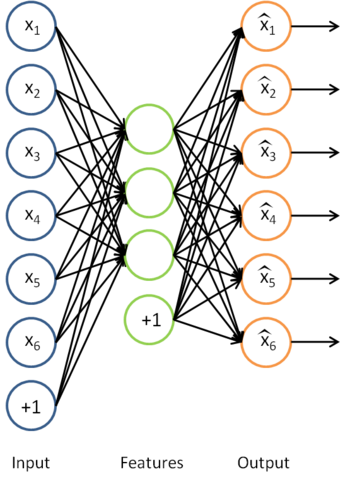
autoencoder可以在无标注数据集中学习特征,给定一个无标注的训练数据集 (下标
(下标  代表“不带类标”),首先进行预处理,比如pca或者白化,然后训练一个sparse autoencoder:
 '
'
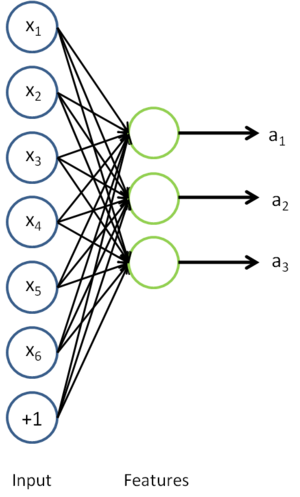
通过训练得到的模型参数  ,给定任意的输入数据
  ,可以计算隐藏单元的激活量(activations)
  。相比原始输入 来说, 可能是一个更好的特征描述。下图的神经网络描述了特征(激活量 )的计算:
对应之前所提到的,假定有  个 已标注训练集
  (下标
(下标  表示“带类标”),现在可以为输入数据找到更好的特征描述。将
  输入到稀疏自编码器,得到隐藏单元激活量
  。接下来,可以直接使用 来代替原始数据 (“替代表示”,Replacement Representation)。也可以合二为一,使用新的向量
  来代替原始数据 (“级联表示”,Concatenation Representation)。
经过变换后,训练集就变成  或者是
或者是 (取决于使用 替换 还是将二者合并)。在实践中,将 和 合并通常表现的更好。考虑到内存和计算的成本,也可以使用替换操作。
最终,可以训练出一个有监督学习算法(例如 svm, logistic regression 等),得到一个判别函数对  值进行预测。预测过程如下:给定一个测试样本
  ,重复之前的过程,将其送入稀疏自编码器,得到
  。然后将 (或者
  )送入分类器中,得到预测值。
从未标注训练集 中学习这一过程中可能计算了各种数据预处理参数。例如计算数据均值并且对数据做均值标准化(mean normalization);或者对原始数据做主成分分析(PCA),然后将原始数据表示为  (又或者使用 PCA 白化或 ZCA 白化)。这样的话,有必要将这些参数保存起来,并且在后面的训练和测试阶段使用同样的参数,以保证新来(测试)数据进入稀疏自编码神经网络之前经过了同样的变换。例如,如果对未标注数据集进行PCA预处理,就必须将得到的矩阵
  保存起来,并且应用到有标注训练集和测试集上;而不能使用有标注训练集重新估计出一个不同的矩阵 (也不能重新计算均值并做均值标准化),否则的话可能得到一个完全不一致的数据预处理操作,导致进入自编码器的数据分布迥异于训练自编码器时的数据分布。
有两种常见的无监督特征学习方式,区别在于有什么样的未标注数据。自学习(self-taught learning) 是其中更为一般的、更强大的学习方式,它不要求未标注数据  和已标注数据
  来自同样的分布。另外一种带限制性的方式也被称为半监督学习,它要求 和 服从同样的分布。下面通过例子解释二者的区别。
假定有一个计算机视觉方面的任务,目标是区分汽车和摩托车图像;也即训练样本里面要么是汽车的图像,要么是摩托车的图像。哪里可以获取大量的未标注数据呢?最简单的方式可能是从互联网上下载一些随机的图像数据集,在这些数据上训练出一个稀疏自编码器,从中得到有用的特征。这个例子里,未标注数据完全来自于一个和已标注数据不同的分布(未标注数据集中,或许其中一些图像包含汽车或者摩托车,但是不是所有的图像都如此)。这种情形被称为自学习。
相反,如果有大量的未标注图像数据,要么是汽车图像,要么是摩托车图像,仅仅是缺失了类标号(没有标注每张图片到底是汽车还是摩托车)。也可以用这些未标注数据来学习特征。这种方式,即要求未标注样本和带标注样本服从相同的分布,有时候被称为半监督学习。在实践中,常常无法找到满足这种要求的未标注数据(到哪里找到一个每张图像不是汽车就是摩托车,只是丢失了类标号的图像数据库?)因此,自学习在无标注数据集的特征学习中应用更广。
下面通过自学习的方法,整合sparse autoencoder 与 softmax regression 来构建一个手写数字的分类。
算法步骤:
1)把MNIST数据库的数据分为labeled(0-4) 与 unlabeled(5-9),并且把labeled data 分为 test data 与 train data,一半用来测试,一般用来训练
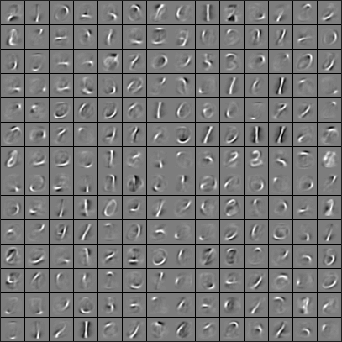
2)用unlabeled data (5-9)训练一个 sparse autoencoder,得到所有参数W(1) W(2) b(1) b(2) ,记做 θ ,展示第一层参数W(1),展示效果如下:
3)使用上面的sparse autoencoder 训练出来的W(1)对labeled data(0-4)训练得到其隐层输出a(2),这样不适用原来的像素值,而使用学到的特征来对0-4进行分类。
4)用上述学到的特征a(2)(i)代替原始输入x(i),现在的样本为{(a(1) ,y(1))(a(2) ,y(2))...(a(m) ,y(m))},用该样本来训练我们的softmax分类器。
5)用训练好的softmax进行预测,在labeled data 中的 test data 进行测试即可。准确率讲道理的话应该有98%以上。
一下是matlab代码。部分代码直接调用到之前章节的:
%% CS294A/CS294W Self-taught Learning Exercise

%  Instructions

%  ------------

%

%  This file contains code that helps you get started on the

%  self-taught learning. You will need to complete code in feedForwardAutoencoder.m

%  You will also need to have implemented sparseAutoencoderCost.m and

%  softmaxCost.m from previous exercises.

%

%% ======================================================================

%  STEP : Here we provide the relevant parameters values that will

%  allow your sparse autoencoder to get good filters; you do not need to

%  change the parameters below.

inputSize  =  * ;

numLabels  = ;

hiddenSize = ;

sparsityParam = .; % desired average activation of the hidden units.

                     % (This was denoted by the Greek alphabet rho, which looks like a lower-case "p",

                     %  in the lecture notes).

lambda = 3e-;       % weight decay parameter

beta = ;            % weight of sparsity penalty term

maxIter = ;

%% ======================================================================

%  STEP : Load data from the MNIST database

%

%  This loads our training and test data from the MNIST database files.

%  We have sorted the data for you in this so that you will not have to

%  change it.

% Load MNIST database files

mnistData   = loadMNISTImages('mnist/train-images-idx3-ubyte');

mnistLabels = loadMNISTLabels('mnist/train-labels-idx1-ubyte');

% Set Unlabeled Set (All Images)

% Simulate a Labeled and Unlabeled set

labeledSet   = find(mnistLabels >=  & mnistLabels <= );

unlabeledSet = find(mnistLabels >= );

%把labeled set分为训练数据 和 测试数据

numTrain = round(numel(labeledSet)/);

trainSet = labeledSet(:numTrain);

testSet  = labeledSet(numTrain+:end);

unlabeledData = mnistData(:, unlabeledSet);

trainData   = mnistData(:, trainSet);

trainLabels = mnistLabels(trainSet)' + 1; % Shift Labels 0-4 to the Range 1-5

testData   = mnistData(:, testSet);

testLabels = mnistLabels(testSet)' + ;   % Shift Labels 0-4 to the Range 1-5

% Output Some Statistics

fprintf('# examples in unlabeled set: %d\n', size(unlabeledData, ));

fprintf('# examples in supervised training set: %d\n\n', size(trainData, ));

fprintf('# examples in supervised testing set: %d\n\n', size(testData, ));

%% ======================================================================

%  STEP : Train the sparse autoencoder

%  This trains the sparse autoencoder on the unlabeled training

%  images.

%  Randomly initialize the parameters

theta = initializeParameters(hiddenSize, inputSize);

%% ----------------- YOUR CODE HERE ----------------------

%  Find opttheta by running the sparse autoencoder on

%  unlabeledTrainingImages

%theta 现再是以个展开的向量,对应[W1,W2,b1,b2]的长向量

opttheta = theta;

opttheta = theta;

addpath minFunc/

options.Method = 'lbfgs';

options.maxIter = ;

options.display = 'on';

[opttheta, loss] = minFunc( @(p) sparseAutoencoderLoss(p, ...

      inputSize, hiddenSize, ...

      lambda, sparsityParam, ...

      beta, unlabeledData), ...

      theta, options);

%% -----------------------------------------------------

% Visualize weights,展示W1'(28*28 * 200的矩阵)

% 把该矩阵的每一列展示为一个28*28的图片,来看效果

W1 = reshape(opttheta(1:hiddenSize * inputSize), hiddenSize, inputSize);

display_network(W1');

%%======================================================================

%% STEP : Extract Features from the Supervised Dataset

%

%  You need to complete the code in feedForwardAutoencoder.m so that the

%  following command will extract features from the data.

trainFeatures = feedForwardAutoencoder(opttheta, hiddenSize, inputSize, ...

                                       trainData);

testFeatures = feedForwardAutoencoder(opttheta, hiddenSize, inputSize, ...

                                       testData);

%%======================================================================

%% STEP : Train the softmax classifier

softmaxModel = struct;

%  Use softmaxTrain.m from the previous exercise to train a multi-class

%  classifier.

%  Use lambda = 1e- for the weight regularization for softmax

% You need to compute softmaxModel using softmaxTrain on trainFeatures and

% trainLabels

lambda = 1e-;

inputSize = hiddenSize;

numClasses = numel(unique(trainLabels));%unique为找出向量中的非重复元素并进行排序

options.maxIter = ;

%注意这里的数据不是x^(i),而是a^().

softmaxModel = softmaxTrain(inputSize, numClasses, lambda, ...

                            trainFeatures, trainLabels, options);

%% -----------------------------------------------------

%%======================================================================

%% STEP : Testing

% Compute Predictions on the test set (testFeatures) using softmaxPredict

% and softmaxModel

[pred] = softmaxPredict(softmaxModel, testFeatures);

%% -----------------------------------------------------

% Classification Score

fprintf('Test Accuracy: %f%%\n', *mean(pred(:) == testLabels(:)));

% (note that we shift the labels by , so that digit  now corresponds to

%  label )

%

% Accuracy is the proportion of correctly classified images

% The results for our implementation was:

%

% Accuracy: .%

%

%

%%%%%%%%%%%%% 以下对应STEP ,%%%%%%%%%%%%%%

function [activation] = feedForwardAutoencoder(theta, hiddenSize, visibleSize, data)

% theta: trained weights from the autoencoder

% visibleSize: the number of input units (probably )

% hiddenSize: the number of hidden units (probably )

% data: Our matrix containing the training data as columns.  So, data(:,i) is the i-th training example.

% We first convert theta to the (W1, W2, b1, b2) matrix/vector format, so that this

% follows the notation convention of the lecture notes.

W1 = reshape(theta(:hiddenSize*visibleSize), hiddenSize, visibleSize);

b1 = theta(*hiddenSize*visibleSize+:*hiddenSize*visibleSize+hiddenSize);

%% ---------- YOUR CODE HERE --------------------------------------

%  Instructions: Compute the activation of the hidden layer for the Sparse Autoencoder.

%计算隐层输出a^()

activation  = sigmoid(W1*data+repmat(b1,[,size(data,)]));

%-------------------------------------------------------------------

end

%-------------------------------------------------------------------

% Here's an implementation of the sigmoid function, which you may find useful

% in your computation of the costs and the gradients.  This inputs a (row or

% column) vector (say (z1, z2, z3)) and returns (f(z1), f(z2), f(z3)).

function sigm = sigmoid(x)

    sigm = 1 ./ (1 + exp(-x));

end
CS229 6.11 Neurons Networks implements of self-taught learning的更多相关文章
- CS229 6.10 Neurons Networks implements of softmax regression
softmax可以看做只有输入和输出的Neurons Networks,如下图: 其参数数量为k*(n+1) ,但在本实现中没有加入截距项,所以参数为k*n的矩阵. 对损失函数J(θ)的形式有: 算法 ...
- (六)6.11 Neurons Networks implements of self-taught learning
在machine learning领域,更多的数据往往强于更优秀的算法,然而现实中的情况是一般人无法获取大量的已标注数据,这时候可以通过无监督方法获取大量的未标注数据,自学习( self-taught ...
- CS229 6.13 Neurons Networks Implements of stack autoencoder
对于加深网络层数带来的问题,(gradient diffuse 局部最优等)可以使用逐层预训练(pre-training)的方法来避免 Stack-Autoencoder是一种逐层贪婪(Greedy ...
- CS229 6.8 Neurons Networks implements of PCA ZCA and whitening
PCA 给定一组二维数据,每列十一组样本,共45个样本点 -6.7644914e-01 -6.3089308e-01 -4.8915202e-01 ... -4.4722050e-01 -7.4 ...
- CS229 6.5 Neurons Networks Implements of Sparse Autoencoder
sparse autoencoder的一个实例练习,这个例子所要实现的内容大概如下:从给定的很多张自然图片中截取出大小为8*8的小patches图片共10000张,现在需要用sparse autoen ...
- (六)6.10 Neurons Networks implements of softmax regression
softmax可以看做只有输入和输出的Neurons Networks,如下图: 其参数数量为k*(n+1) ,但在本实现中没有加入截距项,所以参数为k*n的矩阵. 对损失函数J(θ)的形式有: 算法 ...
- CS229 6.1 Neurons Networks Representation
面对复杂的非线性可分的样本是,使用浅层分类器如Logistic等需要对样本进行复杂的映射,使得样本在映射后的空间是线性可分的,但在原始空间,分类边界可能是复杂的曲线.比如下图的样本只是在2维情形下的示 ...
- CS229 6.16 Neurons Networks linear decoders and its implements
Sparse AutoEncoder是一个三层结构的网络,分别为输入输出与隐层,前边自编码器的描述可知,神经网络中的神经元都采用相同的激励函数,Linear Decoders 修改了自编码器的定义,对 ...
- CS229 6.17 Neurons Networks convolutional neural network(cnn)
之前所讲的图像处理都是小 patchs ,比如28*28或者36*36之类,考虑如下情形,对于一副1000*1000的图像,即106,当隐层也有106节点时,那么W(1)的数量将达到1012级别,为了 ...
随机推荐
- 时间标准基础知识UTC和ISO8601
过去世界各地原本各自订定当地时间,但随着交通和电讯的发达,各地交流日益频繁,不同的地方时间,造成许多困扰,于是在西元1884年的国际会议上制定了全球性的标准时,明定以英国伦敦格林威治这个地方为零度经线 ...
- tomcat中配置https
HTTPS配置中分为单向连接和双向连接,单向连接只需要服务器安装证书,客户端不需要,双向连接需要服务器和客户端都安装证书: 一.Keytool命令: 1.生成密钥对: keytool -genkey ...
- dva 知识点
dva中,路由模式从hashHistory换成 browserHistory: dva-cli创建的项目中,src/index.js相应部分修改如下: import browserHistory fr ...
- mysql 5.45 以后需要 需要 安全套接字问题
错误异常:According to MySQL 5.5.45+, 5.6.26+ and 5.7.6+ requirements SSL connection must be established ...
- docker 容器时间跟宿主机时间同步
docker 容器时间跟宿主机时间同步 docker cp /etc/localtime 87986863838b:/etc/docker cp /etc/localtime container-na ...
- CentOS6.5系统下RPM包安装MySQL5.6(转)
1.查看操作系统相关信息. [root@linuxidc ~]# cat /etc/issue CentOS release 6.5 (Final) Kernel \r on an \m [root@ ...
- LOJ 2587 「APIO2018」铁人两项——圆方树
题目:https://loj.ac/problem/2587 先写了 47 分暴力. 对于 n<=50 的部分, n3 枚举三个点,把图的圆方树建出来,合法条件是 c 是 s -> f 路 ...
- Tensorflow安装环境更新
本博文是对前面两篇tensorflow的博文的一个继续,对环境的更新. 基于tensorflow的MNIST手写识别 安装tensorflow,那叫一个坑啊 主要出发点: 上述两篇博文的程序运行的环境 ...
- IIS webService 并发 性能
IIS webService 并发 性能 做的WebService,客户压力测试500并发(随机步长60s-90s),响应速度不理想. 1,优化程序,压缩执行时间2,提高IIS“最大工作进程数 ...
- 运动目标检测中基于HSV空间的阴影去除算法
在运动目标检测中,常常会出现由于光线被遮挡,或场景其他物体的遮挡,在目标附近或场景里出现阴影,阴影的出现对后期目标的正确分割与处理带了很大的不便.如今,国内外已有不少文献来研究这个问题,并且提出了各种 ...