
deep learning自学知识积累笔记
推荐系统的演变过程
协同过滤(英雄所见略同)思想为类似喜好的人的选择必然也类似。比如小学男生普遍喜欢打手游,中年大叔普遍喜欢射雕英雄传
随后有了SVD奇异值分解,但是SVD要求不能太稀疏,因此有了隐语意模型
隐语意模型的推荐系统
https://www.jianshu.com/p/7b6bb28c1753
核心思想是将user-item ranking矩阵通过隐含的类别向量分解为user-class, class-item矩阵的乘积。
定义损失函数,使用梯度下降法,将P,Q两个矩阵求解出来,后续的推荐就基于$P_I \times Q$获得第i个用户对所有item的评分(兴趣)情况,排序后就可以做出推荐
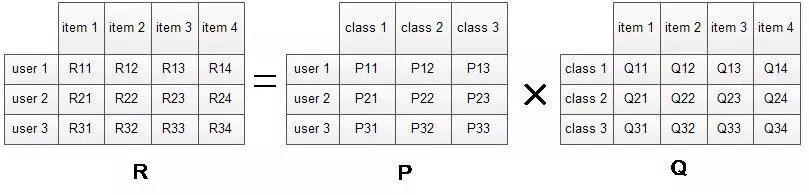
早前的奇异值分解SVD理论:
假设矩阵M是一个m*n的矩阵,则一定存在一个分解 ,其中U是m*m的正交矩阵,V是n*n的正交矩阵,Σ是m*n的对角阵,可以说是完美契合分解评分矩阵这个需求。但是奇异值分解要求矩阵是稠密的,但现实中往往无法满足这个要求。
https://zhuanlan.zhihu.com/p/34497989
PCA降维的本质
比如30*1000000直接就降到了30*29,这不是减少的数据有点太多了么,会不会对性能造成影响。之所以有这个迷惑,是因为最初并不了解pca的工作方式.pca并不是直接对原来的数据进行删减,而是把原来的数据映射到新的一个特征空间中继续表示,所有新的特征空间如果有29维.那么这29维足以能够表示非常非常多的数据,并没有对原来的数据进行删减,只是把原来的数据映射到新的空间中进行表示,所以你的测试样本也要同样的映射到这个空间中进行表示,这样就要求你保存住这个空间坐标转换矩阵,把测试样本同样的转换到相同的坐标空间中。
https://blog.csdn.net/watkinsong/article/details/8234766
Embedding原理
https://blog.csdn.net/laolu1573/article/details/77170407
应用中一般将物体嵌入到一个低维空间 ,只需要再compose上一个从
到
的线性映射就好了。每一个
的矩阵
都定义了
到
的一个线性映射:
。当
是一个标准基向量的时候,
对应矩阵
中的一列,这就是对应id的向量表示。这个概念用神经网络图来表示如下:
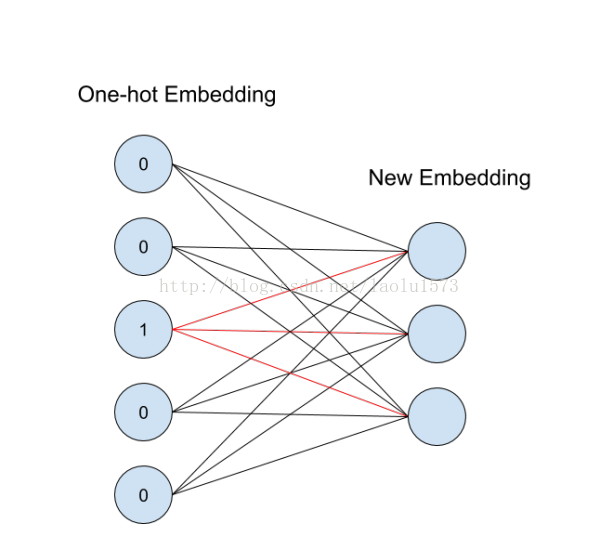

从id(索引)找到对应的One-hot encoding,然后红色的weight就直接对应了输出节点的值(注意这里没有activation function),也就是对应的embedding向量。
One-hot型的矩阵相乘,可以简化为查表操作,这大大降低了运算量。
tf.nn.embedding_lookup:
tf.nn.embedding_lookup()就是根据input_ids中的id,寻找embeddings中的第ids行。比如input_ids=[1,3,5],则找出embeddings中第1,3,5行,组成一个tensor返回。
embedding_lookup不是简单的查表,id对应的向量是可以训练的,训练参数个数应该是 category num*embedding size,也就是说lookup是一种全连接层。

Concisely, it gets the corresponding rows of a embedding layer, specified by a list of IDs and provide that as a tensor. It is achieved through the following process.
- Define a placeholder
lookup_ids = tf.placeholder([10]) - Define a embedding layer
embeddings = tf.Variable([100,10],...) - Define the tensorflow operation
embed_lookup = tf.embedding_lookup(embeddings, lookup_ids) - Get the results by running
lookup = session.run(embed_lookup, feed_dict={lookup_ids:[95,4,14]})
#!/usr/bin/env/python

# coding=utf-8

import tensorflow as tf

import numpy as np

# 定义一个未知变量input_ids用于存储索引

input_ids = tf.placeholder(dtype=tf.int32, shape=[None])

# 定义一个已知变量embedding,是一个5*5的对角矩阵

# embedding = tf.Variable(np.identity(5, dtype=np.int32))

# 或者随机一个矩阵

embedding = a = np.asarray([[0.1, 0.2, 0.3], [1.1, 1.2, 1.3], [2.1, 2.2, 2.3], [3.1, 3.2, 3.3], [4.1, 4.2, 4.3]])

# 根据input_ids中的id,查找embedding中对应的元素

input_embedding = tf.nn.embedding_lookup(embedding, input_ids)

sess = tf.InteractiveSession()

sess.run(tf.global_variables_initializer())

# print(embedding.eval())

print(sess.run(input_embedding, feed_dict={input_ids: [1, 2, 3, 0, 3, 2, 1]}))
tensorflow: what it is
tensorflow is:
1. open source software library for numerical computation using data flow graphs
2. originally developed by google brain team to conduct machine learning research
3. tensorflow is an interface for expressing maching learning algorithms, and an implementation for executing such algorithms.
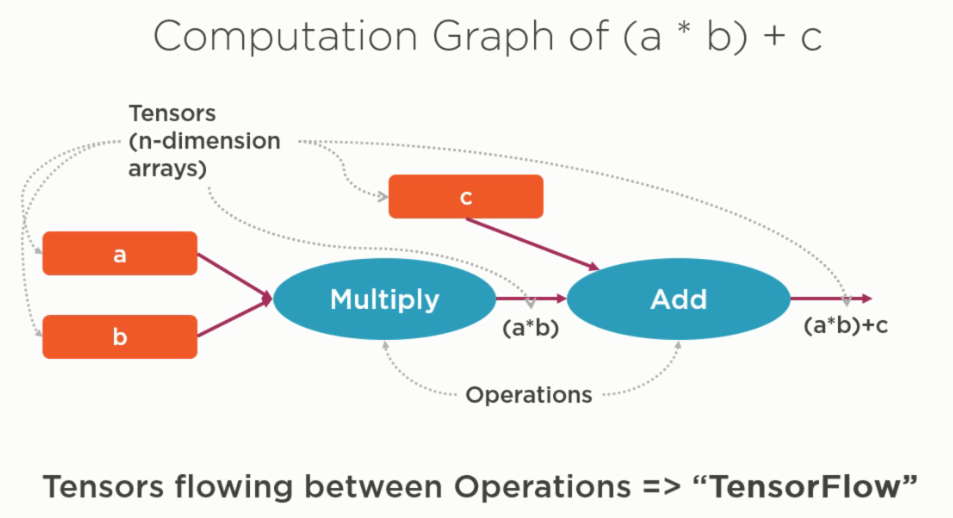
最重要的思想:将数值计算通过graph来表达,在graph中:
operation:
计算图中的节点node被称为operation,他可以有多个inputs(tensor),一个output(tensor).
也可以将op理解为一个可以视为计算图中可以被evaluated value的function
tensor
node之间的edge连接被称为tensor,tensor在node之间流动。从代码角度讲,tensor就是n-dimensional array
tensorflow programming model
import tensorflow as tf

import numpy as np

b = tf.Variable(tf.zeros((100,)),name='b')

W = tf.Variable(tf.random_uniform((784,100),-1,1),name='W')

x = tf.placeholder(tf.float32,(100,784),name='x')

h = tf.nn.relu(tf.matmul(x,W)+b,name='hRelu')

print(tf.get_default_graph().get_operations())

# [

# <tf.Operation 'zeros' type=Const>,

# <tf.Operation 'b' type=VariableV2>,

# <tf.Operation 'b/Assign' type=Assign>,

# <tf.Operation 'b/read' type=Identity>,

# <tf.Operation 'random_uniform/shape' type=Const>,

# <tf.Operation 'random_uniform/min' type=Const>,

# <tf.Operation 'random_uniform/max' type=Const>,

# <tf.Operation 'random_uniform/RandomUniform' type=RandomUniform>,

# <tf.Operation 'random_uniform/sub' type=Sub>,

# <tf.Operation 'random_uniform/mul' type=Mul>,

# <tf.Operation 'random_uniform' type=Add>,

# <tf.Operation 'W' type=VariableV2>,

# <tf.Operation 'W/Assign' type=Assign>,

# <tf.Operation 'W/read' type=Identity>,

# <tf.Operation 'x' type=Placeholder>,

# <tf.Operation 'MatMul' type=MatMul>,

# <tf.Operation 'add' type=Add>,

# <tf.Operation 'hRelu' type=Relu>

# ]

print(tf.get_default_graph().get_all_collection_keys())

# ['variables', 'trainable_variables']

print(tf.get_default_graph().get_name_scope())

print(tf.get_default_graph().get_tensor_by_name('W:0'))

# Tensor("W:0", shape=(784, 100), dtype=float32_ref)

sess = tf.Session()

sess.run(tf.global_variables_initializer())
# run global init op to initialize tf.Variable so that we can go!
# 需要注意的是Variable必须被初始化,因为这是tf的lazy evaluate机制,变量是有状态的,只有初始化了他们我们才能继续计算graph

hValue = sess.run(h,{x: np.random.random((100,784))})

print(h)

# Tensor("hRelu:0", shape=(100, 100), dtype=float32)

print(hValue)

#[[ 3.706625    0.          0.         ...  0.          5.529948

#   18.503458  ]

#[ 0.          0.          0.         ...  0.          6.702546

#20.58909   ]]
需要注意的是h这个python变量引用了最后一个Relu的op(node)! 有的时候并不需要一定使用类似tf_add,tf_multiply这样的函数调用,我们可以直接使用 +, - , *等基本的python运算操作符,而只要其中一个操作数为tensor,则结果也将是一个tensor,比如aTensor+b = c =>则c也是一个tensor。
session.run将返回一个numpy array
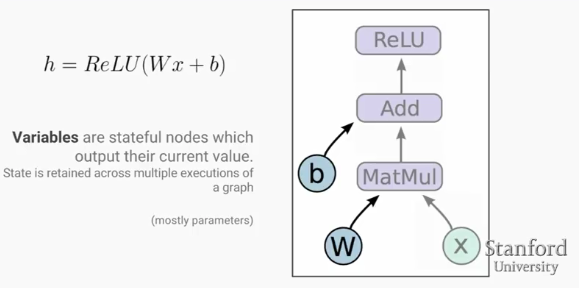
如上图所示,在深度学习中基本计算模块Relu(wx+b)映射到tensorflow计算图中,w和b为Variable,x则是placeholder,将来从外输入值作为x的值。
图中除了线以外都是operation,因此都可以evaluate其value.
Variable是stateful node,他们保持其值在一系列计算过程中,并且默认地会由优化算法在反向传播后来更新他们的值。variable的值可以方便地在训练中或者训练后被存储到disk或者从disk中恢复其快照值。variable就是你的网络中希望训练出来的参数!
Placeholder是那些value可以在执行时execution time被fed的nodes节点(op).他们在计算图定义时没有初始值,但是需要定义其datatype,其shape。
Mathematical Operation:
MatMul, Add, Relu都是数学计算op,他们可以是builtin的,可以是你自己定义的函数
tensorflow architecture: language interface and execution environment
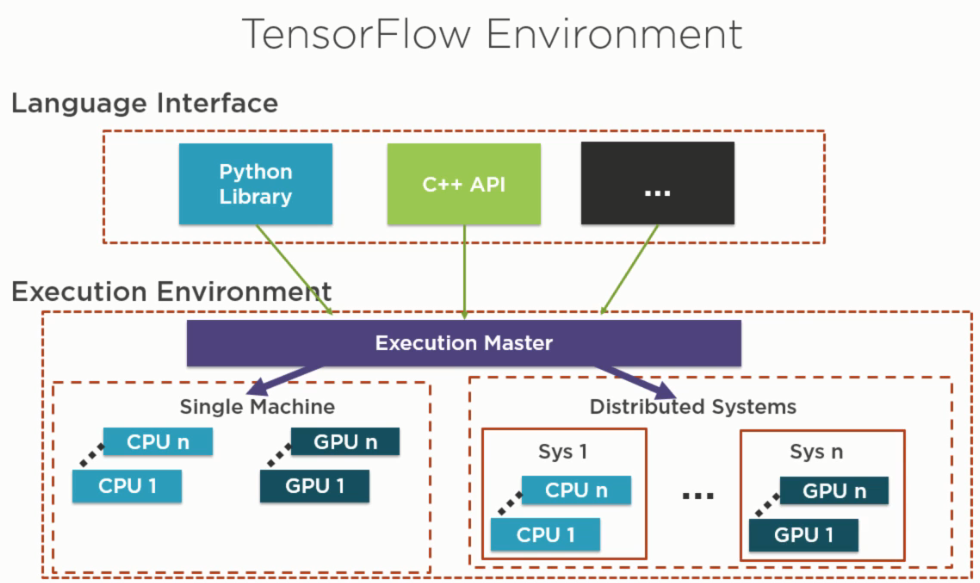
我們可以使用python, c++等语言通过计算图来定义model,随后将graph deploy到一个Session(指定了CPU或者GPU的硬件执行环境)执行环境下训练和预测.
首先定义计算图(compution graph),随后使用一个session来计算graph中的operation
tensor, operations
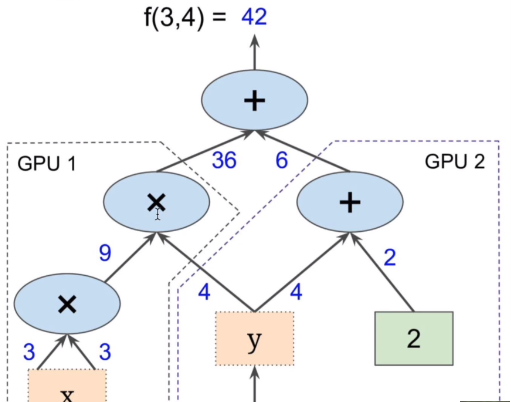
tensorflow计算时分布于不同gpu
tensorboard检查gradientDecent更新房价参数
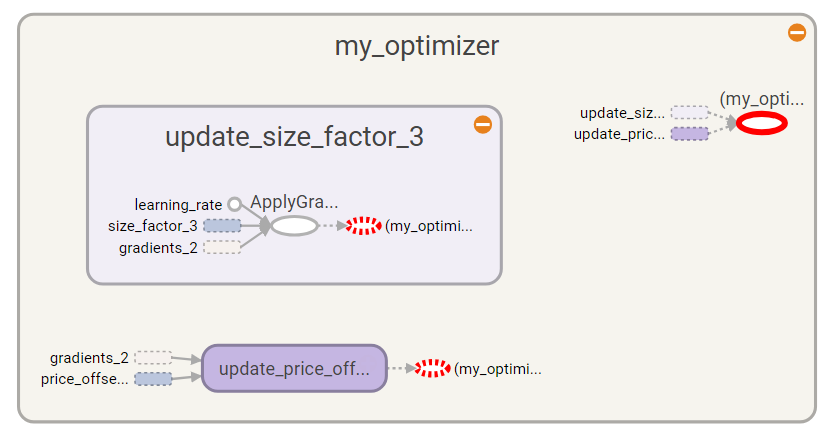
上图中ApplyGradientDecent为一个Operation,my_optimizer是一个含有3个nodes的subGraph,也可以sess.run他
tf_price_pred为一个Add的op,tf_cost_op为一个Sum的op
tf_price_pred = tf.add(tf.multiply(tf_size_factor, tf_house_size), tf_price_offset,name="tf_price_pred")

# 3. Define the Loss Function (how much error) - Mean squared error

tf_cost = tf.reduce_sum(tf.pow(tf_price_pred-tf_price, 2),name="tf_cost_op")/(2*num_train_samples)

optimizer = tf.train.GradientDescentOptimizer(learning_rate,name="my_optimizer").minimize(tf_cost)

            sess.run(optimizer, feed_dict={tf_house_size: x, tf_price: y})
程序和计算图示例:
import tensorflow as tf

a = tf.constant(2,name="a")

b = tf.constant(2,name="b")

x = tf.add(a,b,name="x")

y = tf.multiply(x, 3,name="y")

z = tf.pow(y,3,name="z")

with tf.Session() as sess:

    writer = tf.summary.FileWriter("./graphs2",sess.graph)

    print(sess.run(z))

    writer.close()

# 输出1728
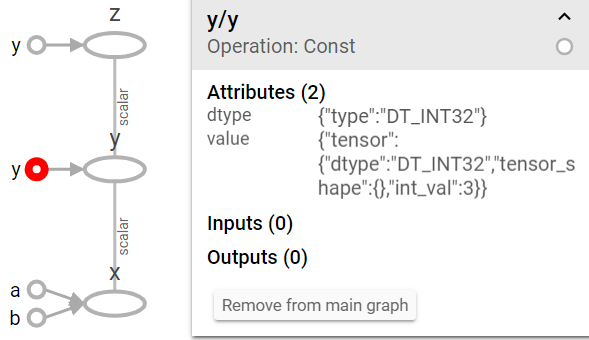
上图中左面的y是tensorflow自动对所有常量数据,比如2,2,3上面的数字自动起名为y(op为Constant),和我们给的x,y,z op是不同的。
x = Add
y = Mul
z = Pow
三个分别为对应的Add, Mul,Pow Operation
当tensorflow session run返回一个tensor时,其value就是一个numpy ndarray
constants stored in the graph defination
tf.constant is an op, tf.Variable is a class and holds serveral ops
import tensorflow as tf

x = tf.Variable(...)

x.initializer # init op

x.assign(...) # write op

x.value() #read op

x.assign_add(...)
variable在使用之前必须用tf.global_variable_initializer来做初始化
使用tf实现lr的计算图
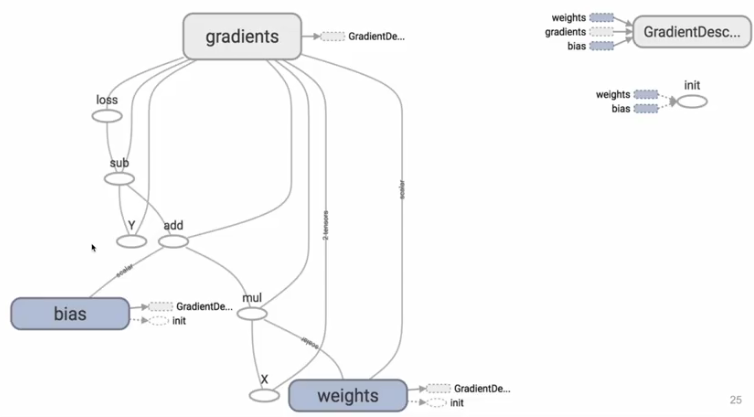
GradientDecent optimizer依赖于weight,bias以及gradients(从optimizer的loss输入查找到对应的依赖!),而gradients这个是tensorflow默认自带的tensor,由tensorflow自己想办法找到导数的计算方法的
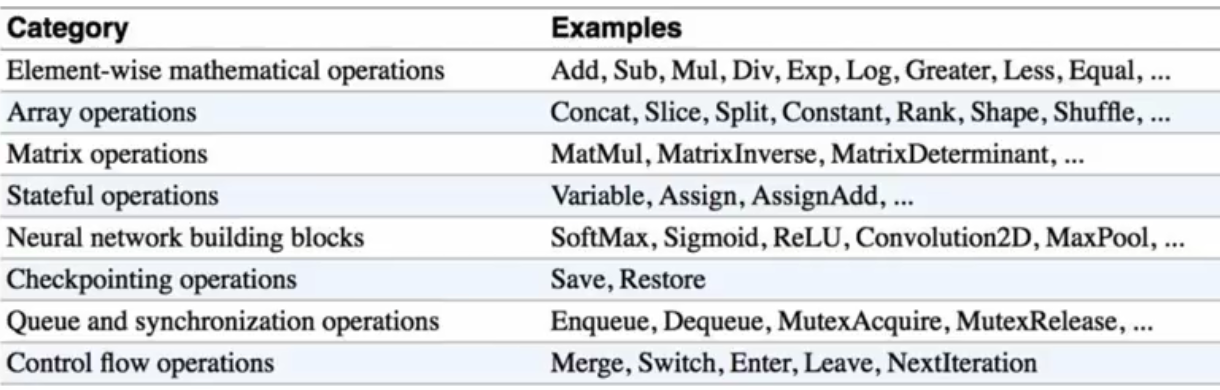
OPs
tensorflow的优化算法又是如何知道应该训练哪些参数的呢?
我们知道tf在训练模型时,核心是使用优化器,比如gradient Decent算法来优化损失函数。但是问题是tf怎么知道sgd在迭代过程中要更新哪些参数呢?
答案就是Variable的Trainable属性为true的变量。所有这些变量都是loss函数所依赖的!
LR自定义huber loss函数对异常值不敏感方案
简单线性回归中,由于使用MSE作为loss的话,对于异常值是比较敏感的,我们可以自己定义loss函数改进相应的机制,比如以下算法
def huber_loss(labels, predictions, delta=1.0):

    residual = tf.abs(predictions - labels)

    condition = tf.less(residual, delta)

    small_res = 0.5 * tf.square(residual)

    large_res = delta * residual - 0.5 * tf.square(delta)

    return tf.select(condition, small_res, large_res)
需要注意的是,我们仅仅通过定义这个loss函数,也就是定义了forward path的计算方法,而不用明确指出其反向求导,因为tensorflow会自动通过该函数定义中的不同op通过链式法则自动求解对应的导数。

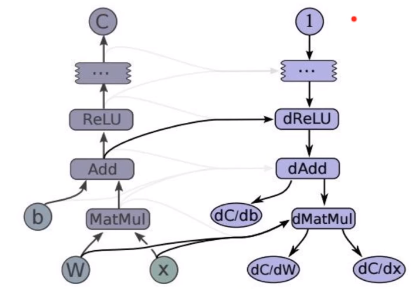
tf.gradients求解任意导数
import tensorflow as tf

# sess = tf.InteractiveSession()

x = tf.Variable(2.0)

y = 2.0* (x ** 3)

z = 3.0+y**2

grad_z = tf.gradients(z,[x,y])

with tf.Session() as sess:

    sess.run(x.initializer)

    print(sess.run(grad_z))
tensorflow典型loop

https://jizhi.im/blog/post/gpu-p2
deep learning自学知识积累笔记的更多相关文章
- Deep learning with Python 学习笔记(11)
总结 机器学习(machine learning)是人工智能的一个特殊子领域,其目标是仅靠观察训练数据来自动开发程序[即模型(model)].将数据转换为程序的这个过程叫作学习(learning) 深 ...
- Deep learning with Python 学习笔记(8)
Keras 函数式编程 利用 Keras 函数式 API,你可以构建类图(graph-like)模型.在不同的输入之间共享某一层,并且还可以像使用 Python 函数一样使用 Keras 模型.Ker ...
- Deep learning with Python 学习笔记(1)
深度学习基础 Python 的 Keras 库来学习手写数字分类,将手写数字的灰度图像(28 像素 ×28 像素)划分到 10 个类别 中(0~9) 神经网络的核心组件是层(layer),它是一种数据 ...
- Deep learning with Python 学习笔记(10)
生成式深度学习 机器学习模型能够对图像.音乐和故事的统计潜在空间(latent space)进行学习,然后从这个空间中采样(sample),创造出与模型在训练数据中所见到的艺术作品具有相似特征的新作品 ...
- Deep learning with Python 学习笔记(9)
神经网络模型的优化 使用 Keras 回调函数 使用 model.fit()或 model.fit_generator() 在一个大型数据集上启动数十轮的训练,有点类似于扔一架纸飞机,一开始给它一点推 ...
- Deep learning with Python 学习笔记(7)
介绍一维卷积神经网络 卷积神经网络能够进行卷积运算,从局部输入图块中提取特征,并能够将表示模块化,同时可以高效地利用数据.这些性质让卷积神经网络在计算机视觉领域表现优异,同样也让它对序列处理特别有效. ...
- Deep learning with Python 学习笔记(6)
本节介绍循环神经网络及其优化 循环神经网络(RNN,recurrent neural network)处理序列的方式是,遍历所有序列元素,并保存一个状态(state),其中包含与已查看内容相关的信息. ...
- Deep learning with Python 学习笔记(5)
本节讲深度学习用于文本和序列 用于处理序列的两种基本的深度学习算法分别是循环神经网络(recurrent neural network)和一维卷积神经网络(1D convnet) 与其他所有神经网络一 ...
- Deep learning with Python 学习笔记(4)
本节讲卷积神经网络的可视化 三种方法 可视化卷积神经网络的中间输出(中间激活) 有助于理解卷积神经网络连续的层如何对输入进行变换,也有助于初步了解卷积神经网络每个过滤器的含义 可视化卷积神经网络的过滤 ...
随机推荐
- Git学习系列之CentOS上安装Git详细步骤(图文详解)
前言 最早Git是在Linux上开发的,很长一段时间内,Git也只能在Linux和Unix系统上跑.不过,慢慢地有人把它移植到了Windows上.现在,Git可以在Linux.Unix.Mac和Win ...
- CentOS 6.5 网络服务器功能的实现①:运用bind搭建基本的DNS服务器
何谓DNS服务?简而言之,DNS服务在互联网中可以实现域名解析(把域名转换成网络可以识别的IP地址). 名词解释①:正向解析:域名解析IP地址:反向解析:IP地址解析域名. DNS服务的正/反向区域解 ...
- rabbitmq 部署(二进制和rpm)与常用命令
目录 一 rabbitmq 简介 二 erlang 安装 三 rabbitmq rpm安装 (二进制安装和rpm安装二选一) 四 rabbitmq 二进制安装(rpm 安装和二进制安装二选一) 五 初 ...
- 2016-06-14 发布 解决Centos7初次开机提示Initial setup of CentOS Linux 7 (core)
安装完成centos7后出现如下提示: Initial setup of CentOS Linux 7 (core) 1) [x] Creat user 2) [!] License informat ...
- linux 初始化工作环境
#!/bin/sh # # init workspace # /bin/svnserve -d -r /home/oracle/projects --listen-port= su - oracle ...
- 我眼中的优秀技术leader
在这家公司工作的四年时间里,我一共接触过两个在技术团队里有很大影响力的leader.本文将基于我在工作中对他们的观察,总结一下他们身上所具有的特质,以作为自己学习的榜样.标题中的“我眼中的”,不仅表示 ...
- SQL Server T—SQL 学生选课数据库SQL语句考试题(45道题)
题目 设有一数据库,包括四个表:学生表(Student).课程表(Course).成绩表(Score)以及教师信息表(Teacher).四个表的结构分别如表1-1的表(一)~表(四)所示,数据如表1 ...
- Android---TextView实现图文混排一
TextView使用ImageSpan显示图片 SpannableStringBuilder spannableStringBuilder = new SpannableStringBuilder() ...
- Java四中引用
在JDK1.2以后将对象应用分为4中,强引用,软引用,弱引用,虚引用,这样的方式可以更加灵活控制对象的声明周期 强引用 String str = "123"; ...
- Lucene 学习-安装 Kibana 视图界面
Kibana 是一个开源的分析与可视化平台,设计出来用于和 Elasticsearch 一起使用的. 你可以使用 Kibana 搜索.查看.交互存放在 Elasticsearch 索引里的数据.使用各 ...