
jQuery控制网页字体大小和肤色
在一些网站上经常看到有控制网页肤色和字体大小的功能,接下来,我们将用两个例子来实现这两个功能。
网页字体大小
首先我们在网页中添加一些被控制大小的文字和字体控制的按钮。
<!DOCTYPE>

<html>

<head>

<meta http-equiv="Content-Type" content="text/html; charset=utf-8" />

<title></title>

 <script src="../scripts/jquery-1.3.1.js" type="text/javascript"></script>

</head>

<body>

<div class="msg">

    <div class="msg_caption">

        <span class="bigger" >放大</span>

        <span class="smaller" >缩小</span>

        <span >20</span>

        <span >18</span>

        <span >16</span>

    </div>

    <div>

        <p id="para">

        This is some text. This is some text. This is some text. This is some text. This

        is some text. This is some text. This is some text. This is some text. This is some

        text. This is some text. This is some text. This is some text. This is some text.

        This is some text. This is some text. This is some text. This is some text. This

        is some text. This is some text.

        </p>

    </div>

</div>

</body>

</html>
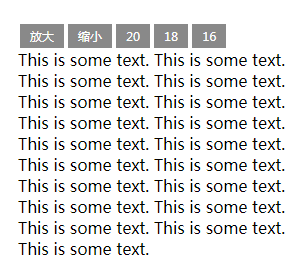
有两种控制字体大小的方式:在当前字体大小的基础上放大或缩小,直接选择字号进行控制。
首先是第一种,需要获取当前文字的字体大小,获取的值是带单位的数值,我们在进行放大缩小操作时,需要进行加减运算,所以需要用parseInt()方法去掉单位再进行运算,运算后的值需要加上单位后再赋值给需要控制的文字,但是需要注意的是,无限放大和缩小并不合适,所以在操作时,需要给一个最大和最小字体。
第二种方式就比较简单了,直接通过点击获取字体大小的数值,然后加上单位就可以进行赋值添加样式了。
<script type="text/javascript">

    $(function(){

        $("span").click(function(){

            var thisEle = $("#para").css("font-size");

            var textFontSize = parseFloat(thisEle , 10);

            var unit = thisEle.slice(-2); //获取单位

            var cName = $(this).attr("class");

            if(cName == "bigger"){

                   if( textFontSize <= 22 ){

                        textFontSize += 2;

                    }

            }else if(cName == "smaller"){

                   if( textFontSize >= 12  ){

                        textFontSize -= 2;

                    }

            }else{

                textFontSize = $(this).text();

            }

            $("#para").css("font-size",  textFontSize + unit);

        });

    });

  </script>
2,网页换肤
网页换肤的原理是通过调用不同的样式表文件来实现不同皮肤的切换,并且需要将换好的皮肤记入Cookie中,这样用户下次访问时,就可以显示用户自定义的皮肤了。
首先设置HTML结构:
<!DOCTYPE>

<html>

<head>

    <title></title>

    <meta http-equiv="Content-Type" content="text/html; charset=utf-8" />

    <link href="css/default.css" rel="stylesheet" type="text/css" />

    <script src="../scripts/jquery-1.3.1.js" type="text/javascript"></script>

</head>

<body>

    <ul id="skin">

        <li id="skin_0" title="灰色" class="selected">灰色</li>

        <li id="skin_1" title="紫色">紫色</li>

        <li id="skin_2" title="红色">红色</li>

        <li id="skin_3" title="天蓝色">天蓝色</li>

        <li id="skin_4" title="橙色">橙色</li>

        <li id="skin_5" title="淡绿色">淡绿色</li>

    </ul>

    <div id="div_side_0">

        <div id="news">

            <h1 class="title">时事新闻</h1>

        </div>

    </div>

    <div id="div_side_1">

        <div id="game">

            <h1 class="title">娱乐新闻</h1>

        </div>

    </div>

</body>

</html>
其中基础样式为:
*{

    margin:0px;

    padding:0px;

}

body {

    font-family: Verdana, Arial, Helvetica, sans-serif;

    font-size: 12px;

}

#div_side_0,#div_side_1

{

    float:left;

    width:120px;

    height:450px;

    }

#skin

{

    margin:10px;

    padding:5px;

    width:210px;

    padding-right:0px;

    list-style:none;

    border: 1px solid #CCCCCC;

    overflow:hidden;

    }

#skin li{

    float:left;

    margin-right:5px;

    width:15px;

    height:15px;

    text-indent:-999px;

    overflow:hidden;

    display:block;

    cursor:pointer;

    background-image:url(theme.gif);

}

#skin_0{

    background-position:0px 0px;

}

#skin_1{

    background-position:15px 0px;

}

#skin_2{

    background-position:35px 0px;

}

#skin_3{

    background-position:55px 0px;

}

#skin_4{

    background-position:75px 0px;

}

#skin_5{

    background-position:95px 0px;

}

#skin_0.selected{

    background-position:0px 15px !important;

}

#skin_1.selected{

    background-position:15px 15px !important;

}

#skin_2.selected{

    background-position:35px 15px !important;

}

#skin_3.selected{

    background-position:55px 15px !important;

}

#skin_4.selected{

    background-position:75px 15px !important;

}

#skin_5.selected{

    background-position:95px 15px !important;

}

.title

{

    cursor:pointer;}

h1{

   margin:10px;

   padding:10px 20px;

   width:60px;

   color:#ffffff;

   font-size:14px;

}

a:link {

    text-decoration: none;

    color: #333333;

}

a:visited {

    color: #333333;

    text-decoration: none;

}

a:hover {

    color: #000000;

    text-decoration: underline;

}
然后根据HTML代码预定义几套换肤用的样式,分别有灰色、紫色、红色等,在本次的实例中为了简化,只是进行简单的背景替换,所以在这些样式文件中只有对于的背景颜色:
在初始化的时候,默认选择灰色,后期将通过更改样式表链接来更换颜色,所以,我们需要为添加背景色的样式表链接添加一个id,方便后期修改。
<link href="css/skin_0.css" rel="stylesheet" type="text/css" id="cssfile" />
网页的初始化效果如下: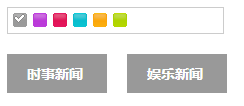
接下来,将通过点击皮肤选择按钮来实现换肤。
首先,选中颜色后,为当前点击的元素添加选中样式。
var $li =$("#skin li");

$li.click(function(){

      $("#"+this.id).addClass("selected")

              .siblings().removeClass("selected");

})
其次,设置网页的皮肤颜色。
$(function(){

    var $li =$("#skin li");

    $li.click(function(){

          $("#"+this.id).addClass("selected")

                 .siblings().removeClass("selected");

          $("#cssfile").attr("href","css/"+this.id+".css");

    })

})
此时,简易版的换肤就实现了,但是,当用户刷新网页或者关闭浏览器后,皮肤又会被初始化,因此,我们需要将当前选择的皮肤进行保存。
这里,我们需要进入jQuery的cookie插件
jQuery.cookie = function(name, value, options) {

    if (typeof value != 'undefined') { // name and value given, set cookie

        options = options || {};

        if (value === null) {

            value = '';

            options.expires = -1;

        }

        var expires = '';

        if (options.expires && (typeof options.expires == 'number' || options.expires.toUTCString)) {

            var date;

            if (typeof options.expires == 'number') {

                date = new Date();

                date.setTime(date.getTime() + (options.expires * 24 * 60 * 60 * 1000));

            } else {

                date = options.expires;

            }

            expires = '; expires=' + date.toUTCString(); // use expires attribute, max-age is not supported by IE

        }

        // CAUTION: Needed to parenthesize options.path and options.domain

        // in the following expressions, otherwise they evaluate to undefined

        // in the packed version for some reason...

        var path = options.path ? '; path=' + (options.path) : '';

        var domain = options.domain ? '; domain=' + (options.domain) : '';

        var secure = options.secure ? '; secure' : '';

        document.cookie = [name, '=', encodeURIComponent(value), expires, path, domain, secure].join('');

    } else { // only name given, get cookie

        var cookieValue = null;

        if (document.cookie && document.cookie != '') {

            var cookies = document.cookie.split(';');

            for (var i = 0; i < cookies.length; i++) {

                var cookie = jQuery.trim(cookies[i]);

                // Does this cookie string begin with the name we want?

                if (cookie.substring(0, name.length + 1) == (name + '=')) {

                    cookieValue = decodeURIComponent(cookie.substring(name.length + 1));

                    break;

                }

            }

        }

        return cookieValue;

    }

};
然后将当前的皮肤保存进cookie,保存后,就可以通过cookie来获取当前的皮肤了,如果cookie存在,则将当前皮肤设置为cookie记录的值,这样,当用户刷新网页后,仍然是当前选择的皮肤。
完整代码如下:
<!DOCTYPE>

<html>

<head>

    <title></title>

    <meta http-equiv="Content-Type" content="text/html; charset=utf-8" />

    <link href="css/default.css" rel="stylesheet" type="text/css" />

    <link href="css/skin_0.css" rel="stylesheet" type="text/css" id="cssfile" />

    <script src="../scripts/jquery-1.3.1.js" type="text/javascript"></script>

    <script src="js/jquery.cookie.js" type="text/javascript"></script>

    <script type="text/javascript">

        $(function(){

            var $li =$("#skin li");

            $li.click(function(){

                $("#"+this.id).addClass("selected")

                            .siblings().removeClass("selected");

                $("#cssfile").attr("href","css/"+ (this.id) +".css"); //设置不同肤色

                $.cookie( "MyCssSkin" ,  this.id , { path: '/', expires: 10 });//存入cookie

            });

            var cookie_skin = $.cookie( "MyCssSkin");  //获取cookie

            if (cookie_skin) {

                //如果存在cookie

                    $("#"+cookie_skin).addClass("selected")

                                      .siblings().removeClass("selected");

                    $("#cssfile").attr("href","css/"+ cookie_skin +".css");

                    $.cookie( "MyCssSkin" ,  cookie_skin  , { path: '/', expires: 10 });

            }

        })

    </script>

</head>

<body>

    <ul id="skin">

        <li id="skin_0" title="灰色" class="selected">灰色</li>

        <li id="skin_1" title="紫色">紫色</li>

        <li id="skin_2" title="红色">红色</li>

        <li id="skin_3" title="天蓝色">天蓝色</li>

        <li id="skin_4" title="橙色">橙色</li>

        <li id="skin_5" title="淡绿色">淡绿色</li>

    </ul>

    <div id="div_side_0">

        <div id="news">

            <h1 class="title">时事新闻</h1>

        </div>

    </div>

    <div id="div_side_1">

        <div id="game">

            <h1 class="title">娱乐新闻</h1>

        </div>

    </div>

</body>

</html>
jQuery控制网页字体大小和肤色的更多相关文章
- jQuery——修改网页字体大小
HTML: <!DOCTYPE html> <html> <head> <meta charset="UTF-8"> <lin ...
- Type.js – 帮助你更好的控制网页字体排版
Type.js 是一款很好的网页字体排版工具.它可以让你使用新的 CSS 属性,在网页上试下更精细的排版控制.设置很简单.上传 type.js 到您的网站,并在你的 HTML 链接中引用.接下来,你就 ...
- javascript控制rem字体大小
摘要:在写响应式H5页面的时候,我常常会用rem字体,为了兼容多个分辨率的设备,需要写多个@media标签,太麻烦并且不够精致,尤其是移动端的页面往往达不到我想要的效果,后来就用js替代了css的@m ...
- [转]响应式网页设计:rem、em设置网页字体大小自适应
本文转自:http://www.cnblogs.com/aimyfly/archive/2013/07/19/3200742.html 「rem」是指根元素(root element,html)的字体 ...
- JavaScript在智能手机上的应用-通过滑动修改网页字体大小
---------------------------------- <script type="text/javascript"> //变量x, ...
- 响应式网页:用em,rem设置网页字体大小自适应
「rem」是指根元素(root element,html)的字体大小,好开心的是,从遥远的 IE6 到版本帝 Chrome 他们都约好了,根元素默认的 font-size 都是 16px.这样一个新的 ...
- 响应式网页设计:rem、em设置网页字体大小自适应
「rem」是指根元素(root element,html)的字体大小,好开心的是,从遥远的 IE6 到版本帝 Chrome 他们都约好了,根元素默认的 font-size 都是 16px.这样一个新的 ...
- rem设置网页字体大小
「rem」是指根元素(root element,html)的字体大小,好开心的是,从遥远的 IE6 到版本帝 Chrome 他们都约好了,根元素默认的 font-size 都是 16px.这样一个新的 ...
- h5 禁止微信内置浏览器调整字体大小方法
ios 通过重写样式控制 body { -webkit-text-size-adjust:100%!important; } android 通过重写事件控制 (function() { if (ty ...
随机推荐
- git在idea中的使用,如何构远程git方仓库
git 下载:http://learning.happymmall.com/git/ 配置用户名:$ git config --glob user.name "forever" ...
- 软工作业No.5 甜美女孩第三周yep
需求&原型改进: 1. 针对课堂讨论环节老师和其他组的问题及建议,对修改选题及需求进行修改 (5分) 没有问题及建议 2. 修改完善上周提交的需求规格说明书(10分) 上周的<需求规格说 ...
- 生成banner的网站
http://patorjk.com/software/taag 例如: .__ .__ .__ .__ .___ | |__ ____ | | | | ______ _ _____________| ...
- Translate Exercises(4)
周五翻译课记录. ---------------------------------- (1)and it is imagined by many that the operations of the ...
- IOS常用代码整理
常用代码整理: 12.判断邮箱格式是否正确的代码: //利用正则表达式验证 -(BOOL)isValidateEmail:(NSString *)email { NSString *emailRege ...
- 【转载】Java Web的web.xml文件作用及基本配置
其实web.xml就是asp.net的web.config一个道理. 说明: 一个web中完全可以没有web.xml文件,也就是说,web.xml文件并不是web工程必须的. web.xml文件是用来 ...
- proxool配置及测试(数据库用的MySQL)
Proxool连接池设置 Proxool连接池是sourceforge下的一个开源项目,这个项目提供一个健壮.易用的连接池,最为关键的是这个连接池提供监控的功能,方便易用,便于发现连接泄漏的情况. ...
- Nginx访问限制模块limit_conn_zone 和limit_req_zone配置使用
nginx可以通过limit_conn_zone 和limit_req_zone两个组件来对客户端访问目录和文件的访问频率和次数进行限制,另外还可以善用进行服务安全加固,两个模块都能够对客户端访问进行 ...
- (1)集合 ---遍历map集合
Map接口 实现Map接口的类用来存储键(key)-值(value) 对.Map 接口的实现类有HashMap和TreeMap等.Map类中存储的键-值对通过键来标识,所以键值不能重复. Ha ...
- 使用Visual Studio Code开发Asp.Net Core WebApi学习笔记(十)-- 发布(Windows)
本篇将在这个系列演示的例子上继续记录Asp.Net Core在Windows上发布的过程. Asp.Net Core在Windows上可以采用两种运行方式.一种是自托管运行,另一种是发布到IIS托管运 ...