
Java Native Interface 基于JNI的嵌入式手机软件开发实例
1、通过JNI和c/c++的库组件、其他代码交互
2、java和c不能互通的原因时数据类型问题
Introduction https://docs.oracle.com/javase/8/docs/technotes/guides/jni/spec/intro.html#java_native_interface_overview
This chapter introduces the Java Native Interface (JNI). The JNI is a native programming interface. It allows Java code that runs inside a Java Virtual Machine (VM) to interoperate with applications and libraries written in other programming languages, such as C, C++, and assembly.
The most important benefit of the JNI is that it imposes no restrictions on the implementation of the underlying Java VM. Therefore, Java VM vendors can add support for the JNI without affecting other parts of the VM. Programmers can write one version of a native application or library and expect it to work with all Java VMs supporting the JNI.
This chapter covers the following topics:
- Java Native Interface Overview
- Historical Background
- Objectives
- Java Native Interface Approach
- Programming to the JNI
- Changes
Java Native Interface Overview
While you can write applications entirely in Java, there are situations where Java alone does not meet the needs of your application. Programmers use the JNI to write Java native methods to handle those situations when an application cannot be written entirely in Java.
The following examples illustrate when you need to use Java native methods:
- The standard Java class library does not support the platform-dependent features needed by the application.
- You already have a library written in another language, and wish to make it accessible to Java code through the JNI.
- You want to implement a small portion of time-critical code in a lower-level language such as assembly.
By programming through the JNI, you can use native methods to:
- Create, inspect, and update Java objects (including arrays and strings).
- Call Java methods.
- Catch and throw exceptions.
- Load classes and obtain class information.
- Perform runtime type checking.
You can also use the JNI with the Invocation API to enable an arbitrary native application to embed the Java VM. This allows programmers to easily make their existing applications Java-enabled without having to link with the VM source code.
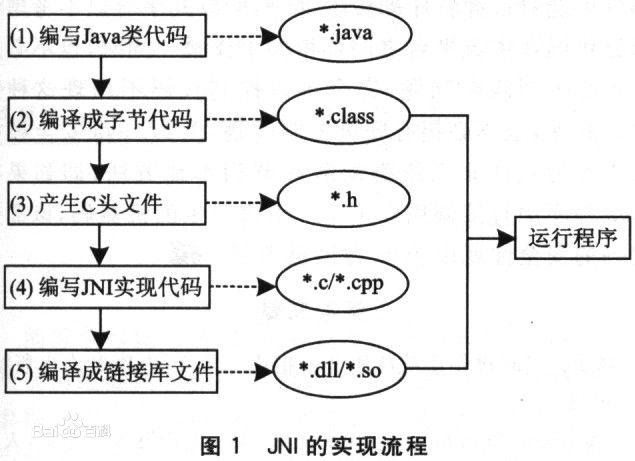
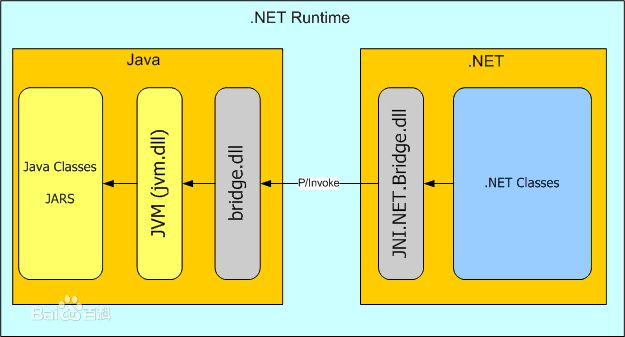
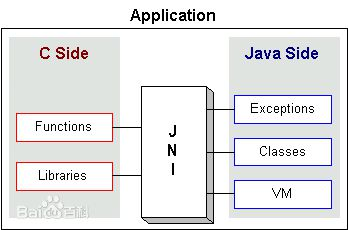

JNI_百度百科 https://baike.baidu.com/item/JNI/9412164?fr=aladdin
调用问题
| Java 类型 | 本地 C 类型 |
实际表示的 C 类型
(Win32)
|
说明 |
|---|---|---|---|
| boolean | jboolean | unsigned char | 无符号,8 位 |
| byte | jbyte | signed char | 有符号,8 位 |
| char | jchar | unsigned short | 无符号,16 位 |
| short | jshort | short | 有符号,16 位 |
| int | jint | long | 有符号,32 位 |
| long | jlong | __int64 | 有符号,64 位 |
| float | jfloat | float | 32 位 |
| double | jdouble | double | 64 位 |
| void | void | N/A | N/A |
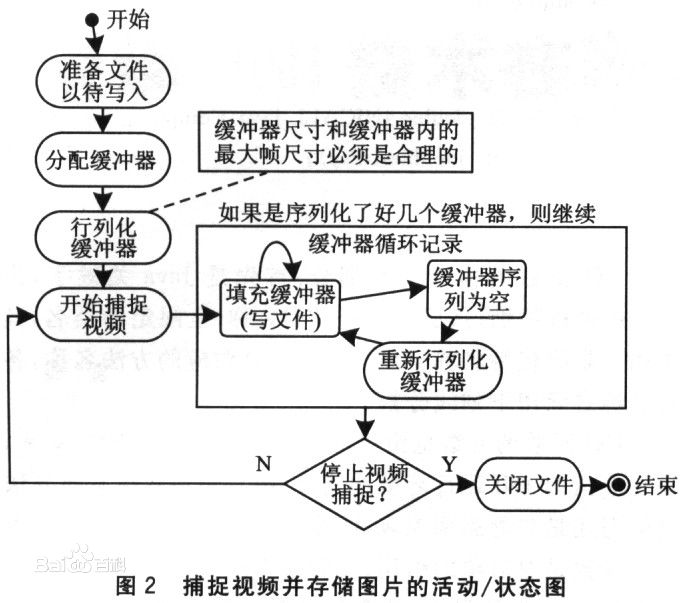
活动状态
视频捕捉
Java Native Interface 基于JNI的嵌入式手机软件开发实例的更多相关文章
- Java Native Interface Specification(JNI)
Java Native Interface Specification(JNI) 使用场景: 需要的功能,标准的java不能提供 有了一个用其他的语言写好的工具包,希望用java去访问它 当需要高性能 ...
- Java Native Interface 六JNI中的异常
本文是<The Java Native Interface Programmer's Guide and Specification>读书笔记 在这里只讨论调用JNI方法可能会出现的异常, ...
- Java Native Interface 五 JNI里的多线程与JNI方法的注册
本文是<The Java Native Interface Programmer's Guide and Specification>读书笔记 JNI里的多线程 在本地方法里写有关多线程的 ...
- Java Native Interface 四--JNI中引用类型
本文是<The Java Native Interface Programmer's Guide and Specification>读书笔记 JNI支持将类实例和数组类型(如jobjec ...
- Java Native Interface 二 JNI中对Java基本类型和引用类型的处理
本文是<The Java Native Interface Programmer's Guide and Specification>读书笔记 Java编程里会使用到两种类型:基本类型(如 ...
- Java Native Interface(JNI)
JNI能让Java代码在Java虚拟机里调用其他编程语言(例如C.C++)写的应用或库,且不会影响任何Java虚拟机的实现. 什么时候用JNI? 1.应用程序所需的平台相关功能,标准的Java类库不支 ...
- 【详解】JNI (Java Native Interface) (二)
案例二:传递参数给C代码,并从其获取结果 注:这里传递的参数是基本类型的参数,在C代码中有直接的映射类型. 此案例所有生成的所有文件如下: (1)编写案例二的Java代码,如下: 这里我们定义了一个n ...
- Java Native Interface Specification Contents 翻译
https://docs.oracle.com/en/java/javase/12/docs/specs/jni/index.html Google翻译 第1章:简介 本章介绍Java Native ...
- android 学习随笔二十七(JNI:Java Native Interface,JAVA原生接口 )
JNI(Java Native Interface,JAVA原生接口) 使用JNI可以使Java代码和其他语言写的代码(如C/C++代码)进行交互. 问:为什么要进行交互? 首先,Java语言提供的类 ...
随机推荐
- php 自定义 分页函数
<?php /** * 分页函数 * @param type $num 数据总数 * @param type $perpage 每页总数 * @param type $curpage 当前分页 ...
- GSAP JS基础教程--动画的控制及事件
好多天没有写无博文啦,今天无聊就再写一下! 今天要讲的是TweenLite的一些事件以及,TweenLite动画的控制,TweenMax类似,请自行参考官方文档:http://api.greensoc ...
- Oracle sqlldr导入之“MAXIMUM ERROR COUNT EXCEEDED”
昨天看到一个同事在通过PL/SQL Developer工具把文本数据往oracle表;有两个文本:一个有30万条记录:一个7万多条记录.在导入到过程中:出现错误记录还需要点击确认.不过使用黑科技(屏幕 ...
- Nginx 代理
如下,配置 Nginx 成为一台代理服务器 [root@localhost ~]$ cat /usr/local/nginx/conf/vhost/proxy.conf server { listen ...
- ts+antd报错error TS2605: JSX element type Xxx is not a constructor function for JSX elements
antd 3 以前的版本需要在 tsconfig.json 的 compilerOptions 中配置 "allowSyntheticDefaultImports": true
- GCC 编译详解[转]
转自http://www.cnblogs.com/azraelly/archive/2012/07/07/2580839.html GNU CC(简称为Gcc)是GNU项目中符合ANSI C标准的编译 ...
- Java访问数据库Mysql
一.概述 本文主要介绍Java接连数据库的基本方法和步骤,并对其中的几个要点进行简要说明. 二.数据库访问步骤 在Java中连接数据库进行的访问主要有以下几个步骤: 加载数据库驱动 注册数据库驱动 建 ...
- router之switch
比较路由中有无switch的区别: 代码一: <Router history={history}> <Route exact path="/" component ...
- 题目1029:魔咒词典(map使用以及字符串读取函数总结)
题目链接:http://ac.jobdu.com/problem.php?pid=1029 详解链接:https://github.com/zpfbuaa/JobduInCPlusPlus // // ...
- 九度OJ小结
1. 高精度问题 可参考题目 题目1137:浮点数加法 http://ac.jobdu.com/problem.php?pid=1137 对于高精度问题可以考虑使用结构体.上述为浮点数加法,因此该 ...