
Assembly - Registers
Processor operations mostly involve processing data. This data can be stored in memory and accessed from thereon. However, reading data from and storing data into memory slows down the processor, as it involves complicated processes of sending the data request across the control bus and into the memory storage unit and getting the data through the same channel.
To speed up the processor operations, the processor includes some internal memory storage locations, called registers.
The registers store data elements for processing without having to access the memory. A limited number of registers are built into the processor chip.
Processor Registers
There are ten 32-bit and six 16-bit processor registers in IA-32 architecture. The registers are grouped into three categories −
- General registers,
- Control registers, and
- Segment registers.
The general registers are further divided into the following groups −
- Data registers,
- Pointer registers, and
- Index registers.
Data Registers
Four 32-bit data registers are used for arithmetic, logical, and other operations. These 32-bit registers can be used in three ways −
As complete 32-bit data registers: EAX, EBX, ECX, EDX.
Lower halves of the 32-bit registers can be used as four 16-bit data registers: AX, BX, CX and DX.
Lower and higher halves of the above-mentioned four 16-bit registers can be used as eight 8-bit data registers: AH, AL, BH, BL, CH, CL, DH, and DL.
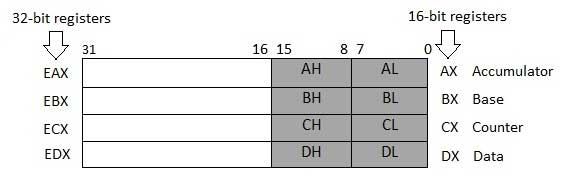
Some of these data registers have specific use in arithmetical operations.
AX is the primary accumulator; it is used in input/output and most arithmetic instructions. For example, in multiplication operation, one operand is stored in EAX or AX or AL register according to the size of the operand.
BX is known as the base register, as it could be used in indexed addressing.
CX is known as the count register, as the ECX, CX registers store the loop count in iterative operations.
DX is known as the data register. It is also used in input/output operations. It is also used with AX register along with DX for multiply and divide operations involving large values.
Pointer Registers
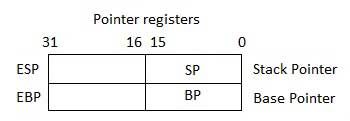
The pointer registers are 32-bit EIP, ESP, and EBP registers and corresponding 16-bit right portions IP, SP, and BP. There are three categories of pointer registers −
Instruction Pointer (IP) − The 16-bit IP register stores the offset address of the next instruction to be executed. IP in association with the CS register (as CS:IP) gives the complete address of the current instruction in the code segment.
Stack Pointer (SP) − The 16-bit SP register provides the offset value within the program stack. SP in association with the SS register (SS:SP) refers to be current position of data or address within the program stack.
Base Pointer (BP) − The 16-bit BP register mainly helps in referencing the parameter variables passed to a subroutine. The address in SS register is combined with the offset in BP to get the location of the parameter. BP can also be combined with DI and SI as base register for special addressing.
Index Registers
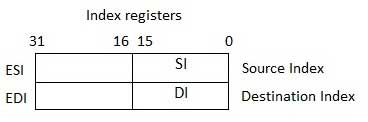
The 32-bit index registers, ESI and EDI, and their 16-bit rightmost portions. SI and DI, are used for indexed addressing and sometimes used in addition and subtraction. There are two sets of index pointers −
Source Index (SI) − It is used as source index for string operations.
Destination Index (DI) − It is used as destination index for string operations.
Control Registers
The 32-bit instruction pointer register and the 32-bit flags register combined are considered as the control registers.
Many instructions involve comparisons and mathematical calculations and change the status of the flags and some other conditional instructions test the value of these status flags to take the control flow to other location.
The common flag bits are:
Overflow Flag (OF) − It indicates the overflow of a high-order bit (leftmost bit) of data after a signed arithmetic operation.
Direction Flag (DF) − It determines left or right direction for moving or comparing string data. When the DF value is 0, the string operation takes left-to-right direction and when the value is set to 1, the string operation takes right-to-left direction.
Interrupt Flag (IF) − It determines whether the external interrupts like keyboard entry, etc., are to be ignored or processed. It disables the external interrupt when the value is 0 and enables interrupts when set to 1.
Trap Flag (TF) − It allows setting the operation of the processor in single-step mode. The DEBUG program we used sets the trap flag, so we could step through the execution one instruction at a time.
Sign Flag (SF) − It shows the sign of the result of an arithmetic operation. This flag is set according to the sign of a data item following the arithmetic operation. The sign is indicated by the high-order of leftmost bit. A positive result clears the value of SF to 0 and negative result sets it to 1.
Zero Flag (ZF) − It indicates the result of an arithmetic or comparison operation. A nonzero result clears the zero flag to 0, and a zero result sets it to 1.
Auxiliary Carry Flag (AF) − It contains the carry from bit 3 to bit 4 following an arithmetic operation; used for specialized arithmetic. The AF is set when a 1-byte arithmetic operation causes a carry from bit 3 into bit 4.
Parity Flag (PF) − It indicates the total number of 1-bits in the result obtained from an arithmetic operation. An even number of 1-bits clears the parity flag to 0 and an odd number of 1-bits sets the parity flag to 1.
Carry Flag (CF) − It contains the carry of 0 or 1 from a high-order bit (leftmost) after an arithmetic operation. It also stores the contents of last bit of a shift or rotate operation.
The following table indicates the position of flag bits in the 16-bit Flags register:
| Flag: | O | D | I | T | S | Z | A | P | C | |||||||
|---|---|---|---|---|---|---|---|---|---|---|---|---|---|---|---|---|
| Bit no: | 15 | 14 | 13 | 12 | 11 | 10 | 9 | 8 | 7 | 6 | 5 | 4 | 3 | 2 | 1 | 0 |
Segment Registers
Segments are specific areas defined in a program for containing data, code and stack. There are three main segments −
Code Segment − It contains all the instructions to be executed. A 16-bit Code Segment register or CS register stores the starting address of the code segment.
Data Segment − It contains data, constants and work areas. A 16-bit Data Segment register or DS register stores the starting address of the data segment.
Stack Segment − It contains data and return addresses of procedures or subroutines. It is implemented as a 'stack' data structure. The Stack Segment register or SS register stores the starting address of the stack.
Apart from the DS, CS and SS registers, there are other extra segment registers - ES (extra segment), FS and GS, which provide additional segments for storing data.
In assembly programming, a program needs to access the memory locations. All memory locations within a segment are relative to the starting address of the segment. A segment begins in an address evenly divisible by 16 or hexadecimal 10. So, the rightmost hex digit in all such memory addresses is 0, which is not generally stored in the segment registers.
The segment registers stores the starting addresses of a segment. To get the exact location of data or instruction within a segment, an offset value (or displacement) is required. To reference any memory location in a segment, the processor combines the segment address in the segment register with the offset value of the location.
Example
Look at the following simple program to understand the use of registers in assembly programming. This program displays 9 stars on the screen along with a simple message −
section    .text

   global_start     ;must be declared for linker (gcc)

_start:             ;tell linker entry point

   mov    edx,len  ;message length

   mov    ecx,msg  ;message to write

   mov    ebx,    ;file descriptor (stdout)

   mov    eax,    ;system call number (sys_write)

   int    0x80     ;call kernel

   mov    edx,    ;message length

   mov    ecx,s2   ;message to write

   mov    ebx,    ;file descriptor (stdout)

   mov    eax,    ;system call number (sys_write)

   int    0x80     ;call kernel

   mov    eax,    ;system call number (sys_exit)

   int    0x80     ;call kernel

section    .data

msg db 'Displaying 9 stars',0xa ;a message

len equ $ - msg  ;length of message

s2 times  db '*'
When the above code is compiled and executed, it produces the following result −
Displaying 9 stars

*********

From : http://www.tutorialspoint.com/assembly_programming/assembly_registers.htm
Assembly - Registers的更多相关文章
- android ARM 汇编学习 —— hello world
android ARM 汇编学习—— 在 android 设备上编译c/cpp代码并用objdump/readelf等工具分析 adb putty 连上手机,用busybox vi 写一个 hello ...
- Beennan的内嵌汇编指导(译)Brennan's Guide to Inline Assembly
注:写在前面,这是一篇翻译文章,本人的英文水平很有限,但内嵌汇编是学习操作系统不可少的知识,本人也常去查看这方面的内容,本文是在做mit的jos实验中的一篇关于内嵌汇编的介绍.关于常用的内嵌汇编(AT ...
- Using assembly writing algorithm programs
This's my first version.The logic is simple, just the selection sort. I spent much time learning how ...
- AT&T Assembly on Linux
je if equal then jmp jg if the second gt the first, then jmp jge if the second ge the first, then jm ...
- Notes on <Assembly Language step by step>
By brant-ruan Yeah, I feel very happy When you want to give up, think why you have held on so long. ...
- CORTEX -M3 : Registers in depth
http://www.zembedded.com/cortex-m3-registers-in-depth/ Thanks for the overwhelm response you show in ...
- Calling 64-bit assembly language functions lodged inside the Delphi source code
Code: http://www.atelierweb.com/calling-64-bit-assembly-language-functions-lodged-inside-the-delphi- ...
- [转]Whirlwind Tour of ARM Assembly
ref:http://www.coranac.com/tonc/text/asm.htm 23.1. Introduction Very broadly speaking, you can divid ...
- [转]iOS Assembly Tutorial: Understanding ARM
iOS Assembly Tutorial: Understanding ARM Do you speak assembly? When you write Objective-C code, it ...
随机推荐
- sql2012还原sql2008备份文件语句
--sql2012还原sql2008语句 --选择master数据库,新建查询 输入下面sql语句 --选择兼容模式(sql 2008)创建数据库db RESTORE DATABASE db FROM ...
- 【2015上半年总结】js开源组件开发系列索引
js开源组件开发系列一索引 2015.8 by 田想兵 个人网站 从3月份进入新公司以来,时经五个月,我以平均每周1个小组件的速度,已经完成的js组件有22个之余了,已基本上全部用到实际项目中,这些小 ...
- RSuite 一个基于 React.js 的 Web 组件库
RSuite http://rsuite.github.io RSuite 是一个基于 React.js 开发的 Web 组件库,参考 Bootstrap 设计,提供其中常用组件,支持响应式布局. 我 ...
- 也来谈谈wap端瀑布流布局
Definition 瀑布流布局,在视觉上表现为参差不齐的多栏布局,随着页面滚动条向下滚动,新数据不断被加载进来. 瀑布流对于图片的展现,是高效而具有吸引力的,用户一眼扫过的快速阅读模式可以在短时间内 ...
- Sublime Text3快捷键实用总结
今天想给大家分享一个我自己最喜欢用的一个编辑器——Sublime Text3的常用快捷键 相信大家每天和代码打交道,接触时间最长的莫过于编辑器了吧,而我就特别喜欢用Sublime Text3这个编辑器 ...
- MS14-064 漏洞测试入侵win7
Microsoft Windows OLE远程代码执行漏洞,OLE(对象链接与嵌入)是一种允许应用程序共享数据和功能的技术, 远程攻击者利用此漏洞通过构造的网站执行任意代码,影响Win95+IE3 – ...
- 关于SharePoint 2013 UserProfile跨场的几点注意
1.跨场中需要以下几个Service实例,没有这几个会遇到各种问题 2.发布场和消费场同时需要创建Host站点,否则消费场的SiteFeed无法使用. 3.跨场关注的问题请参考:http://www. ...
- ORA-03113解决方法
场景: 碰到ORA-00257归档日志写满的解决方法这篇日志当中描述的归档日志写满的情况. 此时我想将数据库切换到非归档模式,参考如何启动或关闭oracle的归档(ARCHIVELOG)模式进行操作, ...
- iOS界面传值的方式(7种)
iOS传值的方式 属性传值 方法传值 代理传值(delegate) block传值 单例模式方式 通知notification方式 UserDefault或者文件方式 1.属性传值 情况:A页面跳转到 ...
- Ubuntu 16.04 LTS 安装配置 Nginx 1.10.0 Php7.0-FPM
1. 安装Nginx,Php-7.0 ~$ sudo add-apt-repository ppa:nginx/stable ~$ sudo apt-get update ~$ sudo apt-ge ...