
使用 Fetch
原文链接:https://css-tricks.com/using-fetch/。 本文介绍了Fetch基本使用方法及zlFetch库的使用
无论用JavaScript发送或获取信息,我们都会用到Ajax。Ajax不需要刷新页面就能发送和获取信息,能使网页实现异步更新。
几年前,初始化Ajax一般使用jQuery的ajax方法:
$.ajax('some-url', {

  success: (data) => { /* do something with the data */ },

  error: (err) => { /* do something when an error happens */}

});也可以不用jQuery,但不得不使用XMLHttpRequest,然而这是相当复杂
幸亏,浏览器现在支持Fetch API,可以无须其他库就能实现Ajax
浏览器支持
桌面浏览器

手机/平板电脑

所有主要的浏览器(除了Opera Mini和老的IE)都支持Fetch。针对不支持的,可以使用Fetch polyfill
Fetch获取数据
使用Fetch获取数据很容易。只需要Fetch你想获取资源。
假设我们想通过GitHub获取一个仓库,我们可以像下面这样使用:
fetch('https://api.github.com/users/chriscoyier/repos');Fetch会返回Promise,所以在获取资源后,可以使用.then方法做你想做的。
fetch('https://api.github.com/users/chriscoyier/repos')

.then(response => {/* do something */})如果这是你第一次遇见Fetch,也许惊讶于Fetch返回的response。如果console.log返回的response,会得到下列信息:
{

  body: ReadableStream

  bodyUsed: false

  headers: Headers

  ok : true

  redirected : false

  status : 200

  statusText : "OK"

  type : "cors"

  url : "http://some-website.com/some-url"

  __proto__ : Response

}可以看出Fetch返回的响应能告知请求的状态。从上面例子看出请求是成功的(ok是true,status是200),但是我们想获取的仓库名却不在这里。
显然,我们从GitHub请求的资源都存储在body中,作为一种可读的流。所以需要调用一个恰当方法将可读流转换为我们可以使用的数据。
Github返回的响应是JSON格式的,所以调用response.json方法来转换数据。
还有其他方法来处理不同类型的响应。如果请求一个XML格式文件,则调用response.text。如果请求图片,使用response.blob方法。
所有这些方法(response.json等等)返回另一个Promise,所以可以调用.then方法处理我们转换后的数据。
fetch('https://api.github.com/users/chriscoyier/repos')

  .then(response => response.json())

  .then(data => {

    // data就是我们请求的repos

    console.log(data)

  });
可以看出Fetch获取数据方法简短并且简单。
接下来,让我们看看如何使用Fetch发送数据。
Fetch发送数据
使用Fetch发送也很简单,只需要配置三个参数。
fetch('some-url', options);第一个参数是设置请求方法(如post、put或del),Fetch会自动设置方法为get。
第二个参数是设置头部。因为一般使用JSON数据格式,所以设置ContentType为application/json。
第三个参数是设置包含JSON内容的主体。因为JSON内容是必须的,所以当设置主体时会调用JSON.stringify。
实践中,post请求会像下面这样:
let content = {some: 'content'};

// The actual fetch request

fetch('some-url', {

  method: 'post',

  headers: {

    'Content-Type': 'application/json'

  },

  body: JSON.stringify(content)

})

// .then()...
Fetch处理异常
虽然希望Ajax响应成功,但是仍会有问题出现:
- 可能尝试获取不存在的资源
- 没有权限获取资源
- 输入参数有误
- 服务器抛出异常
- 服务器超时
- 服务器崩溃
- API更改
- ...
假设我们试图获取不存在错误,并了解如何处理错误。下面的例子我将chriscoyier拼错为chrissycoyier
// 获取chrissycoyier's repos 而不是 chriscoyier's repos

fetch('https://api.github.com/users/chrissycoyier/repos')为了处理此错误,我们需要使用catch方法。
也许我们会用下面这种方法:
fetch('https://api.github.com/users/chrissycoyier/repos')

  .then(response => response.json())

  .then(data => console.log('data is', data))

  .catch(error => console.log('error is', error));
然而却得到下面这样结果:
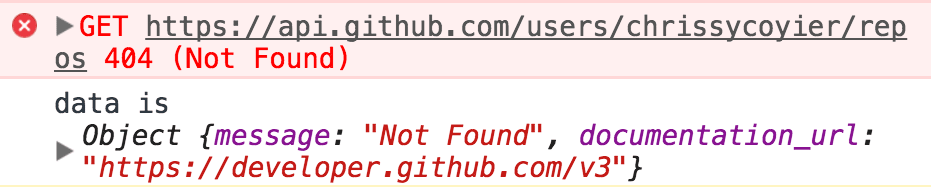
获取失败,但是第二个.then方法会执行。
如果console.log此次响应,会看出不同:
  {

  body: ReadableStream

  bodyUsed: true

  headers: Headers

  ok: false // Response is not ok

  redirected: false

  status: 404 // HTTP status is 404.

  statusText: "Not Found" // Request not found

  type: "cors"

  url: "https://api.github.com/users/chrissycoyier/repos"

}大部分是一样的,只有ok、status和statusText是不同的,正如所料,GitHub上没有发现chrissycoyier。
上面响应告诉我们Fetch不会关心AJAX是否成功,他只关心从服务器发送请求和接收响应,如果响应失败我们需要抛出异常。
因此,初始的then方法需要被重写,以至于如果响应成功会调用response.json。最简单方法是检查response是否为ok。
fetch('some-url')

  .then(response => {

    if (response.ok) {

      return response.json()

    } else {

      // Find some way to get to execute .catch()

    }

});一旦我们知道请求是不成功的,我可以throw异常或rejectPromise来调用catch。
// throwing an Error

else {

  throw new Error('something went wrong!')

}

// rejecting a Promise

else {

  return Promise.reject('something went wrong!')

}这里选择Promise.reject,是因为容易扩展。抛出异常方法也不错,但是无法扩展,唯一益处在于便于栈跟踪。
所以,到现在代码应该是这样的:
fetch('https://api.github.com/users/chrissycoyier/repos')

  .then(response => {

    if (response.ok) {

      return response.json()

    } else {

      return Promise.reject('something went wrong!')

    }

  })

  .then(data => console.log('data is', data))

  .catch(error => console.log('error is', error));
这样错误就会进入catch语句中。
但是rejectPromise时,只输出字符串不太好。这样不清楚哪里出错了,你肯定也不会想在异常时,输出下面这样:

让我们在看看响应:
  {

  body: ReadableStream

  bodyUsed: true

  headers: Headers

  ok: false // Response is not ok

  redirected: false

  status: 404 // HTTP status is 404.

  statusText: "Not Found" // Request not found

  type: "cors"

  url: "https://api.github.com/users/chrissycoyier/repos"

}在这个例子中,我们知道资源是不存在。所以我们可以返回404状态或Not Found原因短语,然而我们就知道如何处理。
为了在.catch中获取status或statusText,我们可以reject一个JavaScript对象:
fetch('some-url')

  .then(response => {

    if (response.ok) {

      return response.json()

    } else {

      return Promise.reject({

        status: response.status,

        statusText: response.statusText

      })

    }

  })

  .catch(error => {

    if (error.status === 404) {

      // do something about 404

    }

  })
上面的错误处理方法对于下面这些不需要解释的HTTP状态很适用。
- 401: Unauthorized
- 404: Not found
- 408: Connection timeout
- ...
但对于下面这些特定的错误不适用:
- 400:Bad request
例如,如果请求错误缺少必要的参数,就会返回400.
光在catch中告诉状态及原因短语并不足够。我们需要知道缺少什么参数。
所以服务器需要返回一个对象,告诉造成错误请求原因。如果使用Node和Express,会返回像下面这样的响应:
res.status(400).send({

  err: 'no first name'

})无法在最初的.then方法中reject,因为错误对象需要response.json来解析。
解决的方法是需要两个then方法。这样可以首先通过response.json读取,然后决定怎么处理。
fetch('some-error')

  .then(handleResponse)

function handleResponse(response) {

  return response.json()

    .then(json => {

      if (response.ok) {

        return json

      } else {

        return Promise.reject(json)

      }

    })

}首先我们调用response.json读取服务器发来的JSON数据,response.json返回Promise,所以可以链式调用.then方法。
在第一个.then中调用第二个.then,因为我们仍希望通过repsonse.ok判断响应是否成功。
如果想发送状态和原因短语,可以使用Object.assign()将二者结合为一个对象。
let error = Object.assign({}, json, {

  status: response.status,

  statusText: response.statusText

})

return Promise.reject(error)可以使用这样新的handleResponse函数,让数据能自动的进入.then和.catch中。
fetch('some-url')

  .then(handleResponse)

  .then(data => console.log(data))

  .catch(error => console.log(error))
处理其他响应类型
到现在,我们只处理JSON格式的响应,而返回JSON格式数据大约占90%。
至于其他的10%呢?
假设上面的例子返回的是XML格式的响应,也许会收到下面异常:

这是因为XML格式不是JSON格式,我们无法使用response.json,事实上,我们需要response.text,所以我们需要通过判断响应的头部来决定内容格式:
.then(response => {

  let contentType = response.headers.get('content-type')

  if (contentType.includes('application/json')) {

    return response.json()

    // ...

  }

  else if (contentType.includes('text/html')) {

    return response.text()

    // ...

  }

  else {

    // Handle other responses accordingly...

  }

});当我遇见这种问题时,我尝试使用ExpressJWT处理身份验证,我不知道可以发生JSON响应数据,所以我将XML格式设为默认。
这是我们到现在完整代码:
fetch('some-url')

  .then(handleResponse)

  .then(data => console.log(data))

  .then(error => console.log(error))

function handleResponse (response) {

  let contentType = response.headers.get('content-type')

  if (contentType.includes('application/json')) {

    return handleJSONResponse(response)

  } else if (contentType.includes('text/html')) {

    return handleTextResponse(response)

  } else {

    // Other response types as necessary. I haven't found a need for them yet though.

    throw new Error(`Sorry, content-type ${contentType} not supported`)

  }

}

function handleJSONResponse (response) {

  return response.json()

    .then(json => {

      if (response.ok) {

        return json

      } else {

        return Promise.reject(Object.assign({}, json, {

          status: response.status,

          statusText: response.statusText

        }))

      }

    })

}

function handleTextResponse (response) {

  return response.text()

    .then(text => {

      if (response.ok) {

        return json

      } else {

        return Promise.reject({

          status: response.status,

          statusText: response.statusText,

          err: text

        })

      }

    })

}
介绍zlFetch
zlFetch库就是上例中handleResponse函数,所以可以不用生成此函数,不需要担心响应来处理数据和错误。
典型的zlfetch像下面这样:
zlFetch('some-url', options)

  .then(data => console.log(data))

  .catch(error => console.log(error));
使用之前,需要安装zlFetch
npm install zl-fetch --save接着,需要引入到你的代码中,如果你需要polyfill,确保加入zlFetch之前引入它。
 // Polyfills (if needed)

require('isomorphic-fetch') // or whatwg-fetch or node-fetch if you prefer

// ES6 Imports

import zlFetch from 'zl-fetch';

// CommonJS Imports

const zlFetch = require('zl-fetch');
zlFetch还能无须转换成JSON格式就能发送JSON数据。
下面两个函数做了同样事情,zlFetch加入Content-type然后将内容转换为JSON格式。
let content = {some: 'content'}

// Post request with fetch

fetch('some-url', {

  method: 'post',

  headers: {'Content-Type': 'application/json'}

  body: JSON.stringify(content)

});

// Post request with zlFetch

zlFetch('some-url', {

  method: 'post',

  body: content

});
zlFetch处理身份认证也很容易。
常用方法是在头部加入Authorization,其值设为Bearer your-token-here。如果你需要增加token选项,zlFetch会帮你创建此域。
所以,下面两种代码是一样的:
let token = 'someToken'

zlFetch('some-url', {

  headers: {

    Authorization: `Bearer ${token}`

  }

});

// Authentication with JSON Web Tokens with zlFetch

zlFetch('some-url', {token});
下面就是使用zlFetch来从GitHub上获取repos:
总结
Fetch是很好的方法,能发送和接收数据。不需要在编写XHR请求或依赖于jQuery。
尽管Fetch很好,但是其错误处理不是很直接。在处理之前,需要让错误信息进入到catch方法中。
使用zlFetch库,就不需要担心错误处理了。
使用 Fetch的更多相关文章
- Git 少用 Pull 多用 Fetch 和 Merge
本文有点长而且有点乱,但就像Mark Twain Blaise Pascal的笑话里说的那样:我没有时间让它更短些.在Git的邮件列表里有很多关于本文的讨论,我会尽量把其中相关的观点列在下面. 我最常 ...
- git提示:Fatal:could not fetch refs from ....
在git服务器上新建项目提示: Fatal:could not fetch refs from git..... 百度搜索毫无头绪,最后FQgoogle,找到这篇文章http://www.voidcn ...
- sublime 插件推荐: Nettuts+ Fetch
Nettuts+ Fetch github地址:Nettuts-Fetch 在sublime中直接用 ctrl+shift+P -> pci -> Nettuts-Fetch 即可下载 这 ...
- git pull和git fetch的区别
Git中从远程的分支获取最新的版本到本地有这样2个命令:1. git fetch:相当于是从远程获取最新版本到本地,不会自动merge Git fetch origin master git log ...
- Hibernate之加载策略(延迟加载与即时加载)和抓取策略(fetch)
假设现在有Book和Category两张表,表的关系为双向的一对多,表结构如下: 假设现在我想查询id为2的那本书的书名,使用session.get(...)方法: Session session=H ...
- SQL Server 2012提供的OFFSET/FETCH NEXT与Row_Number()对比测试(转)
原文地址:http://www.cnblogs.com/downmoon/archive/2012/04/19/2456451.html 在<SQL Server 2012服务端使用OFFSET ...
- Attempt to fetch logical page (...) in database 2 failed. It belongs to allocation unit xxxx not to xxx
今天一个同事说在一个生产库执行某个存储过程,遇到了错误: Fatal error 605 occurred at jul 29 2014 我试着执行该存储过程,结果出现下面错误,每次执行该存储过程,得 ...
- Fetch:下一代 Ajax 技术
Ajax,2005年诞生的技术,至今已持续了 10 年.它是一种在客户端创建一个异步请求的技术,本质上它不算创新,是一组技术的组合.它的核心对象是 XMLHttpRequest. 简单回顾下历史 19 ...
- 在 JS 中使用 fetch 更加高效地进行网络请求
在前端快速发展地过程中,为了契合更好的设计模式,产生了 fetch 框架,此文将简要介绍下 fetch 的基本使用. 我的源博客地址:http://blog.parryqiu.com/2016/03/ ...
- 解决:error: Cannot fetch repo (TypeError: expected string or buffer)
同步源码,问题重现: Fetching project platform/external/libopus Fetching project repo error: Cannot fetch repo ...
随机推荐
- Unity认证
Unity Education- 国际认证 Certified Instructor 培训师认证 Certified User 应用能力认证
- 当前标识没有对“C:\WINDOWS\Microsoft.NET\...”的写访问权限的解决办法
1.需要重新注册IIS服务扩展,在开始运行中输入以下命令运行:aspnet_regiis -i 32位的Windows: --------------------------------------- ...
- phpinfo
phpinfo是一个运行指令,为显示php服务器的配置信息. phpinfo函数是PHP最为常用的配置输出函数.phpinfo函数能够输出服务器PHP当前状态的大量信息,其中包含了PHP的编译选 ...
- python 去除html 超链接href 如何实现?
今天持久男 在抓取数据的时候发现很多内容都加了锚文本, 这怎么办呢? 没办法只能通过工具解决 我是这样解决的: 例如: soup = BeautifulSoup('<p>Hello < ...
- 关于selenium的8种元素定位
selenium中有八种元素定位,分别是:id,name,class_name,tag_name,link_text.partial_link_text.xpath.css 简单的定位可以用 id.n ...
- AQS学习笔记之独占锁
作用 参与 共享锁 acquireShared() 和 独占锁 acquire() 的抢锁逻辑, 具体的抢锁逻辑不作实现,只对第一次抢锁未抢到锁线程做处理,第一次抢锁就抢到的线程就不需要遇到AQS了 ...
- sql的四种匹配模式
1. % 表示任意0个或多个字符.如下语句:Select * FROM user Where name LIKE '%三%'; 将会把name为“张三”,“三脚猫”,“唐三藏”等等有“三”的全找出来. ...
- 2018-2019-2 网络对抗技术 20165337 Exp1 PC平台逆向破解(BOF实验)
实验内容 直接修改程序,跳转到getShell函数. 使用BOF攻击,覆盖返回地址,触发getShell函数. 注入一个自己的shellcode并运行. 任务一:直接修改程序,跳转到getShell函 ...
- 【easy】Number of Segments in a String 字符串中的分段数量
以空格为分隔符,判断一个string可以被分成几部分. 注意几种情况:(1)全都是空格 (2)空字符串(3)结尾有空格 思路: 只要统计出单词的数量即可.那么我们的做法是遍历字符串,遇到空格直接跳过, ...
- C语言中return 0和return 1和return -1
转载声明:本文系转载文章 原文作者:十一月zz 原文地址:https://blog.csdn.net/baidu_35679960/article/details/77542787 1.返回值int ...