
Go语言的堆栈分析
本文为理解翻译,原文地址:http://www.goinggo.net/2015/01/stack-traces-in-go.html
Functions
先从这段代码开始:
02
03 func main() {
04 slice := make([]string, 2, 4)
05 Example(slice, "hello", 10)
06 }
07
08 func Example(slice []string, str string, i int) {
09 panic("Want stack trace")
10 }
Listing 2
goroutine 1 [running]:
main.Example(0x2080c3f50, 0x2, 0x4, 0x425c0, 0x5, 0xa)
/Users/bill/Spaces/Go/Projects/src/github.com/goinaction/code/
temp/main.go:9 +0x64
main.main()
/Users/bill/Spaces/Go/Projects/src/github.com/goinaction/code/
temp/main.go:5 +0x85
goroutine 2 [runnable]:
runtime.forcegchelper()
/Users/bill/go/src/runtime/proc.go:90
runtime.goexit()
/Users/bill/go/src/runtime/asm_amd64.s:2232 +0x1
goroutine 3 [runnable]:
runtime.bgsweep()
/Users/bill/go/src/runtime/mgc0.go:82
runtime.goexit()
/Users/bill/go/src/runtime/asm_amd64.s:2232 +0x1
Listing 3
02 main.Example(0x2080c3f50, 0x2, 0x4, 0x425c0, 0x5, 0xa)
/Users/bill/Spaces/Go/Projects/src/github.com/goinaction/code/
temp/main.go:9 +0x64
03 main.main()
/Users/bill/Spaces/Go/Projects/src/github.com/goinaction/code/
temp/main.go:5 +0x85
Listing 4
main.Example(slice []string, str string, i int)
// Call to Example by main.
slice := make([]string, 2, 4)
Example(slice, "hello", 10)
// Stack trace
main.Example(0x2080c3f50, 0x2, 0x4, 0x425c0, 0x5, 0xa)
Listing 5
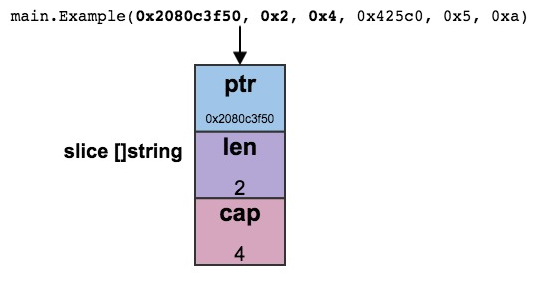
slice := make([]string, 2, 4)
// Slice header values
Pointer: 0x2080c3f50
Length: 0x2
Capacity: 0x4
// Declaration
main.Example(slice []string, str string, i int)
// Stack trace
main.Example(0x2080c3f50, 0x2, 0x4, 0x425c0, 0x5, 0xa)
Figure 1
Listing 6
"hello"
// String header values
Pointer: 0x425c0
Length: 0x5
// Declaration
main.Example(slice []string, str string, i int)
// Stack trace
main.Example(0x2080c3f50, 0x2, 0x4, 0x425c0, 0x5, 0xa)
Figure 2

Listing 7
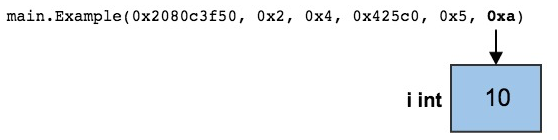
10
// Integer value
Base 16: 0xa
// Declaration
main.Example(slice []string, str string, i int)
// Stack trace
main.Example(0x2080c3f50, 0x2, 0x4, 0x425c0, 0x5, 0xa)
Figure 3
Methods
Listing 8
02
03 import "fmt"
04
05 type trace struct{}
06
07 func main() {
08 slice := make([]string, 2, 4)
09
10 var t trace
11 t.Example(slice, "hello", 10)
12 }
13
14 func (t *trace) Example(slice []string, str string, i int) {
15 fmt.Printf("Receiver Address: %p\n", t)
16 panic("Want stack trace")
17 }
Listing 9
panic: Want stack trace
01 goroutine 1 [running]:
02 main.(*trace).Example(0x1553a8, 0x2081b7f50, 0x2, 0x4, 0xdc1d0, 0x5, 0xa)
/Users/bill/Spaces/Go/Projects/src/github.com/goinaction/code/
temp/main.go:16 +0x116
03 main.main()
/Users/bill/Spaces/Go/Projects/src/github.com/goinaction/code/
temp/main.go:11 +0xae
Packing
Listing 10
02
03 func main() {
04 Example(true, false, true, 25)
05 }
06
07 func Example(b1, b2, b3 bool, i uint8) {
08 panic("Want stack trace")
09 }
Listing 11
02 main.Example(0x19010001)
/Users/bill/Spaces/Go/Projects/src/github.com/goinaction/code/
temp/main.go:8 +0x64
03 main.main()
/Users/bill/Spaces/Go/Projects/src/github.com/goinaction/code/
temp/main.go:4 +0x32
Listing 12
true, false, true, 25
// Word value
Bits Binary Hex Value
00-07 0000 0001 01 true
08-15 0000 0000 00 false
16-23 0000 0001 01 true
24-31 0001 1001 19 25
// Declaration
main.Example(b1, b2, b3 bool, i uint8)
// Stack trace
main.Example(0x19010001)
Conclusion
The Go runtime provides a great deal of information to help us debug our programs. In this post we concentrated on stack traces. The ability to decode the values that were passed into each function throughout the call stack is huge. It has helped me more than once to identify my bug very quickly. Now that you know how to read stack traces, hopefully you can leverage this knowledge the next time a stack trace happens to you.
Go语言的堆栈分析的更多相关文章
- Java线程堆栈分析
不知觉间工作已有一年了,闲下来的时候总会思考下,作为一名Java程序员,不能一直停留在开发业务使用框架上面.老话说得好,机会是留给有准备的人的,因此,开始计划看一些Java底层一点的东西,尝试开始在学 ...
- GDB调试32位汇编堆栈分析
GDB调试32位汇编堆栈分析 测试源代码 #include <stdio.h> int g(int x){ return x+5; } int f(int x){ return g(x)+ ...
- 20145318 GDB调试汇编堆栈分析
20145318 GDB调试汇编堆栈分析 代码 #include<stdio.h> short addend1 = 1; static int addend2 = 2; const sta ...
- 使用Tcmalloc进行堆栈分析
在前一篇译文<使用TCmalloc的堆栈检查>,介绍了Tcmalloc进行堆栈检查,今天翻译<heap-profiling using tcmalloc>,了解如何 TCmal ...
- 20145219 gdb调试汇编堆栈分析
20145219 gdb调试汇编堆栈分析 代码gdbdemo.c int g(int x) { return x+19; } int f(int x) { return g(x); } int mai ...
- 20145314郑凯杰《信息安全系统设计基础》GDB调试32位汇编堆栈分析
20145314郑凯杰<信息安全系统设计基础>GDB调试32位汇编堆栈分析 本篇博客将对第五周博客中的GDB调试32位汇编堆栈进行分析 首先放上以前环境配置的图: 图1: 测试代码: #i ...
- 利用R语言打造量化分析平台
利用R语言打造量化分析平台 具体利用quantmod包实现对股票的量化分析 1.#1.API读取在线行情2.#加载quantmod包3.if(!require(quantmod)){4. instal ...
- gdb运行时结合汇编堆栈分析
一.从源代码文件到可执行文件 从C文件到可执行文件,一般来说需要两步,先将每个C文件编译成.o文件,再把多个.o文件和链接库一起链接成可执行文件.但具体来说,其实是分为四步,下面以ex ...
- R语言重要数据集分析研究——需要整理分析阐明理念
1.R语言重要数据集分析研究需要整理分析阐明理念? 上一节讲了R语言作图,本节来讲讲当你拿到一个数据集的时候如何下手分析,数据分析的第一步,探索性数据分析. 统计量,即统计学里面关注的数据集的几个指标 ...
随机推荐
- EXT.NET 使用总结(3)--动态图表
动态生成雷达图--Radar 效果图: aspx页面代码: <ext:Panel ID="ResultPanel" Border="true" runat ...
- linux安装jdk(非rpm命令)
首先查看当前linux上安装的jdk版本: java -version 复制build 后面的jdk信息 卸载: rpm -e java-1.6.0_22-fcs 或者 yum -y remove j ...
- 移动端js知识总结
1.如果使用jquery绑定touch事件的话,获取touchstart,touchmove的触点坐标用 e.originalEvent.targetTouches[0].pageX, 获取touch ...
- 使用GizwitsOpenAPI,快速开发轻应用
导读:使用机智云提供的Open API(Http / WebSocket),可以快速开发网页或微信应用等基于html的轻应用,用于管理和控制智能设备.机智云 Open API 主要帮助开发者通过 HT ...
- 中国剩余定理(Chinese Remainder Theorem)
我理解的中国剩余定理的含义是:给定一个数除以一系列互素的数${p_1}, \cdots ,{p_n}$的余数,那么这个数除以这组素数之积($N = {p_1} \times \cdots \tim ...
- 服务升级中的zookeeper
服务升级中zookeeper可以管理服务中的配置以及作为leader选举以及分布式事务等, 在这次主要用于配置管理,关于配置管理主要设计如下,通过zookeeper管理配置项,通过 管理界面来管理数据 ...
- C#区分多态和重载-delphi也类似
Delphi也是基于继承和接口的多态性.
- 查看java源码显示source not found
除了下载的jar包之外,还要下载src源码的zip包. 进项目的Java Build Path里找到你想看源码的jar包 Source Attachment Configuration--Extern ...
- 从零开始山寨Caffe·伍:Protocol Buffer简易指南
你为Class外访问private对象而苦恼嘛?你为设计序列化格式而头疼嘛? ——欢迎体验Google Protocol Buffer 面向对象之封装性 历史遗留问题 面向对象中最矛盾的一个特性,就是 ...
- Qt里怎么处理二进制数据
Qt里有个专门的类QDataStream就是专门读写二进制数据的, 它与QByteArray搭配在网络编程中有奇效. 来个栗子: // write data QByteArray data; QDat ...