
KingbaseES 并行查询
背景:随着硬件技术的提升,磁盘的IO能力及CPU的运算能力都得到了极大的增强,如何充分利用硬件资源为运算加速,是数据库设计过程中必须考虑的问题。数据库是IO和CPU密集型的软件,大规模的数据访问需要大量的IO,大数据量的连接操作需要大量的CPU运算。并行查询可以通过在数据的读和计算上,通过把Join、聚合、排序等操作分解成多个子任务实现并行。
一、并行查询功能
在讲述并行前,我们先来看个并行的执行计划:本例启动了4个worker,加上gather,共5个worker。
test=# explain analyze select max(id) from test;

                                                                QUERY PLAN

-------------------------------------------------------------------------------------------------------------------------------------------

 Finalize Aggregate  (cost=95945.78..95945.79 rows=1 width=4) (actual time=573.226..574.809 rows=1 loops=1)

   ->  Gather  (cost=95945.36..95945.77 rows=4 width=4) (actual time=567.567..574.794 rows=5 loops=1)

         Workers Planned: 4

         Workers Launched: 4

         ->  Partial Aggregate  (cost=94945.36..94945.37 rows=1 width=4) (actual time=558.113..558.113 rows=1 loops=5)

               ->  Parallel Seq Scan on test  (cost=0.00..88695.29 rows=2500029 width=4) (actual time=0.069..317.337 rows=2000000 loops=5)

 Planning Time: 0.059 ms

 Execution Time: 574.839 ms

(8 rows)
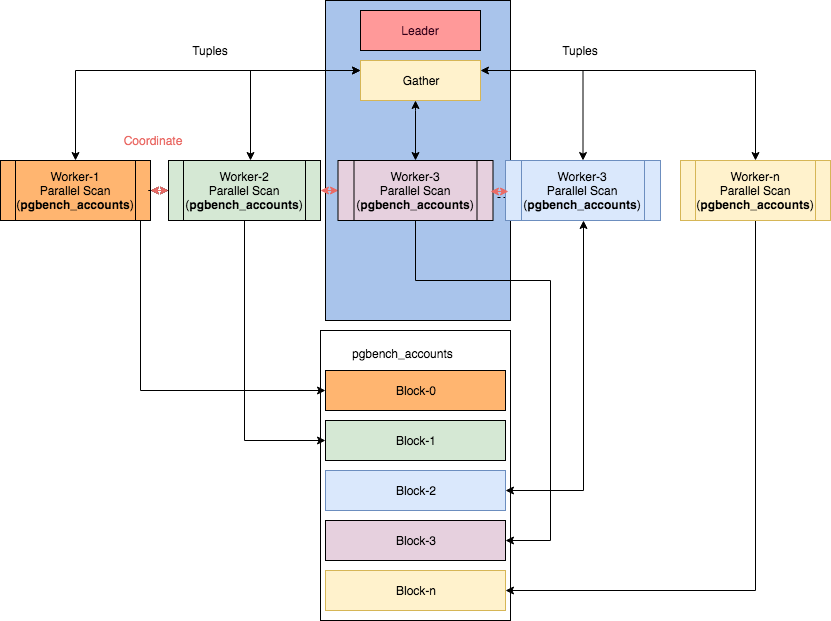
KingbaseES 的并行化包含三个重要组件:进程本身(leader进程)、gather、workers。查询执行是从leader进程开始。一旦开启了并行,就会分配一个gather节点和多个worker线程。relation blocks在各个workers线程之间划分。workers的数量受KingbaseES 的配置参数或对象参数控制。每个进程在内部称之为1个worker,这些worker可以动态地创建、销毁。
当用户输入一个查询语句时,查询分析、查询重写以及查询规划都和原来一样,只有到执行时,才开始真正进入并行查询环节。Gather 节点只是执行计划的一个子节点,属于执行计划的一部分,当查询执行走到Gather 节点时,会话进程会申请一定数量的worker 进程(根据配置参数,以及成本确定)来进行并行查询过程。Gather 进程充当leader worker 的角色,负责收集汇总各个worker 进程查询的结果。该leader worker 进程也会根据查询的数据量大小承担部分的并行查询部分。
Leader worker 进程和其他worker 进程通过动态共享内存进行通信,在每个worker初始化时就为每个worker分配共享内存,用于worker各自获取计划数据和缓存中间结果。其他worker 进程(包括leader worker 进程)把分担查询的结果存储到共享内存中,然后由leader worker 进程进行汇总整个查询的结果。所以需要注意的是,由于并行查询需要使用了动态共享内存,所以dynamic_shared_memory_type 参数需要设置为none 以外的值。下图截取自网络:
二、优化器与并行
查询优化器会根据表或索引大小减少或增加工作线程的数量,min_parallel_table_scan_size 和 min_parallel_index_scan_size 控制此行为。每当表比 min_parallel_(index|table)_scan_size 大 3 倍时,KingbaseES就会添加一个工作线程。Worker的数量不是基于成本的,相反,优化器使用简单的规则,这些规则在生产中可以调整的,可以使用 ALTER TABLE ... SET (parallel_workers = N) 修改特定表的Worker数量。
与worker 数量基于简单规则不同,优化器会基于cost,确认是否使用并行:
- parallel_setup_cost 该参数可以避免并行执行短查询。它对内存设置、进程启动和初始通信所花费的时间进行建模。
- parallel_tuple_cost , leader 和 worker 之间的通信可能需要很长时间,时间与worker发送的元组数量成正比。该参数对通信成本进行建模。
三、并行相关参数
- max_parallel_workers_per_gather 定义了每个并发操作可以使用的 worker的最大数量。该参数为0表示不使用并行。
- max_parallel_workers 定义并行池中所有 worker的数量,也就是整个实例最大并行进程数量。不能大于参数 max_worker_processes 值。
- max_worker_processes 定义了后台worker进程的总数量。
- min_parallel_table_scan_size 表的存储空间至少大于等于该值,才有可能触发并行,默认值8MB。
- min_parallel_index_scan_size 索引存储空间至少大于等于该数值,才有可能触发并行。默认256 KB。
- force_parallel_mode:强制开启并行模式的开关
- dynamic_shared_memory_type 必须被设置为除none之外的值。并行查询要求动态共享内存以便在合作的进程之间传递数据。
- parallel_setup_cost :以避免并行执行短查询。它对内存设置、进程启动和初始通信所花费的时间进行建模
- parallel_tuple_cost :leader 和 worker 之间的通信可能需要很长时间。时间与工作人员发送的元组数量成正比。该参数对通信成本进行建模。
四、主要并行操作
1、并行顺序扫描
顺序扫描是在表上进行的扫描,在该表中一个接一个的块顺序地被评估。顺序扫描允许并行化,这样,整个表将在多个workers线程之间顺序扫描。
test=# explain analyze select * from test where id>9999000;

                                                        QUERY PLAN

--------------------------------------------------------------------------------------------------------------------------

 Gather  (cost=1000.00..96045.36 rows=1000 width=19) (actual time=320.617..329.582 rows=1000 loops=1)

   Workers Planned: 4

   Workers Launched: 4

   ->  Parallel Seq Scan on test  (cost=0.00..94945.36 rows=250 width=19) (actual time=304.470..304.544 rows=200 loops=5)

         Filter: (id > 9999000)

         Rows Removed by Filter: 1999800

 Planning Time: 0.091 ms

 Execution Time: 329.732 ms

(8 rows)

test=# set max_parallel_workers_per_gather=0;    --关闭并行

SET

test=# explain analyze select * from test where id>9999000;

                                                  QUERY PLAN

--------------------------------------------------------------------------------------------------------------

 Seq Scan on test  (cost=0.00..188696.44 rows=1000 width=19) (actual time=871.033..871.126 rows=1000 loops=1)

   Filter: (id > 9999000)

   Rows Removed by Filter: 9999000

 Planning Time: 0.075 ms

 Execution Time: 871.168 ms

(5 rows)
以上例子从1000万条数据中返回1000条,使用并行相比于不使用并行,效率得到了很大提升。
注意:如果顺序扫描结果返回了大量的行,并行扫描的效率可能更低。请看以下例子:
test=# explain analyze select * from test where id>1000000;

                                                     QUERY PLAN

--------------------------------------------------------------------------------------------------------------------

 Seq Scan on test  (cost=0.00..188696.44 rows=8991074 width=19) (actual time=91.963..1173.468 rows=9000000 loops=1)

   Filter: (id > 1000000)

   Rows Removed by Filter: 1000000

 Planning Time: 0.055 ms

 Execution Time: 1452.951 ms

(5 rows)

test=# set force_parallel_mode=on;   --强制使用并行

SET

test=# explain analyze select * from test where id>1000000;

                                                        QUERY PLAN

--------------------------------------------------------------------------------------------------------------------------

 Gather  (cost=1000.00..1088803.84 rows=8991074 width=19) (actual time=97.620..4899.234 rows=9000000 loops=1)

   Workers Planned: 1

   Workers Launched: 1

   Single Copy: true

   ->  Seq Scan on test  (cost=0.00..188696.44 rows=8991074 width=19) (actual time=91.083..1803.754 rows=9000000 loops=1)

         Filter: (id > 1000000)

         Rows Removed by Filter: 1000000

 Planning Time: 0.046 ms

 Execution Time: 5578.338 ms

(9 rows)
以上例子由于返回了90%的,强制开启并行后,执行效率更低了。
2、并行聚合
KingbaseES 通过两个阶段的聚合来支持并行聚合。
- 每个参与查询计划 worker 执行一个聚合步骤, 为自身所负责的分组产生一个部分结果。这在计划中反映为一个 PartialAggregate节点。
- 部分结果被通过Gather 节点传输给 leader。最后, 领导者对所有 worker 的部分结果进行重聚合以得到最终的结果。 这在计划中反映为一个FinalizeAggregate节点。
具体见以下执行计划:
test=# explain analyze select max(id1) from t1 where id1>100000;

                                                                QUERY PLAN

------------------------------------------------------------------------------------------------------------------------------------------

 Finalize Aggregate  (cost=117450.53..117450.54 rows=1 width=4) (actual time=805.452..809.364 rows=1 loops=1)

   ->  Gather  (cost=117450.31..117450.52 rows=2 width=4) (actual time=805.337..809.355 rows=3 loops=1)

         Workers Planned: 2

         Workers Launched: 2

         ->  Partial Aggregate  (cost=116450.31..116450.32 rows=1 width=4) (actual time=799.425..799.425 rows=1 loops=3)

               ->  Parallel Seq Scan on t1  (cost=0.00..106139.24 rows=4124427 width=4) (actual time=5.677..543.455 rows=3300000 loops=3)

                     Filter: (id1 > 100000)

                     Rows Removed by Filter: 33333

 Planning Time: 0.115 ms

 Execution Time: 809.518 ms

(10 rows)
3、并行hashjoin
test=# explain analyze select count(*) from t1,t2 where id1=id2;

                                                                  QUERY PLAN

-----------------------------------------------------------------------------------------------------------------------------------------------

 Finalize Aggregate  (cost=113042.81..113042.82 rows=1 width=8) (actual time=1073.606..1075.476 rows=1 loops=1)

   ->  Gather  (cost=113042.59..113042.80 rows=2 width=8) (actual time=1073.235..1075.466 rows=3 loops=1)

         Workers Planned: 2

         Workers Launched: 2

         ->  Partial Aggregate  (cost=112042.59..112042.60 rows=1 width=8) (actual time=1066.525..1066.532 rows=1 loops=3)

               ->  Hash Join  (cost=584.79..112020.57 rows=8811 width=0) (actual time=7.975..1066.007 rows=6667 loops=3)

                     Hash Cond: (t1.id1 = t2.id2)

                     ->  Parallel Seq Scan on t1  (cost=0.00..95722.40 rows=4166740 width=4) (actual time=0.036..422.131 rows=3333333 loops=3)

                     ->  Hash  (cost=320.46..320.46 rows=21146 width=4) (actual time=7.622..7.623 rows=20000 loops=3)

                           Buckets: 32768  Batches: 1  Memory Usage: 960kB

                           ->  Seq Scan on t2  (cost=0.00..320.46 rows=21146 width=4) (actual time=0.029..3.258 rows=20000 loops=3)

 Planning Time: 0.140 ms

 Execution Time: 1075.664 ms
执行计划里可以看到,在做并行查询时,额外创建了2个worker进程,加上原来的master进程,总共3个进程。Join的外表(t1)数据被平均分配了3份,通过并行scan分散了I/O操作,之后跟hash表数据分别做Join。这里需要注意的是hash表对于每个worker都是完整的一份数据,需要扫描t2 表3次(loops=3)。
以上例子中,hash table由于比较小,并没有采取并行扫描。如果hash table比较大,也可能采用并行hash操作。如下例:
test=# explain analyze select count(*) from t1,t2 where id1=id2;

                                                                   QUERY PLAN

------------------------------------------------------------------------------------------------------------------------------------------------

 Finalize Aggregate  (cost=116941.21..116941.22 rows=1 width=8) (actual time=1535.865..1537.732 rows=1 loops=1)

   ->  Gather  (cost=116941.00..116941.21 rows=2 width=8) (actual time=1534.903..1537.723 rows=3 loops=1)

         Workers Planned: 2

         Workers Launched: 2

         ->  Partial Aggregate  (cost=115941.00..115941.01 rows=1 width=8) (actual time=1528.120..1528.122 rows=1 loops=3)

               ->  Parallel Hash Join  (cost=3860.19..115722.34 rows=87462 width=0) (actual time=29.306..1523.523 rows=66667 loops=3)

                     Hash Cond: (t1.id1 = t2.id2)

                     ->  Parallel Seq Scan on t1  (cost=0.00..95722.40 rows=4166740 width=4) (actual time=0.089..447.474 rows=3333333 loops=3)

                     ->  Parallel Hash  (cost=2316.75..2316.75 rows=123475 width=4) (actual time=28.407..28.407 rows=66667 loops=3)

                           Buckets: 262144  Batches: 1  Memory Usage: 9920kB

                           ->  Parallel Seq Scan on t2  (cost=0.00..2316.75 rows=123475 width=4) (actual time=0.031..10.664 rows=66667 loops=3)

 Planning Time: 0.183 ms

 Execution Time: 1537.846 ms

(13 rows)
4、并行nestloop
test=# explain analyze select count(*) from t1,t2 where id1=id2;

                                                                    QUERY PLAN

---------------------------------------------------------------------------------------------------------------------------------------------------

 Finalize Aggregate  (cost=1409318.65..1409318.66 rows=1 width=8) (actual time=5809.673..5811.717 rows=1 loops=1)

   ->  Gather  (cost=1409318.44..1409318.65 rows=2 width=8) (actual time=5809.422..5811.701 rows=3 loops=1)

         Workers Planned: 2

         Workers Launched: 2

         ->  Partial Aggregate  (cost=1408318.44..1408318.45 rows=1 width=8) (actual time=5803.356..5803.357 rows=1 loops=3)

               ->  Nested Loop  (cost=0.29..1408297.60 rows=8333 width=0) (actual time=0.229..5802.704 rows=6667 loops=3)

                     ->  Parallel Seq Scan on t1  (cost=0.00..95721.08 rows=4166608 width=4) (actual time=0.099..471.209 rows=3333333 loops=3)

                     ->  Index Only Scan using ind_t2_id2 on t2  (cost=0.29..0.31 rows=1 width=4) (actual time=0.001..0.001 rows=0 loops=10000000)

                           Index Cond: (id2 = t1.id1)

                           Heap Fetches: 0
outer table 分为3份,每份与inner table进行独立的连接,最后合并结果。
5、并行mergejoin
test=# explain analyze select count(*) from t1,t2 where id1=id2;

                                                                     QUERY PLAN

-----------------------------------------------------------------------------------------------------------------------------------------------------

 Finalize Aggregate  (cost=670764.90..670764.91 rows=1 width=8) (actual time=9288.707..9288.805 rows=1 loops=1)

   ->  Gather  (cost=670764.69..670764.90 rows=2 width=8) (actual time=9288.697..9288.800 rows=3 loops=1)

         Workers Planned: 2

         Workers Launched: 2

         ->  Partial Aggregate  (cost=669764.69..669764.70 rows=1 width=8) (actual time=8319.546..8319.547 rows=1 loops=3)

               ->  Merge Join  (cost=669520.85..669743.86 rows=8333 width=0) (actual time=8292.466..8319.171 rows=6667 loops=3)

                     Merge Cond: (t1.id1 = t2.id2)

                     ->  Sort  (cost=667780.84..678197.36 rows=4166608 width=4) (actual time=8281.889..8305.812 rows=6668 loops=3)

                           Sort Key: t1.id1

                           Sort Method: external merge  Disk: 51840kB

                           Worker 0:  Sort Method: external merge  Disk: 41408kB

                           Worker 1:  Sort Method: external merge  Disk: 43984kB

                           ->  Parallel Seq Scan on t1  (cost=0.00..95721.08 rows=4166608 width=4) (actual time=0.228..550.298 rows=3333333 loops=3)

                     ->  Sort  (cost=1737.77..1787.77 rows=20000 width=4) (actual time=8.703..9.907 rows=20000 loops=3)

                           Sort Key: t2.id2

                           Sort Method: quicksort  Memory: 1706kB

                           Worker 0:  Sort Method: quicksort  Memory: 1706kB

                           Worker 1:  Sort Method: quicksort  Memory: 1706kB

                           ->  Seq Scan on t2  (cost=0.00..309.00 rows=20000 width=4) (actual time=0.036..3.660 rows=20000 loops=3)

 Planning Time: 0.158 ms

 Execution Time: 9298.753 ms
t1 是大表,scan and sort 都采用了并行;t2 是小表,只有sort 操作采用并行。
6、并行append
test=# explain select * from t1 where id>9999000 union select * from t2 where id>9999900;

                                     QUERY PLAN

-------------------------------------------------------------------------------------

 HashAggregate  (cost=232797.86..232817.86 rows=2000 width=36)

   Group Key: t1.id, t1.data

   ->  Gather  (cost=1000.00..232787.86 rows=2000 width=36)

         Workers Planned: 2

         ->  Parallel Append  (cost=0.00..231587.86 rows=2000 width=36)

               ->  Parallel Seq Scan on t1  (cost=0.00..115778.93 rows=417 width=19)

                     Filter: (id > 9999000)

               ->  Parallel Seq Scan on t2  (cost=0.00..115778.93 rows=417 width=19)

                     Filter: (id > 9999900)
用于union all 的场景。
五、并行使用总结
现在支持的并行场景主要是以下3种:
- parallel sequential scan
- parallel join
- parallel aggregation
鉴于安全考虑,以下4种场景不支持并行:
- 公共表表达式(CTE)的扫描
- 临时表的扫描
- 外部表的扫描(除非外部数据包装器有一个IsForeignScanParallelSafeAPI)
- 对InitPlan或SubPlan的访问
使用并行查询,还有以下限制:
- 必须保证是严格的read only模式,不能改变database的状态
- 查询执行过程中,不能被挂起
- 隔离级别不能是SERIALIZABLE
- 不能调用PARALLEL UNSAFE函数
KingbaseES 并行查询的更多相关文章
- Oracle并行查询出错
1.错误描写叙述 ORA-12801: 并行查询服务器P007中发出错误信号 ORA-01722:无效数字 12801.00000 -"error signaled in parallel ...
- SQL调优(SQL TUNING)并行查询提示(Hints)之pq_distribute的使用
pq_distribute提示通常被用于提升数据仓库中分区表间的连接操作性能. pq_distribute提示允许你确定参与连接的表数据行在生产和消费并行查询服务进程间如何分配. pq_distrib ...
- PostgreSQL9.6的新特性并行查询
PostgreSQL在2016年9月发布了9.6版本,在该版本中新增了并行计算功能,目前PG支持的并行查询主要是顺序扫描(Sequencial Scans),并且支持部分链接查询(join)和聚合(a ...
- 【Oracle】 并行查询
所谓并行执行,是指能够将一个大型串行任务(任何DML,一般的DDL)物理的划分为叫多个小的部分,这些较小的部分可以同时得到处理.何时使用并行执行:1.必须有一个非常大的任务 2.必须有充足的资源(CP ...
- 基于MongoDB分布式存储进行MapReduce并行查询
中介绍了如何基于Mongodb进行关系型数据的分布式存储,有了存储就会牵扯到查询.虽然用普通的方式也可以进行查询,但今天要介绍的是如何使用MONGODB中提供的MapReduce功能进行查询. ...
- 并行查询提高sql查询速度
新项目在使用Oracle开发中遇到测试库千万级数据导致数据慢,除去加索引和存储过程可以明显提速外,使用并行也可以提速 select /*+parallel(a,8)*/ a.* from a 加上/* ...
- hive优化,并行查询
1.hive中控制并行执行的参数有如下几个: $ bin/hive -e set | grep parall hive.exec.parallel=false hive.exec.parallel.t ...
- sql server 2008 System.Data.SqlClient.SqlException (0x80131904): 查询处理器未能为执行并行查询启动必要的线程资源 处理方法
修改并行度: 修改了这个“最大并行度”,如果再没出现 cxpacket应该没问题了 参考资料:http://jingyan.baidu.com/article/5d6edee22daf8799eade ...
- KingbaseES 数据库参数优化
一.数据库应用类型 针对不同的应用模型,需要对数据库配置进行优化: 1.网络应用程序(WEB) 通常受 CPU 限制 DB比RAM小得多 90% 或更多的简单查询 2.在线事务处理 (OLTP) ...
随机推荐
- Linux安装MySQL,数据库工具连接Linux的MySQL
1.centOS中默认安装了MariaDB,需要先进行卸载 rpm -qa | grep -i mariadb rpm -e --nodeps 上面查出来的mariadb 2.下载MySQL仓库并安装 ...
- UiPath鼠标操作元素的介绍和使用
一.鼠标(mouse)操作的介绍 模拟用户使用鼠标操作的一种行为,例如单击,双击,悬浮.根据作用对象的不同我们可以分为对元素的操作.对文本的操作和对图像的操作 二.鼠标对元素的操作在UiPath中的使 ...
- jfinal中如何使用过滤器监控Druid监听SQL执行?
摘要:最开始我想做的是通过拦截器拦截SQL执行,但是经过测试发现,过滤器至少可以监听每一个SQL的执行与返回结果.因此,将这一次探索过程记录下来. 本文分享自华为云社区<jfinal中使用过滤器 ...
- Lambda表达式的无参数无返回值的练习和Lambda表达式有参数有返回值的练习
使用Lambda(无参无返回) 说明:给定一个厨师(Cook)接口,内含唯一的抽象方法makeFood,且无参数.无返回值.如下: public interface Cook{ public abst ...
- SpringMVC-01
1. 概述 1.1 概念 SpringMVC是一种基于Java实现MVC模型的轻量级Web框架 优点 使用简单,开发便捷(相比于Servlet) 灵活性强 项目请求响应架构演进: 软件三层 软件三层 ...
- Linux挂载webdav
Docker挂载webdav(推荐): docker run -itd \ --name mydav \ --device /dev/fuse \ --cap-add SYS_ADMIN \ --se ...
- 分析 java.util.Hashtable 源码
概述 基于J11,该类已经淘汰,如果使用线程安全的则用 ConcurrentHashMap ,用线程不安全的则使用 HashMap .仅与HashMap进行比较 结构以及依赖关系 HashTable ...
- 009 面试题 SQL语句各部分的执行顺序
SQL语句各部分的执行顺序 select distinct...from t1 (left/right) join t2 on t1.xx=t2.xx where t1.xx=? and t2.xx= ...
- DelayQueue达到定时触发效果
DelayQueue的特点就是插入Queue中的数据可以按照自定义的delay时间进行排序.只有delay时间小于0的元素才能够被取出. 这样子,只要开启一个线程循环从DelayQueue中取值执行, ...
- 我又造了个轮子:GrpcGateway
我个人对GRPC是比较感兴趣的,最近在玩通过前端调用GRPC.通过前端调用GRPC业界有两种方式:GRPC Web和GRPC JSON转码. GRPC Web 通过JS或者Blazor WASM调用G ...