
源码详解数据结构Linked List
摘要:java.util.LinkedList 是 Java 集合框架中的成员之一,底层是基于双向链表实现,集合容量可动态变化的。
本文分享自华为云社区《LinkedList 源码分析》,作者: 陈皮的JavaLib。
LinkedList 简介
java.util.Linked List 是 Java 集合框架中的成员之一,底层是基于双向链表实现,集合容量可动态变化的。它继承自 Abstract Sequential List 抽象类,实现了 List 接口。同时还实现了 Cloneable 和 Serializable 三个标记接口,说明 Array List 是可克隆复制的,可序列化的。
Array List 数组列表底层是基于动态数组实现的,所以优点是能支持快速随机访问,但是增删操作可能会比较慢(因为可能需要进行数组扩容,数据拷贝)。而且数组需要先申请一定的内存空间,可能会造成浪费。而链表列表 LinkedList 的优点是增删操作速度比较快,而且列表存储多少元素就动态申请多少节点来存储,比较节省内存空间。
为何要使用双向链表呢,主要在于遍历效率比单向链表高。例如当我们需要查找指定下标的节点,在指定下标进行增删改操作时,先判断这个位置是靠近头部还是尾部,从而决定从头部还是从尾部开始查找,提高效率。
public class LinkedList<E>

    extends AbstractSequentialList<E>

    implements List<E>, Deque<E>, Cloneable, java.io.Serializable {

}
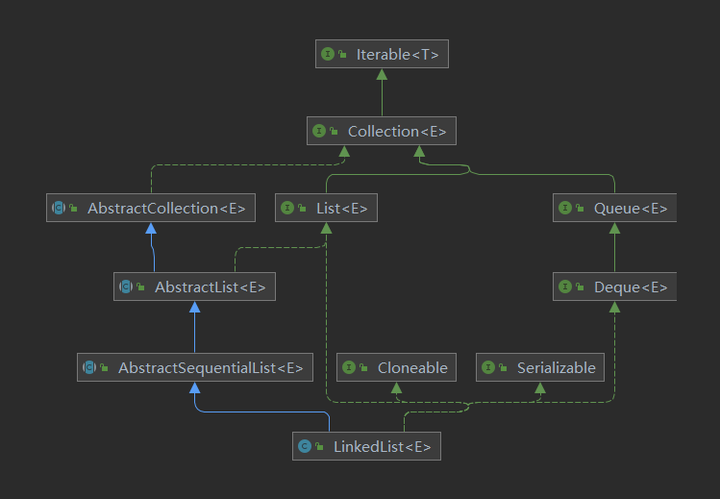
2 LinkedList 源码分析
2.1 内部变量
LinkedList 的元素是存储在节点对象中的,节点类是 LinkedList 类的一个内部私有静态类,源码如下所示:
private static class Node<E> {

    E item;

    Node<E> next;

    Node<E> prev;

    Node(Node<E> prev, E element, Node<E> next) {

        this.item = element;

        this.next = next;

        this.prev = prev;

    }

}
LinkedList 中定义了3个变量,一个代表当前列表的元素个数,另外两个变量指向链表的头部和尾部。以及它的父类 AbstractList 中的 modCount 变量,每次对链表的增删改操作都会使它加1。
transient int size = 0;

transient Node<E> first;

transient Node<E> last;

protected transient int modCount = 0;
2.2 构造函数
ArrayList 有2个构造函数,一个无参构造函数,另一个使用指定 Collection 集合来构造集合的构造函数。
无参构造函数,什么都没有操作。
public LinkedList() {}
使用指定 Collection 集合来构造链表,如果 Collection 不能为 null ,否则会抛出 npe 。
public LinkedList(Collection<? extends E> c) {

    this();

    addAll(c);

}

public boolean addAll(Collection<? extends E> c) {

    return addAll(size, c);

}

public boolean addAll(int index, Collection<? extends E> c) {

    checkPositionIndex(index);

    Object[] a = c.toArray();

    int numNew = a.length;

    if (numNew == 0)

        return false;

    Node<E> pred, succ;

    if (index == size) {

        succ = null;

        pred = last;

    } else {

        succ = node(index);

        pred = succ.prev;

    }

    for (Object o : a) {

        @SuppressWarnings("unchecked") E e = (E) o;

        Node<E> newNode = new Node<>(pred, e, null);

        if (pred == null)

            first = newNode;

        else

            pred.next = newNode;

        pred = newNode;

    }

    if (succ == null) {

        last = pred;

    } else {

        pred.next = succ;

        succ.prev = pred;

    }

    size += numNew;

    modCount++;

    return true;

}
2.3 常用方法
- public E getFirst()
获取链表的第一个元素,如果不存在第一个节点,抛出异常。
public E getFirst() {

    final Node<E> f = first;

    if (f == null)

        throw new NoSuchElementException();

    return f.item;

}
- public E getLast()
获取链表的最后一个元素,如果链表为空,则抛出异常。
public E getLast() {

    final Node<E> l = last;

    if (l == null)

        throw new NoSuchElementException();

    return l.item;

}
- public E removeFirst()
删除第一个元素,如果链表为空,则抛出异常。
public E removeFirst() {

    final Node<E> f = first;

    if (f == null)

        throw new NoSuchElementException();

    return unlinkFirst(f);

}
- public E removeLast()
删除最后一个元素,如果链表为空,则抛出异常。
public E removeLast() {

    final Node<E> l = last;

    if (l == null)

        throw new NoSuchElementException();

    return unlinkLast(l);

}
- public void clear()
情况链表,遍历每一个节点,将每一个节点的内部引用都置为 null ,便于进行垃圾回收。
public void clear() {

    for (Node<E> x = first; x != null; ) {

        Node<E> next = x.next;

        x.item = null;

        x.next = null;

        x.prev = null;

        x = next;

    }

    first = last = null;

    size = 0;

    modCount++;

}
- public boolean add(E e)
在链表尾部添加一个元素。
public boolean add(E e) {

    linkLast(e);

    return true;

}
- public Iterator iterator()
获取 list 的迭代器,用于遍历集合中的元素。
public Iterator<E> iterator() {

    return new Itr();

}
- public int size():返回集合元素个数。
- public boolean contains(Object o):是否包含某个元素。
- public boolean remove(Object o):删除某个元素。
- public E get(int index):获取指定下标的元素。
- public E set(int index, E element):在指定下标修改元素值。
- public void add(int index, E element):在指定下标添加元素。
3 常见面试题分析
3.1 LinkedList 是线程安全的吗?
我们通过分析源码可知,对它的任何操作都是没有加锁的,所以在多线程场景下,它是线程不安全的。它适合在非多线程使用场景下,并且增删操作比较多的情况。
public static void main(String[] args) throws InterruptedException {

    LinkedList<String> list = new LinkedList<>();

    Thread thread1 = new Thread(() -> {

      for (int i = 0; i < 1000; i++) {

        list.add(Thread.currentThread().getName() + i);

      }

    }, "Thread01");

    thread1.start();

    Thread thread2 = new Thread(() -> {

      for (int i = 0; i < 1000; i++) {

        list.add(Thread.currentThread().getName() + i);

      }

    }, "Thread02");

    thread2.start();

    thread1.join();

    thread2.join();

    System.out.println(list.size()); // 输出不一定是2000,例如1850

}
如果增删操作比较多的话,可以使用 LinkedList ,LinkedList 增删操作速度比较快。
如果需要线程安全的话,可以使用 JDK 集合中的工具类 Collections 提供一个方法 synchronizedList 可以将线程不安全的 List 集合变成线程安全的集合对象,如下所示。
public static void main(String[] args) throws InterruptedException {

    LinkedList<String> list = new LinkedList<>();

    // 封装成线程安全的集合

    List<String> synchronizedList = Collections.synchronizedList(list);

    Thread thread1 = new Thread(() -> {

      for (int i = 0; i < 1000; i++) {

        synchronizedList.add(Thread.currentThread().getName() + i);

      }

    }, "Thread01");

    thread1.start();

    Thread thread2 = new Thread(() -> {

      for (int i = 0; i < 1000; i++) {

        synchronizedList.add(Thread.currentThread().getName() + i);

      }

    }, "Thread02");

    thread2.start();

    thread1.join();

    thread2.join();

    System.out.println(synchronizedList.size());

 }
3.2 LinkedList 优缺点
- 优点:增删操作速度快,不仅有头部和尾部双指针,可以根据要操作的下标靠近哪边,从而决定从哪一边开始遍历找到指定的下标。找到位置后,删除和插入操作的时间复杂度为 O(1) 。
- 缺点:不支持快速随机访问,相对 ArrayList 比较慢,但也不是决定的,取决于列表的长度,以及访问的下标位置。
3.3 使用迭代器 Iterator 过程中,可以增删元素吗?
通过源码分析,在获取集合的迭代器方法中,返回的是 AbstractList 抽象类中定义的 ListItr 迭代器对象,在他的父类 Itr 中持有变量 expectedModCount ,在初始化迭代器对象时这个变量的值被赋予此时链表中的操作次数 modCount 。在迭代获取元素时,会检查这两变量是否相等,不相等则抛出并发修改异常。所以不支持在使用迭代器的过程中,对原链表进行增删改操作。但是可以调用迭代器的增删操作。
private class ListItr extends Itr implements ListIterator<E> {

    ListItr(int index) {

        cursor = index;

    }

    public boolean hasPrevious() {

        return cursor != 0;

    }

    public E previous() {

        checkForComodification();

        try {

            int i = cursor - 1;

            E previous = get(i);

            lastRet = cursor = i;

            return previous;

        } catch (IndexOutOfBoundsException e) {

            checkForComodification();

            throw new NoSuchElementException();

        }

    }

    public int nextIndex() {

        return cursor;

    }

    public int previousIndex() {

        return cursor-1;

    }

    public void set(E e) {

        if (lastRet < 0)

            throw new IllegalStateException();

        checkForComodification();

        try {

            AbstractList.this.set(lastRet, e);

            expectedModCount = modCount;

        } catch (IndexOutOfBoundsException ex) {

            throw new ConcurrentModificationException();

        }

    }

    public void add(E e) {

        checkForComodification();

        try {

            int i = cursor;

            AbstractList.this.add(i, e);

            lastRet = -1;

            cursor = i + 1;

            expectedModCount = modCount;

        } catch (IndexOutOfBoundsException ex) {

            throw new ConcurrentModificationException();

        }

    }

}

private class Itr implements Iterator<E> {

    /**

     * Index of element to be returned by subsequent call to next.

     */

    int cursor = 0;

    /**

     * Index of element returned by most recent call to next or

     * previous.  Reset to -1 if this element is deleted by a call

     * to remove.

     */

    int lastRet = -1;

    /**

     * The modCount value that the iterator believes that the backing

     * List should have.  If this expectation is violated, the iterator

     * has detected concurrent modification.

     */

    int expectedModCount = modCount;

    public boolean hasNext() {

        return cursor != size();

    }

    public E next() {

        checkForComodification();

        try {

            int i = cursor;

            E next = get(i);

            lastRet = i;

            cursor = i + 1;

            return next;

        } catch (IndexOutOfBoundsException e) {

            checkForComodification();

            throw new NoSuchElementException();

        }

    }

    public void remove() {

        if (lastRet < 0)

            throw new IllegalStateException();

        checkForComodification();

        try {

            AbstractList.this.remove(lastRet);

            if (lastRet < cursor)

                cursor--;

            lastRet = -1;

            expectedModCount = modCount;

        } catch (IndexOutOfBoundsException e) {

            throw new ConcurrentModificationException();

        }

    }

    final void checkForComodification() {

        if (modCount != expectedModCount)

            throw new ConcurrentModificationException();

    }

}
3.4 LinkedList 可以存储 null 值吗?元素可以重复吗?
LinkedList 底层是由双向链表实现的,并且在添加元素的时候,没有对元素进行值校验,所以可以存储 null 值,并且存储的元素是可以重复的。
public boolean add(E e) {

    linkLast(e);

    return true;

}

void linkLast(E e) {

    final Node<E> l = last;

    final Node<E> newNode = new Node<>(l, e, null);

    last = newNode;

    if (l == null)

        first = newNode;

    else

        l.next = newNode;

    size++;

    modCount++;

}
3.5 如何边遍历 ArrayList 元素,边删除指定元素?
不支持在遍历的同时对原链表进行操作,会抛出 ConcurrentModificationException 并发修改异常,前面我们提到使用迭代器 Iterator 遍历集合时,不能对集合进行增删操作(会导致 modCount 值变化)。应该使用 Iterator 类的 remove 方法。
package com.chenpi;

import java.util.Iterator;

import java.util.LinkedList;

/**

 * @author 陈皮

 * @version 1.0

 * @description

 * @date 2022/3/1

 */

public class ChenPi {

  public static void main(String[] args) {

    LinkedList<String> list = new LinkedList<>();

    list.add("Java");

    list.add("C++");

    list.add("Python");

    list.add("Lua");

    Iterator<String> iterator = list.iterator();

    while (iterator.hasNext()) {

      String next = iterator.next();

      if ("C++".equals(next)) {

        iterator.remove();

        continue;

      }

      System.out.println(next);

    }

  }

}

// 输出结果如下

Java

Python

Lua
源码详解数据结构Linked List的更多相关文章
- 数据结构与算法系列2 线性表 使用java实现动态数组+ArrayList源码详解
数据结构与算法系列2 线性表 使用java实现动态数组+ArrayList源码详解 对数组有不了解的可以先看看我的另一篇文章,那篇文章对数组有很多详细的解析,而本篇文章则着重讲动态数组,另一篇文章链接 ...
- RocketMQ源码详解 | Broker篇 · 其三:CommitLog、索引、消费队列
概述 上一章中,已经介绍了 Broker 的文件系统的各个层次与部分细节,本章将继续了解在逻辑存储层的三个文件 CommitLog.IndexFile.ConsumerQueue 的一些细节.文章最后 ...
- Spark Streaming揭秘 Day25 StreamingContext和JobScheduler启动源码详解
Spark Streaming揭秘 Day25 StreamingContext和JobScheduler启动源码详解 今天主要理一下StreamingContext的启动过程,其中最为重要的就是Jo ...
- spring事务详解(三)源码详解
系列目录 spring事务详解(一)初探事务 spring事务详解(二)简单样例 spring事务详解(三)源码详解 spring事务详解(四)测试验证 spring事务详解(五)总结提高 一.引子 ...
- 条件随机场之CRF++源码详解-预测
这篇文章主要讲解CRF++实现预测的过程,预测的算法以及代码实现相对来说比较简单,所以这篇文章理解起来也会比上一篇条件随机场训练的内容要容易. 预测 上一篇条件随机场训练的源码详解中,有一个地方并没有 ...
- [转]Linux内核源码详解--iostat
Linux内核源码详解——命令篇之iostat 转自:http://www.cnblogs.com/york-hust/p/4846497.html 本文主要分析了Linux的iostat命令的源码, ...
- saltstack源码详解一
目录 初识源码流程 入口 1.grains.items 2.pillar.items 2/3: 是否可以用python脚本实现 总结pillar源码分析: @(python之路)[saltstack源 ...
- Shiro 登录认证源码详解
Shiro 登录认证源码详解 Apache Shiro 是一个强大且灵活的 Java 开源安全框架,拥有登录认证.授权管理.企业级会话管理和加密等功能,相比 Spring Security 来说要更加 ...
- udhcp源码详解(五) 之DHCP包--options字段
中间有很长一段时间没有更新udhcp源码详解的博客,主要是源码里的函数太多,不知道要不要一个一个讲下去,要知道讲DHCP的实现理论的话一篇博文也就可以大致的讲完,但实现的源码却要关心很多的问题,比如说 ...
- Activiti架构分析及源码详解
目录 Activiti架构分析及源码详解 引言 一.Activiti设计解析-架构&领域模型 1.1 架构 1.2 领域模型 二.Activiti设计解析-PVM执行树 2.1 核心理念 2. ...
随机推荐
- centos服务器搭建https
一.环境 OS:CentOS Linux release 8.2.2004 (Core) 硬件:某外网云服务器虚拟机 二.安装命令 1.安装nginx yum install nginx 2.安装签发 ...
- powershell 7 初体验
支持枚举定义,类定义\类继承\接口继承,不支持接口定义\泛型类定义\泛型函数定义,但是作为shell脚本已经相当让人惊喜了, 基本逻辑可以直接套用C#语法格式 # enum_sample/main.p ...
- QPainter和QPainterPath理解
QPainter和QPainterPath QPainterPath (一)简介 (二)常用函数 1.addEllipse() 2.addPath() 3.addPolygon() 4.addRect ...
- 把工单历史表中的数据,按照工单进行分类,每一批工单的数据放在同一个 key 中
/** * 把工单历史表中的数据,按照工单进行分类,每一批工单的数据放在同一个key中 * 将对象列表按名称分类成 Map(分类名必与对象的某 get 方法的后的名一致<如:get(name) ...
- 文心一言 VS 讯飞星火 VS chatgpt (130)-- 算法导论11.2 2题
二.用go语言,对于一个用链接法解决冲突的散列表,说明将关键字 5,28,19,15,20,33,12,17,10 插入到该表中的过程.设该表中有 9 个槽位,并设其散列函数为 h(k)=k mod ...
- 【misc】ctfshow-stega10 --套娃
附件下载下来是一张图片 各种隐写工具一把梭,无果,分析其二进制数据,把图片拖进hxd,发现一段疑似base64的东西 base64解密试试 解密出来是一个网址,打开下载第二个附件:flag.zip,打 ...
- ez_sql
打开界面是查询界面 点击不同的查询页面返回的内容不同,然后url的地址发生变化,毫无疑问注入点在id处 这里直接进行测试 单引号无回显 双引号回显id不存在 初步判断为字符型注入且为单引号包裹 因为双 ...
- 学生开发者勇担青年使命,用AI守护少数人的“视界”
本文分享自华为云社区<[先锋开发者云上说]学生开发者勇担青年使命,用AI守护少数人的"视界">,作者:华为云社区精选 . 青年动人之处,在于他们的勇气,和非凡的创造探索 ...
- Calendar日历类型常见方法(必看!!)
Hi i,m JinXiang 前言 本篇文章主要介绍Calendar日历类型的几种常见方法以及部分理论知识 欢迎点赞 收藏 留言评论 私信必回哟 博主收将持续更新学习记录获,友友们有任何问题可以在 ...
- Streamlit 快速构建交互式页面的python库
基础介绍 streamlit 是什么 Streamlit是一个面向机器学习和数据科学团队的开源应用程序框架,通过它可以用python代码方便快捷的构建交互式前端页面.streamlit特别适合结合大模 ...