
orocos_kdl学习(二):KDL Tree与机器人运动学
KDL(Kinematics and Dynamics Library)中定义了一个树来代表机器人的运动学和动力学参数,ROS中的kdl_parser提供了工具能将机器人描述文件URDF转换为KDL tree.
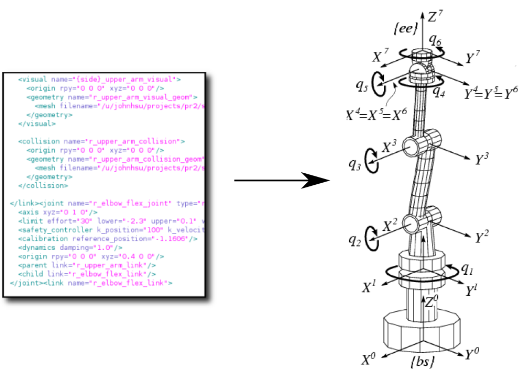
Kinematic Trees: 链或树形结构。已经有多种方式来定义机构的运动学结构,KDL使用图论中的术语来定义:
- A closed-loop mechanism is a graph, 闭链机构是一幅图
- an open-loop mechanism is a tree, 开链机构是一棵树
- an unbranched tree is a chain. 没有分支的树是一个运动链
KDL Chain和KDL Tree都由最基本的KDL Segments元素串接而成,Segment可以理解为机构运动链上的一个运动部件。如下图所示KDL Segment包含关节KDL Joint 以及部件的质量/惯性属性KDL RigidBodyInertia,并且定义了一个参考坐标系Freference和末端坐标系Ftip
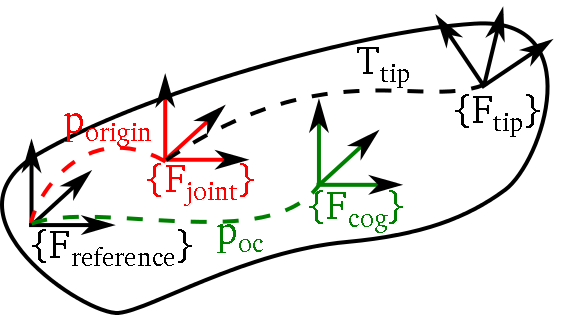
KDL segment
末端到关节坐标系的转换由Ttip描述。在一个运动链或树中,子部件会被添加到父部件的末端,因此上一个部件的Ftip就是下一个部件的参考坐标系Freference (tip frame of parent = reference frame of the child). 通常Fjoint和Freference是重合的,但是也可以存在偏移。
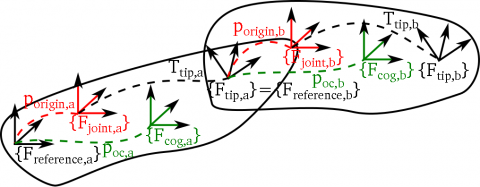
KDL chain
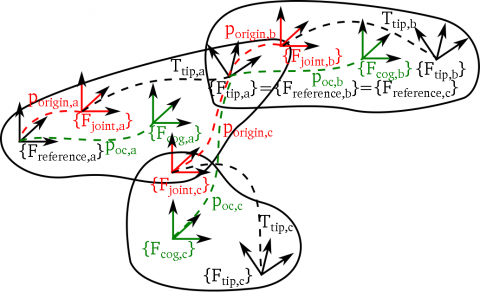
KDL tree
KDL中的定义与URDF中的定义基本是一样的:
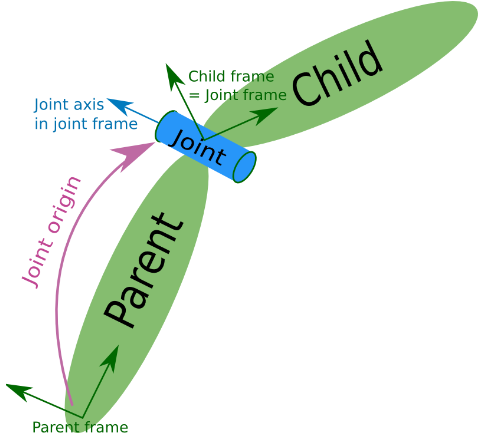
也可以参考MATLAB Robotics System Toolbox中的对Rigid Body Tree Robot Model的描述:

Python中创建KDL tree
参考pykdl_utils,pykdl_utils中包含了kdl_parser.py(用于解析URDF文件并将其转换为KDL tree或chain),kdl_kinematics.py(封装了KDL kinematics的一系列函数,使得用Python调用更方便)等实用程序。下面先安装urdfdom_py(Python implementation of the URDF parser):
sudo apt-get install ros-indigo-urdfdom-py
然后在github上下载pykdl_utils的源代码,使用catkin_make进行编译。
convert URDF objects into PyKDL.Tree
首先通过urdf_parser_py来解析URDF文件,有下面几种使用方式:通过xml字符串解析、xml文件解析,以及从ROS 参数服务器获取robot_description字符串信息。
#! /usr/bin/env python

# Load the urdf_parser_py manifest, you use your own package

# name on the condition but in this case, you need to depend on

# urdf_parser_py.

import roslib; roslib.load_manifest('urdfdom_py')

import rospy

# Import the module

from urdf_parser_py.urdf import URDF

# 1. Parse a string containing the robot description in URDF.

# Pro: no need to have a roscore running.

# Cons: n/a

# Note: it is rare to receive the robot model as a string.

robot = URDF.from_xml_string("<robot name='myrobot'></robot>")

# - OR -

# 2. Load the module from a file.

# Pro: no need to have a roscore running.

# Cons: using hardcoded file location is not portable.

robot = URDF.from_xml_file()

# - OR -

# 3. Load the module from the parameter server.

# Pro: automatic, no arguments are needed, consistent

#      with other ROS nodes.

# Cons: need roscore to be running and the parameter to

#      to be set beforehand (through a roslaunch file for

#      instance).

robot = URDF.from_parameter_server()

# Print the robot

print(robot)
下面编写一个简单的robot.urdf文件,创建一个连杆机器人。joint1为与基座link0相连的基关节,joint3为末端关节。
<robot name="test_robot">

    <link name="link0" />

    <link name="link1" />

    <link name="link2" />

    <link name="link3" />

    <joint name="joint1" type="continuous">

        <parent link="link0"/>

        <child link="link1"/>

        <origin xyz="0 0 0" rpy="0 0 0" />

        <axis xyz="1 0 0" />

    </joint>

    <joint name="joint2" type="continuous">

        <parent link="link1"/>

        <child link="link2"/>

        <origin xyz="0 0 1" rpy="0 0 0" />

        <axis xyz="1 0 0" />

    </joint>

    <joint name="joint3" type="continuous">

        <parent link="link2"/>

        <child link="link3"/>

        <origin xyz="0 0 1" rpy="0 0 0" />

        <axis xyz="1 0 0" />

    </joint>

</robot>
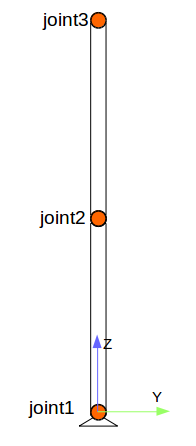
pykdl_utils中还提供了下列几个指令用于测试分析我们的机器人,如果ROS参数服务器中加载了/robot_description则命令行中的xml文件可以省略:
rosrun pykdl_utils kdl_parser.py [robot.xml]

rosrun pykdl_utils kdl_kinematics.py [robot.xml]

rosrun pykdl_utils joint_kinematics.py [robot.xml]
对于我们上面编写的robot.urdf文件,可以用下面命令进行测试:
rosrun pykdl_utils kdl_parser.py `rospack find test`/robot.urdf
下面是KDL运动学一些基本的用法,相关函数可以参考:KDLKinematics Class Reference
#! /usr/bin/env python

# Import the module

from urdf_parser_py.urdf import URDF

from pykdl_utils.kdl_parser import kdl_tree_from_urdf_model

from pykdl_utils.kdl_kinematics import KDLKinematics

robot = URDF.from_xml_file("/home/sc/catkin_ws/src/test/robot.urdf")

tree = kdl_tree_from_urdf_model(robot)

print tree.getNrOfSegments()

chain = tree.getChain("link0", "link3")

print chain.getNrOfJoints()

# forwawrd kinematics

kdl_kin = KDLKinematics(robot, "link0", "link3")

q = [0, 0, 0]

pose = kdl_kin.forward(q) # forward kinematics (returns homogeneous 4x4 matrix)

print pose

q_ik = kdl_kin.inverse(pose) # inverse kinematics

print q_ik

if q_ik is not None:

    pose_sol = kdl_kin.forward(q_ik) # should equal pose

print pose_sol

J = kdl_kin.jacobian(q)

print 'J:', J
我们将URDF文件转换为KDL tree以后可以获取机构运动链/树的相关信息。KDLKinematics的构造函数根据urdf文件,以及机器人的基座base_link和末端end_link就可以创建出运动链:
def pykdl_utils.kdl_kinematics.KDLKinematics.__init__    (self, urdf, base_link, end_link, kdl_tree = None)

# Parameters:

# urdf    URDF object of robot.

# base_link    Name of the root link of the kinematic chain.

# end_link    Name of the end link of the kinematic chain.

# kdl_tree    Optional KDL.Tree object to use. If None, one will be generated from the URDF.
正运动学的计算函数forward参数就是关节角度;逆运动学计算函数inverse的参数为末端位姿矩阵,因为是数值解,还可以指定初始值,以及关节角的范围。
# Inverse kinematics for a given pose, returning the joint angles required to obtain the target pose.

def pykdl_utils.kdl_kinematics.KDLKinematics.inverse(self, pose, q_guess = None, min_joints = None, max_joints = None )


# Parameters:

# pose    Pose-like object represeting the target pose of the end effector.

# q_guess    List of joint angles to seed the IK search.

# min_joints    List of joint angles to lower bound the angles on the IK search. If None, the safety limits are used.

# max_joints    List of joint angles to upper bound the angles on the IK search. If None, the safety limits are used.
C++中创建KDL tree
为了使用KDL parser需要在package.xml中添加相关依赖项:
  <package>

    ...

    <build_depend package="kdl_parser" />

    ...

    <run_depend package="kdl_parser" />

    ...

  </package>
另外还需要在C++程序中加入相关的头文件:
#include <kdl_parser/kdl_parser.hpp>
下面有多种从urdf创建KDL tree的方式:
1. From a file
   KDL::Tree my_tree;

   if (!kdl_parser::treeFromFile("filename", my_tree)){

      ROS_ERROR("Failed to construct kdl tree");

      return false;

   }
2. From the parameter server
   KDL::Tree my_tree;

   ros::NodeHandle node;

   std::string robot_desc_string;

   node.param("robot_description", robot_desc_string, std::string());

   if (!kdl_parser::treeFromString(robot_desc_string, my_tree)){

      ROS_ERROR("Failed to construct kdl tree");

      return false;

   }
3. From an xml element
   KDL::Tree my_tree;

   TiXmlDocument xml_doc;

   xml_doc.Parse(xml_string.c_str());

   xml_root = xml_doc.FirstChildElement("robot");

   if (!xml_root){

      ROS_ERROR("Failed to get robot from xml document");

      return false;

   }

   if (!kdl_parser::treeFromXml(xml_root, my_tree)){

      ROS_ERROR("Failed to construct kdl tree");

      return false;

   }
4. From a URDF model
   KDL::Tree my_tree;

   urdf::Model my_model;

   if (!my_model.initXml(....)){

      ROS_ERROR("Failed to parse urdf robot model");

      return false;

   }

   if (!kdl_parser::treeFromUrdfModel(my_model, my_tree)){

      ROS_ERROR("Failed to construct kdl tree");

      return false;

   }
参考:
Robotics System Toolbox—Rigid Body Tree Robot Model
orocos_kdl学习(二):KDL Tree与机器人运动学的更多相关文章
- TRAC-IK机器人运动学求解器
TRAC-IK和Orocos KDL类似,也是一种基于数值解的机器人运动学求解器,但是在算法层面上进行了很多改进(Specifically, KDL’s convergence algorithms ...
- emberjs学习二(ember-data和localstorage_adapter)
emberjs学习二(ember-data和localstorage_adapter) 准备工作 首先我们加入ember-data和ember-localstorage-adapter两个依赖项,使用 ...
- 集成学习二: Boosting
目录 集成学习二: Boosting 引言 Adaboost Adaboost 算法 前向分步算法 前向分步算法 Boosting Tree 回归树 提升回归树 Gradient Boosting 参 ...
- Android JNI学习(二)——实战JNI之“hello world”
本系列文章如下: Android JNI(一)——NDK与JNI基础 Android JNI学习(二)——实战JNI之“hello world” Android JNI学习(三)——Java与Nati ...
- ReactJS入门学习二
ReactJS入门学习二 阅读目录 React的背景和基本原理 理解React.render() 什么是JSX? 为什么要使用JSX? JSX的语法 如何在JSX中如何使用事件 如何在JSX中如何使用 ...
- TweenMax动画库学习(二)
目录 TweenMax动画库学习(一) TweenMax动画库学习(二) TweenMax动画库学习(三) Tw ...
- Hbase深入学习(二) 安装hbase
Hbase深入学习(二) 安装hbase This guidedescribes setup of a standalone hbase instance that uses the local fi ...
- Struts2框架学习(二) Action
Struts2框架学习(二) Action Struts2框架中的Action类是一个单独的javabean对象.不像Struts1中还要去继承HttpServlet,耦合度减小了. 1,流程 拦截器 ...
- Python学习二:词典基础详解
作者:NiceCui 本文谢绝转载,如需转载需征得作者本人同意,谢谢. 本文链接:http://www.cnblogs.com/NiceCui/p/7862377.html 邮箱:moyi@moyib ...
随机推荐
- Thread类中的join方法
package charpter06; //类实现接口public class Processor implements Runnable { // 重写接口方法 @Override public v ...
- [颜色知识] 潘通色卡、CMYK、RGB、 ARGB...
潘通色卡C结尾的色号都是RGB色系的,而CMYK是印刷系的,两者不能通用的,所以,不能完全对等进行转换 Pantone Colors [色卡]PANTONE潘通色卡C面颜色http://blog.si ...
- [SDOI2012]象棋
题解: sd的题目也真是奇怪 第一题有了最短路第二题还有 第二题有了网络流第三题还有 显然是可以网络流的 但考虑每个点只能存在一个这个条件 刚开始我以为是建分层图..但发现这个时间复杂度太高了 其实我 ...
- [SDOI2014]数数
题解: 做过ac自动机上dp的这题应该就很容易想到了 首先在ac自动机上搞dp 表示当前考虑了i位,在自动机的j位上 然后转移就可以了 考虑限制 显然是一个数位dp 考虑位数小于n显然满足要求 考虑位 ...
- day--16页面布局
后台页面布局 一.fixed布局 <!DOCTYPE html> <html lang="en"> <head> <meta ch ...
- GitHub安装教程
第一步是安装两个软件 安装 git for windows这个是一个git的windows系统的命令行版本https://git-scm.com/downloads或者https://pan.baid ...
- TotoriseGit安装
1.前提 前提是有安装过git. 2.下载 3.安装 二:参考的文档 1.不错的文档 https://www.cnblogs.com/xinlj/p/5978730.html http://blog. ...
- QT学习之第一个程序
QT学习之第一个程序 目录 手动创建主窗口 居中显示 添加窗口图标 显示提示文本 Message Box的应用 手动连接信号与槽 手动创建主窗口 窗口类型 QMainWindow: 可以包含菜单栏.工 ...
- 项目冲刺 Sixth
Sixth Sprint 1.各个成员今日完成的任务 蔡振翼:编写博客 谢孟轩:完善了编辑界面,实现续约功能 林凯:初步实现注册功能 肖志豪:帮助组员 吴文清:完善管理员图书录入功能以及图书录入的界面 ...
- bzoj 3991: [SDOI2015]寻宝游戏 虚树 set
目录 题目链接 题解 代码 题目链接 bzoj 3991: [SDOI2015]寻宝游戏 题解 发现每次答案就是把虚树上的路径*2 接在同一关键点上的点的dfs序是相邻的 那么用set动态维护dfs序 ...