
ID3决策树
决策树
- 优点:计算复杂度不高,输出结果易于理解,对中间值的缺少不敏感,可以处理不相关特征数据
- 缺点:过拟合
决策树的构造
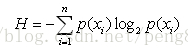
熵:混乱程度,信息的期望值
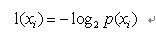
其中p(xi)是选择分类的概率
熵就是计算所有类别所有可能值包含的信息期望值,公式如下:
构造基本思路
信息增益 = 初始香农熵-新计算得到的香农熵(混乱程度下降的多少)
创建根节点(数据)
分裂:选择合适的特征进行分裂,采取的办法是遍历每个特征,然后计算并累加每个特征值的香农熵,与其他特征所计算出来的香农熵对比,选取信息增益最大的那个作为最大信息增益的特征节点进行分裂,分裂时,该特征有几个特征值,就会分裂成多少个树干,之后重复迭代分裂直至不能再分裂为止
好了!懂这些就可以直接上代码了!
from math import log

import operator

def calcShannonEnt(dataSet):

    "计算熵,熵代表不确定度,混乱程度"

    numEntries = len(dataSet)  #训练样本总数

    labelCounts = {}

    for featVec in dataSet:

        currentLabel = featVec[-1]   #取标签

        if currentLabel not in labelCounts.keys():

            labelCounts[currentLabel] = 0

        labelCounts[currentLabel] += 1    #计算对应标签的数量

    shannonEnt = 0.0  #初始化熵

    for key in labelCounts:

        "遍历每个标签字典,标签字典中包含每个标签的数量"

        prob = float(labelCounts[key]) / numEntries    #计算选择该分类的概率概率

        shannonEnt -= prob * log(prob,2)

    return shannonEnt

def createDataSet():

    dataSet = [

        [1,1,'yes'],

        [1,1,'yes'],

        [1,0,'no'],

        [0,1,'no'],

        [0,1,'no'],

    ]

    labels = ['no surfacing','flippers']

    return dataSet,labels

myDat , labels = createDataSet()

ret = calcShannonEnt(myDat)

print(ret)

def splitDataSet(dataSet,axis,value):

    retDataSet = []

    for featVec in dataSet:

        if featVec[axis] == value:

            "把选定特征为特定值的数据集分离出来"

            reducedFeatVec = featVec[:axis]

            reducedFeatVec.extend(featVec[axis+1:])  #把一个列表压缩进一个列表去而不是单纯append

            retDataSet.append(reducedFeatVec)

    return retDataSet

def chooseBestFeatureToSplit(dataSet):

    numFeatures = len(dataSet[0]) - 1

    baseEntropy = calcShannonEnt(dataSet)

    bestInfoGain = 0.0 #信息增益

    bestFeature = -1

    for i in range(numFeatures):

        "遍历特征,选择最大信息增益的特征"

        featList = [example[i] for example in dataSet]  #按特征提取数据,用于分割数据

        uniqueVals = set(featList)  #去重

        newEntropy = 0.0

        for value in uniqueVals:

            "遍历每个不同的特征值,将遍历的每个特征值为节点进行分割,计算熵,累加,选择最大信息增益的特征"

            subDataSet = splitDataSet(dataSet,i,value)#分割数据集,将第几个特征为哪个特征值的数据分离出来

            prob = len(subDataSet) / float(len(dataSet))  #计算这个特征为这个特征值的发生概率

            newEntropy += prob * calcShannonEnt(subDataSet)

        infoGain = baseEntropy - newEntropy  #信息增益:熵值的减少

        if(infoGain > bestInfoGain):

            bestInfoGain = infoGain

            bestFeature = i

    return bestFeature

def majorityCnt(classList):

    "最大投票器,用于数据集只有一个特征的时候"

    classcount = {}

    for vote in classList:

        if vote not in classcount.keys(): classcount[vote] =0

        classcount += 1

    sorteClassCount = sorted(classcount.items(),key=operator.itemgetter(1),reverse=True)

    #由大到小 字典的值排序

    return sorteClassCount[0][0]

def createTree(dataSet,labels):

    classList = [example[-1] for example in dataSet] #取标签

    if classList.count(classList[0]) == len(classList):

        "类别相同停止继续划分"

        return classList[0]

    if len(dataSet[0]) == 1:

        "停止划分,因为没有特征"

        return majorityCnt(classList)

    bestFeat = chooseBestFeatureToSplit(dataSet)

    bestFeatLabel = labels[bestFeat]

    mytree = {bestFeatLabel:{}}

    del(labels[bestFeat])  #该特征也被已划分节点,删除特征

    featValues = [example[bestFeat] for example in dataSet] #提取对于该节点信息增益最大的特征的所有特征值

    uniqueVals = set(featValues) #去重

    for value in uniqueVals:

        "为该节点下最大信息增益的特征的不重合特征值进行再次创建决策树"

        subLabels = labels[:]

        mytree[bestFeatLabel][value] = createTree(splitDataSet(

            dataSet,bestFeat,value

        ),subLabels)

    return mytree

def classify(inputTree,featLabels,testVec):

    "训练完毕,用于预测"

    firstStr = inputTree.keys()[0]  #取第一个节点

    secondDict = inputTree[firstStr]

    featIndex = featLabels.index(firstStr)  #查看这个特征的索引(查这是第几个特征)

    for key in secondDict.keys():

        if testVec[featIndex] == key:

            if type(secondDict[key]).__name__ == 'dict':

                classLabel = classify(secondDict[key],featLabels,testVec)

            else:

                classLabel = secondDict[key]

    return classLabel

def storeTree(inputTree,filename):

    "保存训练完毕的决策树模型"

    import pickle

    fw = open(filename,'w')

    pickle.dump(inputTree,fw)

    fw.close()

def grabTree(filename):

    "加载以保存的决策树模型"

    import pickle

    fr = open(filename)

    return pickle.load(filename,fr)
'''

绘制决策树

'''

import matplotlib.pyplot as plt

decisionNode = dict(boxstyle="sawtooth", fc="0.8")

leafNode = dict(boxstyle="round4", fc="0.8")

arrow_args = dict(arrowstyle="<-")

def getNumLeafs(myTree):

    numLeafs = 0

    firstStr = list(myTree)[0]

    secondDict = myTree[firstStr]

    for key in secondDict.keys():

        if type(secondDict[key]).__name__ == 'dict':#test to see if the nodes are dictonaires, if not they are leaf nodes

            numLeafs += getNumLeafs(secondDict[key])

        else: numLeafs += 1

    return numLeafs

def getTreeDepth(myTree):

    maxDepth = 0

    firstStr = list(myTree)[0]

    secondDict = myTree[firstStr]

    for key in secondDict.keys():

        if type(secondDict[key]).__name__ == 'dict':#test to see if the nodes are dictonaires, if not they are leaf nodes

            thisDepth = 1 + getTreeDepth(secondDict[key])

        else: thisDepth = 1

        if thisDepth > maxDepth: maxDepth = thisDepth

    return maxDepth

def plotNode(nodeTxt, centerPt, parentPt, nodeType):

    createPlot.ax1.annotate(nodeTxt, xy=parentPt, xycoords='axes fraction',

                            xytext=centerPt, textcoords='axes fraction',

                            va="center", ha="center", bbox=nodeType, arrowprops=arrow_args)

def plotMidText(cntrPt, parentPt, txtString):

    xMid = (parentPt[0]-cntrPt[0])/2.0 + cntrPt[0]

    yMid = (parentPt[1]-cntrPt[1])/2.0 + cntrPt[1]

    createPlot.ax1.text(xMid, yMid, txtString, va="center", ha="center", rotation=30)

def plotTree(myTree, parentPt, nodeTxt):#if the first key tells you what feat was split on

    numLeafs = getNumLeafs(myTree)  #this determines the x width of this tree

    depth = getTreeDepth(myTree)

    firstStr = list(myTree)[0]     #the text label for this node should be this

    cntrPt = (plotTree.xOff + (1.0 + float(numLeafs))/2.0/plotTree.totalW, plotTree.yOff)

    plotMidText(cntrPt, parentPt, nodeTxt)

    plotNode(firstStr, cntrPt, parentPt, decisionNode)

    secondDict = myTree[firstStr]

    plotTree.yOff = plotTree.yOff - 1.0/plotTree.totalD

    for key in secondDict.keys():

        if type(secondDict[key]).__name__ == 'dict':#test to see if the nodes are dictonaires, if not they are leaf nodes

            plotTree(secondDict[key], cntrPt, str(key))        #recursion

        else:   #it's a leaf node print the leaf node

            plotTree.xOff = plotTree.xOff + 1.0/plotTree.totalW

            plotNode(secondDict[key], (plotTree.xOff, plotTree.yOff), cntrPt, leafNode)

            plotMidText((plotTree.xOff, plotTree.yOff), cntrPt, str(key))

    plotTree.yOff = plotTree.yOff + 1.0/plotTree.totalD

#if you do get a dictonary you know it's a tree, and the first element will be another dict

def createPlot(inTree):

    fig = plt.figure(1, facecolor='white')

    fig.clf()

    axprops = dict(xticks=[], yticks=[])

    createPlot.ax1 = plt.subplot(111, frameon=False, **axprops)    #no ticks

    #createPlot.ax1 = plt.subplot(111, frameon=False) #ticks for demo puropses

    plotTree.totalW = float(getNumLeafs(inTree))

    plotTree.totalD = float(getTreeDepth(inTree))

    plotTree.xOff = -0.5/plotTree.totalW; plotTree.yOff = 1.0

    plotTree(inTree, (0.5, 1.0), '')

    plt.show()

#def createPlot():

#    fig = plt.figure(1, facecolor='white')

#    fig.clf()

#    createPlot.ax1 = plt.subplot(111, frameon=False) #ticks for demo puropses

#    plotNode('a decision node', (0.5, 0.1), (0.1, 0.5), decisionNode)

#    plotNode('a leaf node', (0.8, 0.1), (0.3, 0.8), leafNode)

#    plt.show()

def retrieveTree(i):

    listOfTrees = [{'no surfacing': {0: 'no', 1: {'flippers': {0: 'no', 1: 'yes'}}}},

                   {'no surfacing': {0: 'no', 1: {'flippers': {0: {'head': {0: 'no', 1: 'yes'}}, 1: 'no'}}}}

                   ]

    return listOfTrees[i]

thisTree = retrieveTree(1)

createPlot(thisTree)
ID3决策树的更多相关文章
- ID3决策树预测的java实现
刚才写了ID3决策树的建立,这个是通过决策树来进行预测.这里主要用到的就是XML的遍历解析,比较简单. 关于xml的解析,参考了: http://blog.csdn.net/soszou/articl ...
- Python3实现机器学习经典算法(三)ID3决策树
一.ID3决策树概述 ID3决策树是另一种非常重要的用来处理分类问题的结构,它形似一个嵌套N层的IF…ELSE结构,但是它的判断标准不再是一个关系表达式,而是对应的模块的信息增益.它通过信息增益的大小 ...
- ID3决策树的Java实现
package DecisionTree; import java.io.*; import java.util.*; public class ID3 { //节点类 public class DT ...
- python ID3决策树实现
环境:ubuntu 16.04 python 3.6 数据来源:UCI wine_data(比较经典的酒数据) 决策树要点: 1. 如何确定分裂点(CART ID3 C4.5算法有着对应的分裂计算方式 ...
- ID3决策树---Java
1)熵与信息增益: 2)以下是实现代码: //import java.awt.color.ICC_ColorSpace; import java.io.*; import java.util.Arra ...
- java编写ID3决策树
说明:每个样本都会装入Data样本对象,决策树生成算法接收的是一个Array<Data>样本列表,所以构建测试数据时也要符合格式,最后生成的决策树是树的根节点,通过里面提供的showTre ...
- 决策树模型 ID3/C4.5/CART算法比较
决策树模型在监督学习中非常常见,可用于分类(二分类.多分类)和回归.虽然将多棵弱决策树的Bagging.Random Forest.Boosting等tree ensembel 模型更为常见,但是“完 ...
- 决策树ID3算法[分类算法]
ID3分类算法的编码实现 <?php /* *决策树ID3算法(分类算法的实现) */ /* *求信息增益Grain(S1,S2) */ //-------------------------- ...
- 机器学习之决策树(ID3 、C4.5算法)
声明:本篇博文是学习<机器学习实战>一书的方式路程,系原创,若转载请标明来源. 1 决策树的基础概念 决策树分为分类树和回归树两种,分类树对离散变量做决策树 ,回归树对连续变量做决策树.决 ...
随机推荐
- 那些年读过的书《Java并发编程实战》和《Java并发编程的艺术》三、任务执行框架—Executor框架小结
<Java并发编程实战>和<Java并发编程的艺术> Executor框架小结 1.在线程中如何执行任务 (1)任务执行目标: 在正常负载情况下,服务器应用 ...
- js生成唯一的id
1.生成[0,1)的随机数的Math.random Math.random().toString().replace(".", "");// 生成唯一的id 2 ...
- python中的list以及list与array相互转换
python中的list是一种有序集合,可以随时增删元素: # -*- coding: utf-8 -*- frameID = 1 frameID_list = [] frameID_list.app ...
- state访问状态对象
状态对象赋值给内部对象,也就是把stroe.js中的值,赋值给我们模板里data中的值.我们有三种赋值方式: 1.通过computed的计算属性直接赋值 Count.vue {count} <s ...
- (1.6)MySQL执行计划
关键词:mysql执行计划 1.用法 [1.1]explain select * from tab_name........ [1.2]desc select * from tab_name..... ...
- 011-docker-安装-rabbitmq-management:3.7.13
1.搜索镜像 docker search rabbitmq 2.拉取合适镜像 选择合适tag:https://hub.docker.com/,下载3.7.13 带web管理界面版本 docker pu ...
- throws和throw的区别
throws是声明在方法上,告诉调用者这个方法可能会出现的问题.格式 : 方法() throws 自定义异常类(异常类) 就是在这个方法里面会出问题时,new throw时, ...
- NgDL:【第二周】NN基础
1.计算图的导数计算 正向比如说是计算代价函数值,反向就是增大多少a/b/c对J的影响,也就是导数的意义,这里讲的是求导链式法则. 2.向量化 节约大量计算时间 简直是100倍的时间,看来之前实现的那 ...
- zabbix 监控 ElasticSearch
ElasticSearch 可以直接使用zabbix官方的模板 模板地址: https://github.com/mkhpalm/elastizabbix 通过zabbix server 直接监控 ...
- [LeetCode] 110. Balanced Binary Tree_Easy tag: DFS
Given a binary tree, determine if it is height-balanced. For this problem, a height-balanced binary ...