
聊聊ReentrantLock的内部实现
大家都用过ReentrantLock,但是大家对内部实现是否足够了解呢,下面我就简单说一下其中的实现原理。
ReentrantLock是可重入锁,也就是同一个线程可以多次获取锁,每获取一次就会进行一次计数,解锁的时候就会递减这个计数,直到计数变为0。
它有两种实现,一种是公平锁,一种是非公平锁,那么默认是什么锁呢?看完如下代码想必你也知道了。
/**

     * Creates an instance of {@code ReentrantLock}.

     * This is equivalent to using {@code ReentrantLock(false)}.

     */

    public ReentrantLock() {

        sync = new NonfairSync();

    }
它的内部结构的实现是如何的呢? 首先NonFairSync类是静态内部类,它继承了Sync。
/**

     * Sync object for non-fair locks

     */

    static final class NonfairSync extends Sync
Sync继承了AbstractQueuedSynchronizer,简称AQS。同时Sync里边实现了tryRelease方法,因为公平锁和非公平锁都可以用这个方法释放锁。
/**

     * Base of synchronization control for this lock. Subclassed

     * into fair and nonfair versions below. Uses AQS state to

     * represent the number of holds on the lock.

     */

    abstract static class Sync extends AbstractQueuedSynchronizer
继续看非公平锁的lock方法,采用CAS进行当前状态的设置state=0,表示没有线程占用,state=1表示已经有现成占用了,设置成功了,将当前线程设置为线程拥有者,并且是排他的。如果有现成占用了,那么需要进入acquire(1),需要获取一个锁。
/**

         * Performs lock.  Try immediate barge, backing up to normal

         * acquire on failure.

         */

        final void lock() {

            if (compareAndSetState(0, 1))

                setExclusiveOwnerThread(Thread.currentThread());

            else

                acquire(1);

        }
acquire方法首先进行tryAcquire,尝试获取锁,即调用nonfairTryAcquire,判断当前锁是否state=0, 则没有现成占用,则进行设置。如果被占用了判断该线程是否是当前线程占用的,如果是的话,那么可以进行重入,即当前可以获取锁,计数器进行加1。否则的话返回失败。返回失败后执行addWaiter方法,也就是添加到等待的队列。Node是一个双向列表,也就是把需要等待的线程放到放到Node,并且链接起来。
            /**

     * Acquires in exclusive mode, ignoring interrupts.  Implemented

     * by invoking at least once {@link #tryAcquire},

     * returning on success.  Otherwise the thread is queued, possibly

     * repeatedly blocking and unblocking, invoking {@link

     * #tryAcquire} until success.  This method can be used

     * to implement method {@link Lock#lock}.

     *

     * @param arg the acquire argument.  This value is conveyed to

     *        {@link #tryAcquire} but is otherwise uninterpreted and

     *        can represent anything you like.

     */

    public final void acquire(int arg) {

        if (!tryAcquire(arg) &&

            acquireQueued(addWaiter(Node.EXCLUSIVE), arg))

            selfInterrupt();

    }

        /**

         * Performs non-fair tryLock.  tryAcquire is implemented in

         * subclasses, but both need nonfair try for trylock method.

         */

        final boolean nonfairTryAcquire(int acquires) {

            final Thread current = Thread.currentThread();

            int c = getState();

            if (c == 0) {

                if (compareAndSetState(0, acquires)) {

                    setExclusiveOwnerThread(current);

                    return true;

                }

            }

            else if (current == getExclusiveOwnerThread()) {

                int nextc = c + acquires;

                if (nextc < 0) // overflow

                    throw new Error("Maximum lock count exceeded");

                setState(nextc);

                return true;

            }

            return false;

        }

    /**

     * Creates and enqueues node for current thread and given mode.

     *

     * @param mode Node.EXCLUSIVE for exclusive, Node.SHARED for shared

     * @return the new node

     */

    private Node addWaiter(Node mode) {

        Node node = new Node(Thread.currentThread(), mode);

        // Try the fast path of enq; backup to full enq on failure

        Node pred = tail;

        if (pred != null) {

            node.prev = pred;

            if (compareAndSetTail(pred, node)) {

                pred.next = node;

                return node;

            }

        }

        enq(node);

        return node;

    }
接下来看一下Node的大致内容,有两个指针,一个是prev,一个是next,还保存着当前的线程。同时里边还有一个共享锁和独占锁,SHARED和EXCLUSIVE。ReentrantLock采用的就是独占锁。Semaphore,CountDownLatch等采用的是共享锁,即有多个线程可以同时获取锁。
static final class Node {

        /** Marker to indicate a node is waiting in shared mode */

        static final Node SHARED = new Node();

        /** Marker to indicate a node is waiting in exclusive mode */

        static final Node EXCLUSIVE = null;

        /**

         * Link to predecessor node that current node/thread relies on

         * for checking waitStatus. Assigned during enqueuing, and nulled

         * out (for sake of GC) only upon dequeuing.  Also, upon

         * cancellation of a predecessor, we short-circuit while

         * finding a non-cancelled one, which will always exist

         * because the head node is never cancelled: A node becomes

         * head only as a result of successful acquire. A

         * cancelled thread never succeeds in acquiring, and a thread only

         * cancels itself, not any other node.

         */

        volatile Node prev;

        /**

         * Link to the successor node that the current node/thread

         * unparks upon release. Assigned during enqueuing, adjusted

         * when bypassing cancelled predecessors, and nulled out (for

         * sake of GC) when dequeued.  The enq operation does not

         * assign next field of a predecessor until after attachment,

         * so seeing a null next field does not necessarily mean that

         * node is at end of queue. However, if a next field appears

         * to be null, we can scan prev's from the tail to

         * double-check.  The next field of cancelled nodes is set to

         * point to the node itself instead of null, to make life

         * easier for isOnSyncQueue.

         */

        volatile Node next;

        /**

         * The thread that enqueued this node.  Initialized on

         * construction and nulled out after use.

         */

        volatile Thread thread;

        /**

         * Link to next node waiting on condition, or the special

         * value SHARED.  Because condition queues are accessed only

         * when holding in exclusive mode, we just need a simple

         * linked queue to hold nodes while they are waiting on

         * conditions. They are then transferred to the queue to

         * re-acquire. And because conditions can only be exclusive,

         * we save a field by using special value to indicate shared

         * mode.

         */

        Node nextWaiter;
大致的思路我们看了一下,总体的流程图我画了一下。ReentrankLock内核采用的是AQS实现的,AQS里边采用的是双向链表,即如果当前线程未获取到锁将会加入到链表中。
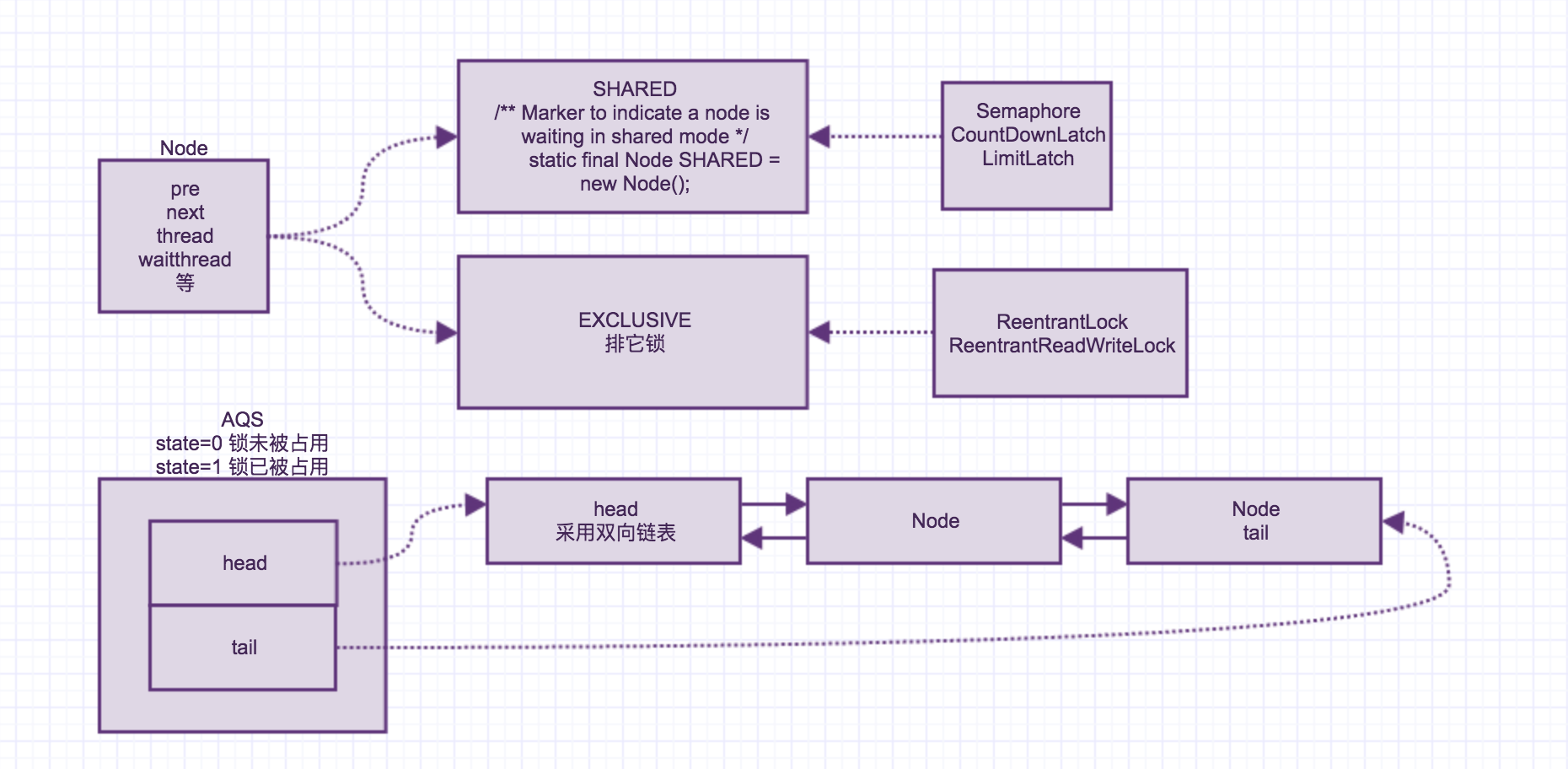
那么公平锁和非公平锁的实现的不同点在哪里呢?公平锁和非公平锁就差在 !hasQueuedPredecessors() ,也就是前边没有排队者的话,我就可以获取锁了。
/**

         * Fair version of tryAcquire.  Don't grant access unless

         * recursive call or no waiters or is first.

         */

        protected final boolean tryAcquire(int acquires) {

            final Thread current = Thread.currentThread();

            int c = getState();

            if (c == 0) {

                if (!hasQueuedPredecessors() &&

                    compareAndSetState(0, acquires)) {

                    setExclusiveOwnerThread(current);

                    return true;

                }

            }

            else if (current == getExclusiveOwnerThread()) {

                int nextc = c + acquires;

                if (nextc < 0)

                    throw new Error("Maximum lock count exceeded");

                setState(nextc);

                return true;

            }

            return false;

        }
如果当前线程之前还有线程等待就会返回true,如果当前节点是头结点,或者当前队列为空就会返回false。非公平锁没有这句话的判断,所以直接去竞争锁。
   /**

     * Queries whether any threads have been waiting to acquire longer

     * than the current thread.

     *

     * <p>An invocation of this method is equivalent to (but may be

     * more efficient than):

     *  <pre> {@code

     * getFirstQueuedThread() != Thread.currentThread() &&

     * hasQueuedThreads()}</pre>

     *

     * <p>Note that because cancellations due to interrupts and

     * timeouts may occur at any time, a {@code true} return does not

     * guarantee that some other thread will acquire before the current

     * thread.  Likewise, it is possible for another thread to win a

     * race to enqueue after this method has returned {@code false},

     * due to the queue being empty.

     *

     * <p>This method is designed to be used by a fair synchronizer to

     * avoid <a href="AbstractQueuedSynchronizer#barging">barging</a>.

     * Such a synchronizer's {@link #tryAcquire} method should return

     * {@code false}, and its {@link #tryAcquireShared} method should

     * return a negative value, if this method returns {@code true}

     * (unless this is a reentrant acquire).  For example, the {@code

     * tryAcquire} method for a fair, reentrant, exclusive mode

     * synchronizer might look like this:

     *

     *  <pre> {@code

     * protected boolean tryAcquire(int arg) {

     *   if (isHeldExclusively()) {

     *     // A reentrant acquire; increment hold count

     *     return true;

     *   } else if (hasQueuedPredecessors()) {

     *     return false;

     *   } else {

     *     // try to acquire normally

     *   }

     * }}</pre>

     *

     * @return {@code true} if there is a queued thread preceding the

     *         current thread, and {@code false} if the current thread

     *         is at the head of the queue or the queue is empty

     * @since 1.7

     */

    public final boolean hasQueuedPredecessors() {

        // The correctness of this depends on head being initialized

        // before tail and on head.next being accurate if the current

        // thread is first in queue.

        Node t = tail; // Read fields in reverse initialization order

        Node h = head;

        Node s;

        return h != t &&

            ((s = h.next) == null || s.thread != Thread.currentThread());

    }
这个就是ReentrantLock的基本原理,接下来咱们继续看看与之一块使用的Condition。Condition是一个接口,它的实现类是ConditionObject。调用await的时候也会将当前线程的一些信息加入到队列当中。ConditionObject中有一个firstWaiter和LastWaiter分别指向的了等待队列的头和尾。

当调用Condition的signal方法是,则会将第一个Node转换到同步队列,如下图所示。
好了,总结一下:
1. ReentrankLock默认是非公平锁。
2.ReentrankLock的内部实现采用的AQS的双向链表实现。获取锁的线程会被封装成Node里边,供后续使用。
3.公平锁采用判断当前Node是不是头结点,如果是的话就获取锁并做业务处理,不是头结点的不能获取所。
4.非公平锁没有判断当前结点,采用CAS,谁第一个拿到了state=0,则视为获取锁。
5.Condition的await和notify也采用类似的机制,当执行await是,会将当前线程信息的相关信息放入到Node的列表,记录firstWaiter和lastWaiter指向的信息。
希望对大家有所帮助,如果有问题的请及时指出。
聊聊ReentrantLock的内部实现的更多相关文章
- 聊聊ReentrantLock实现原理
ReentrantLock 是常用的锁,相对于Synchronized ,lock锁更人性化,阅读性更强 从LOCK切入 考虑下面的场景如果有A,B线程,同时去执行lock.lock(Lock loc ...
- 聊聊ReentrantLock基于AQS的公平锁和非公平锁的实现区别
ReentrantLock锁的实现是基于AQS实现的,所以先简单说下AQS: AQS是AbstractQueuedSynchronizer缩写,顾名思义:抽象的队列同步器,它是JUC里面许多同步工具类 ...
- 【JUC】JDK1.8源码分析之ReentrantLock(三)
一.前言 在分析了AbstractQueuedSynchronier源码后,接着分析ReentrantLock源码,其实在AbstractQueuedSynchronizer的分析中,已经提到过Ree ...
- java分析源码-ReentrantLock
一.前言 在分析了 AbstractQueuedSynchronier 源码后,接着分析ReentrantLock源码,其实在 AbstractQueuedSynchronizer 的分析中,已经提到 ...
- Java中可重入锁ReentrantLock原理剖析
本文由码农网 – 吴极心原创,转载请看清文末的转载要求,欢迎参与我们的付费投稿计划! 一. 概述 本文首先介绍Lock接口.ReentrantLock的类层次结构以及锁功能模板类AbstractQue ...
- ReentrantLock源码分析与理解
在上面一篇分析ThreadExecutedPool的文章中我们看到线程池实现源码中大量使用了ReentrantLock锁,那么ReentrantLock锁的优势是什么?它又是怎么实现的呢? Reent ...
- 5.Lock接口及其实现ReentrantLock
jdk1.7.0_79 在java.util.concurrent.locks这个包中定义了和synchronized不一样的锁,重入锁——ReentrantLock,读写锁——ReadWriteLo ...
- ReentrantLock和synchronized的性能对比
详见:http://blog.yemou.net/article/query/info/tytfjhfascvhzxcytpo8 ReentrantLock和内部锁的性能对比 Reentran ...
- 并发编程(五)——AbstractQueuedSynchronizer 之 ReentrantLock源码分析
本文将从 ReentrantLock 的公平锁源码出发,分析下 AbstractQueuedSynchronizer 这个类是怎么工作的,希望能给大家提供一些简单的帮助. AQS 结构 先来看看 AQ ...
随机推荐
- mysql 查询优化 ~ 善用profie利器
一 简介:利用profile分析慢语句的过程有助于我们进行语句的优化 二 执行过程 set profiling=1; set profiling=0; 2 执行sql 3 查看过程消耗 三 ...
- case7 淋巴瘤子类分类实验记录
case7 淋巴瘤子类分类实验记录 简介 分类问题:3分类 (identifying three sub-types of lymphoma: Chronic Lymphocytic Leukemia ...
- STM32F103X datasheet学习笔记---Interrupts and events
1.前言 本章主要介绍STM32中断和事件相关的内容 2.NVIC NVIC管理着包括内核异常等中断 主要特性 68个外部中断源(不包含16个内部中断线) 可编程优先级为16级 低延迟异常和中断处理 ...
- nginx配置集群
1.准备两个Tomcat 首先在Linux机器上部署两个Tomcat,端口分别为80和8080 2.分别部署测试应用 在两个tomcat下分别部署同一个应用testapp,很简单,就是在页面显示当前系 ...
- 强大的Js树型控件Dtree使用详解
http://www.lmwlove.com/ac/ID868 在学习文章之前,要学会看官方网站http://destroydrop.com/javascripts/tree.从官方页面你能知道:dt ...
- Oracle11默认用户名和密码
安装Oracle时,若没有为下列用户重设密码,则其默认密码如下: 用户名 / 密码 登录身份 说明s ...
- jquery之源码
1.插件扩展机制 所有的Jquery代理对象的实例,都是扩展自$.fn对象的 意味着只要我们继续扩展$.fn这个对象的功能,就相当于扩展了所有的Jquery代理对象的实例的功能 代码 var $bod ...
- Python 定值类
1.__str__和__repr__ 如果要把一个类的实例变成 str,就需要实现特殊方法__str__(): class Person(object): def __init__(self, nam ...
- 方法名太多,使用方法的重载(overload)来解决
package chapter04; /* 问题:方法名太多了,不容易记忆,有时会出错 使用方法的重载(overload)来解决 */public class C09_Method { public ...
- HDU1711 Number Sequence(KMP模板题)
Number Sequence Time Limit: 10000/5000 MS (Java/Others) Memory Limit: 32768/32768 K (Java/Others) ...