
使用flink Table &Sql api来构建批量和流式应用(1)Table的基本概念
从flink的官方文档,我们知道flink的编程模型分为四层,sql层是最高层的api,Table api是中间层,DataStream/DataSet Api 是核心,stateful Streaming process层是底层实现。
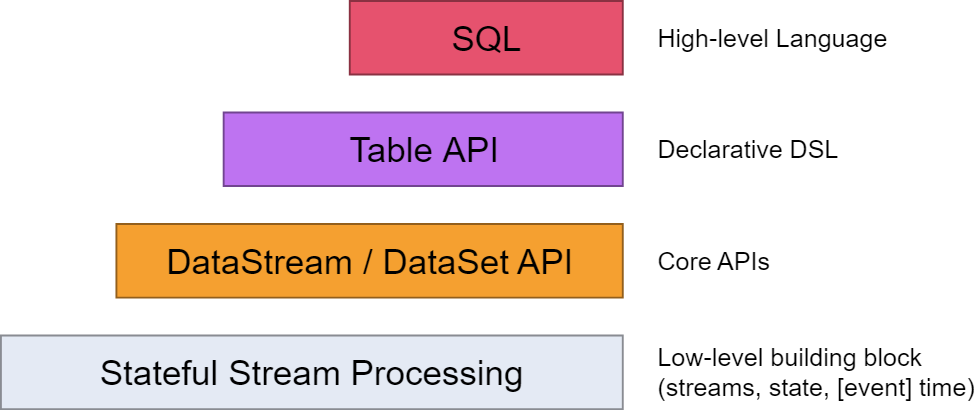
其中,
flink dataset api使用及原理 介绍了DataSet Api
flink DataStream API使用及原理介绍了DataStream Api
flink中的时间戳如何使用?---Watermark使用及原理 介绍了底层实现的基础Watermark
flink window实例分析 介绍了window的概念及使用原理
Flink中的状态与容错 介绍了State的概念及checkpoint,savepoint的容错机制
0. 基本概念:
0.1 TableEnvironment
TableEnvironment是Table API和SQL集成的核心概念,它主要负责:
2、注册一个外部目录Catalog
3、执行SQL查询
4、注册一个用户自定义函数UDF
5、将DataStream或者DataSet转换成Table
6、持有BatchTableEnvironment或者StreamTableEnvironment的引用
/**

 * The base class for batch and stream TableEnvironments.

 *

 * <p>The TableEnvironment is a central concept of the Table API and SQL integration. It is

 * responsible for:

 *

 * <ul>

 *     <li>Registering a Table in the internal catalog</li>

 *     <li>Registering an external catalog</li>

 *     <li>Executing SQL queries</li>

 *     <li>Registering a user-defined scalar function. For the user-defined table and aggregate

 *     function, use the StreamTableEnvironment or BatchTableEnvironment</li>

 * </ul>

 */
0.2 Catalog
Catalog:所有对数据库和表的元数据信息都存放再Flink CataLog内部目录结构中,其存放了flink内部所有与Table相关的元数据信息,包括表结构信息/数据源信息等。
/**

 * This interface is responsible for reading and writing metadata such as database/table/views/UDFs

 * from a registered catalog. It connects a registered catalog and Flink's Table API.

 */
其结构如下:

0.3 TableSource
在使用Table API时,可以将外部的数据源直接注册成Table数据结构。此结构称之为TableSource
/**

 * Defines an external table with the schema that is provided by {@link TableSource#getTableSchema}.

 *

 * <p>The data of a {@link TableSource} is produced as a {@code DataSet} in case of a {@code BatchTableSource}

 * or as a {@code DataStream} in case of a {@code StreamTableSource}. The type of ths produced

 * {@code DataSet} or {@code DataStream} is specified by the {@link TableSource#getProducedDataType()} method.

 *

 * <p>By default, the fields of the {@link TableSchema} are implicitly mapped by name to the fields of

 * the produced {@link DataType}. An explicit mapping can be defined by implementing the

 * {@link DefinedFieldMapping} interface.

 *

 * @param <T> The return type of the {@link TableSource}.

 */
0.4 TableSink
数据处理完成后需要将结果写入外部存储中,在Table API中有对应的Sink模块,此模块为TableSink
/**

 * A {@link TableSink} specifies how to emit a table to an external

 * system or location.

 *

 * <p>The interface is generic such that it can support different storage locations and formats.

 *

 * @param <T> The return type of the {@link TableSink}.

 */
0.5 Table Connector
在Flink1.6版本之后,为了能够让Table API通过配置化的方式连接外部系统,且同时可以在sql client中使用,flink 提出了Table Connector的概念,主要目的时将Table Source和Table Sink的定义和使用分离。
通过Table Connector将不同内建的Table Source和TableSink封装,形成可以配置化的组件,在Table Api和Sql client能够同时使用。
    /**

     * Creates a table source and/or table sink from a descriptor.

     *

     * <p>Descriptors allow for declaring the communication to external systems in an

     * implementation-agnostic way. The classpath is scanned for suitable table factories that match

     * the desired configuration.

     *

     * <p>The following example shows how to read from a connector using a JSON format and

     * register a table source as "MyTable":

     *

     * <pre>

     * {@code

     *

     * tableEnv

     *   .connect(

     *     new ExternalSystemXYZ()

     *       .version("0.11"))

     *   .withFormat(

     *     new Json()

     *       .jsonSchema("{...}")

     *       .failOnMissingField(false))

     *   .withSchema(

     *     new Schema()

     *       .field("user-name", "VARCHAR").from("u_name")

     *       .field("count", "DECIMAL")

     *   .registerSource("MyTable");

     * }

     *</pre>

     *

     * @param connectorDescriptor connector descriptor describing the external system

     */

    TableDescriptor connect(ConnectorDescriptor connectorDescriptor);
本篇主要聚焦于sql和Table Api。
1.sql
1.1 基于DataSet api的sql
示例:
package org.apache.flink.table.examples.java;

import org.apache.flink.api.java.DataSet;

import org.apache.flink.api.java.ExecutionEnvironment;

import org.apache.flink.table.api.Table;

import org.apache.flink.table.api.java.BatchTableEnvironment;

/**

 * Simple example that shows how the Batch SQL API is used in Java.

 *

 * <p>This example shows how to:

 *  - Convert DataSets to Tables

 *  - Register a Table under a name

 *  - Run a SQL query on the registered Table

 */

public class WordCountSQL {

    // *************************************************************************

    //     PROGRAM

    // *************************************************************************

    public static void main(String[] args) throws Exception {

        // set up execution environment

        ExecutionEnvironment env = ExecutionEnvironment.getExecutionEnvironment();

        BatchTableEnvironment tEnv = BatchTableEnvironment.create(env);

        DataSet<WC> input = env.fromElements(

            new WC("Hello", 1),

            new WC("Ciao", 1),

            new WC("Hello", 1));

        // register the DataSet as table "WordCount"

        tEnv.registerDataSet("WordCount", input, "word, frequency");

        // run a SQL query on the Table and retrieve the result as a new Table

        Table table = tEnv.sqlQuery(

            "SELECT word, SUM(frequency) as frequency FROM WordCount GROUP BY word");

        DataSet<WC> result = tEnv.toDataSet(table, WC.class);

        result.print();

    }

    // *************************************************************************

    //     USER DATA TYPES

    // *************************************************************************

    /**

     * Simple POJO containing a word and its respective count.

     */

    public static class WC {

        public String word;

        public long frequency;

        // public constructor to make it a Flink POJO

        public WC() {}

        public WC(String word, long frequency) {

            this.word = word;

            this.frequency = frequency;

        }

        @Override

        public String toString() {

            return "WC " + word + " " + frequency;

        }

    }

}
其中,BatchTableEnvironment
/**

 * The {@link TableEnvironment} for a Java batch {@link ExecutionEnvironment} that works

 * with {@link DataSet}s.

 *

 * <p>A TableEnvironment can be used to:

 * <ul>

 *     <li>convert a {@link DataSet} to a {@link Table}</li>

 *     <li>register a {@link DataSet} in the {@link TableEnvironment}'s catalog</li>

 *     <li>register a {@link Table} in the {@link TableEnvironment}'s catalog</li>

 *     <li>scan a registered table to obtain a {@link Table}</li>

 *     <li>specify a SQL query on registered tables to obtain a {@link Table}</li>

 *     <li>convert a {@link Table} into a {@link DataSet}</li>

 *     <li>explain the AST and execution plan of a {@link Table}</li>

 * </ul>

 */
BatchTableSource
/** Defines an external batch table and provides access to its data.

 *

 * @param <T> Type of the {@link DataSet} created by this {@link TableSource}.

 */
BatchTableSink
/** Defines an external {@link TableSink} to emit a batch {@link Table}.

 *

 * @param <T> Type of {@link DataSet} that this {@link TableSink} expects and supports.

 */
1.2 基于DataStream api的sql
示例代码
package org.apache.flink.table.examples.java;

import org.apache.flink.streaming.api.datastream.DataStream;

import org.apache.flink.streaming.api.environment.StreamExecutionEnvironment;

import org.apache.flink.table.api.Table;

import org.apache.flink.table.api.java.StreamTableEnvironment;

import java.util.Arrays;

/**

 * Simple example for demonstrating the use of SQL on a Stream Table in Java.

 *

 * <p>This example shows how to:

 *  - Convert DataStreams to Tables

 *  - Register a Table under a name

 *  - Run a StreamSQL query on the registered Table

 *

 */

public class StreamSQLExample {

    // *************************************************************************

    //     PROGRAM

    // *************************************************************************

    public static void main(String[] args) throws Exception {

        // set up execution environment

        StreamExecutionEnvironment env = StreamExecutionEnvironment.getExecutionEnvironment();

        StreamTableEnvironment tEnv = StreamTableEnvironment.create(env);

        DataStream<Order> orderA = env.fromCollection(Arrays.asList(

            new Order(1L, "beer", 3),

            new Order(1L, "diaper", 4),

            new Order(3L, "rubber", 2)));

        DataStream<Order> orderB = env.fromCollection(Arrays.asList(

            new Order(2L, "pen", 3),

            new Order(2L, "rubber", 3),

            new Order(4L, "beer", 1)));

        // convert DataStream to Table

        Table tableA = tEnv.fromDataStream(orderA, "user, product, amount");

        // register DataStream as Table

        tEnv.registerDataStream("OrderB", orderB, "user, product, amount");

        // union the two tables

        Table result = tEnv.sqlQuery("SELECT * FROM " + tableA + " WHERE amount > 2 UNION ALL " +

                        "SELECT * FROM OrderB WHERE amount < 2");

        tEnv.toAppendStream(result, Order.class).print();

        env.execute();

    }

    // *************************************************************************

    //     USER DATA TYPES

    // *************************************************************************

    /**

     * Simple POJO.

     */

    public static class Order {

        public Long user;

        public String product;

        public int amount;

        public Order() {

        }

        public Order(Long user, String product, int amount) {

            this.user = user;

            this.product = product;

            this.amount = amount;

        }

        @Override

        public String toString() {

            return "Order{" +

                "user=" + user +

                ", product='" + product + '\'' +

                ", amount=" + amount +

                '}';

        }

    }

}
其中,StreamTableEnvironment
/**

 * The {@link TableEnvironment} for a Java {@link StreamExecutionEnvironment} that works with

 * {@link DataStream}s.

 *

 * <p>A TableEnvironment can be used to:

 * <ul>

 *     <li>convert a {@link DataStream} to a {@link Table}</li>

 *     <li>register a {@link DataStream} in the {@link TableEnvironment}'s catalog</li>

 *     <li>register a {@link Table} in the {@link TableEnvironment}'s catalog</li>

 *     <li>scan a registered table to obtain a {@link Table}</li>

 *     <li>specify a SQL query on registered tables to obtain a {@link Table}</li>

 *     <li>convert a {@link Table} into a {@link DataStream}</li>

 *     <li>explain the AST and execution plan of a {@link Table}</li>

 * </ul>

 */
StreamTableSource
/** Defines an external stream table and provides read access to its data.

 *

 * @param <T> Type of the {@link DataStream} created by this {@link TableSource}.

 */
StreamTableSink
/**

 * Defines an external stream table and provides write access to its data.

 *

 * @param <T> Type of the {@link DataStream} created by this {@link TableSink}.

 */
2. table api
示例
package org.apache.flink.table.examples.java;

import org.apache.flink.api.java.DataSet;

import org.apache.flink.api.java.ExecutionEnvironment;

import org.apache.flink.table.api.Table;

import org.apache.flink.table.api.java.BatchTableEnvironment;

/**

 * Simple example for demonstrating the use of the Table API for a Word Count in Java.

 *

 * <p>This example shows how to:

 *  - Convert DataSets to Tables

 *  - Apply group, aggregate, select, and filter operations

 */

public class WordCountTable {

    // *************************************************************************

    //     PROGRAM

    // *************************************************************************

    public static void main(String[] args) throws Exception {

        ExecutionEnvironment env = ExecutionEnvironment.createCollectionsEnvironment();

        BatchTableEnvironment tEnv = BatchTableEnvironment.create(env);

        DataSet<WC> input = env.fromElements(

                new WC("Hello", 1),

                new WC("Ciao", 1),

                new WC("Hello", 1));

        Table table = tEnv.fromDataSet(input);

        Table filtered = table

                .groupBy("word")

                .select("word, frequency.sum as frequency")

                .filter("frequency = 2");

        DataSet<WC> result = tEnv.toDataSet(filtered, WC.class);

        result.print();

    }

    // *************************************************************************

    //     USER DATA TYPES

    // *************************************************************************

    /**

     * Simple POJO containing a word and its respective count.

     */

    public static class WC {

        public String word;

        public long frequency;

        // public constructor to make it a Flink POJO

        public WC() {}

        public WC(String word, long frequency) {

            this.word = word;

            this.frequency = frequency;

        }

        @Override

        public String toString() {

            return "WC " + word + " " + frequency;

        }

    }

}
3.数据转换
3.1 DataSet与Table相互转换
DataSet-->Table
注册方式:
          // register the DataSet as table "WordCount"

          tEnv.registerDataSet("WordCount", input, "word, frequency");
     转换方式:
       Table table = tEnv.fromDataSet(input);
Table-->DataSet
DataSet<WC> result = tEnv.toDataSet(filtered, WC.class);
3.2 DataStream与Table相互转换
DataStream-->Table
注册方式:
tEnv.registerDataStream("OrderB", orderB, "user, product, amount");
     转换方式:
       Table tableA = tEnv.fromDataStream(orderA, "user, product, amount");
Table-->DataStream
DataSet<WC> result = tEnv.toDataSet(filtered, WC.class);
参考资料
【1】https://ci.apache.org/projects/flink/flink-docs-release-1.8/concepts/programming-model.html
【2】Flink原理、实战与性能优化
使用flink Table &Sql api来构建批量和流式应用(1)Table的基本概念的更多相关文章
- 使用flink Table &Sql api来构建批量和流式应用(2)Table API概述
从flink的官方文档,我们知道flink的编程模型分为四层,sql层是最高层的api,Table api是中间层,DataStream/DataSet Api 是核心,stateful Stream ...
- 使用flink Table &Sql api来构建批量和流式应用(3)Flink Sql 使用
从flink的官方文档,我们知道flink的编程模型分为四层,sql层是最高层的api,Table api是中间层,DataStream/DataSet Api 是核心,stateful Stream ...
- Flink 另外一个分布式流式和批量数据处理的开源平台
Apache Flink是一个分布式流式和批量数据处理的开源平台. Flink的核心是一个流式数据流动引擎,它为数据流上面的分布式计算提供数据分发.通讯.容错.Flink包括几个使用 Flink引擎创 ...
- 8、Flink Table API & Flink Sql API
一.概述 上图是flink的分层模型,Table API 和 SQL 处于最顶端,是 Flink 提供的高级 API 操作.Flink SQL 是 Flink 实时计算为简化计算模型,降低用户使用实时 ...
- Flink table&Sql中使用Calcite
Apache Calcite是什么东东 Apache Calcite面向Hadoop新的sql引擎,它提供了标准的SQL语言.多种查询优化和连接各种数据源的能力.除此之外,Calcite还提供了OLA ...
- Demo:基于 Flink SQL 构建流式应用
Flink 1.10.0 于近期刚发布,释放了许多令人激动的新特性.尤其是 Flink SQL 模块,发展速度非常快,因此本文特意从实践的角度出发,带领大家一起探索使用 Flink SQL 如何快速构 ...
- kafka传数据到Flink存储到mysql之Flink使用SQL语句聚合数据流(设置时间窗口,EventTime)
网上没什么资料,就分享下:) 简单模式:kafka传数据到Flink存储到mysql 可以参考网站: 利用Flink stream从kafka中写数据到mysql maven依赖情况: <pro ...
- Flink Batch SQL 1.10 实践
Flink作为流批统一的计算框架,在1.10中完成了大量batch相关的增强与改进.1.10可以说是第一个成熟的生产可用的Flink Batch SQL版本,它一扫之前Dataset的羸弱,从功能和性 ...
- Flink系列之1.10版流式SQL应用
随着Flink 1.10的发布,对SQL的支持也非常强大.Flink 还提供了 MySql, Hive,ES, Kafka等连接器Connector,所以使用起来非常方便. 接下来咱们针对构建流式SQ ...
随机推荐
- JS 中click和onclick的区别
1.onclick是绑定事件,告诉浏览器在鼠标点击时候要做什么 2.click本身是方法,作用是触发onclick事件,只要执行了元素的click()方法,就会触发onclick事件
- VisualSVN5.1.7补丁原创发布
VisualSVN5.1.7补丁原创发布 一切尽在发布中.
- C# 声明基于角色的安全性
using System;using System.Collections.Generic;using System.Linq;using System.Security;using System.S ...
- Nancy Web框架
原文 Nancy Web框架 Nancy框架 一.创建第一个Nancy应用 二.探索Nancy的module 1. 模块能够在全局被发现 2. 使用模块为路由创建一个根 三.定义路由 1. 方法 2. ...
- php延时执行
sleep(秒) usleep(毫秒) 让它睡上一会.
- Win8Metro(C#)数字图像处理--2.14Prewitt 边缘检测
原文:Win8Metro(C#)数字图像处理--2.14Prewitt 边缘检测 [函数名称] 图像Prewitt边缘检测函数PrewittEdgeProcess(WriteableBitmap ...
- 栈内存不是只有2M吗?为什么不溢出?
#include <stdio.h> #include <wchar.h> #include <stdlib.h> #define MAX_PATH 1024 FI ...
- Realm_King 之 .NET 打包详细教程(B)
上篇(Realm_King 之 .NET 打包详细教程(A))给大家讲述了打包基本的操作,接下来帮助大家如何覆盖安装,希望大家仔细阅读... (一)看到你的解决方案,选中你的安装程序,点击F4会弹出改 ...
- 基于ASP.NET的新闻管理系统(三)代码展示
5.1.1栏目部分 增加栏目(addLanMu.aspx): <html xmlns="http://www.w3.org/1999/xhtml"> <head ...
- Spring之基于注解的注入
对于DI使用注解,将不再需要在Spring配置文件中声明Bean实例.Spring中使用注解,需要在原有Spring运行环境基础上再做一些改变,完成以下三个步骤. (1)导入AOP的Jar包.因为注解 ...