
使用CXF实现WebService
一、首先创建一个maven项目,引入相应的jar包
<?xml version="1.0" encoding="UTF-8"?>

<project xmlns="http://maven.apache.org/POM/4.0.0"

         xmlns:xsi="http://www.w3.org/2001/XMLSchema-instance"

         xsi:schemaLocation="http://maven.apache.org/POM/4.0.0 http://maven.apache.org/xsd/maven-4.0.0.xsd">

    <modelVersion>4.0.0</modelVersion>

    <groupId>xw</groupId>

    <artifactId>xw</artifactId>

    <version>1.0-SNAPSHOT</version>

    <properties>

        <cxf.version>2.2.3</cxf.version>

    </properties>

    <dependencies>

    <!-- CXF Dependencies -->

    <dependency>

        <groupId>org.apache.cxf</groupId>

        <artifactId>cxf-rt-frontend-jaxws</artifactId>

        <version>${cxf.version}</version>

    </dependency>

    <dependency>

        <groupId>org.apache.cxf</groupId>

        <artifactId>cxf-rt-transports-http</artifactId>

        <version>${cxf.version}</version>

    </dependency>

    <!-- Jetty is needed if you're are not using the CXFServlet -->

    <dependency>

        <groupId>org.apache.cxf</groupId>

        <artifactId>cxf-rt-transports-http-jetty</artifactId>

        <version>${cxf.version}</version>

    </dependency>

    </dependencies>

    <build>

        <finalName>spirngMVC</finalName>

        <plugins>

            <!-- 编码和编译和JDK版本 -->

            <plugin>

                <groupId>org.apache.maven.plugins</groupId>

                <artifactId>maven-compiler-plugin</artifactId>

                <version>2.3.2</version>

                <configuration>

                    <source>1.8</source>

                    <target>1.8</target>

                    <encoding>utf8</encoding>

                </configuration>

            </plugin>

        </plugins>

    </build>

</project>
二、服务端
1、公开Web服务的接口IHelloService
@WebService

public interface IHelloService {

    Customer selectMaxIdCustomer(Customer c1,Customer c2);

    Customer selectLongNameCustomer(Customer c1,Customer c2);

}
使用@WebService注解表示公开为Web服务,使用这个注解的接口将公开所有的方法,如果你想屏蔽某个方法,可以使用方法注解@WebMethod(exclude = true)设置为true表示屏蔽该方法。
2、实现类HelloServiceImpl
public class HelloServiceImpl implements IHelloService {

    @Override

    public Customer selectMaxIdCustomer(Customer c1, Customer c2) {

        if(c1.getId() >= c2.getId() ){

            return c1;

        }else{

            return c2;

        }

    }

    @Override

    public Customer selectLongNameCustomer(Customer c1, Customer c2) {

        if(c1.getName().length() >= c2.getName().length() ){

            return c1;

        }else{

            return c2;

        }

    }

}
实现了Web服务的具体功能。
3、Customer类
@XmlRootElement(name = "Customer")

public class Customer {

    private long id;

    private String name;

    public long getId() {

        return id;

    }

    public void setId(long id) {

        this.id = id;

    }

    public String getName() {

        return name;

    }

    public void setName(String name) {

        this.name = name;

    }

}
这个类是公开为Web服务的接口中的参数类型和返回值,因此你需要使用@XmlRootElement(name = "Customer")注解告诉CXF如何在XML和Java Object之间处理。
4、发布Web服务
public class ServerSimple {

    public static void main(String[] args) throws Exception{

        Endpoint.publish("http://localhost:8080/helloWorld", new HelloServiceImpl());

    }

}
使用CXF自带的Jetty运行服务端,设置URL和服务类就行
三、查看WSDL
访问http://localhost:8080/helloWorld?wsdl地址可以看到很长的XML,就是WSDL,如果看到WSDL就代表Web服务发布成功了
This XML file does not appear to have any style information associated with it. The document tree is shown below.

<wsdl:definitions xmlns:ns1="http://schemas.xmlsoap.org/soap/http" xmlns:soap="http://schemas.xmlsoap.org/wsdl/soap/" xmlns:tns="http://cxf/" xmlns:wsdl="http://schemas.xmlsoap.org/wsdl/" xmlns:xsd="http://www.w3.org/2001/XMLSchema" name="HelloServiceImplService" targetNamespace="http://cxf/">

<wsdl:types>

<xs:schema xmlns:tns="http://cxf/" xmlns:xs="http://www.w3.org/2001/XMLSchema" elementFormDefault="unqualified" targetNamespace="http://cxf/" version="1.0">

<xs:element name="Customer" type="tns:customer"/>

<xs:element name="selectLongNameCustomer" type="tns:selectLongNameCustomer"/>

<xs:element name="selectLongNameCustomerResponse" type="tns:selectLongNameCustomerResponse"/>

<xs:element name="selectMaxIdCustomer" type="tns:selectMaxIdCustomer"/>

<xs:element name="selectMaxIdCustomerResponse" type="tns:selectMaxIdCustomerResponse"/>

<xs:complexType name="selectLongNameCustomer">

<xs:sequence>

<xs:element minOccurs="0" name="arg0" type="tns:customer"/>

<xs:element minOccurs="0" name="arg1" type="tns:customer"/>

</xs:sequence>

</xs:complexType>

<xs:complexType name="customer">

<xs:sequence>

<xs:element name="id" type="xs:long"/>

<xs:element minOccurs="0" name="name" type="xs:string"/>

</xs:sequence>

</xs:complexType>

<xs:complexType name="selectLongNameCustomerResponse">

<xs:sequence>

<xs:element minOccurs="0" name="return" type="tns:customer"/>

</xs:sequence>

</xs:complexType>

<xs:complexType name="selectMaxIdCustomer">

<xs:sequence>

<xs:element minOccurs="0" name="arg0" type="tns:customer"/>

<xs:element minOccurs="0" name="arg1" type="tns:customer"/>

</xs:sequence>

</xs:complexType>

<xs:complexType name="selectMaxIdCustomerResponse">

<xs:sequence>

<xs:element minOccurs="0" name="return" type="tns:customer"/>

</xs:sequence>

</xs:complexType>

</xs:schema>

</wsdl:types>

<wsdl:message name="selectLongNameCustomer">

<wsdl:part element="tns:selectLongNameCustomer" name="parameters"></wsdl:part>

</wsdl:message>

<wsdl:message name="selectLongNameCustomerResponse">

<wsdl:part element="tns:selectLongNameCustomerResponse" name="parameters"></wsdl:part>

</wsdl:message>

<wsdl:message name="selectMaxIdCustomer">

<wsdl:part element="tns:selectMaxIdCustomer" name="parameters"></wsdl:part>

</wsdl:message>

<wsdl:message name="selectMaxIdCustomerResponse">

<wsdl:part element="tns:selectMaxIdCustomerResponse" name="parameters"></wsdl:part>

</wsdl:message>

<wsdl:portType name="IHelloService">

<wsdl:operation name="selectLongNameCustomer">

<wsdl:input message="tns:selectLongNameCustomer" name="selectLongNameCustomer"></wsdl:input>

<wsdl:output message="tns:selectLongNameCustomerResponse" name="selectLongNameCustomerResponse"></wsdl:output>

</wsdl:operation>

<wsdl:operation name="selectMaxIdCustomer">

<wsdl:input message="tns:selectMaxIdCustomer" name="selectMaxIdCustomer"></wsdl:input>

<wsdl:output message="tns:selectMaxIdCustomerResponse" name="selectMaxIdCustomerResponse"></wsdl:output>

</wsdl:operation>

</wsdl:portType>

<wsdl:binding name="HelloServiceImplServiceSoapBinding" type="tns:IHelloService">

<soap:binding style="document" transport="http://schemas.xmlsoap.org/soap/http"/>

<wsdl:operation name="selectLongNameCustomer">

<soap:operation soapAction="" style="document"/>

<wsdl:input name="selectLongNameCustomer">

<soap:body use="literal"/>

</wsdl:input>

<wsdl:output name="selectLongNameCustomerResponse">

<soap:body use="literal"/>

</wsdl:output>

</wsdl:operation>

<wsdl:operation name="selectMaxIdCustomer">

<soap:operation soapAction="" style="document"/>

<wsdl:input name="selectMaxIdCustomer">

<soap:body use="literal"/>

</wsdl:input>

<wsdl:output name="selectMaxIdCustomerResponse">

<soap:body use="literal"/>

</wsdl:output>

</wsdl:operation>

</wsdl:binding>

<wsdl:service name="HelloServiceImplService">

<wsdl:port binding="tns:HelloServiceImplServiceSoapBinding" name="HelloServiceImplPort">

<soap:address location="http://localhost:8080/helloWorld"/>

</wsdl:port>

</wsdl:service>

</wsdl:definitions>
四、WSDL的构成
一个 WSDL 文档的主要结构是类似这样的:
<definitions>

<types>

  data type definitions........

</types>

<message>

  definition of the data being communicated....

</message>

<portType>

  set of operations......

</portType>

<binding>

  protocol and data format specification....

</binding>

</definitions>
- <wsdl:definitions>是WSDL的根元素,需要关注的元素有name="HelloServiceImplService",属性值为公开的Web服务的实现类+Service,targetNamespace="http://cxf/"指定目标名称空间,还有xmlns:tns="http://cxf/"的属性值就是targetNamespace的属性值,默认使用实现类的包名的反缀,所以其实我该贴一张目录就显而易见了

- <wsdl:types>通过<xs:element>定义Web Service使用的数据类型,<xs:element name="Customer" type="tns:customer"/>其中name是这个复杂类型的JAXB注解的name属性值,type是tns:+JAXB注解的name属性值全小写形式,再往下会看到XXX元素和XXXResponse元素,其中XXX是方法名称,是对方法参数的封装,XXXResponse是对返回值的封装。</xs:complexType>将对XXX和XXXResponse指定封装的内容
- </wsdl:message>将输入参数和响应结果、受检查的异常信息包装为消息
- </wsdl:portType>描述了 web service、可被执行的操作,以及相关的消息。</wsdl:input></wsdl:output>指定输入和输出
- </wsdl:binding>每个端口定义消息格式和协议细节
- 最后的</wsdl:service>name属性指定服务的名称,</wsdl:port>的name指定port名称,<soap:address location="http://localhost:8080/helloWorld"/>指定Web服务的地址
五、客户端
具体代码:
public final class Client {

    public static void main(String[] args) throws Exception{

        JaxWsProxyFactoryBean factory = new  JaxWsProxyFactoryBean ();

        factory.setAddress("http://localhost:8080/helloWorld");

        factory.setServiceClass(IHelloService.class);

        IHelloService o = (IHelloService) factory.create();

        Customer c1 = new Customer();

        c1.setId(1);

        c1.setName("A");

        Customer c2= new Customer();

        c1.setId(2);

        c1.setName("AC");

        System.out.println(o.selectMaxIdCustomer(c1,c2).getName());

    }

}
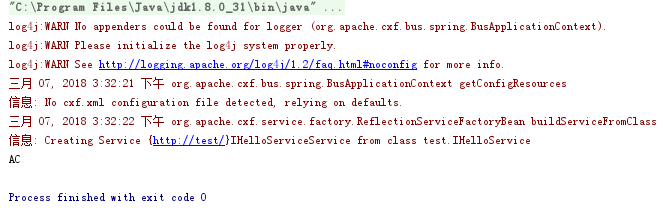
使用JaxWsProxyFactoryBean客户端代理工厂调用Web服务,输出:
使用CXF实现WebService的更多相关文章
- 使用CXF发布WebService
这里普及一下WebService和cxf的知识.关于webservice和cxf: WebService.各种提供服务的组件 .企业总线.通讯总线(ESB)CXF:是一个SOA框架,Axi ...
- CXF发布webService服务以及客户端调用
这篇随笔内容是CXF发布webService服务以及客户端调用的方法 CXF是什么? 开发工作之前需要下载CXF和安装 下载地址:http://cxf.apache.org 安装过程: <1&g ...
- 3.使用CXF开发webService
CXF 简介 关于 Apache CXF Apache CXF = Celtix + XFire,Apache CXF 的前身叫 Apache CeltiXfire,现在已经正式更名为 Apache ...
- Apache CXF实现WebService入门教程(附完整源码)
Apache CXF实现WebService非常简单实用,只需要几步就可以实现一个简单的web service. 首先我们需要新建一个maven项目,在pom中添加依赖和jetty作为测试的web s ...
- struts1+spring+myeclipse +cxf 开发webservice以及普通java应用调用webservice的实例
Cxf + Spring+ myeclipse+ cxf 进行 Webservice服务端开发 使用Cxf开发webservice的服务端项目结构 Spring配置文件applicationCont ...
- 使用cxf开发webservice应用时抛出异常
在使用cxf开发webservice应用时,报出了类似下面的错误 JAXB: [javax.xml.bind.UnmarshalException: unexpected element (uri:& ...
- cxf构建webservice的两种方式
一.简介 对于基于soap传输协议的webservice有两种开发模式,代码优先和契约优先的模式.代码优先的模式是通过编写服务器端的代码,使用代码生成wsdl:契约优先模式首先编写wsdl,再通过ws ...
- CXF之webservice
使用 CXF 做 webservice 简单例子 Apache CXF 是一个开放源代码框架,提供了用于方便地构建和开发 Web 服务的可靠基础架构.它允许创建高性能和可扩展的服务,您可以将这 ...
- [置顶] 利用CXF发布webService的小demo
其实webService的发布不仅仅只有xfire,今天,给大家介绍一下用CXF发布一个webService的小demo,CXF也是我做webService用的第一个框架... 先将相关的jar引进来 ...
- 【转】构建基于CXF的WebService服务
构建基于CXF的WebService服务 Apache CXF = Celtix+ XFire,开始叫 Apache CeltiXfire,后来更名为 Apache CXF 了,以下简称为 CXF.C ...
随机推荐
- easyui datagrid 单元格 编辑时 事件 修改另一单元格
//datagrid 列数据 $('#acc').datagrid({ columns : [ [ { field : 'fee_lend', title : '收费A', width : 100, ...
- Java面试总结(一)
1.equals和==和hashcode “==”是运算符,比较两个变量的值是否相等 equals是Object类的方法.比较两个对象是否相等 hashcode是Object类的方法,返回一个 ...
- hive merge into 批量更新测试
一.使用条件 hive2.2.0及之后的版本支持使用merge into 语法,使用源表数据批量目标表的数据.使用该功能还需做如下配置 1.参数配置 set hive.support.concurre ...
- Java编程思想:泛型接口
import java.util.Iterator; import java.util.Random; public class Test { public static void main(Stri ...
- 算法学习笔记,几个简单的Demo
算法初学的一些心得 前言:现在工作也快一年多了,有时间下班回家会学学算法,陆陆续续也接触了一些 貌似我知道的就冒泡排序其他的都不是很了解 最近买了一本书,边学边记录吧! 一些常用的方法 暴力破解 下面 ...
- JVM的内存区域
Java虚拟机在执行Java程序的过程中会把它所管理的内存划分为若干个不同的数据区域, 包含程序计数器.虚拟机栈.本地方法栈.Java堆.方法区(运行时常量池).直接内存等,不同的版本会有所差异 各区 ...
- 前端三剑客之HTML
目录 what is html html基本格式 html常用标签及其属性 @() what is html (hypertext marked language)超文本标记语言,负责页面文本.图片内 ...
- spring全局异常抓取validation校验信息
@ControllerAdvicepublic class GlobalExceptionHandler { @ExceptionHandler({Exception.class}) @Respons ...
- 小白开学Asp.Net Core 开篇
开学Asp.Net Core 开篇 一.准备工作 1.操作环境:Win10 2.开发工具:VS2019 3.运行环境:.Net Core 2.2 4.数据库:SqlServer2012 二.项目搭建 ...
- Ubuntu通过修改配置文件进行网络配置
Ubuntu系统进行网络配置有的时候用图形界面不起作用,这种情况下可以直接修改某些启动脚本或配置文件 Ubuntu系统进行网络配置涉及到几个配置文件1./etc/network/interfaces ...