
golang数据结构和算法之LinkedList链表
差不多自己看懂了,可以自己写测试了。:)
LinkedList.go
package LinkedList

//"fmt"

type Node struct {
	data int
	next *Node
}

type LinkedList struct {
	head *Node
}

func (list *LinkedList) InsertFirst(i int) {
	data := &Node{data: i}
	if list.head != nil {
		data.next = list.head
	}
	list.head = data
}

func (list *LinkedList) InsertLast(i int) {
	data := &Node{data: i}
	if list.head == nil {
		list.head = data
		return
	}
	current := list.head
	for current.next != nil {
		current = current.next
	}
	current.next = data
}

func (list *LinkedList) RemoveByValue(i int) bool {
	if list.head == nil {
		return false
	}

	if list.head.data == i {
		list.head = list.head.next
		return true
	}
	current := list.head
	for current.next != nil {
		if current.next.data == i {
			current.next = current.next.next
			return true
		}
		current = current.next
	}
	return false
}

func (list *LinkedList) RemoveByIndex(i int) bool {
	if list.head == nil {
		return false
	}
	if i < 0 {
		return false
	}

	if i == 0 {
		list.head = list.head.next
		return true
	}
	current := list.head
	for u := 1; u < i; u++ {
		if current.next.next == nil {
			return false
		}
		current = current.next
	}
	current.next = current.next.next
	return true
}

func (list *LinkedList) SearchValue(i int) bool {
	if list.head == nil {
		return false
	}
	current := list.head
	for current != nil {
		if current.data == i {
			return true
		}
		current = current.next
	}
	return false
}

func (list *LinkedList) GetFirst() (int, bool) {
	if list.head == nil {
		return 0, false
	}
	return list.head.data, true
}

func (list *LinkedList) GetLast() (int, bool) {
	if list.head == nil {
		return 0, false
	}
	current := list.head
	for current.next != nil {
		current = current.next
	}
	return current.data, true
}

func (list *LinkedList) GetSize() int {
	count := 0
	current := list.head
	for current != nil {
		count += 1
		current = current.next
	}
	return count
}

func (list *LinkedList) getItems() []int {
	var items []int
	current := list.head
	for current != nil {
		items = append(items, current.data)
		current = current.next
	}
	return items
}
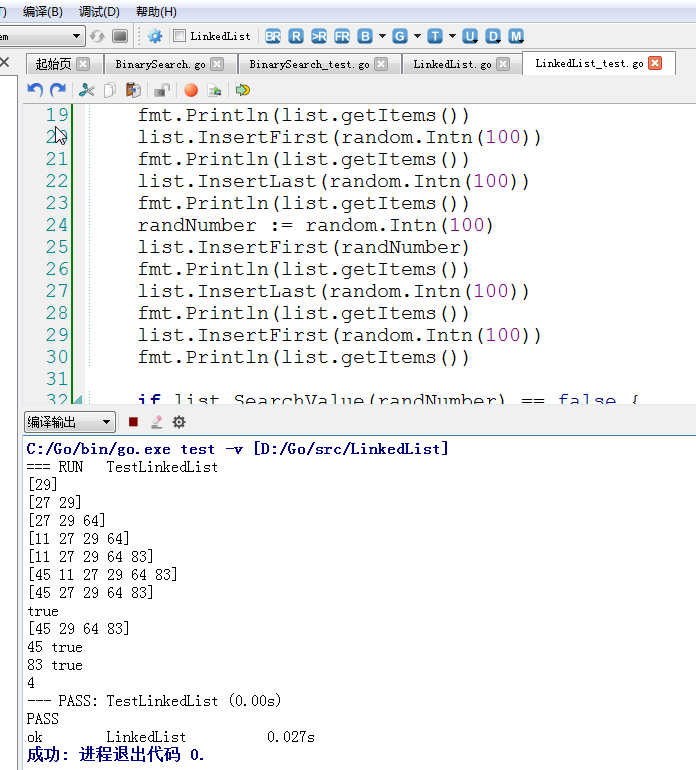
LinkedList_test.go
package LinkedList

import (
	"fmt"
	"math/rand"
	"testing"
	"time"
)

func TestLinkedList(t *testing.T) {
	random := rand.New(rand.NewSource(time.Now().UnixNano()))
	headNode := &Node{
		data: random.Intn(100),
		next: nil,
	}
	list := &LinkedList{
		head: headNode,
	}
	fmt.Println(list.getItems())
	list.InsertFirst(random.Intn(100))
	fmt.Println(list.getItems())
	list.InsertLast(random.Intn(100))
	fmt.Println(list.getItems())
	randNumber := random.Intn(100)
	list.InsertFirst(randNumber)
	fmt.Println(list.getItems())
	list.InsertLast(random.Intn(100))
	fmt.Println(list.getItems())
	list.InsertFirst(random.Intn(100))
	fmt.Println(list.getItems())

	if list.SearchValue(randNumber) == false {
		t.Fail()
	}
	list.RemoveByValue(randNumber)
	if list.SearchValue(randNumber) == true {
		t.Fail()
	}
	fmt.Println(list.getItems())
	fmt.Println(list.RemoveByIndex(1))
	fmt.Println(list.getItems())
	fmt.Println(list.GetFirst())
	fmt.Println(list.GetLast())
	fmt.Println(list.GetSize())

}
golang数据结构和算法之LinkedList链表的更多相关文章
- golang数据结构和算法之QueueLinkedList链表队列
队列和堆栈不一样的地方在于进出顺序: 堆栈是后进先出, 队列是先进先出. QueueLinkedList.go package QueueLinkedList type Node struct { d ...
- golang数据结构和算法之StackLinkedList链表堆栈
会了上一个,这个就差不离了. StackLinkedList.go package StackLinkedList type Node struct { data int next *Node } t ...
- 每周一练 之 数据结构与算法(LinkedList)
这是第三周的练习题,原本应该先发第二周的,因为周末的时候,我的母亲大人来看望她的宝贝儿子,哈哈,我得带她看看厦门这座美丽的城市呀. 这两天我抓紧整理下第二周的题目和答案,下面我把之前的也列出来: 1. ...
- golang数据结构和算法之BinarySearch二分查找法
基础语法差不多了, 就需要系统的撸一下数据结构和算法了. 没找到合适的书, 就参考github项目: https://github.com/floyernick/Data-Structures-and ...
- Android版数据结构与算法(三):基于链表的实现LinkedList源码彻底分析
版权声明:本文出自汪磊的博客,未经作者允许禁止转载. LinkedList 是一个双向链表.它可以被当作堆栈.队列或双端队列进行操作.LinkedList相对于ArrayList来说,添加,删除元素效 ...
- java数据结构和算法04(链表)
前面我们看了数组,栈和队列,大概就会这些数据结构有了一些基本的认识,首先回顾一下之前的东西: 在数组中,其实是分为有序数组和无序数组,我简单实现了无序数组,为什么呢?因为有序数组的实现就是将无序数组进 ...
- 数据结构与算法JavaScript描述——链表
1.数组的缺点 数组不总是组织数据的最佳数据结构,原因如下. 在很多编程语言中,数组的长度是固定的,所以当数组已被数据填满时,再要加入新的元素就会非常困难. 在数组中,添加和删除元素也很麻烦,因为需要 ...
- 数据结构与算法(c++)——反转链表
算法概述:要求实现将一条单向链表反转并考虑时间复杂度. 算法分析: 数组法(略): 将列表元素逐个保存进数组,之后再逆向重建列表 点评:实现逻辑最简单,需要额外的内存开销. 移动指针: 通过三个指针逐 ...
- 数据结构和算法之单向链表二:获取倒数第K个节点
我们在做算法的时候或多或少都会遇到这样的问题,那就是我们需要获取某一个数据集的倒数或者正数第几个数据.那么今天我们来看一下这个问题,怎么去获取倒数第K个节点.我们拿到这个问题的时候自然而然会想到我们让 ...
随机推荐
- linux学习(六)计划任务命令
目录 at命令 @(计划任务命令) at命令 at命令用于指定在未来某一时间执行一个任务,该任务只能被执行一次 at [选项] [时间] f:指定包含具体指令的任务文件 q:指定新任务队列名称 l:显 ...
- 前端三剑客之-html
web服务本质 import socket def main(): sock = socket.socket(socket.AF_INET, socket.SOCK_STREAM) sock.bind ...
- python脚本实现音频m4a格式转成MP3格式
群里看到有人询问:谁会用python将微信音频文件后缀m4a格式转成mp3格式,毫不犹豫回了句:我会.然后就私下聊起来了 解决方法介绍如下: 工具:windows系统,python2.7,转换库ffm ...
- Linux系统学习 八、SSH服务—SSH远程管理服务
1.SSH简介 ssh(安全外壳协议)是Secure Shell的缩写,是建立在应用层和传输层基础上的安全协议.传输的时候是经过加密的,防止信息泄露,比telnet(明文传递)要安全很多. ftp安装 ...
- Python入门基础学习(模块,包)
Python基础学习笔记(五) 模块的概念:模块是python程序架构的一个核心概念 每个以拓展名py结尾的python源代码文件都是一个模块 模块名同样也是一个标识符,需要符合标识符的命名规则 在模 ...
- 201871010116-祁英红《面向对象程序设计(java)》第八周学习总结
项目 内容 <面向对象程序设计(java)> https://home.cnblogs.com/u/nwnu-daizh/ 这个作业的要求在哪里 https://www.cnblogs.c ...
- 数据库导出--Oracle-dmp格式
expdp 数据库名/数据库密码@orcl directory=backdir dumpfile=导出文件名称.dmp 例: expdp bedManager_nt/123456@orcl direc ...
- Note | 常用指令,工具,教程和经验笔记
目录 图像处理 机器学习和数学 编程环境和工具 写作工具 其他 图像处理 获取图像频域并分解为高低频:https://www.cnblogs.com/RyanXing/p/11630493.html ...
- python 各层级目录下的import方法
---恢复内容开始--- 以前经常使用python2.现在很多东西都切换到了python3,发现很多东西还是存在一些差异化的.跨目录import是常用的一种方法,并且有不同的表现形式,新手很容易搞混. ...
- selenium三大切换的骚操作之显性等待
一.handle窗口切换 当点击某个元素后,会重新生成一个新的页签,但此时我们的操作仍然在原先的窗口当中,如果要在新的窗口继续操作元素,那么就要用到handle窗口切换的方法. 常用方法: windo ...